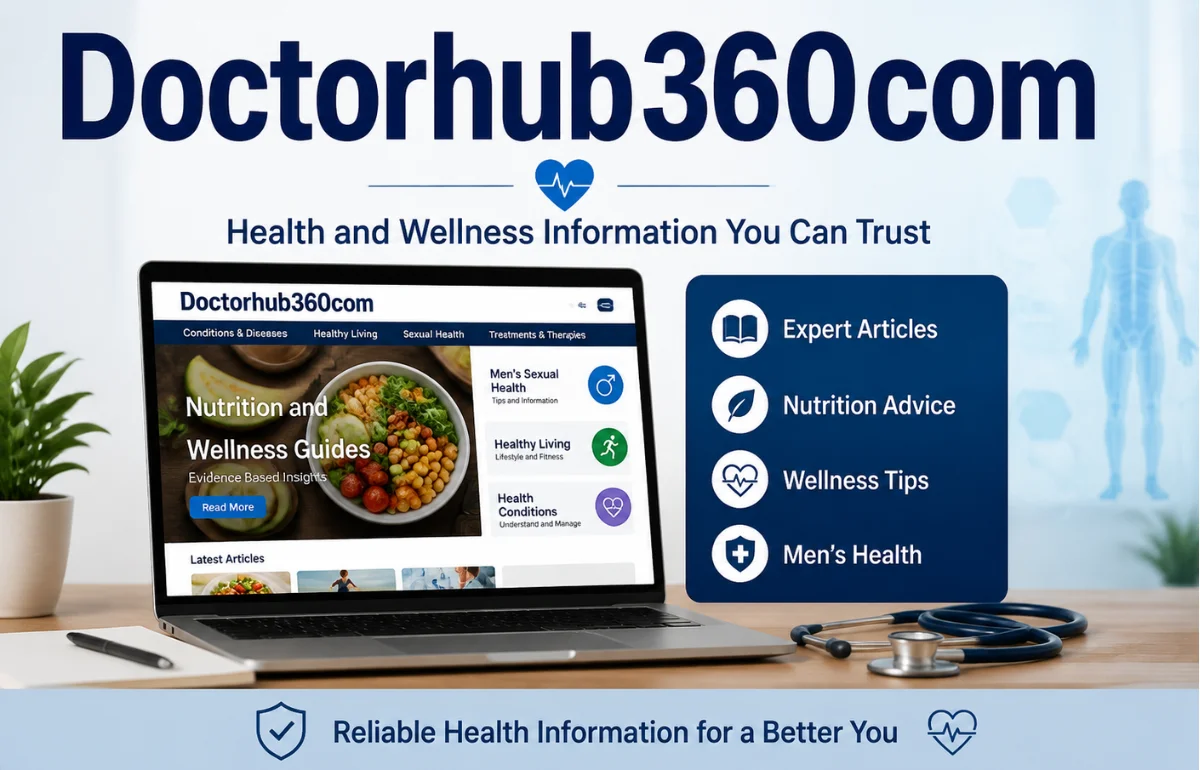
Doctorhub360.com is a health and wellness content website that publishes articles on nutrition, general medical conditions, sexual health, and treatment topics. It runs on WordPress using a standard news-magazine template, and its content leans heavily toward nutrition science, particularly amino acids, alongside general wellness and men’s health topics. It is not a telehealth service, a doctor-booking platform, or a diagnostic tool, whatever you may have read elsewhere.
I went looking for that “elsewhere” myself, because it’s worth explaining. If you’ve searched this name recently, you’ve probably run into a wave of articles describing Doctorhub360.com as some kind of AI-powered neurology platform with virtual specialist appointments and digital health records. I checked the actual site to see how much of that holds up.
What Doctorhub360.com Actually Is
Strip away the marketing language you’ll find on other sites, and Doctorhub360.com is, at its core, a content blog.
It’s built on the JNews WordPress theme, a template widely used by independent publishers and news sites. The homepage meta description describes it as a source of “reliable health news, expert analysis on medical conditions, and deep-dive nutrition guides.”
That framing is accurate as far as it goes. What you get when you actually browse the site is a stream of articles, organized into four categories, published under a single author byline. There’s no patient portal, no appointment scheduler, no chatbot, and no symptom checker anywhere in the navigation.
I want to be clear about something before going further. Websites change. What I’m describing here reflects what was live on the site when I reviewed it. If you’re reading this months later, it’s worth checking the site yourself rather than taking any write-up, including this one, as permanently current.
What Doctorhub360.com Actually Covers

The site organizes its content into four categories, and each one has a distinct focus.
Conditions & Diseases
This category is where general medical topics live, but when I worked through the archive, the bulk of what’s actually published here is nutrition-adjacent rather than disease-specific.
Articles cover things like heart disease risk factors, the role of taurine (commonly associated with energy drinks), amino acids and weight management, and everyday toxin exposure. It reads more like a nutrition-and-prevention section than a clinical disease encyclopedia.
Healthy Living
This section covers lifestyle content: weight loss, macronutrients and micronutrients, meal planning, and exercise strategy. The tone is consumer-friendly, aimed at readers looking for general wellness guidance rather than clinical detail.
Sexual Health
This category focuses heavily on men’s sexual health. Topics include penis size and enhancement methods, non-surgical enlargement approaches, stretching techniques, vacuum pump devices, and surgical options.
This is sensitive medical territory, and it’s the category where I’d personally want the strongest sourcing and clearest disclaimers. I’ll come back to that.
Treatments & Therapies
At the time I reviewed it, this category existed in the site’s main navigation but showed no published content. It’s set up as a placeholder for future articles rather than an active section.
Who’s Actually Behind the Content
This is where things get thinner, and it matters if you’re trying to decide how much weight to give the site’s advice.
Most of the articles I found carry a single byline: Margaret Scott. There’s no visible author bio attached to that name on the pages I reviewed, no listed credentials, no medical degree, no linked professional profile.
I also checked the site’s About page, since that’s usually where a publisher establishes who they are and why readers should trust them. On Doctorhub360.com, that page is still the default WordPress placeholder text that ships with every new WordPress install, the “Hi there, I’m a bike messenger by day” sample copy that’s meant to be replaced before a site goes live.
Finding the literal default template copy still sitting on a published health website tells you something. It suggests the site hasn’t invested in the editorial transparency that credible health publishers typically prioritize, things like a named medical review process, contributor credentials, or an editorial policy page.
None of this means the information on the site is automatically wrong. But it does mean you should treat it the way you’d treat any blog without disclosed medical review, and verify anything important against a source that does disclose that.
Clearing Up the Telehealth Confusion
Now to the part that actually prompted this article.
If you search “Doctorhub360.com,” especially alongside terms like “neurological diseases,” you’ll find a long list of articles on unrelated, low-profile websites describing it as a sophisticated digital health platform. The claims repeated across these pieces include AI-powered early detection for conditions like Alzheimer’s and Parkinson’s, virtual appointment booking with neurology specialists, and cloud-based digital health records that patients can share with their care team.
I looked for every one of those features on the actual site. None of them exist there, at least not in any form I could find in the navigation, category structure, or published content.
What I found instead is a fairly conventional content blog with categories focused on nutrition and general wellness, run on a stock WordPress theme, with no booking system, no account dashboard beyond a basic login/registration form built into the theme itself, and no clinical tools of any kind.
I can’t tell you with certainty why so many unrelated websites describe features that aren’t there. What I can tell you is that if you’re searching for Doctorhub360.com because you want to book a virtual neurologist appointment or use an AI symptom tracker, you won’t find that on the actual site, and you shouldn’t plan your care around the assumption that you will.
Doctorhub360.com: Claims vs. What’s Actually There
Why So Many Websites Describe Features That Aren’t There
This is worth a short detour, because it’s genuinely useful context that I couldn’t find explained clearly anywhere else while researching this.
A specific pattern shows up across a cluster of low-authority websites, guest-post blogs, marketing sites, even a few larger publications, that all describe Doctorhub360.com using nearly identical language: the same phrase repeated unnaturally throughout each article, the same list of AI-powered features, sometimes the exact same fabricated quote attributed to a “DoctorHub360 Expert Team” that doesn’t appear to exist anywhere on the actual site.
That pattern is consistent with a coordinated content or backlink campaign, the kind where a batch of near-identical articles gets placed across many small websites to build search visibility around a particular name or phrase. It happens across plenty of industries, and health and wellness brands aren’t immune to it.
I’m not in a position to say who commissioned that content or why. What matters for you as a reader is simpler: when you see the same unusual claim repeated word-for-word across a dozen unrelated websites, that repetition itself isn’t evidence the claim is true. It’s worth checking the actual source directly, which is exactly what I did before writing any of this.
How the Nutrition Content Actually Reads
Since amino acids and nutrition make up most of what’s actually published, it’s worth talking about how that content holds up.
The writing is approachable. Articles explain concepts like essential versus non-essential amino acids, how leucine supports muscle protein synthesis, or how tryptophan relates to mood and sleep, without drowning the reader in jargon. If you’re a casual reader wanting a plain-language primer on why protein timing matters or what taurine actually does, it’s readable.
Browsing through the archive, I came across individual pieces on arginine and heart health, L-glutamine and gut healing, amino acids and immune function, amino acids and detoxification, and a roundup on amino acids for athletic performance. There’s a real breadth to the amino acid coverage specifically, more than most general wellness blogs bother putting together in one place.
What’s missing is depth you’d expect from an authoritative nutrition source: no citations to peer-reviewed research, no links to studies, no registered dietitian or nutrition scientist credited as author or reviewer. Claims are stated with confidence but without the sourcing that would let a reader verify them independently. One article, for instance, recommends consulting a healthcare professional before starting any supplement regimen, which is sound advice, but it sits alongside supplement suggestions that aren’t themselves backed by a cited study.
I’d treat this content the way I’d treat a well-written wellness newsletter: fine for general orientation on a topic, not something to build a medical or supplement decision around without cross-checking elsewhere.
Sexual Health Content Deserves Extra Scrutiny
I want to flag the sexual health category specifically, because it’s the area where unverified claims carry the most potential for real harm or wasted money.
Topics like non-surgical enhancement methods, stretching techniques, and vacuum pump devices are exactly the kind of content where poor sourcing can lead readers toward ineffective or even unsafe practices. Without disclosed medical review or cited clinical evidence, I wouldn’t treat anything in this category as a substitute for a conversation with a urologist or a licensed healthcare provider.
If a health topic feels personal enough that you wouldn’t want to get it wrong, that’s usually a sign to go straight to a credentialed source rather than a general wellness blog.
Should You Trust Doctorhub360.com for Medical Decisions?

Not on its own, and I say that as a general standard, not as a specific knock against this one site.
There’s a simple way to evaluate any health website: check whether it discloses who wrote the content, whether a medical professional reviewed it, whether claims are backed by citations, and how recently it was updated. Doctorhub360.com falls short on most of these markers based on what I reviewed.
Here’s how it compares to the kind of sources I’d actually lean on for medical decisions.
Doctorhub360.com vs. Established Medical Reference Sites
This doesn’t mean everything on Doctorhub360.com is inaccurate. General nutrition information is fairly low-stakes territory, and a lot of what’s published lines up with mainstream nutrition science. But “low-stakes and plausible” is a different bar than “clinically reviewed and sourced,” and it’s worth knowing which one you’re reading.
There’s also a practical difference in what each type of source is built for. Established medical sites are designed to answer “what should I do about this symptom.” A general wellness blog like Doctorhub360.com is better suited to answering “what’s the general idea behind this topic.” Confusing the two is where readers get into trouble, not because the wellness blog is necessarily wrong, but because it was never built to carry that kind of weight.
What a Genuine Telehealth Platform Actually Looks Like
Since so much of the confusion around Doctorhub360.com centers on telehealth claims, it helps to know what the real thing looks like, so you can tell the difference next time.
A legitimate virtual care platform will show its clinical licensing clearly, usually naming the states or countries where its providers are licensed to practice. It will list the actual specialists or provider network by name, not just a vague reference to “expert advice.” It will have a working booking flow you can test, not just a description of one. And it will publish a privacy policy explaining exactly how your health data is stored and who can access it, which matters enormously if the platform claims to offer digital health records.
Doctorhub360.com, as I found it, has none of these elements. That absence is itself useful information. If a site can’t show you the mechanics of the service it supposedly offers, it’s reasonable to assume the service isn’t actually there.
How to Use the Site Safely, If You Use It At All
A few habits make sense if you come across Doctorhub360.com content in a search result and want to read further.
Treat any specific claim, especially dosage suggestions, supplement recommendations, or anything related to a diagnosed condition, as a starting point for a conversation with your doctor or a registered dietitian, not as standalone guidance.
Cross-reference anything that surprises you against a source that discloses its medical reviewers, like MedlinePlus, a hospital system’s patient education pages, or a professional association’s public resources.
Be especially cautious with the sexual health content. If a method or device is being recommended without clinical citation, assume it hasn’t been independently verified.
Don’t assume the telehealth or AI features described elsewhere online are real. If you need an actual virtual appointment or symptom-tracking tool, look for a platform that clearly states its clinical licensing, not one that’s only described that way on unrelated third-party blogs.
My Take After Reviewing the Site
I went into this expecting to find at least some trace of the telehealth features that get attributed to Doctorhub360.com across the web. I didn’t find any of them.
What I found instead is a modest, WordPress-built wellness blog with a genuine focus on amino acids and general nutrition, a men’s sexual health section that needs more scrutiny than it currently gets, and almost none of the editorial transparency that would let a reader confidently trust it for anything beyond casual reading.
That’s not a dramatic verdict. It’s just an accurate one, and accuracy is in short supply in a lot of what’s currently written about this site.
If you’re a casual reader curious about amino acids or general wellness topics, there’s readable content here. If you’re trying to make an actual medical decision, treat this the same way you’d treat any unreviewed blog: useful as a starting point, not a stopping point.
Frequently Asked Questions
What is Doctorhub360.com used for?
It’s a content website publishing articles on nutrition, general wellness, sexual health, and health conditions, aimed at general readers rather than clinical decision-making.
Is Doctorhub360.com a telehealth or virtual doctor platform?
No. Despite claims made on other websites, the live site has no appointment booking, video consultation, or AI diagnostic tools.
Who writes the content on Doctorhub360.com?
Most articles are credited to a single author, Margaret Scott, with no bio or medical credentials disclosed on the site as reviewed.
Is Doctorhub360.com a reliable source for medical information?
It’s reasonable for general nutrition reading, but it lacks disclosed medical review or research citations, so important health decisions should be verified elsewhere.
What topics does Doctorhub360.com cover most?
Amino acids and nutrition make up most of its content, alongside healthy living advice and a men’s sexual health section.
Where This Leaves You
Doctorhub360.com is a real website with real content, just not the kind of platform a lot of search results claim it is. If you land here through a search for neurological disease help, virtual appointments, or AI-powered diagnostics, you’re better off going directly to a licensed telehealth provider or your own physician.
If you’re here for general nutrition reading, treat it as a casual resource, and take anything specific to your health straight to a professional who can actually examine your situation.

Noah Sterling is a technology research writer with 8+ years of experience covering emerging technologies, software trends, digital tools, and innovation. He creates practical, research-based articles to help readers understand the evolving technology landscape.