Managing brittle, weakened lengths while coping with a greasy scalp often feels like an impossible balancing act. Yet dermatological insights show that both issues frequently share a single catalyst: excessive heat exposure during routine drying. High temperatures strip vital moisture from the hair shaft, causing cuticle scales to lift and leading to frizz, dullness, and breakage. At the same time, direct heat on the scalp elevates localized skin temperatures, which stimulates sebaceous glands to produce up to 10% more oil for every 1°C increase in heat.
As reported by Dermatocare, maintaining healthier hair and a balanced scalp starts with avoiding excessive heat and using controlled temperatures, adequate dryer distance, and steady airflow instead.
How Heat Affects Hair Fiber and Scalp Balance
Understanding the physiological impact of thermal styling helps reframe daily hair care habits:
- The Impact of Distance: Decreasing the gap between the dryer nozzle and your hair exponentially increases surface heat, causing acute damage to protective cuticle layers. Research suggests that blow-drying hair from about 15 cm away while continually moving the dryer may be gentler on its internal structure than allowing it to air-dry fully, as prolonged wetness can affect the hair’s cell membrane complex.
- Cumulative Stress: Even moderate heat settings (such as 60°C) add up over time, gradually degrading internal hair proteins, lowering tensile strength, and causing moisture loss with daily exposure.
- Sebum Trigger: Direct hot airflow warms scalp tissue, accelerating sebum excretion within 90 minutes and trapping individuals in a cycle of frequent washing and repeated heat application.
Assessing Your Hair Porosity
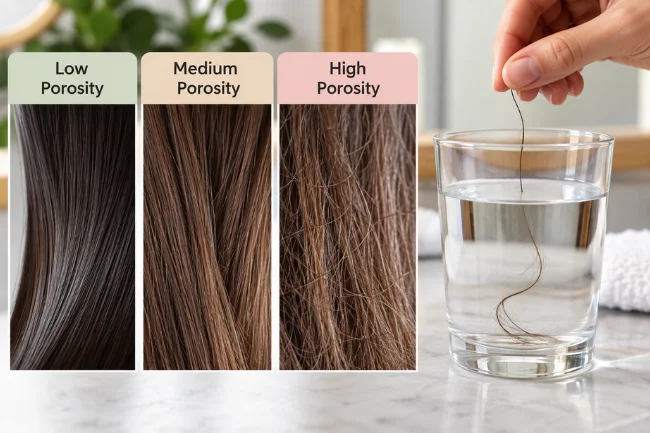
Determining how easily your hair absorbs and loses moisture provides a baseline for setting heat limits:
- Low Porosity: Cuticle scales lie flat and tight. Hair takes longer to absorb water and dry, but demonstrates higher resistance to thermal stress.
- Medium Porosity: Cuticle scales are balanced and intact, allowing predictable moisture retention and standard styling resilience.
- High Porosity: Cuticles are raised, pitted, or damaged due to chemical processing or severe heat exposure. Hair absorbs moisture instantly but loses it just as fast, leaving strands fragile and prone to breakage.
At-Home Porosity Check: Place a clean, dry strand of hair into a glass of room-temperature water. If the strand sinks quickly, high porosity is present, signaling that strict distance and temperature limits are essential during styling.
A Safe Drying Routine for Fragile, Oil-Prone Hair
To protect strand structure while avoiding sebum overproduction, adopt a targeted drying protocol:
- Gently pat hair dry with a microfiber towel; avoid rough friction while hair is wet and vulnerable.
- Apply a lightweight thermal protectant evenly across mid-lengths and ends.
Keep the hair dryer roughly 15 cm from your strands and move it continuously from one section to another to avoid concentrating heat in one spot.
- Use low or medium heat settings for drying the hair lengths.
- Switch instantly to cool air when working near the roots to prevent thermal stimulation of scalp oil glands.
- Conclude with a brief cold-air pass over the entire head to seal the cuticle and set the style.
Next-Generation Temperature Management
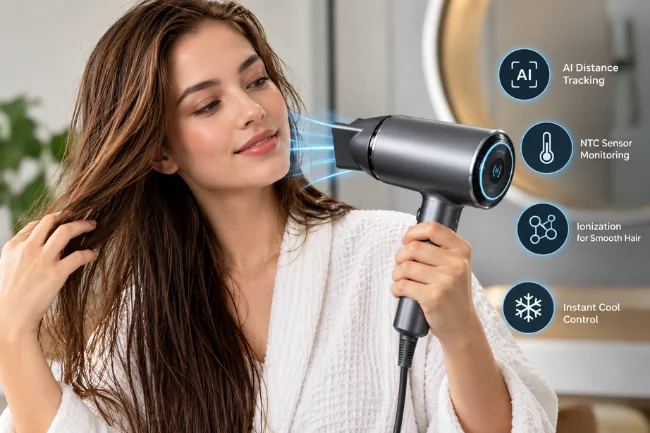
Modern engineering solutions like the AENO HD5 AI ProDryer illustrate how intelligent technology addresses heat-induced hair damage. Utilizing automated AI distance tracking, the device measures proximity to the hair surface and continuously recalculates thermal output to prevent localized overheating. Combined with real-time NTC sensor monitoring, built-in ionization to tame flyaways, and convenient instant-cool controls, advanced styling tools make it possible to achieve quick, thorough drying while safeguarding both scalp balance and hair health.

Natalie Brooks is a hair care writer with 6 years of experience creating practical content about hair health, scalp care, hair routines, ingredients, and everyday maintenance. She focuses on helping readers understand their hair needs through simple, research-informed guidance while promoting realistic care practices and informed choices.