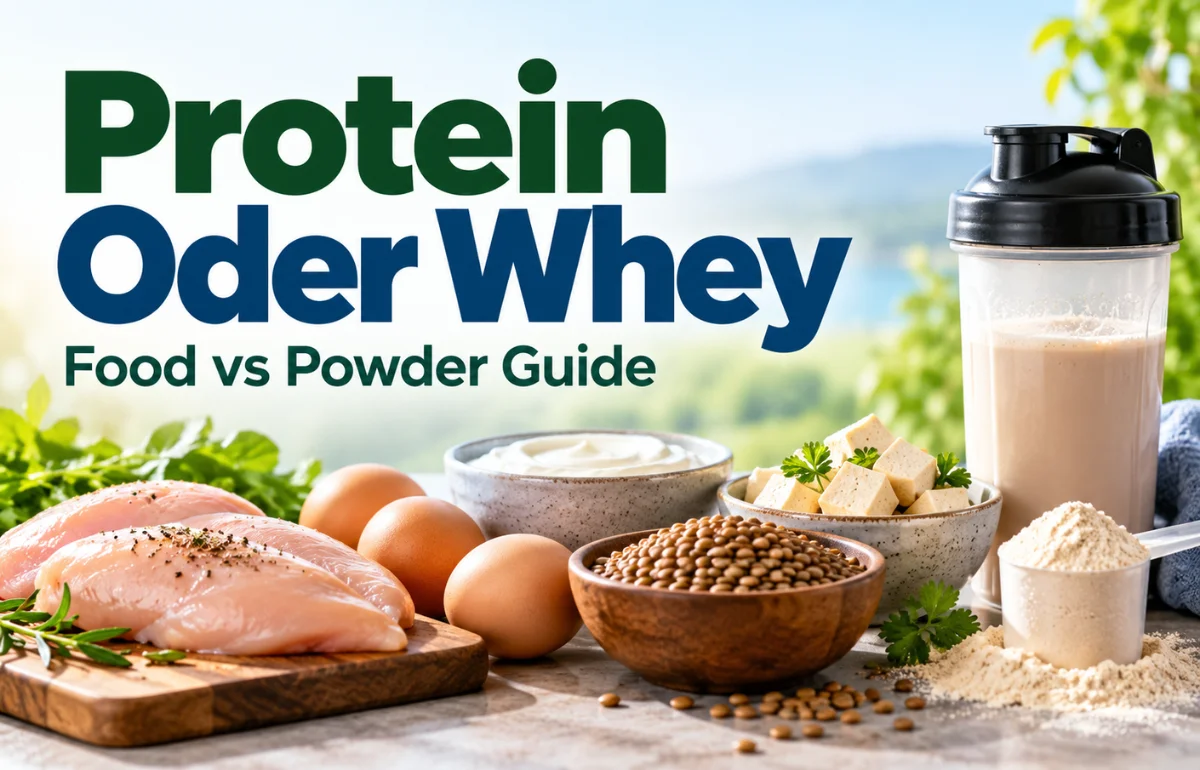
Protein Oder Whey means “protein or whey,” but the two are not competing nutrients. Protein is the nutrient your body uses to maintain and repair tissues, including muscle. Whey is a particular protein extracted from milk, commonly sold as a powder. So the practical question is whether you need more protein at all, and, if you do, whether whey is the most convenient way to get it. Food, whey powder, and other protein powders can all contribute to the same daily protein target. For most people, the deciding factors are their usual diet, training, budget, and tolerance for dairy—not a special muscle-building property that only a tub can provide.
I find the phrase useful because it catches a common mistake at the start: comparing a nutrient with one of its sources. Once I separate those ideas, the choice becomes much easier.
Protein Oder Whey: the difference in plain language
Protein consists of amino acids. Enzymes, hormones, immune proteins, and tissue repair depend on an adequate supply. Essential amino acids must come from food.
Chicken, fish, eggs, dairy, tofu, lentils, soy foods, and many other foods provide protein. “Protein powder” describes a product category that can include whey, casein, soy, pea, egg, or blends. Whey is one option within that category. It supplies all nine essential amino acids and is especially rich in leucine, an amino acid involved in stimulating muscle protein synthesis.
Whey begins as the liquid portion separated during cheese production. Processing concentrates its proteins into a powder. That origin matters if you avoid milk, have a milk allergy, or are sensitive to lactose, the sugar in milk.
| Term | What it means | Practical takeaway |
|---|---|---|
| Dietary protein | A nutrient found across animal and plant foods | Count all meaningful sources toward your daily intake |
| Protein powder | A convenient supplement made from one or more sources | The ingredient list tells you what type you are buying |
| Whey protein | Milk-derived protein sold as concentrate, isolate, or hydrolysate | A convenient complete protein, but unsuitable for milk allergy |
The real comparison is usually food versus a whey supplement, or whey versus another powder.
How much protein do you need before considering a scoop?

I would start with an ordinary day’s meals. A supplement makes sense only in relation to what is already on the plate. The standard recommended allowance for generally healthy adults is about 0.8 grams per kilogram of body weight per day; it is a baseline for nutritional adequacy, not a customized target for someone doing demanding resistance training. The NIH Office of Dietary Supplements reports that athletes may need roughly 1.2–2.0 g/kg/day, depending on their activity and circumstances. A sports-nutrition position stand places most exercising people seeking training adaptations around 1.4–2.0 g/kg/day.
For a 70 kg adult, those figures translate to about 56 g at the general baseline and roughly 98–140 g within the 1.4–2.0 g/kg training range. That upper range is not a universal instruction to eat 140 g. Training demands, total food intake, age, goals, and medical advice can change the appropriate target.
To estimate a gap, record a typical day, including snacks and drinks, then add the protein from labels or reliable food data. Suppose a 70 kg person aiming for 112 g eats about 90 g. The remaining 22 g could come from dinner, yogurt, tofu, or powder. If the total is already near 112 g, an extra shake is simply extra food.
Spread intake in a way you can sustain
Protein at several meals can make a daily target easier to reach. Sports-nutrition guidance often discusses roughly 20–40 g of high-quality protein per eating occasion, adjusted for body size and context. That is a planning range, not a rule that anything above 40 g is wasted.
The post-workout clock also gets too much attention. Having protein near training can be convenient, but the evidence does not support panic over a narrow “anabolic window.” If lunch contained a substantial amount of protein and you train in the afternoon, dinner may be a perfectly sensible next opportunity. Consistent training and sufficient daily food matter more than racing for a shaker the minute a session ends.
Whole-food protein or whey: what changes?
A scoop can deliver a useful amount of protein with little preparation. That is valuable after a late workout, during travel, or when appetite is low. But a shake does not reproduce everything in a meal. Yogurt can bring calcium; beans bring fiber; fish may supply omega-3 fats; eggs and tofu contribute other nutrients. Their exact profiles vary, yet the principle holds: foods deliver more than a protein number.
I would look at the problem the supplement should solve. A rushed, low-protein breakfast may be easier with a shake. If vegetables, fiber, and adequate calories are missing across the day, whey does not fix the pattern.
| Situation | Food-first option | When whey might help |
|---|---|---|
| Breakfast is low in protein | Eggs, Greek yogurt, tofu scramble, or fortified soy yogurt | A quick drink when a full meal is impractical |
| You need a portable snack | Yogurt, roasted soybeans, or a prepared sandwich | Powder in a shaker with water available later |
| Daily target is already met | Continue varied meals | No clear need for an additional scoop |
| Dairy causes problems | Soy, pea, egg, or other suitable foods and powders | Only if the issue is lactose rather than milk allergy, and a suitable product is tolerated |
A scoop can fill a genuine gap while meals remain the foundation, particularly for someone with higher requirements.
Whey concentrate, isolate, and hydrolysate
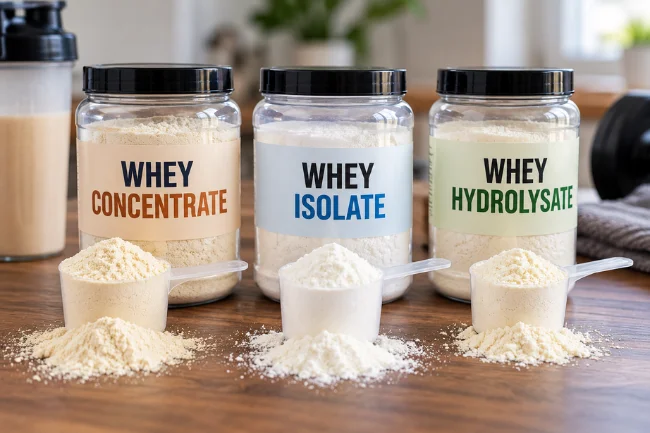
These names describe processing, not three levels of fitness achievement. Whey concentrate retains varying amounts of lactose and fat alongside protein. Whey isolate is filtered further, generally yielding a higher proportion of protein and less lactose per serving. Hydrolysate has been partially broken into smaller peptides during processing.
Concentrate often makes sense when price and taste are priorities and dairy agrees with you. Isolate can be useful when you want less lactose or a higher protein proportion, though the label matters more than the word “isolate” alone. Hydrolysate tends to cost more and may taste bitter. Faster digestion in a laboratory measure does not automatically translate into meaningfully greater muscle growth in someone whose overall intake and training are already sound.
One label detail often gets overlooked: the grams of powder in a scoop are not the grams of protein. A 30 g scoop containing 24 g of protein is 80% protein by that serving calculation; the rest can include flavoring, sweeteners, fat, carbohydrate, and moisture. A different 30 g scoop might supply 20 g. Compare the nutrition panel rather than assuming identical scoops are equivalent.
A better way to compare prices
I calculate cost per 25 g of actual protein rather than price per tub or price per scoop. Divide the package price by its total grams of declared protein, then multiply by 25. For example, a $40 package with 1,000 g of protein costs $1 per 25 g; a $32 package with 640 g costs $1.25 per 25 g. The cheaper-looking tub is more expensive for the amount you are buying.
This removes misleading differences in scoop size. I would still check flavor, tolerance, ingredients, allergens, and verifiable certification.
Is whey better than plant protein for muscle?
Whey has an appealing amino-acid profile and is well studied, but “better” needs an outcome attached. A short-term increase in muscle protein synthesis is not identical to a visible difference in strength or muscle after months of training. Total protein intake, resistance exercise, sufficient energy, and the composition of each serving all affect the result.
Plant protein is not a single ingredient, either. Soy, pea, rice, and blends have different amino-acid profiles. Soy supplies all essential amino acids; varied plant foods can also meet needs across the day. Some powders may require a different serving size or a complementary blend to provide an amino-acid profile comparable to whey.
In a 12-week randomized trial, soy and whey supplements matched for leucine produced no significant differences in the measured gains in lean mass or strength during resistance training. That does not prove every plant powder performs identically to every whey powder. It does show why I would not dismiss a suitable plant option just because its source is different. A systematic review of trials likewise found no source-related difference in absolute lean mass or strength overall, while noting differences in some other measures and subgroups.
For someone who eats no dairy, a well-chosen soy product or suitable plant blend can be a workable alternative. For someone who enjoys whey and tolerates it, there is no need to switch on principle. The best protein source is one that helps meet needs consistently without causing problems elsewhere in the diet.
Who should think twice about whey?

Milk allergy is different from lactose intolerance
Whey is a milk protein. If you have a diagnosed milk allergy, whey isolate is still milk-derived; filtering out much of the lactose does not make the milk protein safe. Look for an appropriate non-milk source and read allergen information carefully.
Lactose intolerance involves difficulty digesting milk sugar, not an allergic reaction to milk protein. Some people with lactose intolerance tolerate small amounts of dairy; others do not. Isolate often contains less lactose than concentrate, but products differ, and flavorings or other milk ingredients can change the result. The NIDDK guidance on lactose intolerance recommends checking ingredients and adjusting intake to symptoms. Persistent symptoms deserve an individual assessment rather than repeated guesses with new tubs.
Kidney disease and other individual needs
Healthy people do not need to assume that a reasonable protein target for training will damage their kidneys. Someone with chronic kidney disease, however, may need a specifically planned amount and type of protein. The NIDDK recommends discussing protein choices with a dietitian or health professional. In that situation, a general gym target is the wrong tool for making the decision.
Pregnancy, adolescence, recovery from illness, and a history of disordered eating can also change the conversation. I would seek advice tailored to the person instead of treating a powder label as a nutrition plan. A serving suggestion on a container describes how to use that product; it does not determine what an individual needs.
How I would choose a protein powder
First, I would define the gap: how many grams of protein are difficult to obtain through regular meals? Then I would choose a source compatible with dietary preferences and allergies. Only after that would I compare products. This order keeps a marketing claim from setting the goal.
On the label, I would check the grams of protein per serving, the serving size, total calories, added sugars, and the full ingredient list. Some products are simple powders; others are higher-calorie mixes with a long list of extras. Neither is automatically bad, but they serve different purposes. “Mass gainer” is particularly easy to confuse with plain protein powder if you only read the front of the package.
I would also be cautious with phrases such as “FDA approved protein.” In the United States, the FDA does not approve dietary supplements for safety and effectiveness before marketing. Independent certification offers a more concrete check. For athletes concerned about prohibited substances, NSF Certified for Sport is an example of a program that assesses products against its stated criteria. Verify the exact product and flavor in the certifier’s listing rather than trusting a logo-shaped graphic on a marketplace image.
Flavor and digestion still matter. A bargain tub is no bargain if it tastes unpleasant or upsets your stomach. Try a smaller package first, and see whether it makes eating easier.
Common mistakes that make the decision harder
One mistake is treating “whey” as a replacement for all other protein. A person can eat adequate protein without any powder, and a person can drink whey while still falling short overall. The daily pattern tells the story.
Another is assuming more is always better. If your intake already meets an appropriate target, adding servings may add calories and cost without a useful training advantage. This matters especially when a shake is mixed with milk, nut butter, oats, and fruit: it may be a substantial meal, not a near-calorie-free protein delivery system.
A third is judging a product solely by absorption speed. Whey’s relatively quick digestion is real, but everyday eating is not a race between powders. Meal timing, total intake, tolerance, and adherence are easier to act on and usually more relevant to an ordinary buying decision.
Finally, I would avoid comparing a carefully formulated whey isolate with a random low-protein plant mix and declaring an entire category superior. Compare actual servings, essential-amino-acid quality where available, dietary fit, and price. The source name is only the beginning of the comparison.
The practical answer
If you are meeting your protein needs with foods you enjoy, you do not need whey. If you regularly fall short and a drink is convenient, whey is a straightforward option when you tolerate milk. If you avoid dairy, choose an appropriate alternative and pay attention to the protein delivered per serving.
I would spend a week checking my usual meals before buying anything. Estimate an appropriate daily target, identify the real gap, and try the simplest way to close it. That small exercise answers “Protein Oder Whey?” more reliably than any front-of-tub promise.
FAQs
Is protein powder the same thing as whey protein?
No. Protein powder is the broader category; whey is one milk-derived type. Powders can also be made from soy, pea, egg, casein, and other sources.
Do I need whey protein to build muscle?
No. Resistance training and adequate daily protein matter more than the format. Whey can help when regular food does not conveniently cover your needs.
Is whey isolate better than whey concentrate?
Isolate usually has less lactose and a higher protein proportion, while concentrate is often less expensive. The better choice depends on tolerance, label details, and budget.
Can I take whey protein without working out?
Yes, whey is a food-derived protein source, but you may have no reason to supplement if meals already provide enough. It does not build muscle on its own without a training stimulus.
When is the best time to drink whey protein?
Choose a time that helps you meet your daily target. After exercise is convenient, but there is no need to treat a few minutes after a workout as a strict deadline.
This article provides general nutrition information, not personal medical advice. Protein needs vary. If you have a milk allergy, kidney disease, or another condition that affects your diet, ask a qualified healthcare professional before changing your protein intake or using whey.

Dr. Hannah Collins is a nutrition and diet specialist with 13+ years of experience helping people make informed food choices and develop healthier eating habits. She shares evidence-based nutrition guidance focused on balanced diets, meal planning, healthy lifestyles, and sustainable wellness.