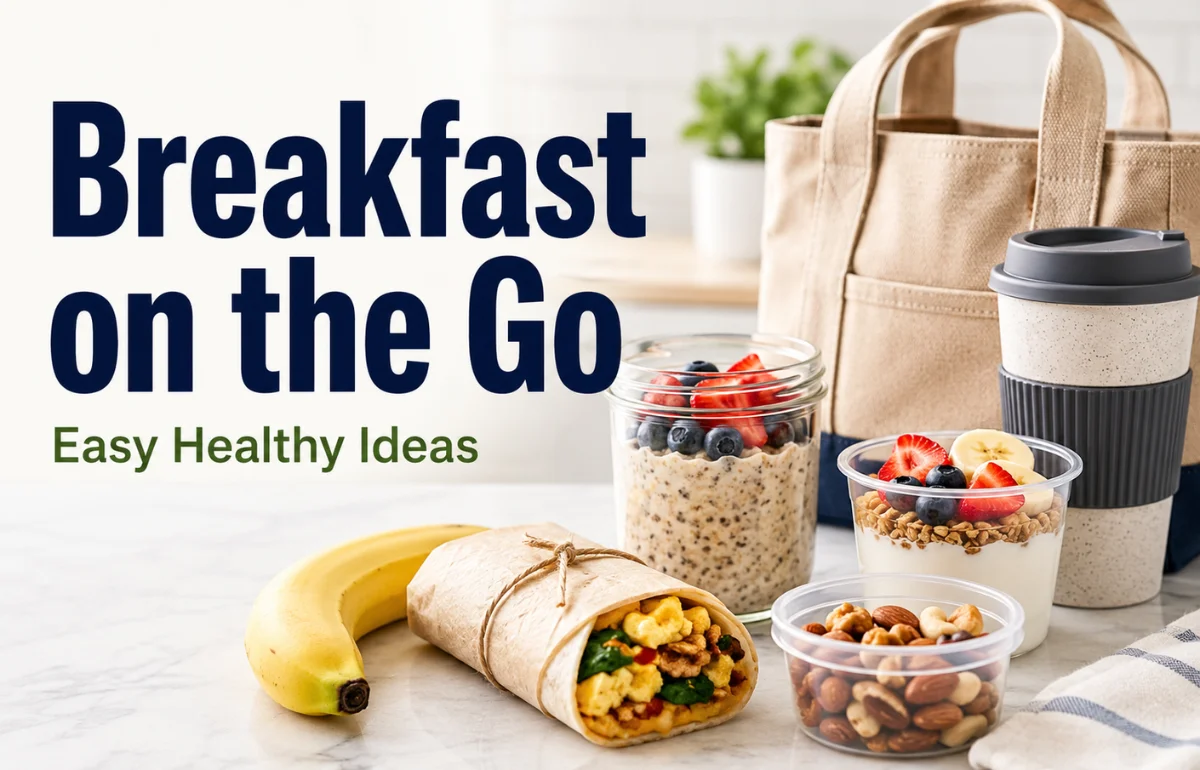
Breakfast on the go is a morning meal designed to be eaten away from the kitchen, usually while commuting, traveling, heading to work, taking children to school, or moving between early appointments. A good portable breakfast is quick to prepare, easy to carry, reasonably mess-free, and filling enough to support the first part of the day.
I don’t think breakfast on the go has to mean grabbing a pastry, packaged breakfast bar, or oversized coffee because there was no time to cook. With a little planning, it can include protein, fiber, whole grains, fruit, healthy fats, and other nutrient-rich foods in a format that fits a busy schedule.
The real goal is simple: make breakfast convenient without making nutrition an afterthought.
What Makes a Good Breakfast on the Go?
Convenience matters, but portability alone does not make something a useful breakfast.
I recommend looking at five qualities: nutrition, staying power, preparation time, portability, and how realistically the food fits your morning routine.
A breakfast that takes 40 minutes to prepare may be nutritious, but it is unlikely to become a reliable weekday option for someone leaving home at 6:30 a.m. Likewise, a snack that takes ten seconds to grab but leaves you hungry an hour later may not do the job either.
For most people, a balanced portable breakfast includes some combination of:
- A protein source such as eggs, Greek yogurt, cottage cheese, milk, tofu, nut butter, or cheese
- Fiber-rich carbohydrates such as oats, whole-grain bread, fruit, or high-fiber cereal
- Healthy fats from nuts, seeds, avocado, or nut butter
- Fruit or vegetables when practical
- Enough food to match the person’s appetite and morning activity level
There is no single perfect formula. Someone working at a desk has different needs from a person doing physical labor, training early in the morning, or traveling for several hours.
Why a Balanced Portable Breakfast Matters
A common mistake is treating breakfast as a race to consume something before leaving the house.
That usually turns the decision into a convenience contest. Doughnut or yogurt? Sweet coffee or eggs? Granola bar or nothing?
I find a better question is: “What can I realistically eat this morning that will keep me satisfied until my next planned meal?”
Protein and fiber are particularly useful considerations because they can make breakfast more substantial. Whole foods such as eggs, dairy, oats, fruit, nuts, seeds, and whole grains can also provide vitamins and minerals alongside calories.
This does not mean every breakfast needs to look nutritionally perfect.
If the choice on an unusually busy morning is between a practical store-bought breakfast and skipping food despite being hungry, convenience has genuine value. The better long-term strategy is building several dependable options rather than expecting yourself to prepare an elaborate meal every morning.
12 Easy Breakfast on the Go Ideas
1. Overnight Oats
Overnight oats are one of my first recommendations for people who have almost no spare time in the morning.
Combine oats with milk or yogurt in a covered container and refrigerate them overnight. Chia seeds, berries, chopped fruit, cinnamon, nut butter, and nuts can be added according to preference.
Because preparation happens the night before, breakfast is ready when you open the refrigerator.
2. Greek Yogurt With Fruit and Nuts
Greek yogurt is easy to turn into a portable breakfast with very little preparation.
Add berries, banana, chopped apple, nuts, seeds, or a small portion of granola. Keeping crunchy toppings in a separate container prevents them from becoming soft before breakfast.
Choose an insulated lunch bag when the yogurt will be away from refrigeration for an extended period.
3. Egg and Whole-Grain Breakfast Sandwich
A homemade breakfast sandwich can be prepared with an egg, whole-grain English muffin or bread, cheese, and vegetables such as spinach or tomato.
Making several ahead of time can turn what feels like a cooked weekend breakfast into an easy weekday option.
For people who prefer savory food in the morning, this can be much more satisfying than forcing themselves to eat something sweet simply because it is convenient.
4. Peanut Butter and Banana Toast
Whole-grain toast topped with peanut or another nut butter and sliced banana takes only a few minutes to assemble.
For better portability, turn it into a sandwich instead of leaving it open-faced. That small change makes a surprisingly big difference when breakfast has to survive a commute.
5. Breakfast Burrito
Breakfast burritos are excellent for batch preparation.
Eggs, beans, cheese, vegetables, potatoes, avocado, or lean meat can be wrapped in a tortilla and refrigerated or frozen in individual portions.
The advantage is flexibility: the same basic format can be adjusted for different dietary preferences without changing the preparation routine.
6. Smoothie With Protein and Fiber
A smoothie can work well when eating solid food early in the morning feels difficult.
Instead of making it almost entirely from juice and fruit, I recommend building it more like a meal. Fruit can be combined with milk or fortified plant-based milk, yogurt, nut butter, oats, chia seeds, or another suitable protein source.
Remember that portability depends on temperature. Keep dairy-based and other perishable smoothies cold until consumed.
7. Cottage Cheese and Fruit Cup
Cottage cheese pairs well with berries, pineapple, peaches, sliced pear, or other fruit.
It requires almost no cooking and provides a savory-to-mild base for people who do not want a heavily sweetened breakfast.
A leak-resistant container matters here more than an attractive one.
8. Homemade Breakfast Box
A breakfast box is especially useful for people who prefer several small foods instead of one large meal.
Try combinations such as hard-boiled eggs, fruit, cheese, whole-grain crackers, nuts, vegetables, and hummus.
I like the concept because it removes the assumption that breakfast has to be a traditional “breakfast food.”
9. Chia Pudding
Chia seeds absorb liquid and create a pudding-like texture when refrigerated.
Prepare them the night before with milk or a suitable alternative, then add fruit, nuts, seeds, or spices.
It is another useful option for mornings when opening the refrigerator needs to be the hardest part of breakfast preparation.
10. Whole-Grain Waffle Sandwich
Whole-grain waffles are surprisingly portable when used like bread.
Spread nut or seed butter between two waffles and add banana or sliced strawberries. A prepared frozen waffle can make this a particularly quick breakfast.
11. High-Protein Breakfast Wrap
A wrap can combine eggs, cottage cheese, tofu, chicken, beans, vegetables, cheese, or avocado depending on your dietary needs.
Keep wet ingredients modest if the wrap will sit for several hours. Excess salsa, tomato, or sauce can turn a convenient breakfast into a leaking one.
12. Fruit, Nuts, and a Simple Protein Source
Some mornings call for the simplest possible solution.
A banana or apple paired with a small portion of nuts and a yogurt, cheese portion, milk drink, or hard-boiled eggs requires almost no assembly.
It may not look impressive on social media, but practical breakfasts tend to be the ones people actually repeat.
Comparing Popular Grab-and-Go Breakfast Options
| Breakfast | Prep Time | Protein Potential | Fiber Potential | Portability | Best For |
|---|---|---|---|---|---|
| Overnight oats | 5 minutes night before | Moderate | High | Excellent | Meal prep |
| Egg sandwich | 5–10 minutes | High | Moderate | Excellent | Savory breakfast |
| Greek yogurt bowl | 3–5 minutes | High | Moderate | Good | Quick mornings |
| Smoothie | 5 minutes | Moderate to high | Moderate | Excellent | Low morning appetite |
| Breakfast burrito | 10–15 minutes or batch prep | High | Moderate to high | Excellent | Bigger appetites |
| Fruit + nuts + yogurt | Under 3 minutes | Moderate | Moderate | Excellent | No-cook mornings |
The most nutritious option on paper is not necessarily the best choice for your schedule.
If one meal requires ingredients you rarely buy or preparation you consistently avoid, choose something simpler. Consistency is more useful than building an ambitious breakfast routine that lasts three days.
Healthy Breakfast on the Go vs. Common Convenience Choices
Many commercial breakfast foods are marketed around speed rather than fullness or nutritional balance.
That does not automatically make packaged foods “bad.” I would simply compare them based on what they contribute to the meal.
| Convenience Choice | Common Limitation | Easy Upgrade |
|---|---|---|
| Sweet pastry | Often low in protein and fiber | Add yogurt and fruit |
| Plain coffee | Not a complete meal | Pair with eggs or overnight oats |
| Sugary cereal bar | May be closer to a snack | Add milk, yogurt, nuts, or fruit |
| Plain bagel | Mostly carbohydrate | Add egg, cheese, nut butter, or avocado |
| Fruit alone | May not satisfy for long | Pair with protein and healthy fat |
| Store-bought smoothie | Can vary greatly in composition | Check ingredients and pair with solid food if needed |
Rather than banning foods, I prefer the “add before subtracting” approach.
If you enjoy a bagel, consider adding protein. If you like a muffin, pair it with Greek yogurt. Improving a breakfast people already enjoy can be more sustainable than replacing everything with foods they do not want to eat.
Breakfast on the Go for Weight Management
People searching for breakfast ideas for weight loss often expect a list of special foods.
I would focus instead on portions, overall diet quality, protein, fiber, and how the breakfast affects hunger later in the day.
A highly restrictive breakfast that leaves someone extremely hungry by midmorning may make their eating plan harder to maintain. A more balanced meal could include eggs with whole-grain toast and fruit, Greek yogurt with berries and seeds, or oats with milk and nut butter.
Individual calorie and nutrition needs vary considerably, so a breakfast that works for one person may be too large or too small for another.
Breakfast on the Go for Kids
Portable breakfasts for children should be simple enough to eat comfortably and appropriate for their age.
Useful options can include mini egg sandwiches, yogurt with soft fruit, oatmeal cups, nut or seed butter sandwiches where permitted, cheese with fruit, or homemade muffins served alongside a protein-containing food.
Allergies, choking hazards, school food policies, and temperature control deserve extra attention.
I would also avoid making rushed mornings the first time a child sees an unfamiliar breakfast. Foods that are already accepted at home are usually easier to turn into grab-and-go meals.
How to Prepare Grab-and-Go Breakfasts Without Meal Prepping All Sunday
Meal preparation does not have to mean covering the kitchen counter with 25 containers.
One useful method is what I call “component prep.”
Instead of assembling every breakfast in advance, prepare the slow parts. Boil several eggs. Wash fruit. Portion nuts. Make four overnight oat jars. Freeze a few breakfast burritos. Keep yogurt and whole-grain bread available.
Then a weekday breakfast may require only one or two decisions.
Another useful strategy is keeping three levels of breakfast available:
Level 1: Completely Ready
Overnight oats, prepared burritos, yogurt cups, hard-boiled eggs, or breakfast boxes.
Level 2: Two-Minute Assembly
Toast with nut butter, yogurt with fruit, cottage cheese bowls, or cereal with milk and nuts.
Level 3: Emergency Breakfast
Shelf-stable fruit, individual nut portions, whole-grain crackers, suitable breakfast bars, or other foods you can keep available when plans change.
This three-level system solves a problem many breakfast articles overlook: every morning does not provide the same amount of time.
A useful breakfast routine needs a backup plan, not just an ideal plan.
Food Safety Matters When Breakfast Travels
Portable food sometimes spends longer outside the refrigerator than people expect.
Foods containing eggs, dairy, cooked meat, and other perishables should be handled with appropriate temperature control. An insulated lunch bag with cold packs can be useful when breakfast will not be eaten soon after leaving home.
Also choose containers based on the food rather than appearance.
A tightly sealed jar works for overnight oats. A vented or wrapped container may be better for a warm sandwich. Smoothies need dependable bottles with leak-resistant lids.
The best breakfast container is the one you can put in a bag without thinking about it again.
How to Build Your Own Portable Breakfast
When I evaluate a breakfast combination, I use a very simple framework:
Choose one protein source.
Add a fiber-rich carbohydrate or fruit.
Include healthy fat when useful.
Then make sure the result is genuinely portable.
For example:
Egg + whole-grain English muffin + avocado.
Greek yogurt + berries + oats + walnuts.
Apple + peanut butter + milk.
Oats + yogurt + banana + chia seeds.
Beans + eggs + vegetables + whole-grain tortilla.
There is plenty of room for personal preference. Breakfast does not need to follow a rigid nutritional template to be worthwhile.
What to Look for When Buying Breakfast Instead
Sometimes buying breakfast is the realistic option.
When choosing food at a café, convenience store, airport, or drive-through, I look for combinations rather than chasing a supposedly perfect menu item.
An egg sandwich and fruit, yogurt with nuts, oatmeal with milk, or a breakfast wrap with vegetables can all be reasonable possibilities.
Pay attention to serving size, added sugars, sodium, fiber, and protein when those factors matter to your dietary needs, but do not let label analysis turn a five-minute breakfast decision into unnecessary stress.
The goal is a workable meal.
FAQs About Breakfast on the Go
What is the healthiest breakfast on the go?
A balanced option usually combines protein, fiber-rich carbohydrates, and nutrient-dense foods, such as Greek yogurt with fruit and nuts or eggs with whole-grain toast.
What can I eat for breakfast when I have no time?
Try overnight oats, yogurt and fruit, a banana with nut butter, hard-boiled eggs, a prepared breakfast burrito, or a simple breakfast box.
What breakfast keeps you full the longest?
Meals containing both protein and fiber tend to be more substantial, such as eggs with whole grains, Greek yogurt with oats and berries, or oatmeal with nuts and seeds.
Can I make breakfast on the go the night before?
Yes. Overnight oats, chia pudding, breakfast burritos, egg sandwiches, yogurt jars, and breakfast boxes are particularly suitable for advance preparation.
What is a good portable breakfast that does not need cooking?
Fruit with nuts and yogurt, cottage cheese with fruit, whole-grain cereal with milk, nut butter sandwiches, and prepared breakfast boxes require little or no cooking.
Make Busy Mornings Easier, Not Perfect
Breakfast on the go works best when it fits the life you actually have.
I recommend choosing three dependable breakfasts: one you can prepare ahead, one you can assemble in two minutes, and one emergency option for mornings when nothing goes according to plan.
Start with foods you already enjoy, improve the balance where necessary, and make them easier to carry. A sustainable breakfast routine is not built around perfect mornings. It is built to keep working on the busy ones.

Dr. Hannah Collins is a nutrition and diet specialist with 13+ years of experience helping people make informed food choices and develop healthier eating habits. She shares evidence-based nutrition guidance focused on balanced diets, meal planning, healthy lifestyles, and sustainable wellness.