нуде is a Serbian Cyrillic verb form that most often means “they offer” or “they are offering” in English. It comes from the infinitive нудити (nuditi), an imperfective verb meaning “to offer,” “to present something for consideration,” or, in some contexts, “to bid.” Grammatically, нуде is the third-person plural present-tense form, so it normally refers to people, companies, shops, hotels, employers, or other plural subjects that offer something.
A simple example is “Хотели нуде бесплатан доручак,” meaning “Hotels offer free breakfast.” If the subject is omitted, Serbian can still use нуде because the verb ending already shows that the subject is plural. That is why “Шта нуде?” naturally means “What do they offer?”
When I analyze this word in a real sentence, I do not translate it in isolation. I first check who is doing the offering, what is being offered, and whether the reflexive particle се appears nearby. Those three clues usually reveal the most natural English meaning.
What Does нуде Mean?
The direct Latin-script transliteration of нуде is nude. In Serbian, however, this is not the English adjective “nude.” It is a verb form built from нудити (nuditi).
The verb нудити is classified as an imperfective verb meaning “to offer,” while linguistic references also record an intransitive sense related to bidding. Its third-person plural present form is nude, written нуде in Cyrillic.
Depending on context, нуде can naturally be translated as “they offer,” “they are offering,” “provide,” “make available,” or sometimes “bid.”
The best translation depends on the sentence rather than the word alone.
For example:
“Продавнице нуде попусте.”
Stores offer discounts.
“Послодавци нуде рад од куће.”
Employers offer work-from-home options.
“Купци нуде више.”
The buyers are bidding higher.
The core idea stays similar: someone is putting something forward for another person to accept, consider, buy, use, or respond to.
нуде Is a Verb, Not the Noun “Offers”
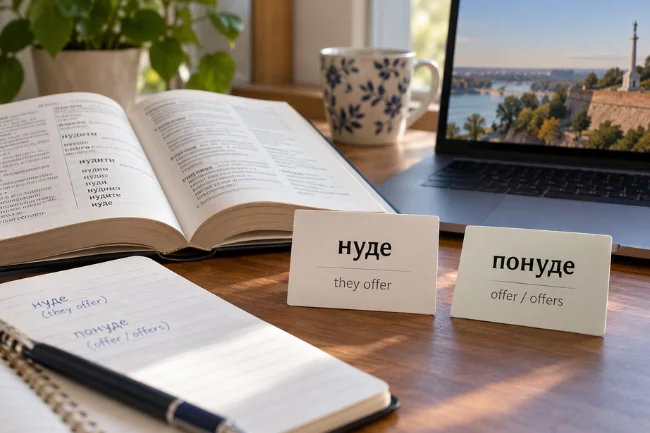
One of the most useful distinctions for English-speaking readers is that нуде is normally a verb form.
If you see it in a Serbian sentence, think first of “they offer,” not the plural noun “offers.”
That matters because a visually similar word, понуде (ponude), can function differently. Понуде may be connected to the noun понуда, meaning “offer,” and it can also be a verb form of понудити (ponuditi).
This is exactly the kind of detail that gets lost when a translation tool shows only one English equivalent.
нуде vs. понуде vs. понуда
The practical takeaway is simple: an extra по- at the beginning can change both the word family and the grammatical meaning.
How нуде Fits Into Serbian Verb Conjugation
Serbian verbs change according to person and number. Нуде belongs to the present-tense conjugation of нудити.
Standard conjugation gives the present forms nudim, nudiš, nudi, nudimo, nudite, and nude. The third-person plural form is therefore нуде/nude.
This pattern also explains why Serbian can leave out a subject pronoun more often than English.
“Они нуде добре услове” means “They offer good conditions,” but “Нуде добре услове” can communicate the same basic idea when the subject is already clear from context.
English generally needs the explicit “they.” Serbian often does not because the verb ending already carries that information.
Why нуде Can Mean “They Offer” or “They Are Offering”

English distinguishes between a simple present form and a present continuous form.
“They offer free delivery” usually describes a general service or regular feature.
“They are offering free delivery this week” describes something more temporary.
Serbian does not map onto that distinction in exactly the same way. Context, time expressions, and the wider sentence help determine whether the English translation should sound habitual, general, current, or temporary.
Consider this sentence:
“Ове продавнице нуде бесплатну доставу.”
These stores offer free delivery.
Now compare it with:
“Ове недеље нуде бесплатну доставу.”
This week they are offering free delivery.
The Serbian verb form нуде stays the same. The English verb changes because the surrounding time information changes the natural interpretation.
This is why I prefer context-based translation over word-for-word substitution. Translating every instance as “they offer” may be understandable, but it can sound unnatural when the Serbian sentence clearly describes a temporary promotion or activity happening now.
The Role of Verb Aspect: нудити vs. понудити
A deeper point, and one many short definitions overlook, is verbal aspect.
Нудити is imperfective. In broad terms, imperfective verbs can present an action as ongoing, repeated, habitual, or viewed without emphasizing its endpoint.
The related verb понудити is perfective and generally presents the act of offering as a bounded event or a complete act of making an offer. Reference sources classify nuditi as imperfective and ponuditi as perfective.
Compare the underlying idea:
“Они нуде помоћ.”
They offer help / They are offering help.
“Они ће понудити помоћ.”
They will offer help.
The difference is not simply one English translation versus another. Serbian aspect tells the reader something about how the action is being viewed.
For a beginner, I would not make this more complicated than necessary. A useful rule is that нуде commonly describes offering as an ongoing, repeated, regular, or current activity, while forms of понудити more often frame making the offer as a single bounded act.
Common Real-World Contexts Where You Will See нуде
The word appears naturally in shopping, travel, employment, finance, hospitality, professional services, online platforms, auctions, and everyday speech.
Understanding these contexts is more useful than memorizing one dictionary translation.
Shops and Ecommerce
Online shops and physical retailers often use нуде when describing products, discounts, delivery, warranties, or payment choices.
“Продавнице нуде сезонске попусте.”
Stores offer seasonal discounts.
“Неки сајтови нуде бесплатну доставу.”
Some websites offer free delivery.
“Продавци нуде различите начине плаћања.”
Sellers offer different payment methods.
In this setting, “offer,” “provide,” and “make available” may all work in English. “Offer” is usually the safest first interpretation, but it does not have to be the final translation.
Hotels, Airlines, and Travel Services
Travel pages frequently describe what hotels, agencies, airlines, or tour providers include.
“Хотели нуде доручак и бесплатан интернет.”
Hotels offer breakfast and free internet.
“Туристичке агенције нуде породичне аранжмане.”
Travel agencies offer family packages.
“Авио-компаније нуде различите тарифе.”
Airlines offer different fares.
Here, нуде describes features or services available to customers. It does not mean the noun “deals.”
If a page says “hoteli nude,” the grammatical meaning is “hotels offer,” not “hotel offers.”
That difference becomes especially valuable when reading booking pages or automatically translated travel websites.
Jobs and Employee Benefits
You may also see нуде on career pages and in job listings.
“Компаније нуде флексибилно радно време.”
Companies offer flexible working hours.
“Неки послодавци нуде приватно здравствено осигурање.”
Some employers offer private health insurance.
The grammatical subject here is the employer or company. The thing being offered might be salary, employee benefits, a contract condition, professional training, remote work, bonuses, or additional leave.
If several employers are being discussed, нуде is exactly the form I would expect.
Banking, Insurance, and Professional Services
Financial institutions and service businesses also use the verb frequently.
“Банке нуде стамбене кредите.”
Banks offer housing loans.
“Осигуравајуће куће нуде различите пакете.”
Insurance companies offer different packages.
“Агенције нуде консултантске услуге.”
Agencies provide consulting services.
The last example shows why good translation is not mechanical.
“Agencies offer consulting services” is perfectly correct, but “Agencies provide consulting services” may sound more natural depending on the surrounding English text.
The Serbian word has not changed. Only the best English rendering has.
Auctions and Bidding
Нудити can also carry the meaning “to bid,” particularly when money, competing buyers, or an auction price is understood.
“Купци нуде више за ретке предмете.”
Buyers bid more for rare items.
Dictionary entries for nuditi record an intransitive bidding sense as well as the more familiar “to offer” meaning.
If the surrounding vocabulary mentions an auction, price, buyer, bidder, competing amount, or increasing price, “bid” may therefore be better English than “offer.”
A Small Grammar Detail That Can Change the Translation: нуде се

The particle се can substantially change how a sentence sounds in natural English.
Compare:
“Компаније нуде нове услуге.”
Companies offer new services.
Now look at:
“Нуде се нове услуге.”
New services are offered / New services are available.
In the second example, нуде се should not normally be translated literally as “they offer themselves.”
Serbian reflexive and impersonal constructions can produce an English meaning closer to “are offered,” “are being offered,” or “are available.”
Another useful example is:
“Станови се нуде на продају.”
Apartments are offered for sale.
This construction is especially common in advertisements, property listings, classified pages, and commercial descriptions.
When I see се near нуде, I check whether English needs a passive or availability construction rather than an active sentence containing “they offer.”
That single habit prevents a large number of awkward translations.
What Comes After нуде?
The item being offered can appear as a direct object, while a recipient can also be expressed. Grammar references for nuditi show a common structure involving the recipient and the thing being offered.
Consider:
“Они нуде гостима кафу.”
They offer the guests coffee.
“Компанија нуди клијентима подршку.”
The company offers clients support.
With нуде, the subject becomes plural:
“Компаније нуде клијентима подршку.”
Companies offer clients support.
You do not need to master the entire Serbian case system to understand the basic meaning.
I find it more useful at first to ask three questions in ordinary language: who is offering something, what is being offered, and who can receive or accept it?
Once those roles are clear, the English sentence is usually straightforward.
нуде in Cyrillic and nude in Latin Script
Serbian can be written in both Cyrillic and Latin scripts. The Cyrillic form нуде corresponds to Latin nude.
That transliteration creates an unusual source of confusion for English speakers because nude is already an English word referring to a lack of clothing.
The Serbian and English words have completely different meanings in this context.
If you see a sentence such as:
“Hoteli nude besplatan doručak.”
you are looking at Serbian written in Latin script. The sentence means:
“Hotels offer free breakfast.”
Here, nude is a Serbian verb and has nothing to do with the English adjective.
This distinction can be especially useful when search engines, translation tools, or multilingual websites process a single Latin-script word without enough context. The spelling alone is not sufficient to identify the meaning.
нуде, нуди, and нудите Are Easy to Confuse
A reader who is new to Serbian may encounter several forms that differ by only one or two letters.
Нуди means “he/she/it offers” in the present tense. It can also function as an imperative in the appropriate context.
Нуде means “they offer.”
Нудите means “you offer” when addressing more than one person or using a formal form of address.
These endings matter because Serbian packs information about the subject into the verb itself.
Compare:
“Хотел нуди доручак.”
The hotel offers breakfast.
“Хотели нуде доручак.”
The hotels offer breakfast.
Only a small change appears in the Serbian verb, but that change tells you whether the subject is singular or plural.
This is one reason I would avoid translating Serbian by matching isolated words without checking the sentence.
Common Translation Mistakes With нуде
The first common mistake is treating нуде as the noun “offers.” In an ordinary Serbian sentence, it is usually a conjugated verb meaning “they offer.”
Another mistake is confusing nude in Serbian Latin script with the English word “nude.” The spelling happens to be identical, but the languages and meanings are different.
A third problem is translating every occurrence as “they offer” even when natural English calls for “they are offering,” “provide,” “make available,” “bid,” or a passive expression such as “are offered.”
The particle се is another frequent source of errors. A phrase such as “нуде се опције” is often more naturally translated as “options are available” or “options are offered.”
Finally, нуде should not be confused with понуде. The words belong to related vocabulary around offering, but their grammatical functions can differ substantially.
A Reliable Way to Translate нуде in Any Sentence
When I encounter нуде in unfamiliar text, I use a short context check rather than immediately choosing one English word.
I begin with the subject. If the sentence concerns hotels, shops, companies, employers, banks, sellers, agencies, or people in the plural, the basic meaning “offer” is usually a strong fit.
I then look at what follows the verb. Discounts, services, jobs, food, financing, help, products, packages, and options normally point toward the standard sense of providing or presenting something.
If the surrounding sentence concerns auctions or competing prices, I consider “bid” instead.
Finally, I check whether се appears with the verb. If it does, English may need a construction such as “are offered,” “are being offered,” or “are available.”
This approach handles far more real sentences than memorizing a single one-word translation.
Why Understanding нуде Helps Beyond One Word
Learning нуде also gives you a useful introduction to several broader features of Serbian.
You can see how verb endings communicate person and number. You can see why a subject pronoun may disappear when context already identifies the subject.
You also encounter the difference between imperfective нудити and perfective понудити, as well as the relationship between verbs and the noun понуда.
I would therefore learn the keyword as part of a small word family rather than treating it as an isolated translation.
Нудити means “to offer.”
Нуде means “they offer.”
Нуди means “he, she, or it offers.”
Понудити is the related perfective verb for making an offer as a bounded act.
Понуда is a noun meaning an offer, proposal, or bid.
Once these relationships become familiar, Serbian shopping pages, advertisements, job posts, hotel descriptions, financial websites, and ordinary conversations become noticeably easier to interpret.
FAQs About нуде
What does нуде mean in English?
нуде usually means “they offer” or “they are offering.” In auction or price-bidding contexts, it can also mean “they bid.”
Is нуде singular or plural?
нуде is the third-person plural present-tense form of нудити, so it normally corresponds to “they offer.”
What is the difference between нуде and понуде?
нуде comes from the imperfective verb нудити, while понуде can be a form of the perfective verb понудити or a grammatical form of the noun понуда.
Is Serbian nude the same as the English word “nude”?
No. Serbian Latin-script nude corresponds to Cyrillic нуде and means “they offer”; the identical English spelling has a completely different meaning.
What does нуде се mean?
Depending on context, нуде се often means “are offered,” “are available,” or “are being offered,” rather than the active phrase “they offer.”
Final Takeaway
нуде is a compact but useful Serbian verb form. In most contexts, the best starting translation is “they offer,” but natural English may require “they are offering,” “provide,” “bid,” or “are available” depending on the sentence.
If you are learning Serbian or translating a page, read the entire sentence before settling on one meaning. Identify the subject, look at what is being offered, and check whether се is present. That gives you a reliable translation based on grammar and context instead of a guess based on a single word.

Emily Carter is a personal growth writer with 9 years of experience creating practical content about confidence, mindset, productivity, habits, goal setting, and self-improvement. She focuses on helping readers build positive routines, develop self-awareness, and make meaningful changes through simple, actionable strategies.