
Arreed is a rare historical spelling of an English verb meaning to explain, interpret, declare, advise, or guess something. It belongs to the same word family as aread, arede, arreede, and arread. These forms appear in older English writing, but they are not part of ordinary conversation today. Arreed can also be a person’s first name, and the six letters A-R-R-E-E-D can be rearranged into familiar words such as reader and reread.
The meaning depends on where you encounter it. In an old poem, the word may ask someone to interpret a mystery or offer advice. In an academic paper, it may be somebody’s name. In a word puzzle, it might simply be a collection of letters. I find that separating these three uses answers most of the confusion before it starts.
What Does Arreed Mean in English?
The simplest modern equivalents are explain, interpret, advise, and guess. The precise choice depends on the sentence. For instance, someone might be asked to arreed a dream, meaning to explain its significance. In another passage, a speaker might arreed a companion, meaning to give that person counsel.
According to Collins English Dictionary, the related form aread has five recorded senses: declaring, guessing or divining, interpreting, advising, and making a decision. Some are labelled archaic, and others obsolete. These labels explain why the word may be understandable in a historical setting without being natural in modern speech.
How the Meaning Changes With Context
Consider three invented modern-English illustrations, not quotations from historical texts:
- “Arreed the dream” would mean “interpret the dream.”
- “I arreed you to be cautious” would mean “I advise you to be cautious.”
- “Can you arreed the answer?” would mean “Can you guess or work out the answer?”
Is Arreed a Real Word or a Misspelling?
Yes, Arreed is a documented historical English form. Its rarity does not make it imaginary. The World English Historical Dictionary, reproducing an early historical dictionary entry, lists arreed among the spellings of aread and assigns that form to the sixteenth and seventeenth centuries. It also records the exact spelling in a quotation attributed to John Milton in 1643.
There is a useful distinction here: a word can be historically legitimate without being a standard word in contemporary writing. You probably would not use arreed in an email, school report, or business proposal unless you were quoting or discussing older English.
Where Does Arreed Come From?
Its Old English Roots
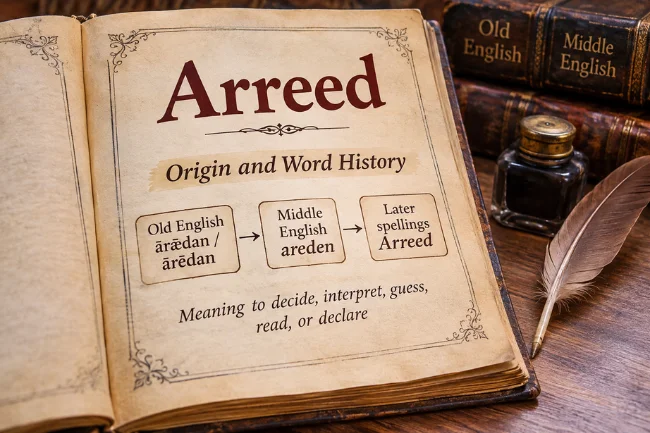
The history goes further back than the unusual double-r spelling suggests. The family traces to Old English ārǣdan or ārēdan, a verb associated with deciding, interpreting, guessing, reading, and declaring. It developed through Middle English forms such as areden before appearing in several later spellings.
A Concise Dictionary of Middle English, compiled by A. L. Mayhew and Walter W. Skeat, gives a-reden the meanings “to declare” and “to interpret.” That connection is more informative than treating Arreed as a newly invented combination of letters.
There is also a connection to the English verb read. Both belong to an older Germanic linguistic history in which understanding, interpreting, and advising were closely related ideas. The German word erraten, meaning to guess, is a cognate. A cognate is a word in another language that shares a historical ancestor; it is not necessarily a word borrowed directly from that language.
Why Did the Spelling Change?
English spelling was not always standardized the way it is now. Medieval scribes used regional conventions, and later poets sometimes chose an older-looking form for rhythm, tone, or atmosphere. The resulting variations do not always mark separate words.
| Spelling | How It Appears in Reference Works | Practical Meaning |
|---|---|---|
| Arreed | Historical variant, recorded for the 1500s–1600s | Explain, advise, interpret, or judge |
| Aread | Common dictionary headword for the older verb | Declare, divine, interpret, advise, decide |
| Arede | Historical alternative form | Same general word family |
| Arreede | Variant explicitly listed by Collins | Same meanings as aread |
| Arread | Separate dictionary headword listing arreed as a variant | Declare, explain, counsel, conjecture |
The spellings are related, but a dictionary’s choice of headword matters. Collins lists arreede directly under aread, while Wiktionary’s arread entry explicitly identifies arreed as an alternative form. Neither fact means all five forms are equally common or suitable for modern prose.
What Do Historical Examples Actually Show?
This is where I prefer original evidence to a long chain of unsourced definitions. The historical dictionary record includes dated examples that reveal how writers used this word family in sentences.
Guessing or Interpreting the Unknown
A version of Luke 22:64 printed by William Tyndale in 1526 uses the wording “Arede who it is that smoote the?” The speaker is being challenged to identify someone. Here, the meaning is closer to guess or tell than to read written text.
A Middle English example associated with Cursor Mundi, dated before 1300 in the dictionary record, says “I shal arede wel þi sweuene.” The unfamiliar word sweuene means a dream. The sentence therefore illustrates interpreting a dream, not reading a physical document.
Offering Advice or Judgment
A 1643 passage by John Milton is quoted with the words “Let me arreed him.” In this context, the verb conveys counsel or admonition. Crucially, this example uses the exact spelling arreed, rather than merely a similar form.
The historical record also includes examples of making decisions and solving riddles. Those are related ideas, but I would not flatten every occurrence into one fixed definition. Asking somebody to explain a dream is different from advising them on a course of action.
For anyone studying an old text, I recommend preserving the original spelling in a quotation and giving the modern sense immediately afterward. That retains the author’s language while keeping the meaning accessible.
How Is Arreed Pronounced?

The historical word family has a dictionary-supported pronunciation, although an individual’s name may be pronounced differently. Collins gives aread and arreede the pronunciation /əˈriːd/, roughly “uh-REED,” with the stress on the second syllable. The final part rhymes with reed.
There is a limitation: a dictionary pronunciation for an archaic verb cannot establish how every person named Arreed says their name. If you are introducing someone, their own pronunciation takes priority over an etymological guess.
Is Arreed the Same as Aread, Arread, and Arreede?
For historical vocabulary research, these are spelling relatives of the same older verb. You can usually compare their meanings under the same entry family. The differences matter more when you are searching digital archives or quoting a particular edition.
For example, looking up only Arreed may miss a passage printed as arede. Searching aread alone may miss an author who chose arread. That is why a variant-spelling search often produces a better understanding of an old term than a single exact-match search.
I would keep two rules in mind. First, use the spelling that actually appears in your source when discussing that source. Second, use the reference dictionary’s headword when citing its definition. This prevents accidental changes to evidence while making references easier to check.
Does Arreed Have a Modern Use?
As an ordinary English verb, Arreed is now highly unusual. The related terms are mainly encountered in historical dictionaries, older literature, literary criticism, and discussions of archaic English. A writer might deliberately revive one for an old-fashioned or poetic effect, but the result may puzzle a general audience.
I would choose interpret in an explanation of a dream, advise in a recommendation, and conjecture when someone reaches an uncertain answer. Those replacements are more precise than forcing an uncommon historical spelling into a sentence where it adds no value.
Arreed as a First Name
Arreed is also used as a given name. A verifiable example is Arreed F. Barabasz, a psychologist and professor emeritus associated with Washington State University. The American Psychological Association’s psychologist directory includes his professional biography and credentials.
His name also appears in scholarly records. A 2006 research paper indexed by PubMed lists Arreed Barabasz and Marianne Barabasz as authors of a study concerning hypnotic inductions and irritable bowel syndrome. This is strong evidence of the spelling functioning as an actual person’s first name.
Does the Name Have the Same Meaning as the Verb?
Not necessarily. A historical dictionary tells us how a word was used, not why parents selected a particular name. I have not found reliable evidence establishing one universally accepted baby-name meaning, cultural origin, or popularity ranking for Arreed.
Calling it a name that definitely means “wise adviser” or “interpreter” would stretch the linguistic evidence. Those phrases may reflect associations with the old verb, but they are not proven explanations for the modern given name.
If you are researching a person, check full names, institutional affiliations, book credits, and publication records. These sources provide much stronger identification than speculative baby-name websites.
Words You Can Make From ARREED
A word-game search treats ARREED as six letter tiles: one A, one D, two E’s, and two R’s. They can form several valid words even if the original sequence is not accepted as a play.
I checked the Official Scrabble Word Finder, using the same six letters rearranged as RAEDER. It returns 37 playable words, including five that use all six tiles. The table below groups useful examples by length; it is not intended to reproduce every shorter entry.
| Length | Examples From Those Letters |
|---|---|
| Six letters | dearer, reader, reared, redear, reread |
| Five letters | darer, drear, eared, erred, rared |
| Four letters | dare, dear, deer, rare, read, rear, reed |
| Three letters | are, ear, era, err, red |
| Two letters | ad, ae, ar, da, de, ed, er, re |
The five six-letter plays are useful because they consume the full rack. The word redear is less familiar than reader: it names a kind of sunfish, which explains why a valid game word may still look surprising.
Does ARREED Itself Count in Scrabble?
The official U.S. finder shows the five six-letter options above, but not ARREED itself, among the playable results for these letters. I would therefore avoid playing ARREED as an accepted U.S. Scrabble word on the strength of its historical dictionary status.
Game word lists differ across countries, editions, and apps. Check the dictionary specified by your game before making a scored play. A general anagram site can list archaic words that are excluded from a particular competition’s approved vocabulary.
How to Recognize the Intended Meaning
When I investigate an unfamiliar word, I start with its immediate surroundings rather than with a search snippet. A few small clues normally settle which meaning is relevant.
A sentence about dreams, riddles, or prophecy points toward the historical verb. A name followed by a surname, university, or article title points toward a person. A grid of letters, tile scores, or anagram results points toward a puzzle.
The source date also matters. A seventeenth-century passage deserves a historical dictionary lookup. A modern academic citation calls for author records. An online word game requires its current accepted list, not simply a centuries-old definition.
Finally, distinguish a source’s claim from your interpretation. An entry that records a spelling in the 1600s establishes historical use. It does not prove the spelling has remained popular, that it is accepted in Scrabble, or that someone with that first name has inherited the word’s meaning.
Common Mistakes to Avoid
The first mistake is assuming Arreed must be a typing error because a familiar dictionary does not give it a prominent entry. Historical lexicons document many legitimate forms that modern learners rarely see.
The second is confusing related spellings with identical evidence. If a dictionary documents arreede, that does not by itself prove every claim about arreed. Fortunately, historical records also document the exact double-r, double-e spelling.
The third is trusting every word-unscrambler result without checking its rules. A list of anagrams is a search aid; its source dictionary decides whether each suggestion can be played.
Why This Old Word Is Still Worth Knowing
Arreed is a small example of a much larger feature of English: words can survive in texts long after they stop being common in speech. Their spellings change, their meanings narrow or expand, and later writers sometimes revive them for atmosphere.
I also like what the word reveals about historical ideas of knowledge. To interpret a riddle, offer counsel, and reach a decision may look like separate actions now. In this verb family, those actions share a linguistic history. Seeing that connection can make older poetry and prose less intimidating.
Frequently Asked Questions About Arreed
What Is the Meaning of Arreed?
Arreed is a historical form of an English verb meaning to interpret, explain, declare, advise, or guess, depending on its context. It can also be a first name.
Is Arreed an Actual English Word?
Yes. Historical dictionary records include arreed as a variant spelling of aread, with documented use in older English writing.
How Do You Pronounce Arreed?
For the historical word family, Collins gives /əˈriːd/, roughly “uh-REED.” Someone using Arreed as a name may pronounce it differently.
Is ARREED a Valid Scrabble Word?
The U.S. Official Scrabble Word Finder does not include ARREED among its playable six-letter results for those letters. It does list reader, reread, reared, dearer, and redear.
Where Did Arreed Originate?
The historical verb traces through Middle English areden to Old English ārǣdan or ārēdan. That linguistic origin should not be assumed to explain every modern use of Arreed as a name.
Final Thoughts
Arreed is best understood as a documented historical spelling with meanings related to interpretation, advice, and judgment—not as one mysterious modern term with a single universal definition. Its use as a first name and in word puzzles adds two distinct contexts.
If you found Arreed in a book, record the sentence and compare it with aread, arread, and arreede in a historical dictionary. That quick source check will give you a more accurate answer than guessing from the spelling alone.

Emily Carter is a personal growth writer with 9 years of experience creating practical content about confidence, mindset, productivity, habits, goal setting, and self-improvement. She focuses on helping readers build positive routines, develop self-awareness, and make meaningful changes through simple, actionable strategies.