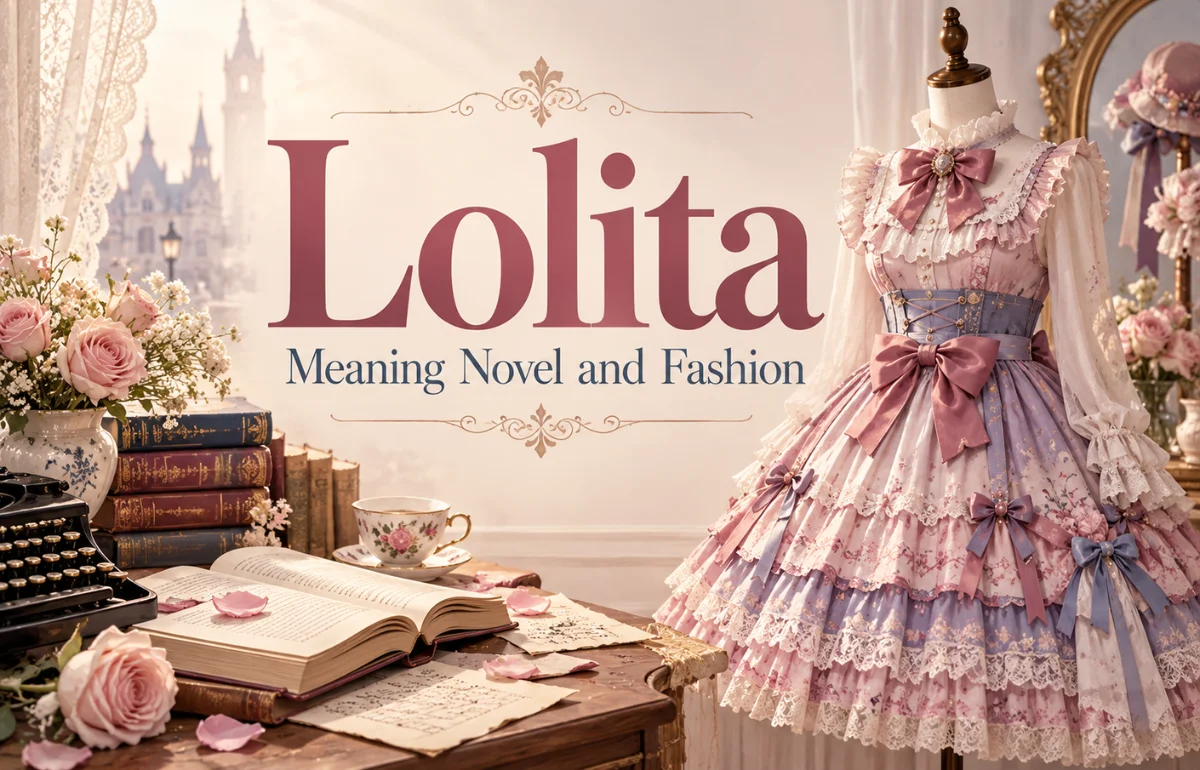
Lolita is a word with several meanings. It is a Spanish diminutive of Lola, a name derived from Dolores, but it is best known as the title of Vladimir Nabokov’s 1955 novel about a man who abuses a young girl named Dolores Haze. The term also identifies a Japanese street-fashion movement featuring decorative dresses, lace, bows, and historically inspired silhouettes.
These meanings should not be treated as interchangeable. Nabokov’s story examines obsession, manipulation, and the misuse of language, whereas Lolita fashion emphasizes personal expression, elegance, and carefully coordinated clothing.
Films, advertising, and popular slang have added further associations. Understanding which meaning someone intends is the starting point for understanding Lolita accurately.
What Does Lolita Mean?
The original name is straightforward. In Spanish, Lola is a familiar form of Dolores, and Lolita is an affectionate diminutive of Lola. Someone named Lolita is not automatically referencing fiction or fashion.
The cultural meaning is less straightforward. After Nabokov’s novel became famous, the name acquired associations with its fictional central character.
Later film imagery and popular usage sometimes turned it into shorthand for a supposedly seductive young girl. I consider that shorthand misleading: it shifts responsibility toward a child, although the novel’s adult narrator is responsible for the harm he inflicts.
In Japanese fashion, meanwhile, the same word refers to a recognizable clothing aesthetic. Context, not spelling alone, tells you what Lolita means.
The History of Lolita by Vladimir Nabokov
Who Wrote Lolita, and When Was It Published?
Vladimir Nabokov, a Russian-born novelist who also wrote in English, published Lolita in Paris in 1955 through Olympia Press. The American edition followed in 1958.
Its subject and the restrictions of the publishing climate made publication controversial, but literary discussion soon extended beyond scandal to the craftsmanship of its prose.
Nabokov was interested in wordplay, perception, memory, and people who cannot be trusted to describe themselves truthfully.
Those interests shape the entire novel. Its elaborate language isn’t an ornament placed on an ordinary plot; the language is part of how the plot works.
A plot summary cannot fully explain why the book remains debated.
What Happens in the Novel?
The novel is presented largely as the account of Humbert Humbert, an educated adult who becomes fixated on 12-year-old Dolores Haze.
He stays in the home of her mother, Charlotte, then marries Charlotte while concealing his intentions toward the child. After Charlotte dies, Humbert takes Dolores on a journey across the United States and sexually exploits and controls her.
Humbert calls Dolores “Lolita,” but the name he prefers is not the whole person.
Dolores also has ordinary interests, frustrations, friendships, and hopes that his narration frequently pushes aside. Her life reaches readers through her abuser’s voice.
The book combines travel, satire, literary references, and a deeply disturbing account of coercion.
I would not describe it as a conventional romance. An adult’s fixation on a child does not become mutual love because the adult tells the story beautifully.
Dolores Haze and the Problem With the Name “Lolita”
One of the most revealing details is surprisingly simple: the character’s name is Dolores Haze. “Lolita” is Humbert’s chosen name for her, not a complete description of her identity.
I find it useful to pay attention to who gets to name whom in a story.
Humbert controls the narration, chooses flattering descriptions of himself, and filters Dolores’s actions through his preferences. He also decides which moments deserve attention and which disappear into silence.
The difference between Dolores and “Lolita” therefore becomes a question of perspective.
Dolores is a child with a life beyond Humbert. “Lolita,” as he presents her, is a distorted image assembled to serve his desires.
This is why using the name as a casual label for a flirtatious minor misses a critical point.
Such language can repeat the narrator’s distortion rather than recognize the child’s lack of power. The name has a literary history, but that history does not justify applying an adult’s sexual interpretation to children in real life.
Why Is Lolita So Controversial?

An Unreliable Narrator Can Sound Persuasive
Humbert is what literary critics call an unreliable narrator: someone whose version of events cannot be accepted without scrutiny.
He is articulate, funny at times, and skilled at presenting excuses as insight. This makes his storytelling especially manipulative.
In ordinary conversation, confidence and elegant wording often sound like credibility.
Nabokov makes that habit uncomfortable. Humbert’s intelligence does not cancel his actions; it makes his self-justifications more sophisticated.
When I assess a passage, I ask three questions: What does Humbert claim? What does he admit happened? And what might Dolores say if she could narrate the same scene?
The space between those answers tells us more than the narrator’s charm.
Abuse Is Not the Same as a Forbidden Romance
Some descriptions of Lolita emphasize taboo attraction while overlooking coercion. That framing is incomplete.
The central relationship involves an adult abusing a child who depends on him and cannot give meaningful consent to what he demands.
The novel’s moral difficulty lies partly in the conflict between polished language and cruel conduct.
Readers can recognize artistic achievement without admiring Humbert. They can also decide that the subject matter is not something they wish to read.
Literary admiration and discomfort can reasonably coexist.
Censorship, Reputation, and Misunderstanding
The book’s initial publication history unfolded amid strong restrictions and disagreements over sexual content in literature.
The controversy also reduced the novel to sensational headlines.
A useful distinction is between a story depicting wrongdoing and a story endorsing it.
Whether every artistic choice succeeds is open to interpretation, yet depiction alone does not prove approval. Conversely, calling a work a classic does not place it beyond criticism.
For me, a serious reading of Lolita needs both textual attention and moral clarity. Neither replaces the other.
What Makes Lolita an Important Literary Work?
The novel has remained influential because its form and subject are inseparable.
Nabokov asks readers to work: to examine vocabulary, notice contradictions, question timing, and look past the speaker’s polished performance.
Its American setting matters too. Motels, highways, commercial signs, and ordinary suburban spaces surround the characters.
Humbert, an outsider to American culture, describes these details with a mixture of fascination and contempt. The result is also a portrait of postwar America, not only a psychological account of one man.
Then there is the book’s layered structure.
A fictional editorial foreword introduces the story before Humbert takes control of the narrative. That framing encourages a reader to consider how documents gain an appearance of authority simply because they arrive with formal introductions and confident voices.
I see a modern lesson here: an impressive account is not necessarily an honest one.
Whether I’m reading a memoir, a persuasive essay, or a social-media post, I try to separate the speaker’s style from the evidence underneath it.
That is an interpretation of the novel, not a claim that Nabokov wrote it as a modern media-literacy manual.
Lolita in Film and Popular Culture

The 1962 Adaptation by Stanley Kubrick
Stanley Kubrick directed the first major film adaptation in 1962, with James Mason as Humbert and Sue Lyon as Dolores.
The movie uses dark comedy and an atmosphere of unease while reshaping material that faced strict screen-content constraints at the time.
One especially lasting image comes from the film’s promotional artwork: heart-shaped sunglasses and a lollipop.
This imagery became closely associated with Lolita in popular culture, even though a marketing image cannot stand in for the novel’s portrayal of abuse and control.
That distinction is worth remembering when someone knows the poster but has never encountered the book.
The 1997 Adaptation by Adrian Lyne
Adrian Lyne directed a second major English-language film adaptation in 1997, featuring Jeremy Irons as Humbert and Dominique Swain as Dolores.
Its approach differs in tone and emphasis from Kubrick’s version.
Neither adaptation is a neutral replacement for reading the book. Actors, camera angles, editing, and music necessarily alter whose emotions audiences notice.
I recommend treating each film as an interpretation rather than assuming it conveys every nuance of Nabokov’s first-person narration.
What Is Japanese Lolita Fashion?
Lolita fashion is a Japanese street-fashion style recognized by structured, often knee-length or longer skirts, petticoats, blouses, decorative headwear, lace, ribbons, and coordinated accessories.
It developed into a distinct subculture in Japan during the late twentieth century and became particularly visible in the 1990s.
According to London’s Victoria and Albert Museum, the style draws on historical European clothing, Japanese ideas of cuteness, and connections with music scenes including visual kei.
For many wearers, it offers a way to express creativity and identity through a carefully planned outfit, often called a coordinate or “coord.”
Despite the shared word, the fashion is not an enactment of Nabokov’s story.
Its emphasis is typically on elaborate presentation, modesty, and individual taste rather than sexual display.
This is where precision matters most. Searching for Lolita dresses should not invite assumptions about wearers’ motives.
Sweet, Gothic, and Classic Lolita Styles
These are starting points, not strict rules; outfits often blend influences.
What unites the styles is often their deliberate silhouette and attention to overall coordination, not a single color or accessory.
Is Lolita Fashion the Same as Cosplay?
No. Cosplay generally means dressing as an identifiable fictional character, while Lolita fashion can be worn as a personal style without representing anyone from a story.
A person might combine the two, but the categories are different.
The details also matter. A petticoat creates the skirt’s shape; a blouse and legwear complete the silhouette; matching shoes, headwear, and a bag help the outfit look intentional.
For someone encountering the style for the first time, I suggest looking at the full outfit rather than calling any frilly dress “Lolita.”
Why the Two Meanings Are Often Confused
The confusion begins with a familiar word carrying very different cultural associations.
A Western reader may recognize a controversial novel, while a Japanese fashion enthusiast may immediately picture an elaborate dress.
Search engines, short videos, and image-heavy posts can make the confusion worse by displaying a film poster beside fashion photography without explaining the difference.
The same problem occurs when a headline uses the term without context.
Here is my practical test: look for the surrounding nouns.
“Nabokov,” “Humbert,” “Dolores,” and “novel” point to literature. “Petticoat,” “coord,” “Gothic,” and “Harajuku” usually indicate fashion.
A personal name requires no connection to either topic.
This context-first approach is simple, but it prevents one of the most common mistakes: assigning one community’s meaning to someone else’s use of the word.
How to Talk About Lolita Responsibly Today

The term deserves care, not panic.
I can discuss a controversial novel as literature while being clear about the abuse it depicts. I can admire an inventive fashion tradition without attaching sexual stereotypes to its wearers.
And I can respect someone whose actual name is Lolita without treating that person as a reference to fiction.
For readers, I recommend three habits.
First, identify which meaning is intended before judging a headline, photograph, or conversation.
Second, name the people involved accurately: Dolores is the child in Nabokov’s novel, while Humbert is the adult responsible for his behavior.
Third, resist turning an image or aesthetic into a complete explanation of a work or community.
Compare how the term changes across media.
Read a brief book synopsis, examine the 1962 film’s promotional imagery, and then look at a museum description of Japanese Lolita fashion. Notice what each source foregrounds and omits.
The lesson I take from that comparison isn’t that all meanings are equally problematic.
It is that language carries histories, and those histories need context.
Should You Read the Book, Watch the Films, or Explore the Fashion?
That depends on your interests.
If you study literature, Lolita offers a demanding example of unreliable narration and the power of style. An annotated edition can help explain its dense allusions and wordplay.
Be aware that the book includes sexual abuse of a child, coercion, and psychological manipulation.
If you’re interested in cinema, compare the Kubrick and Lyne adaptations with attention to how their filmmaking choices change the audience’s relationship to Humbert and Dolores.
If you’re researching Japanese fashion, begin with museum collections, garments, and accounts by actual participants rather than relying on Western assumptions about the label.
These paths share a keyword but answer different questions.
Conclusion
Lolita can mean a traditional name, a deeply contested novel, two influential film adaptations, or an expressive Japanese fashion style.
The clearest way to understand it is to identify the context and resist the stereotypes attached to the word.
If you’re exploring the subject further, choose the source that matches your interest: read the novel critically, compare its adaptations, or study the history and design of Lolita fashion through museum resources.
Frequently Asked Questions About Lolita
What Is the Original Meaning of Lolita?
Lolita is a Spanish diminutive of Lola, which comes from the name Dolores. It became internationally famous through Nabokov’s novel.
Is Lolita Based on a True Story?
Lolita is a fictional novel, not a biography or a verified account of one real person, although scholars discuss its possible influences.
Why Was the Novel Lolita Controversial?
Its depiction of child sexual abuse, combined with a persuasive and unreliable adult narrator, challenged readers and publishing conventions.
Is Japanese Lolita Fashion Related to the Book?
The words share a complicated cultural history, but the fashion has its own identity and is not a reenactment of the novel.
What Is the Difference Between Gothic and Sweet Lolita?
Gothic Lolita favors darker, dramatic designs, while Sweet Lolita commonly uses pastel colors, playful prints, and decorative bows.

Emily Carter is a personal growth writer with 9 years of experience creating practical content about confidence, mindset, productivity, habits, goal setting, and self-improvement. She focuses on helping readers build positive routines, develop self-awareness, and make meaningful changes through simple, actionable strategies.