What does mbaile mean? In Irish (Gaeilge), mbaile is the eclipsed form of baile, a noun that can mean “home,” “town,” or a local settlement, depending on the sentence. The initial m appears because Irish grammar sometimes changes the first sound and spelling of a word. That process is called eclipsis, or urú in Irish. So mbaile is not a new word with a completely separate meaning; it is baile in a particular grammatical setting.
You may encounter it in i mbaile (“in a town”), ár mbaile (“our town” or “our home”), or the place name i mBaile Átha Cliath (“in Dublin”). I find the most useful question is not simply “What does mbaile translate to?” but “What caused baile to change here?” Once I answer that, the whole phrase becomes easier to understand.
What Does Mbaile Mean in English?
The short answer is that mbaile carries the underlying meaning of baile. Depending on context, a good translation could involve a town, a home, a hometown, or a community. It is not a reliable one-word equivalent of the English noun “house.”
For example, a person may be describing the settlement where they live rather than the building where they sleep. In another sentence, the same Irish root may point to a place of belonging. English often separates these ideas into different words; Irish can express several of them through baile and its related phrases.
The Foclóir Gaeilge–Béarla entry for baile, provided by Foras na Gaeilge, records this broad range of uses. The modern English–Irish dictionary entry for home also distinguishes a dwelling, a home area, and movement toward home. Those distinctions are worth keeping in mind before choosing a translation.
Is mbaile a separate word?
Grammatically, it is a form of another word rather than an unrelated vocabulary item. Linguists call the unchanged dictionary form the base form, or lemma. Here the lemma is baile; mbaile is a mutated form.
That explains why a dictionary search for mbaile may redirect you to baile. The dictionary is not overlooking the spelling. It is grouping the related forms under the entry that explains their shared meaning.
Why Does Baile Become Mbaile?
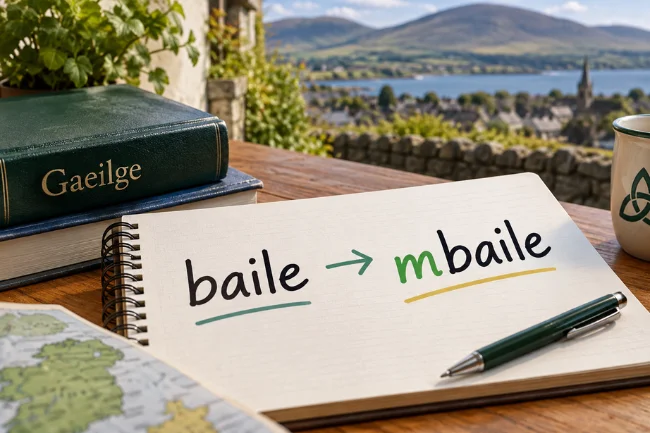
Irish has a feature that feels unusual to many English speakers: the beginning of a word can change according to what comes before it. These changes are called initial mutations. They help show grammatical relationships within a phrase.
Eclipsis is one kind of mutation. When it affects a word beginning with b, an m is placed before the b, producing mb. In ordinary pronunciation, that opening is heard as an m sound rather than two fully pronounced consonants.
The change from baile to mbaile therefore tells you something about the surrounding grammar. It does not indicate that the town has changed, that the word has become plural, or that a different place is being described.
The pattern is not unique to baile: bord can similarly become mbord. Recognizing the rule is more useful than memorizing mbaile as an exception.
After the preposition i, meaning “in”
One of the clearest triggers is the preposition i. When i stands before a suitable consonant-initial noun without the definite article, it normally causes eclipsis.
That gives us i mbaile, meaning “in a town” in an appropriate context. The same principle appears in i mBaile Átha Cliath, meaning “in Dublin.” The word i supplies the location relationship, while mbaile shows the required mutation.
I recommend learning i mbaile as a phrase, so the grammatical trigger stays attached to the meaning.
After possessive words such as ár and a
Eclipsis can also mark possession. The Irish word ár means “our,” and ár mbaile can mean “our town” or “our home,” depending on the situation. The plural possessive bhur (“your,” addressed to more than one person) also triggers eclipsis, as does a when it means “their.”
That last point is particularly useful because Irish has three possessive forms written a. The following mutation helps distinguish them: a bhaile can mean “his home,” a baile can mean “her home,” and a mbaile can mean “their home.” The noun’s changed opening is doing grammatical work that English usually assigns to separate possessive words.
These are regular features of Irish, not optional decorative spellings. For a fuller account of the triggers, see the Irish eclipsis overview.
Baile vs. Mbaile vs. Bhaile: What’s the Difference?
Three similar-looking forms can appear in Irish texts. All are related to the same base noun, but they are not interchangeable. Their spelling tells you which grammatical change has happened.
| Form | What it is | Example | What to notice |
|---|---|---|---|
| baile | Base form | an baile, “the town” | No initial mutation is shown |
| mbaile | Eclipsed form | i mbaile, “in a town” | m is added before b |
| bhaile | Lenited form | sa bhaile, “at home” | h follows b, changing its sound |
Lenition, called séimhiú, is another Irish initial mutation. With the letter b, it is written bh. Its pronunciation differs from the m sound of mbaile, although the exact result depends on dialect.
Do not apply a translation from one row everywhere: sa bhaile means “at home,” while i mbaile can mean “in a town.” The prepositions matter too.
There is also a regional wrinkle: sa mbaile occurs in some Connacht speech, particularly where eclipsis follows sa. Standard learner materials commonly teach sa bhaile. Seeing both does not mean that one writer has invented a word; it can reflect a real dialect difference.
How Do You Pronounce Mbaile?
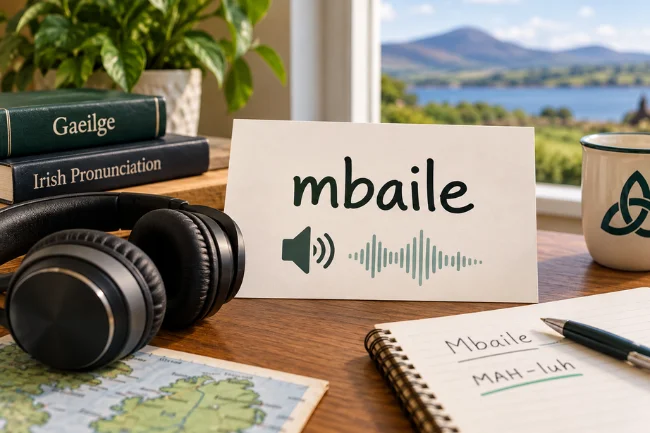
The safest starting point is to pronounce the opening mb as an m sound. Do not read it as an English word beginning with a separate “em” syllable, and do not give the b a second, distinct burst as you might when sounding out unfamiliar English letters.
The rest of the pronunciation varies across Irish dialects. A broad English approximation is something like “MAH-luh,” but that is only a memory aid. It cannot reproduce Irish consonant quality or the different vowel sounds found around the country.
Traditional descriptions distinguish Munster, Connacht, and Ulster pronunciations, and there is variation within those regions as well. A recording by a speaker from the dialect you are learning will teach you more than a single English phonetic spelling.
Why the written b is still there
I think of the b as a useful visual clue to the original word. It remains in the spelling, even though the eclipsing m supplies the initial sound. Remove the grammatical trigger and you may see baile again.
This is why recognizing the base word is more productive than trying to pronounce every letter separately. Irish spelling records relationships between word forms as well as sounds.
Where You Will See Mbaile in Real Irish
The meaning becomes much clearer when the word is placed beside nearby expressions. Here are phrases that learners are likely to meet in reading, conversation, local news, or travel information.
| Irish expression | Natural English meaning | Main point |
|---|---|---|
| i mbaile | in a town | i triggers eclipsis |
| i mBaile Átha Cliath | in Dublin | A proper place name changes after i |
| ár mbaile | our home or town | ár triggers eclipsis |
| a mbaile | their home or town | Plural possessive a triggers eclipsis |
| sa bhaile | at home | Common standard expression with lenition |
| sa mbaile | at home | Regional form, especially in parts of Connacht |
| abhaile | homeward; home as a destination | Expresses movement toward home |
| as baile | away from home | Expresses absence from home |
The phrases answer different questions: Where is someone? Where are they going? Whose place is it?
Mbaile in Irish place names
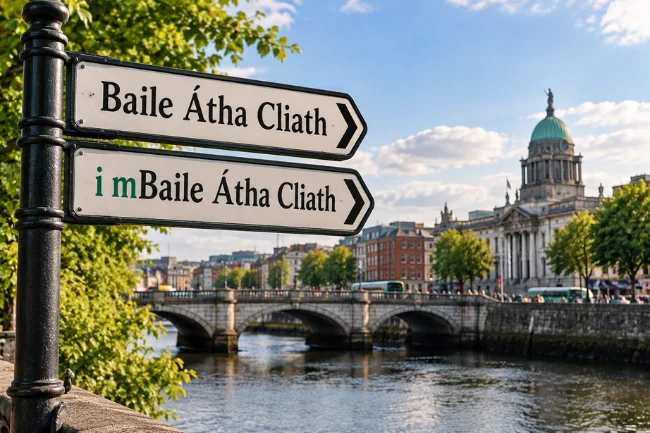
Baile is common in Irish place names, and Baile Átha Cliath is the Irish name for Dublin. Add the preposition i and the first word changes: i mBaile Átha Cliath. Foras na Gaeilge’s dictionary gives this exact construction when translating “in Dublin.”
The capitalization is deliberate. When an uppercase B begins the proper name, the prefixed m is written in lowercase: mBaile. With an ordinary lowercase noun, the result is mbaile. This is useful when reading signs, event announcements, maps, and Irish-language news.
The m belongs to the sentence’s grammar, not to the permanent name of Dublin.
Being at home is different from going home
English uses “home” for both a location and a destination. Irish usually makes the distinction more visibly.
Tá sí sa bhaile means “She is at home.” Chuaigh sí abhaile means “She went home.” The first describes where she is; the second describes movement toward that location.
Abhaile is a useful word in its own right. It should not be confused with mbaile simply because the two spellings contain the same familiar letters. Similarly, as baile generally relates to being away from home, rather than travelling toward it.
The Foras na Gaeilge home entry illustrates these distinctions with everyday examples. I would use that entry before assuming one Irish phrase can cover every English sentence containing “home.”
Four Examples That Make the Grammar Click
I find it helpful to compare short sentences and notice what triggers each form.
1. Tá cónaí orm i mBaile Átha Cliath.
This means “I live in Dublin.” The location is the named city, but i still triggers eclipsis. The base place name remains Baile Átha Cliath when used without that particular trigger.
2. Is breá liom ár mbaile.
This can mean “I love our town.” Here, ár tells us who the town belongs to or who identifies with it. The m on mbaile follows the possessive rule; it does not add affection by itself.
3. Tá sí sa bhaile.
This means “She is at home.” There is no mbaile in the common standard spelling, even though the sentence is about home. That is a useful reminder that meaning alone does not determine which mutation appears.
4. Chuaigh sí abhaile.
This means “She went home.” The direction of movement makes abhaile appropriate. Substituting mbaile because both words relate to home would produce the wrong construction.
Common Mistakes People Make With Mbaile
Treating it as an English or technology term
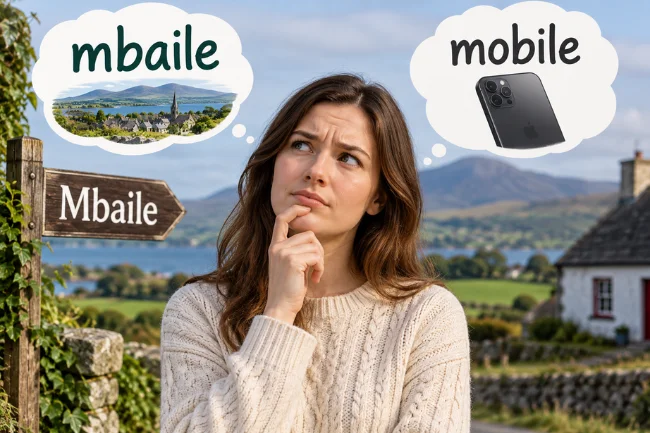
The letters can look like a misspelling of “mobile,” but the Irish usage is established. A business, song, or product could independently use Mbaile as a name; check the context before assuming a technological meaning.
Assuming mbaile always means house
The English word “house” often suggests a building. Irish teach is a common word for that physical structure. Baile more readily refers to home, a town, or the community and locality attached to a person.
Those concepts can overlap, but they are not identical. If someone mentions their baile, I would look for clues about whether they mean the place they live, the place they grew up, or an actual town on a map.
Thinking the extra m makes the word plural
It does not. Eclipsis is not an ordinary plural ending. Irish has other ways to mark number, including a plural form bailte for “towns.” The initial m in mbaile is connected to the grammatical environment, not to how many towns are involved.
Ignoring dialect differences
When one source gives sa bhaile and a speaker says sa mbaile, it can be tempting to declare one wrong. I would first check the region, the grammatical construction, and whether the source is describing standard written Irish or a local spoken variety. Both forms deserve context.
How I Would Learn and Check the Word
If I encountered mbaile in an unfamiliar sentence, I would use a simple three-question check.
First, what comes immediately before it? A preposition such as i or a possessive such as ár often explains the m. Second, is the writer describing a location, a destination, or ownership? That helps separate i mbaile, abhaile, and ár mbaile. Third, is the phrase a common noun or part of a proper name such as Baile Átha Cliath?
This method is more reliable than memorizing the English translation “home” and applying it to every sentence. It also helps when Irish text contains other mutations that look unfamiliar at first.
For verification, I start with the dictionary resources maintained by Foras na Gaeilge. I compare the Irish–English dictionary entry, the newer English–Irish examples, and any available pronunciation recordings. For grammar details, I then check a dedicated explanation of eclipsis and the relevant standard or dialect convention.
One final habit is worth adopting: copy a complete, authentic example into your notes, not just the isolated word. “I mBaile Átha Cliath — in Dublin” preserves the trigger, capitalization, and meaning together. It will be much easier to recognize next time.
Frequently Asked Questions About Mbaile
What does mbaile mean in Irish?
Mbaile is the eclipsed form of baile, a noun associated with home, town, or locality; the best English translation depends on the phrase.
Why is there an m before baile?
Irish eclipsis, or urú, adds m before an initial b in certain grammatical settings, such as after the preposition i.
How do you pronounce mbaile?
The mb begins with an m sound, not two separate consonants. The vowel and following sounds vary by Irish dialect.
What is the difference between mbaile and bhaile?
Mbaile shows eclipsis, while bhaile shows lenition. Both derive from baile but appear under different grammatical conditions.
Does sa mbaile mean at home?
Yes, in some regional Irish usage. Sa bhaile is the commonly taught standard expression for “at home.”
Final Thoughts
Mbaile becomes much less mysterious once you recognize the base word baile and the rule of eclipsis. Its meaning comes from the wider phrase; its initial m tells you how Irish grammar is working.
The next time you see mbaile, check the word before it and read the full sentence. Then compare what you find with a trusted Irish dictionary. That small habit will help you understand not only this word, but many other Irish expressions built through initial mutations.

Emily Carter is a personal growth writer with 9 years of experience creating practical content about confidence, mindset, productivity, habits, goal setting, and self-improvement. She focuses on helping readers build positive routines, develop self-awareness, and make meaningful changes through simple, actionable strategies.