
“Calculate Pokémon damage” means working out how many hit points a Pokémon’s attack can remove from its target. In standard main-series battles, the calculation combines level, move power, attacking and defensive stats, then applies effects such as type matchups, same-type attack bonus, weather, and a random damage roll. The result is usually a range of possible damage values.
I find that range more useful than a single number because it answers a practical question: can this attack reliably secure a knockout, or could the opponent survive? A Pokémon damage calculator handles the detailed arithmetic once you enter the correct battle conditions.
This article focuses on standard main-series mechanics, using Scarlet and Violet examples. Pokémon GO, Pokémon UNITE, and other battle systems need tools built for their own rules.
What You Need Before Calculating Damage
Two Pokémon of the same species can deal different damage with the same move. Their levels, training, natures, abilities, and held items can change the outcome.
I begin with the actual battle stats. A species’ base Attack describes its starting potential; it is not the Attack number to insert into a damage calculation.
For a useful result, gather the attacker’s level and relevant offensive stat, the move’s power and category, and the defender’s relevant defensive stat. Include maximum HP, current HP, stat boosts, status conditions, and field effects.
The normal stat pairings are:
| Move category | Attacking stat | Defensive stat | What this means |
|---|---|---|---|
| Physical | Attack | Defense | Strong physical attackers pressure targets with lower Defense |
| Special | Special Attack | Special Defense | Strong special attackers pressure targets with lower Special Defense |
| Status | Usually no direct damage calculation | Usually neither | These moves commonly change battle conditions rather than remove HP directly |
These pairings describe ordinary attacks, rather than every exception.
Psyshock, for example, remains a special move but targets Defense instead of Special Defense. I check unusual move descriptions before trusting a manual calculation.
The Pokémon Damage Formula Explained Simply

A useful overview of the standard formula is:
Damage ≈ (((2 × Level ÷ 5 + 2) × Power × A ÷ D) ÷ 50 + 2) × Modifiers
Here, A represents the relevant attacking stat, and D represents the relevant defensive stat. Power means the move’s effective base power, which may change under specific conditions.
Modifiers account for the battle situation. They include the random roll, STAB, type effectiveness, and other applicable effects.
The approximation sign matters. The games perform calculations in a particular order, with rounding at intermediate stages. Multiplying every effect together and rounding only once can produce the wrong answer.
I use the formula to understand why damage changes. For an exact knockout threshold, I use a calculator that supports the selected game.
Base Power Is Not Final Damage
An 80-power move does not automatically remove 80 HP. Against a bulky target, it may remove much less; against a vulnerable target, much more.
Move power is one input. The attacker’s stats and the defender’s resistance to that attack determine how much of that power becomes damage.
That distinction also explains why choosing the move with the highest printed power can be a poor decision.
A Worked Example With Real Arithmetic
Here is a deliberately simplified, hypothetical Scarlet and Violet matchup:
- The attacker is level 50.
- The move has 80 base power.
- The relevant attacking stat is 150.
- The relevant defensive stat is 100.
- The move receives ordinary STAB and is twice super effective.
- The defender has 200 maximum HP.
- No other damage-changing effects apply.
First, the level component is 2 × 50 ÷ 5 + 2 = 22.
Next, 22 × 80 × 150 ÷ 100 = 2,640.
Dividing by 50 gives 52.8. The base calculation truncates that to 52, then adds 2, producing 54 base damage.
At the lowest random roll, 54 × 0.85 becomes 45 after truncation. Applying ordinary STAB gives 67 under the relevant rounding rule, then the super-effective multiplier produces 134 damage.
At the highest roll, 54 becomes 81 after STAB, then 162 after type effectiveness.
The final range is therefore 134–162 HP, or 67–81% of the defender’s maximum health. These figures are my calculation from the stated inputs, rather than a claim about a particular species or competitive set.
What That Range Tells You
Against the target’s full 200 HP, this attack cannot knock it out in one ordinary hit. Two successful hits will knock it out if the conditions stay unchanged and it receives no healing.
If the target instead has 150 HP remaining, eight of the sixteen ordinary random-roll outcomes reach at least 150 damage. That gives a 50% knockout chance, conditional on the move hitting.
The same damage range supports different decisions because the target’s remaining health changes.
The Main Effects That Change Damage

When I calculate Pokémon damage, I check the effects that could change the decision first. Small details matter most when a target is close to surviving.
STAB and Type Effectiveness
STAB stands for same-type attack bonus. An ordinary move matching one of the attacker’s types receives a 1.5× damage multiplier.
Type effectiveness is separate. A move can be super effective, resisted, neutral, or ineffective. Against a dual-type defender, the interactions combine: two weaknesses can produce 4× effectiveness, while two resistances can produce 0.25× effectiveness.
For quick comparisons, an 80-power STAB move has a rough power comparison of 120. A neutral 100-power move without STAB may therefore be weaker when everything else matches.
That shortcut helps compare candidates, but it does not replace the full calculation.
Weather, Screens, and Burn
Under ordinary conditions, rain boosts Water damage by 1.5× and halves Fire damage. Sun boosts Fire damage by 1.5× and halves Water damage.
Reflect reduces physical damage, while Light Screen reduces special damage, with format-dependent details. Burn normally halves physical attack damage; Guts is one exception.
I treat each effect as an input to verify. A forgotten screen or status condition can completely change an apparent knockout.
Held Items, Abilities, and Critical Hits
Items and abilities can affect offensive stats, defensive stats, move power, or the damage calculation itself. I enter their names into the calculator rather than assuming every effect is a final multiplier.
Critical hits also need their own calculation. Their interaction with stat changes means that multiplying a normal result by a guessed factor can be misleading.
For planning, I compare the ordinary result with a separately selected critical-hit result when that risk matters.
Terastallization
In Scarlet and Violet, ordinary non-Stellar Terastallization changes the Pokémon’s defensive typing to its Tera Type. Moves matching that type also receive an offensive boost.
Original-type STAB is retained, and matching an original type with the Tera Type normally raises that type’s STAB to 2×.
I calculate both the current position and the plausible position after Terastallization. Stellar Tera has additional rules and needs its own settings.
How to Use a Pokémon Damage Calculator Accurately
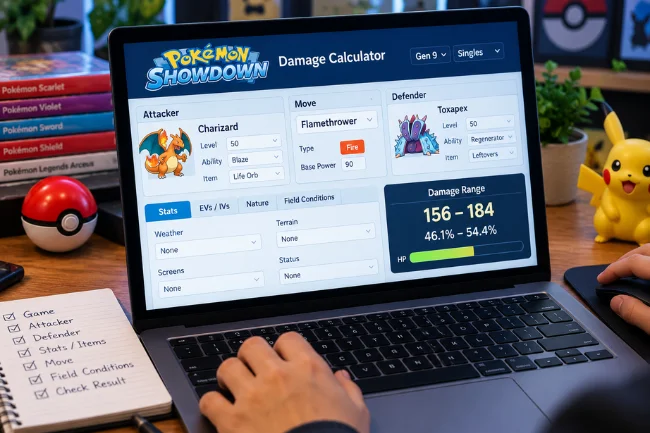
The Pokémon Showdown damage calculator provides generation-specific calculations and fields for Pokémon, moves, stats, items, abilities, and battle conditions. Its published project documents the underlying damage engine.
I use this order:
- Select the correct game or generation and battle format.
- Choose the attacker and defender, including their correct forms.
- Enter levels, natures, IVs, EVs, abilities, and held items.
- Select the move and enter relevant stat changes.
- Add weather, terrain, screens, status, and other field effects.
- Set current HP, then inspect the damage range and knockout information.
Imported sets save time, but they remain assumptions until they match the Pokémon being evaluated.
Before acting on the result, I read the calculation’s description. It should describe the battle I intended to model. If the level, item, defensive investment, or field condition is wrong, the displayed percentage answers a different question.
How to Read Damage Rolls and Knockout Chances
For ordinary attacks in Scarlet and Violet, the random factor has sixteen equally likely values, from 85% through 100%. Rounding can make several rolls produce the same final HP damage.
This is why I count successful roll outcomes rather than just distinct damage numbers.
Here is how I interpret common calculator results:
| Result | Meaning under the entered conditions | Practical response |
|---|---|---|
| Guaranteed OHKO | Every modeled damage roll is enough for a one-hit knockout | Check accuracy and whether the opponent can change the position |
| Possible OHKO | Only some rolls reach the knockout threshold | Decide whether the gamble is acceptable |
| Guaranteed 2HKO | The modeled sequence secures a knockout in two hits | Check healing, stat changes, and opportunities to attack |
| Maximum damage below current HP | An ordinary single hit cannot knock out the target | Consider chip damage, another move, or support |
Calculator knockout descriptions can account for selected hazards and end-of-turn effects, so I read the complete wording.
Knockout Probability Is Not Move Accuracy
Suppose a hypothetical attack has a 75% chance to knock out through its damage rolls and 80% accuracy.
Assuming those events are independent and no other effects interfere, its overall immediate knockout chance is 0.75 × 0.80 = 0.60, or 60%.
A stronger move can therefore offer a less dependable finish. I compare the chance of actually securing the knockout, especially when missing would lose the position.
Use Survival Margins to Make the Numbers Useful
A damage percentage tells me how hard an attack hits. A survival margin tells me how much room remains for something to go wrong.
I calculate it as:
Survival margin = Current HP − Maximum modeled damage
If my Pokémon has 180 HP remaining and the attack can deal at most 172, the margin is eight HP. It survives every modeled ordinary roll, but that protection depends on the entered conditions.
If it takes ten HP of chip damage first, its current HP becomes 170. The margin is now negative two, meaning the strongest modeled rolls can knock it out.
This method helps me compare defensive changes. Raising HP, improving the relevant defense, or removing a damage boost is useful when it changes the survival threshold.
I also keep offensive and defensive questions separate: surviving an attack does not establish that my Pokémon moves first or can win the exchange.
How EVs, IVs, and Nature Affect Your Result

Effort values, individual values, and nature help determine the stats used in damage calculations. Two otherwise similar builds can therefore sit on opposite sides of a knockout threshold.
At level 50, EV gains do not follow a universal “four EVs equals one point” rule. IVs and rounding influence where the next stat point appears.
I prefer testing a benchmark to adding investment without a target. For example, does a defensive change let the Pokémon survive the strongest ordinary roll from the attack I need it to handle?
Once the benchmark is met, I check whether further investment improves another relevant matchup. If the extra points change no useful outcome, another stat may deserve them.
What to Do When the Opponent’s Stats Are Unknown
A calculator cannot reveal an unseen EV spread or held item. I handle that uncertainty by calculating plausible alternatives.
For the defender, I might compare an offensive build, a build with substantial HP investment, and one with stronger investment in the relevant defense.
If my attack knocks out all three, the decision is fairly robust. If it only knocks out the frailest version, the result depends heavily on an unconfirmed assumption.
Observed damage can narrow those possibilities. I compare the HP loss with each candidate’s predicted range, while checking whether the move, boosts, and field conditions stayed the same.
One observed hit usually does not identify a build uniquely. Different assumptions can produce overlapping ranges, and a displayed percentage may hide the exact HP loss.
My rule is to keep plausible explanations until the evidence separates them. That makes damage calculation useful without pretending it supplies hidden information.
Extra Checks for Doubles and Unusual Attacks
In standard modern doubles battles, a damaging spread move hitting multiple targets normally receives a 0.75× spread modifier. Switching the calculator between singles and doubles can therefore change the result.
I also check ally support, protective effects, and whether both opponents remain valid targets.
For a multi-hit move, I verify how many hits the calculator models. For attacks whose power changes with HP, speed, or other conditions, I check that the relevant inputs match the turn being evaluated.
The calculator should model the attack as it happens, including its special behavior.
Common Mistakes That Make Damage Results Misleading
The mistake I would check first is using a species’ base stat instead of its calculated battle stat.
Other frequent problems include choosing the wrong level, leaving a previous weather setting active, forgetting stat changes, and evaluating a defender’s original typing after it Terastallizes.
Current HP deserves another look too. A target at 60% health presents a different knockout threshold from a healthy target, even when the damage range is unchanged.
Finally, a correct calculation does not predict the opponent’s action. Switching, healing, protecting, or changing the field can prevent the modeled attack sequence from happening.
I use the result as evidence for a decision, alongside the available moves and the position on the field.
Put One Matchup to the Test
To calculate Pokémon damage effectively, start with accurate inputs, read the complete range, and connect it to a specific decision. The most useful result tells you whether an attack finishes the target or whether your Pokémon survives the reply.
Choose one matchup you regularly struggle with. Calculate it at full health, after realistic chip damage, and under one plausible change in conditions. Those comparisons give you something concrete to use in your next battle.
Frequently Asked Questions
How do you calculate Pokémon damage?
Use the relevant level, move power, attacking stat, and defensive stat, then apply battle modifiers. A generation-specific calculator handles the detailed rounding.
Why does the same Pokémon move deal different damage?
Ordinary attacks use random damage rolls. Changes in stats, items, abilities, typing, or field conditions can also change the result.
What does STAB mean in Pokémon?
STAB means same-type attack bonus. It normally increases damage by 1.5× when the move matches one of the attacker’s types.
Does super-effective damage always guarantee a knockout?
No. The target’s defensive stats, remaining HP, and other battle effects can let it survive even a super-effective attack.
Can a Pokémon damage calculator predict exact damage?
It can show the possible damage values for the entered conditions. For an ordinary randomized attack, it cannot predict which roll will occur.

Noah Sterling is a technology research writer with 8+ years of experience covering emerging technologies, software trends, digital tools, and innovation. He creates practical, research-based articles to help readers understand the evolving technology landscape.