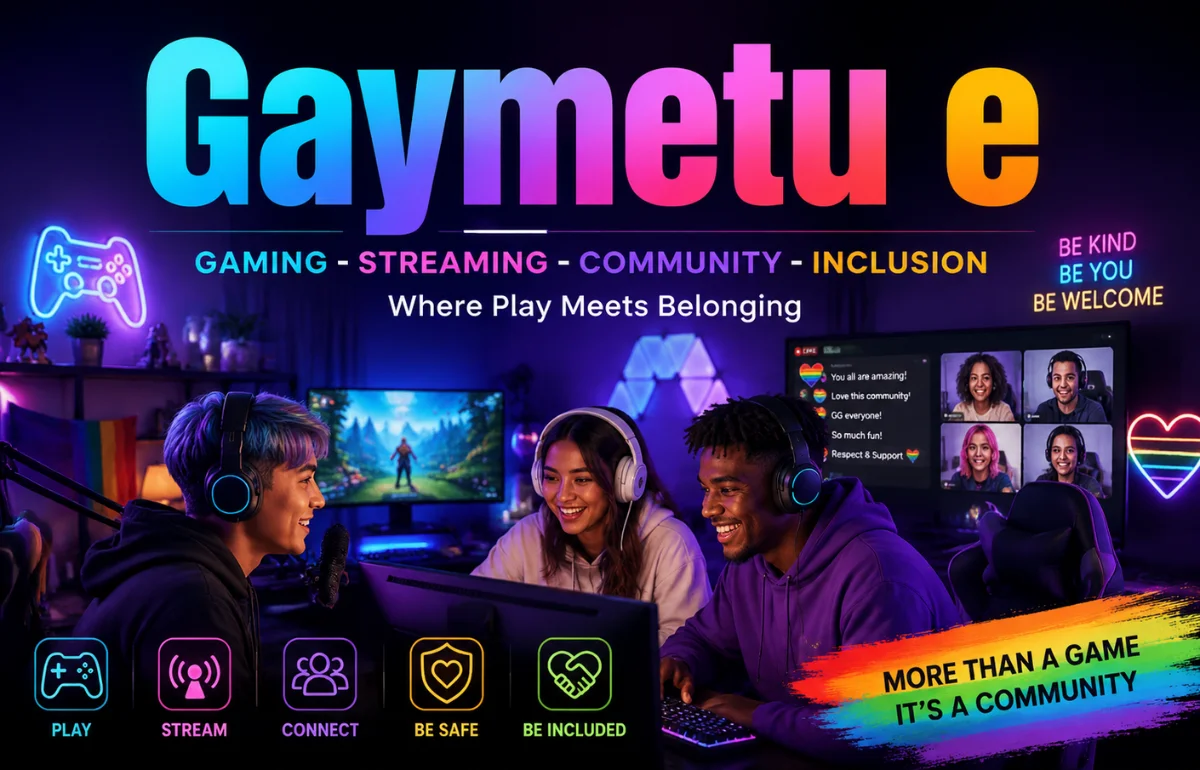
Gaymetu e is an emerging internet term used to describe the overlap of inclusive gaming, livestreaming, interactive entertainment, digital identity, and community participation. In simple terms, it refers to online spaces where people do more than play or watch: they communicate, create, influence experiences, and build communities around shared interests.
The definition is not yet standardized. Some websites use Gaymetu e as a broad label for technology-driven entertainment, while others describe it as an inclusive gaming movement focused on streaming and belonging. I have not found an authoritative industry body, academic source, registered platform, or original manifesto that establishes one official meaning. That uncertainty is part of the story, not a detail to hide.
What Does Gaymetu e Actually Mean?
The most responsible definition is this: Gaymetu e is a developing digital-culture concept associated with participatory gaming, creator-led streaming, inclusive communities, and interactive online experiences.
When I reviewed the pages currently using the phrase, I noticed that they often spoke with more certainty than their evidence supported. One article treated Gaymetu e as the entire intersection of technology and interactive entertainment. Another presented it as an inclusive gaming and streaming movement.
Neither supplied a verifiable origin for the name.
That means readers should treat Gaymetu e as an emerging label rather than a formally established product category.
| Question | Best evidence-based answer |
|---|---|
| Is Gaymetu e a recognized technology? | No recognized technical standard has been established. |
| Is it a specific app or platform? | Current search results do not confirm a single official service with documented features. |
| Is it connected to gaming? | Yes. Most current uses connect it with gaming, streaming, or interactive entertainment. |
| Is inclusion part of the idea? | Many descriptions associate it with welcoming and diverse online communities. |
| Does it have one official definition? | Not at present; published definitions vary. |
Why Is the Term Appearing Online?
Unfamiliar digital terms often gain visibility before their meanings become settled. A phrase may begin as a brand idea, domain name, community label, SEO topic, or piece of internet slang.
Other publishers then interpret it, expand it, and sometimes present speculation as established history. Gaymetu e appears to be following that pattern.
Its growing visibility also makes sense because it sits beside several real digital trends. Gaming is increasingly social. Streamers are community hosts as well as entertainers.
Players attend virtual concerts, contribute fan art, join private servers, vote during live broadcasts, and maintain friendships inside digital spaces. A term that tries to unite gaming, identity, creativity, and belonging therefore feels plausible, even when its origin remains unclear.
The Five Elements That Define Gaymetu e

Rather than forcing the term into one narrow box, I find it more useful to examine the five elements that repeatedly appear around it.
1. Participatory gaming
Traditional media asks an audience to watch. Participatory gaming asks people to act, decide, respond, cooperate, compete, or create.
That participation can be as simple as choosing a character or as complex as running a multiplayer guild. The central idea is agency: the user affects what happens instead of receiving a completely fixed experience.
2. Livestreaming and creator interaction
Streaming turns gameplay into a shared event. Viewers can talk with creators, react in real time, suggest challenges, vote in polls, support channels, and become recognizable members of a recurring audience.
Under the Gaymetu e interpretation, the chat is not secondary to the content. It is part of the experience.
A successful stream is therefore not judged only by its viewer count. The quality of the interaction, the behavior of the community, and the creator’s ability to make participants feel welcome matter as well.
3. Inclusive digital identity
Many current explanations connect Gaymetu e with spaces where LGBTQ+ players, disabled gamers, women, international audiences, and other underrepresented groups can participate without being treated as outsiders.
Real inclusion requires more than welcoming language. It involves enforceable conduct rules, trained moderators, reporting systems, privacy controls, and representation that does not reduce people to stereotypes.
Major platforms already recognize this need. Twitch prohibits hateful or harassing conduct based on characteristics including gender identity, sexual orientation, and disability. Discord treats platform rules and community-level moderation as separate but connected layers of safety.
4. Community creation
A healthy gaming community produces more than messages. Members may organize tournaments, create guides, make fan art, translate resources, host support channels, edit videos, develop modifications, or welcome new players.
This is where Gaymetu e becomes broader than a game. The game may attract people, but relationships and shared culture give the community staying power.
Communities also develop their own language, traditions, recurring events, and standards of behavior. These shared practices can turn a temporary audience into a recognizable digital culture.
5. Interactive entertainment beyond games
The idea can also include branching stories, virtual concerts, live audience voting, mixed-reality events, and educational simulations.
Netflix has described interactive storytelling as a branching format in which viewers can influence how a story unfolds. That is a clearer example of interactive entertainment than simply watching episodes in a different order.
This distinction matters because not every digital experience is interactive. A person watching a conventional livestream remains a viewer unless the platform gives that person a meaningful way to participate or influence the experience.
Gaymetu e Compared With Related Concepts
Gaymetu e overlaps with familiar digital categories, but it should not be used as a careless replacement for all of them.
| Concept | Main focus | User role | How it differs from Gaymetu e |
|---|---|---|---|
| Online gaming | Playing networked games | Player or teammate | May not include streaming, identity-led community, or creator culture |
| Livestreaming | Broadcasting live content | Viewer, subscriber, or creator | Can exist without gaming or persistent community participation |
| Social media | Publishing and discussing content | Follower, poster, or moderator | Usually broader and less centered on playable experiences |
| Metaverse | Persistent or connected virtual environments | Avatar, creator, or visitor | A technology vision rather than an inclusion-focused community idea |
| Esports | Organized competitive gaming | Competitor or spectator | Prioritizes competition, rankings, and events |
| Gaymetu e | Gaming, streaming, identity, and community | Participant, creator, viewer, or moderator | Best understood as a combined cultural label rather than a fixed platform |
This comparison also prevents a common content problem: attaching every fashionable technology to the keyword.
Gaymetu e does not automatically require virtual reality, artificial intelligence, blockchain, NFTs, or the metaverse. Those tools may support an interactive experience, but they do not define it.
What a Genuine Gaymetu e Community Would Look Like
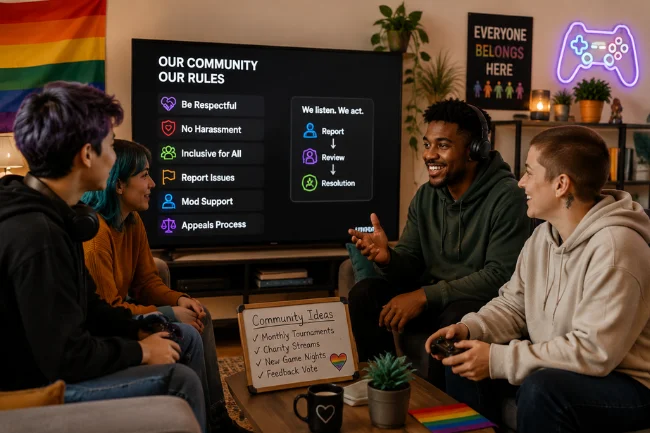
Because there is no confirmed official platform, the strongest way to evaluate the idea is through observable community practices.
A credible Gaymetu e-style space would publish clear rules, explain how reports are handled, identify moderator responsibilities, and provide a consistent appeals process. It would protect members from targeted harassment without shutting down respectful disagreement.
It would also make participation accessible. Accessibility is not the same as placing a game in the cloud.
It includes readable subtitles, remappable controls, screen narration, color filters, speech-to-text, difficulty options, reduced-motion settings, and support for adaptive hardware.
Xbox, for example, publicly documents features such as adaptive controllers, narration, magnification, color filters, captioning, and speech transcription. Its accessibility tags are designed to help players understand supported features before choosing a game.
An authentic community would also give members meaningful influence. Feedback would shape events, rules, schedules, collaborations, and content formats.
“Community-driven” should describe a visible process, not merely a marketing slogan.
Potential Benefits of Gaymetu e
Gaymetu e can be a useful idea when it encourages designers and community leaders to think beyond downloads, views, or player counts.
For players, the main benefit is belonging. A welcoming group can make a multiplayer game less intimidating and give isolated users a regular place to connect.
For creators, the model supports deeper relationships with audiences. A viewer who helps choose an event theme, submits artwork, or contributes to a community project has a different connection from someone who watches one clip and leaves.
For developers, inclusive participation can reveal barriers that internal teams miss. Community feedback may identify inaccessible menus, unclear moderation rules, culturally narrow stories, or features that unintentionally exclude part of the audience.
Brands can also use interactive experiences to invite participation. However, the value comes from listening and responding, not from placing inclusive language on a campaign that offers users no real influence.
Risks and Problems to Watch
The positive language around Gaymetu e should not distract from the risks attached to online communities.
Unverified claims
The first risk is misinformation. A publisher may describe Gaymetu e as an established platform, international movement, or new technology without identifying who created it or where users can officially join.
Readers should look for primary documentation, named leadership, dated product information, transparent ownership, and independently verifiable activity.
A professionally designed website alone does not prove that a platform, movement, or service has an active community behind it.
Harassment and weak moderation
A community cannot call itself inclusive while leaving targeted members to manage abuse alone. Written rules are useful only when moderators enforce them consistently and members know how to report problems.
Automated filters can help identify spam or banned terms, but context still requires human judgment. Discord’s safety material presents automated moderation as one part of a wider moderation system, not a complete substitute for people.
Privacy and data collection
Gaming and streaming platforms can collect account information, messages, viewing behavior, device data, purchases, and interaction patterns.
Users should know what information is collected, why it is needed, who receives it, and how long it is retained.
A new community should never ask members to reveal their identity, sexuality, physical location, or personal history as proof that they belong.
Token representation
Featuring a Pride flag or using inclusive wording does not guarantee meaningful representation.
Strong communities include diverse people in decision-making, moderation, content creation, event planning, and paid leadership. They do not use marginalized identities only when those identities are useful for promotion.
Accessibility gaps
A space can be socially welcoming and still exclude people through poor design.
Small text, uncaptioned streams, flashing effects, voice-only participation, expensive hardware, and high bandwidth requirements can all create barriers. These practical details deserve as much attention as public statements about inclusion.
How I Evaluate Claims About Gaymetu e
When I assess an unfamiliar online concept, I use three questions.
First, what can be verified? I look for an original source, a clear owner, dated documentation, product evidence, and independent references.
Second, what is interpretation? Describing Gaymetu e as an inclusive digital-culture idea may be reasonable, but it should be labeled as an interpretation unless a primary source confirms it.
Third, what remains useful regardless of the label? Safer moderation, accessible design, fair representation, and meaningful participation are valuable whether the community uses the Gaymetu e name or not.
This approach keeps the discussion factual without stripping away the term’s possible cultural value.
The Future of Gaymetu e
Gaymetu e may develop into a recognizable community identity, become attached to a specific platform, or remain a loosely defined web phrase. The available evidence does not justify predicting one outcome with confidence.
Its underlying themes are more durable than the name. Players increasingly expect social features, creators want two-way relationships with audiences, and communities face pressure to improve safety and accessibility.
The most credible future version of Gaymetu e would therefore be practical rather than promotional. It would have transparent ownership, visible community activity, strong moderation, accessible design, and a clear explanation of what members can actually do.
Frequently Asked Questions
What is Gaymetu e?
Gaymetu e is an emerging term associated with inclusive gaming, streaming, interactive entertainment, and online community participation.
Is Gaymetu e a real gaming platform?
No authoritative evidence currently confirms it as one established platform; online sources use the term in several different ways.
Is Gaymetu e related to LGBTQ+ gaming?
Many current descriptions connect it with LGBTQ+ inclusion and diverse gaming communities, although no official definition has been verified.
How is Gaymetu e different from the metaverse?
Gaymetu e is framed as a community and culture concept, while the metaverse refers more broadly to persistent or connected virtual environments.
How can I join a Gaymetu e community?
Verify the organizer, rules, privacy policy, moderation process, and active member presence before joining any group that uses the name.
A Clearer Way to Understand Gaymetu e
Gaymetu e is best treated as a developing label for the meeting point of gaming, streaming, interactive media, identity, and community. It reflects real changes in digital culture, but its origin and official status remain unverified.
Before repeating bold claims about it, check the source behind the definition. Then focus on the standards that matter most: safety, accessibility, transparency, representation, and genuine member participation.
Use those criteria to judge any platform or community that presents itself under the Gaymetu e name.

Noah Sterling is a technology research writer with 8+ years of experience covering emerging technologies, software trends, digital tools, and innovation. He creates practical, research-based articles to help readers understand the evolving technology landscape.