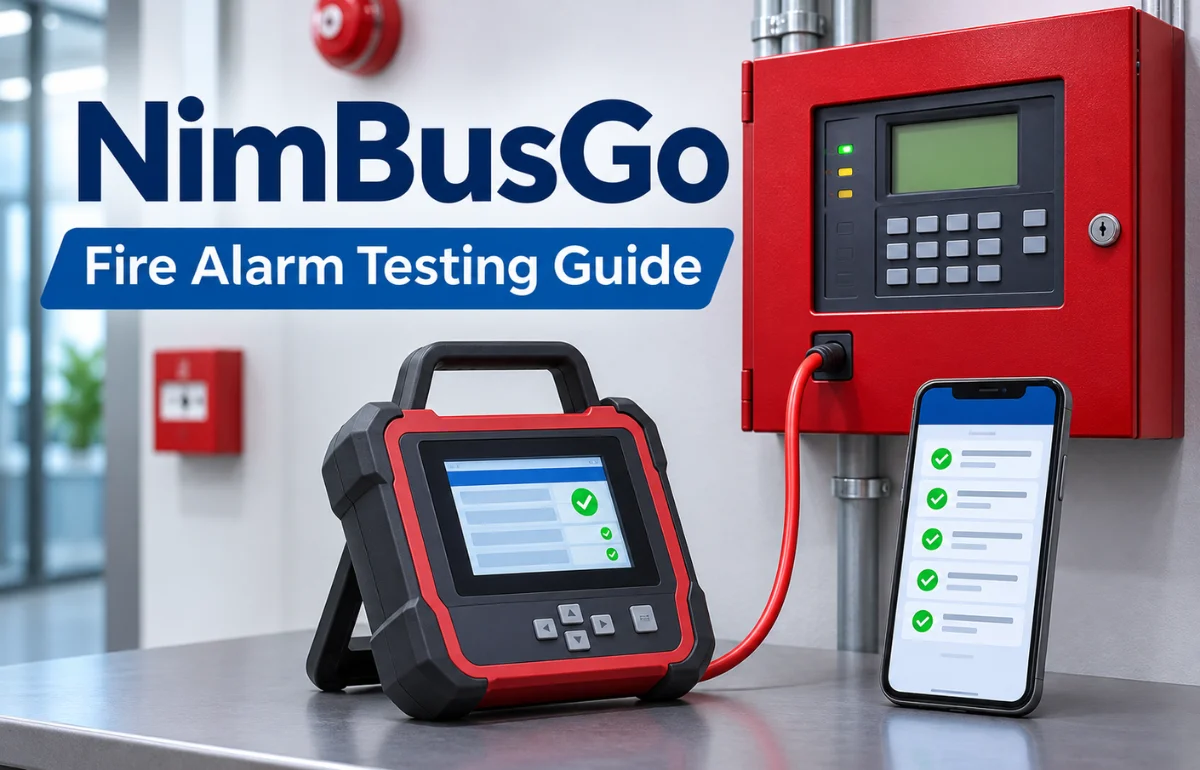
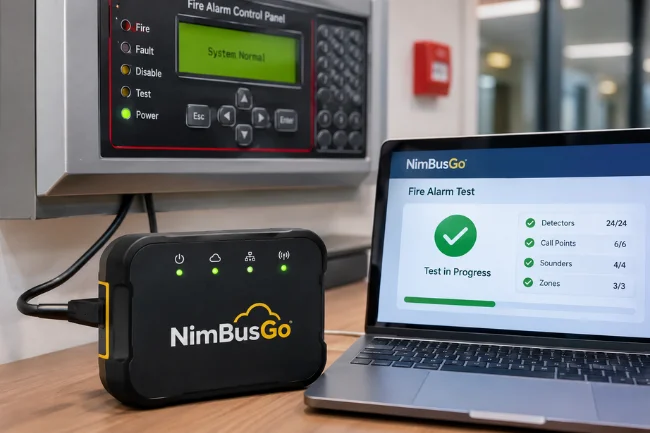
NimBusGo, officially styled NimbusGo by Nimbus Digital, is a portable fire alarm testing device that helps engineers record servicing activity directly from compatible fire alarm control panels. It connects to a panel during a site visit, captures test events, and sends the resulting records to a cloud platform. Used with the Nimbus Digital mobile app, it can help technicians document which devices responded, record faults, and give clients access to testing evidence.
In simple terms, NimBusGo turns much of the paperwork associated with fire alarm maintenance into a digital record linked to actual panel activity. It is intended mainly for fire protection contractors and system integrators, rather than household consumers. Its value comes from traceability: not just saying a test happened, but preserving information about what was tested and when.
Why Fire Alarm Testing Records Matter
Fire alarm servicing involves more than walking around a building and checking detectors. On a large site, an engineer may need to verify hundreds or thousands of devices, document exceptions, and hand over reliable records to a facilities team.
Traditional workflows can involve handwritten notes, separate panel event logs, photographs saved on a phone, and spreadsheets completed later. Every transfer risks mistakes or missing information.
The practical question I ask is simple: if a client requests proof that a particular detector was tested six months ago, how quickly can the contractor find it? A searchable, timestamped record can make that answer easier. However, good documentation supports competent maintenance; it does not replace it.
How Does NimBusGo Work?
The workflow combines a physical gateway, a compatible fire alarm panel, a mobile app, and Nimbus’s cloud-based reporting system. Rather than treating these as separate products, I find it more useful to think of them as one chain of evidence.
1. Connect the Device to the Fire Alarm Panel
An engineer brings nimbusGo to the site and connects it using the appropriate cable or adapter. The device includes USB-A and serial connections, but the exact connection method depends on the panel manufacturer and model.
Broad manufacturer coverage does not mean every panel version is supported. I would check the exact model and adapter before visiting.
2. Pair It With the Mobile App
The Nimbus Digital App is available for Android and iOS. The technician powers on the unit, selects it inside the app, and pairs it there rather than through the phone’s ordinary Bluetooth settings.
The app displays battery and signal status. A roaming eSIM supports cellular uploads, while Wi-Fi is an alternative when reception is poor.
3. Carry Out the Physical Tests
During a service visit, the engineer tests the required devices. When a detector or call point generates a recognized event at the panel, the app can automatically update its test status. Other equipment, including sounders, may need a manually selected outcome.
The engineer can also record failures, advisories, inaccessible devices, notes, and photos. A useful audit trail must include exceptions, not just passes.
4. Review and Share the Records
Test activity is synchronized with the Nimbus cloud, where authorized users can review service information, asset records, and reports. The company’s servicing guidance says a visit cannot be formally ended while uploads remain pending, helping prevent an incomplete transfer.
I would still review the finished report before sharing it.
Key NimBusGo Features That Make a Difference
Automatic Test Logging and Timestamped Evidence
NimBusGo’s main selling point is its ability to capture recognized events from the fire alarm control panel rather than relying exclusively on someone ticking a box. Nimbus describes the resulting test records as non-editable, which is intended to preserve their evidential value.
A panel event is useful evidence, though it cannot prove every inspection task was completed correctly.
A Digital Asset Register
The platform can build an asset record as devices and zones are identified during servicing. That is especially useful in buildings where inherited spreadsheets no longer match the installed equipment.
I would compare expected assets with recorded outcomes and investigate any device without a result.
Fault Notes, Photographs, and Reporting
The mobile workflow supports comments, photographs, and fault outcomes. This can help a service manager understand what an engineer found without waiting for a telephone explanation at the end of the day.
According to Nimbus, clients can access relevant records through a portal instead of repeatedly requesting reports.
Portable Connectivity and Field Use
Because NimbusGo is a portable unit, contractors can take it between sites rather than permanently installing a dedicated device at every location. USB-C charging and status LEDs help technicians manage it on the move.
Status LEDs show battery, cloud, panel, and Bluetooth conditions, making pre-test checks easier.
NimBusGo Versus Traditional Fire Alarm Test Records
The biggest difference is where the information originates and how much is copied by hand.
| Comparison point | Paper or spreadsheet process | NimBusGo-supported process |
|---|---|---|
| Capturing a detector response | Engineer records result manually | Recognized panel events can be logged automatically |
| Evidence of timing | Handwritten or manually entered time | System-generated timestamps for captured events |
| Recording faults | Notes and photos may be scattered | Fault outcome, notes, and photos within the workflow |
| Sharing records | Email, scanning, or manual export | Cloud records and customer portal |
| Main dependency | Accurate manual entry and filing | Supported panel, correct setup, and data synchronization |
Digital records are not infallible: wrong asset selections and missed failures still require human review.
A Realistic Example: Testing a Large Office Building
Consider a hypothetical office building with 600 listed fire alarm devices. A contractor has scheduled servicing and needs a record that identifies completed tests, failures, and items that could not be accessed.
With a manual process, one person might operate devices while another checks panel responses, or the engineer may later reconcile notes with the panel log. With nimbusGo connected to a supported panel, recognized responses can appear in the mobile workflow as testing takes place.
I would judge success by the final exception list. Suppose 575 devices show completed outcomes, 15 require attention, and 10 are not tested. The service report should explain all 25 exceptions rather than present a misleading headline that the visit was finished.
This example illustrates an evaluation method; it is not a measured result from a Nimbus customer site.
Panel Compatibility: What to Verify Before Buying
Nimbus lists compatible equipment from manufacturers including Advanced, Gent, Kentec, Notifier, Siemens, Honeywell, Fike, and Tyco. Its published compatibility page names specific ranges, such as Advanced MxPro 4/5, Gent Vigilon, Kentec Syncro, and Notifier ID-series panels.
The model-level detail is essential. For instance, a product family may include variants with different communication capabilities. The company also lists panel-specific cables and adapters, so I would never assume one generic lead is suitable for an entire mixed estate.
Before agreeing to a rollout, ask for written confirmation of your panel models, firmware requirements, connection ports, cable part numbers, and any limits on available event data. A short supervised test on a representative panel is more meaningful than a broad compatibility slogan.
Does NimBusGo Help With Fire Safety Compliance?
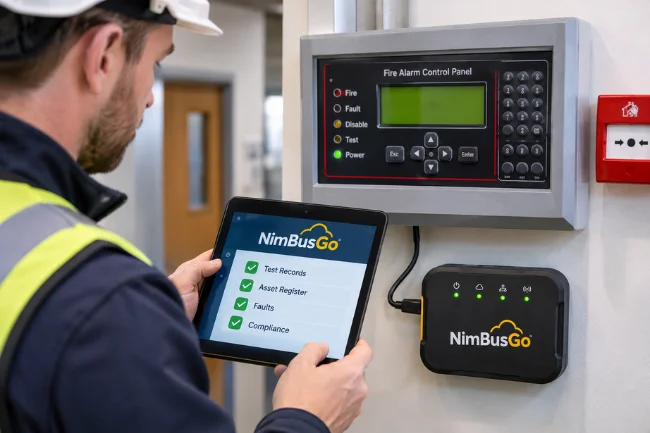
It can support compliance documentation, but I would be cautious about calling any device a guarantee of compliance. In the UK, BS- 5839-1:2025 is the current code of practice for fire detection and fire alarm systems in non-domestic premises; it replaced the 2017 edition in April 2025.
Nimbus markets its non-editable records as supporting BS 5839 servicing and evidence requirements. That is useful, but actual conformity depends on the maintenance schedule, technical procedures, competence of the people carrying out the work, and the condition of the system.
An event record cannot establish that sound levels, batteries, interfaces, and other required checks were assessed. Competent service providers must still apply the standard.
I would therefore describe NimBusGo as a tool for stronger traceability and record management, not as a substitute for a fire safety strategy or professional judgment.
NimBusGo Pricing and the Real Cost of Ownership
Nimbus Digital’s product page currently advertises an entry offer of £545 as a one-off starter package and £70 per month for platform access. However, the company’s online shop also lists a different nimbusGo Starter Pack at £1,485 excluding VAT, including the device, an accessory pack, and a 12-month subscription. That shop listing was marked out of stock when checked.
Because the bundles differ, I would request an itemized quotation covering hardware, adapters, onboarding, VAT, and renewals.
The key calculation is not the sticker price alone. It is whether the system saves enough working time and improves documentation enough to justify its total cost.
A Simple Break-Even Calculation
Imagine a contractor saves 30 minutes of engineer administration on 20 service visits each month. That equals 10 hours. At an illustrative internal labour cost of £35 an hour, the gross time value is £350 per month before subscription fees, hardware costs, and any additional software charges.
These are illustrative numbers. Time saved becomes financial value only if it reduces costs or increases productive capacity.
Nimbus advertises labour reductions of up to 50% in suitable situations. I would treat that as a vendor claim to test in a pilot, not a forecast for every building.
Who Is NimBusGo Best Suited For?
The strongest fit is a fire protection contractor servicing multiple compatible panels and regularly producing detailed test records. It may be particularly attractive where sites have many devices, clients request audit evidence, and office teams spend significant time rebuilding reports after visits.
Building managers can benefit indirectly through access to clearer information, even though the portable unit is primarily an engineer’s field tool. A small contractor working on a handful of straightforward systems may find that existing processes remain adequate, especially if adapter and subscription costs outweigh the expected savings.
I would prioritize testing volume and reporting complexity over company size.
NimBusGo Versus Nimbus Connect: Are They the Same?
No. They are related Nimbus Digital products with different primary purposes. NimBusGo is portable and centered on on-site servicing, while Nimbus Connect is described by the company as a permanently installed hub for ongoing fire panel visibility and notifications.
| Question | NimBusGo | Nimbus Connect |
|---|---|---|
| Primary user | Service engineer or fire protection contractor | Building or facilities manager |
| Typical installation | Portable connection during visits | Fixed connection to an existing panel |
| Core purpose | Record and manage on-site tests | Ongoing monitoring, alerts, and visibility |
| Typical value | Faster service documentation | Earlier awareness of panel events |
| Can it replace professional inspections? | No | No |
I would choose based on whether the problem is periodic servicing or continuous visibility.
The Questions I Would Ask Before Adopting NimBusGo
What Happens When the Internet Connection Drops?
Nimbus supports cellular and Wi-Fi connections, but real buildings have basements, risers, and plant rooms with weak signals. The servicing documentation acknowledges pending uploads that complete once a usable connection returns.
Before a purchase, I would ask for a practical demonstration of interrupted connectivity, data recovery, and report completion. I would also confirm how long unsent records are retained and what happens if the device is reset. Nimbus specifically warns that resetting while uploads are pending could cause data loss.
How Can Managers Spot Missing Tests?
A comprehensive-looking report can still contain omissions. I would want a clear reconciliation between the expected asset list, tests completed, failures, inaccessible devices, and items that could not be matched to the panel configuration.
Unresolved exceptions should remain visible until somebody addresses them.
Who Can Access, Export, and Keep the Records?
Because the workflow uses a cloud service, buyers should ask about user permissions, data retention, export options, backups, and what happens if a subscription ends. I did not find enough independently verified detail to promise particular cybersecurity certifications or retention periods.
Records should remain accessible if the contractor changes providers.
Can the Tool Fit Existing Office Software?
Nimbus has described an integration with Simpro through Dokkit, connecting field test evidence with asset records, compliance reports, and job management. That could reduce duplicate entry for contractors already using those systems.
I would confirm integration fees, supported fields, and availability before buying.
What Independent Evidence Says
Published case studies offer useful context, although they are not controlled trials. Nimbus reports that Marlowe Fire & Security Group adopted its platform to improve traceability across complex sites and reduce administrative work. That is a relevant use case, but the account appears on the supplier’s website.
An independent HSE Network comparison published in June 2026 also identified nimbusGo as a specialist fire alarm testing product. It reported that major verified public review scores were difficult to find. I see that as a reason to request customer references and run a realistic demonstration, not as proof that the technology succeeds or fails.
I would trust a measured pilot using my own panels and engineers most.
Final Verdict: Is NimBusGo Worth Considering?
NimBusGo addresses a genuine problem: producing dependable fire alarm servicing records without rebuilding them from handwritten notes and disconnected files. Its combination of panel-event capture, mobile workflows, cloud reporting, and client visibility makes it worth examining for contractors with demanding maintenance schedules.
I would begin with a panel compatibility check, a full-cost quotation, and a pilot on one representative site. Measure time saved, missing-test visibility, and report quality. If those results improve, there is a credible case for expanding its use.
Frequently Asked Questions About NimBusGo
What is NimBusGo used for?
It is used by fire alarm technicians to capture servicing events, document test outcomes, and manage digital maintenance records for compatible fire alarm systems.
Is NimBusGo an app or a physical device?
It is a portable physical device that works with the Nimbus Digital mobile app and cloud platform.
Does NimBusGo work with every fire alarm panel?
Not necessarily. Nimbus supports many manufacturers, but users should verify the exact panel model, configuration, and required adapter.
How much does NimBusGo cost?
Nimbus advertises an entry offer of £545 plus £70 per month; its store lists a separate £1,485 bundle excluding VAT. Request a current itemized quote.
Can NimBusGo make a fire alarm system compliant by itself?
No. It can improve testing records, but compliance also depends on competent inspections, proper maintenance, and applicable standards.

Noah Sterling is a technology research writer with 8+ years of experience covering emerging technologies, software trends, digital tools, and innovation. He creates practical, research-based articles to help readers understand the evolving technology landscape.