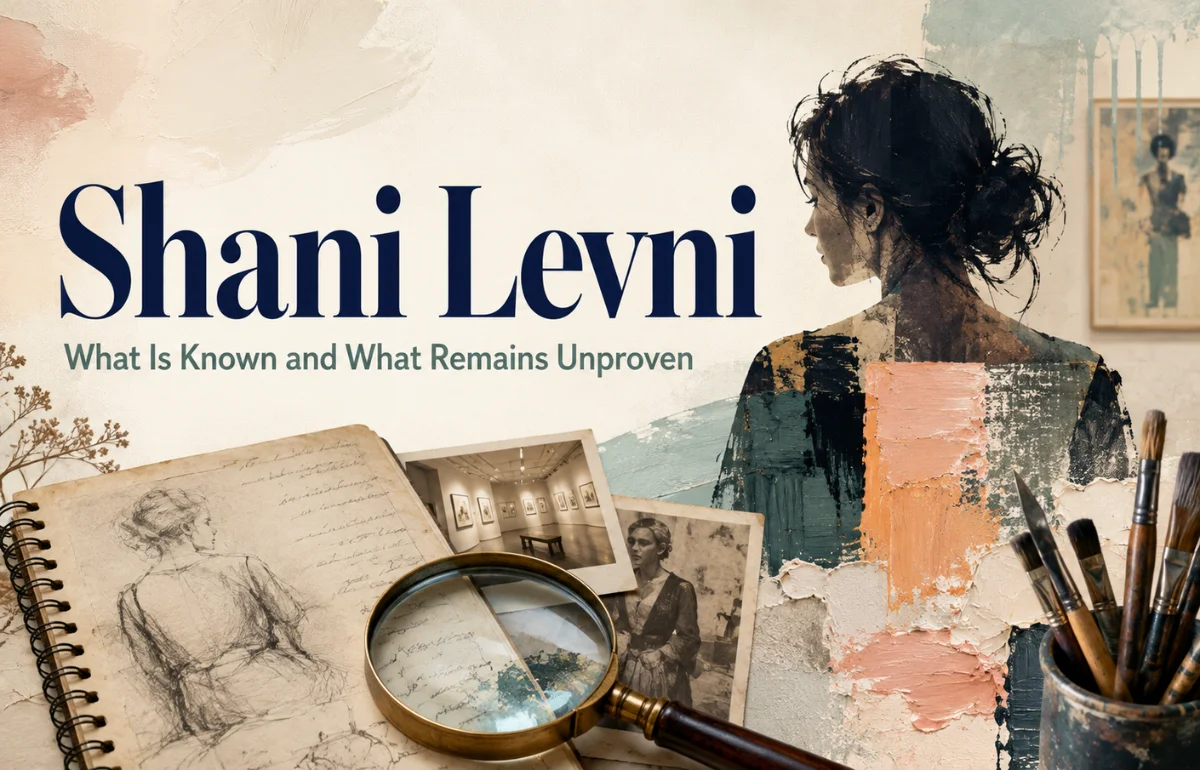
Shani Levni is a name that appears across recent online profiles describing an Israeli multidisciplinary artist associated with mixed-media painting, installation, performance, writing, and social activism. However, as of August 2026, the widely repeated biography cannot be independently confirmed through clear primary records from the museums, galleries, university, nonprofit, or major media organizations linked to it.
That distinction matters. Several websites present a precise birth date, education history, exhibition list, named artworks, and charitable initiative as settled facts. When I reviewed the search trail, I found a tightly repeated narrative but very little original documentation. The most accurate answer to “Who is Shani Levni?” is therefore this: she is an online biographical subject described as a contemporary artist, but the identity and career attached to that name remain unverified.
Why Shani Levni Is Appearing in Search Results
Interest in Shani Levni appears to come from a cluster of articles published mainly in 2025 and 2026. These pages use remarkably similar details: a birth in Tel Aviv on April 15, 1990; a BFA from Bezalel Academy of Arts and Design; postgraduate study in Berlin; exhibitions at the Tel Aviv Museum of Art, Jerusalem Biennale, and Rosenfeld Gallery; and a nonprofit called The Root Collective.
On the surface, that level of consistency looks reassuring. In practice, repeated wording can mean later publishers are copying or paraphrasing one earlier account rather than independently confirming it.
I noticed the same artwork titles and descriptive phrases appearing repeatedly, including “Whispers of the Olive Tree,” “Letters Never Sent,” “Between Earth and Sky,” and “The Weight of Light.”
The repetition creates the impression of a documented career, yet the articles rarely link to exhibition catalogues, museum archives, artist interviews, or contemporary reviews.
Reported Biography Versus Verifiable Record
The clearest way to understand the topic is to separate what websites claim from what can currently be substantiated.
| Detail | Common online claim | Current evidence status |
|---|---|---|
| Identity | Israeli multidisciplinary artist and writer | The name appears in recent web content, but the detailed artist identity is not independently established |
| Birth | April 15, 1990, in Tel Aviv | Repeated by several profiles; no cited primary record |
| Education | BFA from Bezalel and an MFA in Berlin | Repeated online; no publicly identified alumni or thesis record |
| Exhibitions | Tel Aviv Museum of Art, Jerusalem Biennale, Rosenfeld Gallery | Claimed by profiles; no linked institutional catalogue or press release |
| Artworks | Four frequently named mixed-media projects | Described in blogs; no reliable catalogue images, dimensions, ownership records, or reviews |
| Activism | Founder of The Root Collective in 2023 | Frequently claimed; no clearly identified official organization or registry record |
| Public recognition | TEDx, UNESCO, museum collections, and international panels | Mentioned without direct links or independently named programs |
A 2026 investigation of the same content cluster reported that it could not find independent museum, academic, nonprofit, or established press documentation supporting the standard biography.
It also highlighted how multiple sites repeat the same exact details despite providing no traceable original source.
This does not prove that no private individual named Shani Levni exists. It means the public figure described in these articles has not been adequately documented.
The Artist Profile Repeated Across the Web
Most biographies describe Levni as a contemporary mixed-media artist whose work explores identity, memory, belonging, diaspora, displacement, spirituality, and collective trauma.
The reported visual language is equally specific. Articles mention acrylic and oil paint, found objects, handwritten text, translucent washes, impasto, gold leaf, Hebrew lettering, pomegranates, olive branches, maps, suitcases, and ladders.
These are plausible materials and symbols within contemporary art, but plausibility is not evidence of authorship.
Reported Works and Exhibitions
“Whispers of the Olive Tree” is usually described as a 2018 mixed-media work shown at the Tel Aviv Museum of Art.
“Letters Never Sent” is presented as an interactive installation at the Jerusalem Biennale, while “Between Earth and Sky” is linked to a 2020 solo show at Rosenfeld Gallery. A Berlin exhibition titled “The Weight of Light” is often described as forthcoming in 2025.
The dates expose a serious editorial problem. Articles published in 2026 still call the supposed 2025 Berlin exhibition “upcoming,” without saying whether it opened, moved, or was cancelled.
That suggests the text was reused without a meaningful update.
One later article introduced another alleged exhibition, “A Parallel Universe” at Sputnik Gallery in New York, and called it the firmest evidence of a real career. Yet searches for that exact title and artist mainly lead back to the article making the claim, not to a gallery archive or independent review.
What Is The Root Collective?
The Root Collective is described online as an arts nonprofit founded by Shani Levni in 2023 to work with refugee and immigrant youth.
Several profiles claim that it organized 28 sessions in five countries, reached more than 600 participants, and helped create 12 public murals. The numbers are precise, which makes them sound measurable and trustworthy.
The problem is that the articles do not identify the five countries, participating schools, local partners, funders, staff, mural locations, annual reports, or registration details.
For a genuine international nonprofit, I would expect at least some operational footprint: a legal name, registration number, leadership page, program photographs, partner acknowledgements, donation information, impact report, or coverage from a community organization.
Until that documentation appears, the initiative should be described as reported rather than confirmed.
Why the Online Biography Raises Red Flags
A thin public record is not automatically suspicious. Emerging artists often have small audiences, limited press coverage, and incomplete institutional archives.
The unusual feature here is the mismatch between the scale of the claims and the absence of supporting material.
The standard biography connects Shani Levni to respected museums, a prominent art school, international activism, UNESCO panels, TEDx appearances, public collections, and hundreds of program participants. A career with that footprint would normally leave multiple independent traces.
| Strong credibility signal | What the current profiles usually provide |
|---|---|
| Museum or gallery catalogue | A venue name inside an unsourced paragraph |
| Artist interview or statement | Quotes without a recording, transcript, date, or publisher |
| Original artwork photography | Generic or repeated images with unclear provenance |
| Education confirmation | School names without graduation records or faculty context |
| Nonprofit accountability | Impact figures without registration, partners, or reports |
| Independent criticism | Vague references to “critics” or “viewers” without names |
The exact-match website shanilevni.com adds another complication. It presents a detailed biography, but the site also contains generic categories and unrelated posts.
Its footer says, “I’m Shani Levni,” while an investigation reported that another part of the site disclaims affiliation with or representation of the person.
That inconsistency weakens the site as a primary source.
Is Shani Levni Connected to Michael Aloni?
Some newer pages claim that Shani Levni is or was the partner of Israeli actor Michael Aloni. The main artist profile on shanilevni.com also references that alleged relationship.
I could not find a reliable statement from either person, a representative, or established entertainment reporting that confirms the connection.
A separate investigation concluded that the claim conflicts with the relationships documented in independent coverage of Aloni’s public life.
For readers, the responsible position is simple: do not repeat the relationship as fact. Personal-life claims need stronger sourcing than a network of anonymous or lightly edited biography pages.
What Can Be Said Responsibly About Shani Levni?
At present, the safest description is not a conventional celebrity biography. It is an explanation of an unresolved online identity.
The name Shani Levni is associated in recent web content with a Tel Aviv-born multidisciplinary artist working across painting, installation, performance, and community activism.
The profiles consistently attribute themes of memory, identity, displacement, and belonging to her work. They also assign her a specific education, exhibition history, nonprofit, and set of artworks.
Those details remain claims until a traceable first-party or institutional source confirms them.
I would update this assessment if any of the following became available:
- A verified artist account linking to a portfolio and exhibition history.
- A museum, biennale, or gallery archive naming the artist and work.
- A Bezalel alumni record or a Berlin thesis catalogue.
- A registered organization and public reporting for The Root Collective.
- A dated interview, exhibition catalogue, studio visit, or reputable critical review.
This standard is not unusually strict. It is the normal level of evidence used for biographies involving real people, respected institutions, charitable work, and personal relationships.
Why This Story Matters Beyond One Name
The Shani Levni search results offer a useful lesson about modern information quality. Search engines can surface many pages that appear independent even when they repeat the same unsupported source material.
Volume is not verification. A claim does not become stronger because ten websites paraphrase it.
When I assess an unfamiliar public figure, I look for a source chain. Where did the birth date first appear? Who documented the exhibition? Which organization published the impact figures? Can the quotation be traced to a recording or transcript?
When those questions lead in circles, an honest article should show the uncertainty rather than hide it.
That approach is also better for readers. Someone searching “Shani Levni” is probably trying to identify the person, understand the artwork, confirm a relationship, or find an official profile.
A confident but unsupported biography may answer quickly, yet it does not answer reliably.
A Clearer Way to Read the Available Information
Readers can treat the current online material in three layers.
First, the name’s presence in search results is real. Multiple recent websites publish an artist narrative under it.
Second, the repeated artistic description is a reported narrative. It may reflect a real person, a fictionalized profile, an SEO content cluster, or a mixture of accurate and invented details.
Third, the major biographical claims remain unverified. Museum exhibitions, education, nonprofit leadership, public appearances, and personal relationships should not be presented as confirmed without direct documentation.
That is the most useful answer currently available because it respects both possibilities: a private person may exist behind the name, while the widely circulated biography may still be unreliable.
What Readers Should Do Next
Before citing Shani Levni in a school paper, news story, biography, or art article, trace each important claim to a primary source.
Save institutional pages, catalogue entries, dated interviews, and original photographs rather than relying on recycled summaries.
Readers who possess a genuine exhibition catalogue, verified portfolio, or organizational record can help clarify the public record by sharing it with the publisher or institution best placed to authenticate it.
Frequently Asked Questions
Who is Shani Levni?
Shani Levni is described online as an Israeli multidisciplinary artist, but the detailed biography attached to the name remains independently unverified.
Is Shani Levni a real artist?
A private person with that name may exist, but reliable institutional evidence for the widely repeated public art career has not been established.
What art is Shani Levni known for?
Online profiles associate the name with mixed-media works about identity, memory, diaspora, and spirituality, including several unverified exhibition titles.
Did Shani Levni found The Root Collective?
Several websites say she founded it in 2023, but no clear official registration, leadership record, or independent impact report has been identified.
Is Shani Levni Michael Aloni’s partner?
The claim appears on some recent websites, but no reliable public statement or established media source currently confirms it.
You May Also Read: Tozymagazine.com Review: 5 Essential Facts to Know

Midori Michael is an independent digital content research writer with 8+ years of experience creating well-researched articles on digital marketing, business, technology, and lifestyle topics. She focuses on simplifying complex information through accurate research and clear editorial writing.