
Fenchar.com is an English-language online publication that shares articles about technology, business, digital marketing, health, education, travel, beauty, and everyday living. It works more like a multi-topic blog or digital magazine than an online store, social network, or software tool. Readers can browse its published content, while writers and businesses can propose guest articles using the instructions on its contributor page. The site describes its goal as sharing useful information and welcoming contributors. That explains what it offers, but it does not automatically establish the accuracy of every article or the value of a paid publishing arrangement.
I reviewed the site’s public pages and a sample of its content in November 2026 to separate what readers can verify from what remains unclear. Here is what I found, and how I would approach the platform as a reader or potential contributor.
Fenchar.com at a Glance
| Feature | What the public website shows |
|---|---|
| Website | fenchar.com |
| Format | General-interest digital publication |
| Main language | English |
| Topics | Technology, business, education, health, lifestyle, travel, and more |
| Content access | Published articles are readable through the website |
| Contributions | Guest article proposals are accepted |
| Public contact | guestpost@technicalinterest.com |
| Account access | A sign-in link leads to a WordPress login page |
| Legal owner | Not clearly identified on the pages reviewed |
| Information checked | November 6, 2026 |
The distinction between what is visible and what is verified matters. A website’s own description establishes its stated purpose; it is not independent proof of ownership, readership, or editorial standards.
What Is Fenchar.com Actually Used For?
For most visitors, its main function is simple: finding and reading articles. Someone comparing skincare ingredients might encounter a beauty guide. A student may find advice on study habits. A business reader could land on a post about industrial operations or digital marketing.
The website also serves a second audience: people who want to publish. Its Write For Us page invites writers, professionals, and companies to submit topics or drafts. That makes content collaboration part of its public publishing model.
I would not describe it as a specialist medical resource, an investment platform, or an application that performs tasks for users. Its primary product is written content. The difference is especially useful for anyone arriving through a search result and wondering whether an account or subscription is necessary just to read.
How the Website Is Organized
The homepage uses a magazine-style layout: featured stories appear near the top, followed by topical sections, recent posts, and additional article recommendations. There is also a search field for headlines and a menu linking to pages such as About Us, Privacy Policy, and Write For Us.
Individual articles typically show a headline, category, byline, update date, and reading-time estimate. At least some longer posts include a contents menu that jumps to specific subheadings. These features make a long article easier to scan rather than forcing someone to read from beginning to end.
A visible Sign In option leads to a WordPress login page. I could confirm the destination, but not what privileges a regular reader receives after signing in. Public articles do not appear to require login, so I would avoid creating an account unless I had a clear reason to do so.
What Topics Does Fenchar.com Cover?
Technology and Digital Marketing
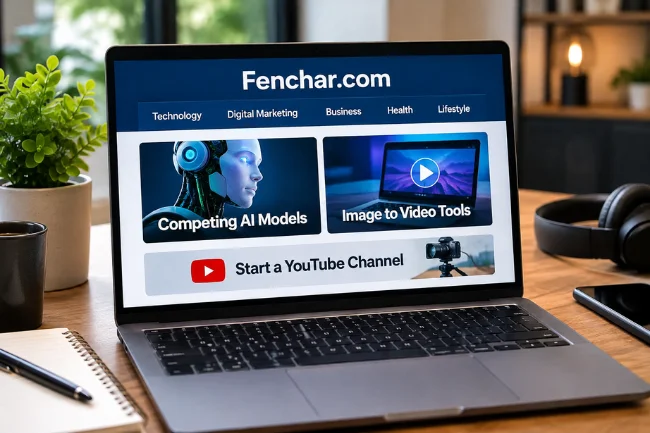
The technology side includes software, digital tools, consumer devices, and emerging trends. A homepage example in November 2026 discussed competing AI models, while another article examined image-to-video tools. Elsewhere, the site includes broader guides on topics such as starting a YouTube channel.
These pieces may be useful starting points, but technical claims can change quickly. I would check product documentation and publication dates before following advice about a platform’s features or eligibility requirements.
Business, Finance, and Professional Life
Business coverage spans entrepreneurship, e-commerce, workplace issues, and industry-specific operations. One published example addresses biofilm control in California industrial water systems. The site also has introductory material on cryptocurrency investing and online business ideas.
This variety is convenient for browsing, although a general-interest site should not be treated as a substitute for a qualified financial, legal, or technical adviser. I would look for supporting evidence whenever an article makes an expensive or high-stakes recommendation.
Health, Beauty, and Everyday Wellness
Health and beauty content ranges from skincare ingredients and fitness-related concerns to nutrition and family routines. A November 5, 2026 article examines fragrance in skincare, including irritation, allergies, and the differences between fragrance-free and unscented products.
That is a more specific example than simply saying the site publishes wellness tips. Still, medical decisions deserve stronger checks than ordinary lifestyle suggestions: named expertise, reputable references, and advice tailored to the reader’s circumstances.
Education, Home Improvement, and Travel
Education articles include online learning and study habits. Home-related posts discuss storage, flooring, maintenance, and energy efficiency. Travel coverage includes luxury resorts, island-hopping itineraries, safari lodges, and destination planning.
What stands out to me is the range, not one narrowly defined editorial specialty. Readers can explore unrelated subjects in the same place. The trade-off is that expertise needs to be judged article by article, not inferred from the website’s broad menu.
Is Fenchar.com Still Publishing New Content?
Yes, the homepage displayed articles dated November 3, November 4, and November 5, 2026 when I checked it on November 6. Recent examples included a beauty article about fragrance in skincare and a travel feature on Caribbean island hopping.
Those dates demonstrate visible publishing activity, but they do not tell us how frequently every category is updated. Nor does a recent date prove an article’s underlying facts were freshly checked. I separate three questions when assessing a publication: Is it posting? Is it updating older advice? And can readers see what changed?
For time-sensitive subjects, the second and third questions matter most. An older home-storage tip may remain useful for years; a software comparison or financial claim may not.
Who Writes the Articles, and Can You Trust Them?
Posts display different bylines, including individual names, team labels, and the generic name “admin.” That tells readers who an article is attributed to, but a byline alone does not establish relevant qualifications or independent editorial review.
Fenchar.com’s About Us page says its team aims to publish well-researched, informative work. Its guest-post page says submissions undergo editorial review for quality, relevance, originality, and usefulness. Those are stated policies, not an audit of how consistently the policies are enforced.
When I evaluate an unfamiliar article, I look for named expertise, links to original evidence, an understandable explanation of the claim, and a clear date. I also ask whether the author is selling something connected to the advice. These checks are more reliable than assuming a polished page must be correct.
A site can publish both excellent and weak articles. I would judge Fenchar.com on the quality of the particular post I am reading rather than assigning one blanket credibility rating to every category.
How to Submit a Guest Post to Fenchar.com
The public contributor guidelines welcome articles about business, startups, technology, software, SEO, wellness, education, home improvement, finance, and industry trends. Writers, industry professionals, and businesses are invited to pitch ideas.
The stated requirements are straightforward:
- Submit original content that offers practical value.
- Aim for at least 800 words; the site calls this a recommended minimum.
- Use clear headings and readable paragraphs.
- Avoid excessive promotion.
- Follow the publisher’s ethical content standards.
To approach the editorial team, I would first review recent articles in the relevant category. That helps avoid proposing a topic already covered or sending a pitch that does not match its audience.
Next, I would prepare a focused subject line, a two- or three-sentence explanation of the proposed article, its intended audience, and a short note on my relevant experience. The official instructions request your name, topic or draft, website or company details when relevant, and any publication requirements.
The submission address is guestpost@technicalinterest.com. Notice that this email uses a different domain from the publication. It is nevertheless the address published on Fenchar.com’s own About Us and Write For Us pages. I would still confirm the terms in writing before sharing sensitive information or making a payment.
The guidelines say the editors may edit, approve, or decline submissions. They do not publicly establish a guaranteed acceptance rate or turnaround time. A thoughtful pitch is a better starting point than assuming publication is automatic.
Is Guest Posting Free, and Are Backlinks Included?
This is where I would slow down. The public guidelines do not specify a standard guest-post price, whether every accepted piece includes an author link, whether links are followed, or how long a post stays live. Those details should not be guessed from the fact that a website accepts contributions.
Before agreeing to a placement, ask whether there is a fee, what editorial changes are permitted, how links are handled, and whether the article will be labeled as sponsored. Also ask whether you may review the final version before publication.
Guest posting can be useful for sharing expertise and reaching interested readers. It is not a guaranteed ranking shortcut. Google Search Central advises qualifying paid placements with rel="sponsored" or rel="nofollow"; its spam policies also warn against buying links primarily to manipulate search rankings.
For me, a credible publishing opportunity starts with audience fit and editorial standards. An impressive-looking metric is not enough if the people reading the article are unlikely to care about the topic.
What Can You Verify, and What Remains Unclear?
A useful review should distinguish direct observations from unanswered questions. Here is my snapshot of the public information available in November 2026.
| Publicly visible or stated | Not established by the pages reviewed |
|---|---|
| Articles across several categories | Independently verified audience size |
| Recent publication dates | An exact publishing schedule |
| Guest-post guidelines and contact email | Standard fees or guaranteed publication |
| Editorial-review policy | Independent evidence of review outcomes |
| About Us and Privacy Policy pages | Clearly documented legal ownership |
One detail deserves special care: the footer displays a “Foxiz News Network” and “Ruby Design Company” copyright line, and some homepage links point to a Foxiz theme-demo domain. Those look like leftover website-template elements; they are not reliable evidence that those names own Fenchar.com. Likewise, a copyright year is not proof of the domain’s launch date.
I also noticed that the named contact address belongs to a different domain. That is a legitimate question to raise with the publisher, but the mismatch by itself does not prove wrongdoing. Transparency is about asking for evidence, not turning unanswered questions into accusations.
Privacy, Account Access, and Basic Safety
Fenchar.com publishes a Privacy Policy explaining that it may collect information supplied through inquiries, along with technical data such as IP addresses, device details, browser information, and site-usage data. It also discusses cookies, potential third-party services, and requests to access, update, or remove personal information.
For casual reading, I would keep the usual precautions: avoid unnecessary sign-ups, use a unique password if an account is needed, and examine any external link before sharing personal information. A privacy policy describes the operator’s stated practices; it is not a security certification or proof that every third-party page is safe.
The website is not inherently suspicious just because it runs WordPress or accepts guest posts. Equally, a functioning website does not establish that every advertised service or outside offer is trustworthy. If a contributor arrangement involves payment, request written terms and verify who will receive the money.
Who Will Find Fenchar.com Useful?

For a casual reader, its advantage is convenience. One site offers a mix of practical articles, from home care to digital tools. For a writer, the most relevant feature is the openly published guest-contribution policy.
For researchers or marketers, I see a more limited use: the site can help discover topics, examples, and possible publishing opportunities, but important claims still need independent sources. I would not rely on its article count, visible dates, or design alone to judge backlink value or editorial authority.
The best way to use it is to begin with the specific article or opportunity that brought you there. Read closely, check primary sources, and decide whether the information solves your actual problem. Browsing more pages is helpful only when those pages add evidence, not simply more words.
Final Thoughts
Fenchar.com is a broad online publication with publicly accessible articles and a formal channel for guest-post pitches. Its active homepage and clearly stated submission requirements make it easy to understand the basics. Questions about ownership, pricing, link policies, and editorial verification deserve more direct evidence.
My advice is practical: explore a few articles in the category you care about, verify important claims, and contact the publisher for written terms before pursuing a collaboration. You will make a better decision from documented details than from either blanket praise or blanket suspicion.
Frequently Asked Questions
What is Fenchar.com?
It is an English-language digital publication offering articles on technology, business, health, education, lifestyle, and other subjects.
Is Fenchar.com a legitimate website?
It is an accessible publishing website with public policies and recent posts, but its visible pages do not independently establish every detail about ownership or reliability.
Can I publish a guest post on Fenchar.com?
Yes. Its Write For Us page accepts proposals and lists originality, usefulness, formatting, and a recommended 800-word minimum among its guidelines.
Does Fenchar.com charge for guest posts?
Its publicly available contributor guidelines do not state a standard fee. Ask the editorial contact to confirm pricing and terms before proceeding.
Do I need an account to read Fenchar.com articles?
Public articles are accessible without signing in. The site has a login link, but the benefits of an ordinary reader account are not clearly explained.

Midori Michael is an independent digital content research writer with 8+ years of experience creating well-researched articles on digital marketing, business, technology, and lifestyle topics. She focuses on simplifying complex information through accurate research and clear editorial writing.