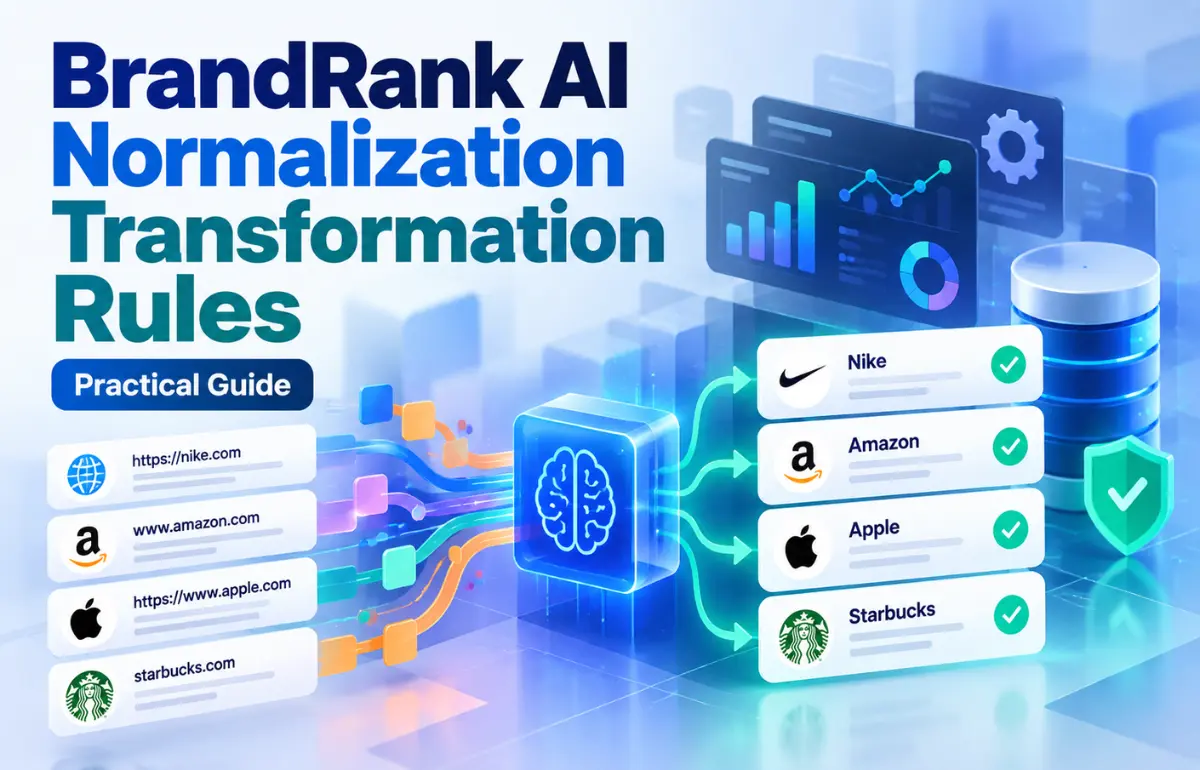
BrandRank.ai normalization transformation rules can be understood as practices for standardizing brand information and converting unstructured AI answers into consistent, measurable records. Normalization links verified variations of a name, URL, or product to one approved identity. Transformation turns raw information into fields such as brand mentioned, source cited, and recommendation made. I use the phrase here as a practical educational framework, rather than a verified name for BrandRank.ai’s internal technology.
When I checked BrandRank.ai’s official product pages and FAQ for this article, I found descriptions of prompt testing, citation analysis, and brand monitoring. I did not find a public technical specification using this exact phrase. That distinction matters if you want reliable information instead of assumptions about a proprietary system.
Below, I explain how to apply these principles to your own brand data, where mistakes happen, and how to measure the results without overstating what cleaner records can achieve.
What BrandRank.ai Publicly Says It Does
BrandRank.ai describes a service that tests priority prompts across AI platforms, captures answers, examines cited sources, and identifies gaps in brand visibility and content. Its FAQ discusses visibility, vulnerability, and content readiness. Its homepage also emphasizes Recommendation Share, distinguishing an appearance in an answer from an actual recommendation.
Those public descriptions explain the measurement problem. They do not reveal every matching rule, weighting formula, or processing decision behind the platform.
My approach is to separate documented product claims from recommendations you can implement independently. The rules below belong to that second category. They are useful for an internal audit or reporting workflow, whether you use BrandRank.ai, another monitoring service, or a spreadsheet.
Normalization and Transformation Solve Different Problems
Suppose an answer mentions “Cedar Lantern,” while a directory lists “Cedar Lantern Lighting Ltd.” Normalization asks whether those names represent the same business. Transformation asks what useful information can be extracted from the answer.
I would verify the identity first. A shared word or similar spelling is not enough to establish a match.
| Process | Main question | Example output |
|---|---|---|
| Normalization | Which approved representation should I use? | A verified alias maps to Cedar Lantern |
| Entity resolution | Do these records describe the same entity? | Matching website and registration details support a link |
| Transformation | Which fields can I extract? | Mention: yes; recommendation: no |
| Validation | Was the decision correct? | Reviewer confirms the match and supporting evidence |
Database normalization and numerical scaling are different subjects. Organizing relational tables or scaling numbers between zero and one does not resolve an ambiguous brand name.
For this topic, I keep the focus on identity, evidence, and measurement. That is where a marketing team can make practical improvements.
Why Consistent Brand Data Matters
Inconsistent records can distort your own reporting before an AI platform ever sees them. If three spelling variations become three separate brands in a dashboard, your mention totals and competitor comparisons may be wrong.
The opposite error is just as damaging. Combining two unrelated businesses can inflate visibility and attach someone else’s complaints to your company.
Cleaner public information also gives customers and information systems a clearer account of who you are. However, I would not promise that standardizing a name automatically produces higher rankings or more AI citations.
Accuracy is a result you can verify directly. Improved discoverability is an outcome you need to measure separately.
Build a Canonical Brand Record First
Before writing transformation rules, I recommend creating one reference record that your team approves. Give the brand a stable internal identifier so the record survives a name change.
Include the display name, legal name, official website, verified profiles, product relationships, operating markets, and known aliases. Add a source and verification date for each fact.
A legal name and a trading name may both be correct. Store their relationship instead of deleting one to make everything look uniform.
Historical information needs similar care. If a company rebrands, record when each name applied. Otherwise, a report about last year may incorrectly present the current name as the wording originally used.
I would also assign an owner. Someone must decide whether a new alias is legitimate, whether a subsidiary deserves its own record, and when outdated information should be corrected.
Practical BrandRank.ai Normalization Transformation Rules
Match Brand Names Using Evidence
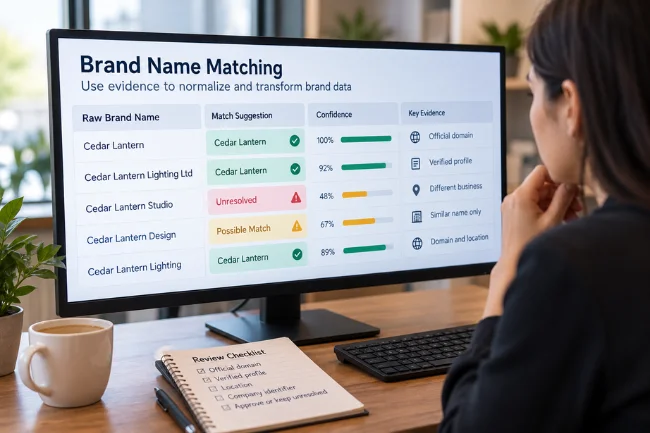
Start with approved aliases. For a new variation, compare supporting details such as the official domain, verified profile, location, or company identifier.
Use fuzzy matching to suggest candidates for review. Avoid letting a similarity score make every final decision automatically.
“Cedar Lantern Studio” should not become “Cedar Lantern” just because most of the words match. It could be an unrelated design business. I prefer leaving a record unresolved to creating a confident but false association.
Clean URLs Without Losing Their Meaning
Keep the original URL alongside the version used for comparison. Standardize only the parts whose meaning you understand.
For example, a campaign tracking parameter may be removable from a reporting copy. A parameter identifying a product variant may be essential.
Verify redirects before treating HTTP and HTTPS, or www and non-www addresses, as equivalent. Preserve meaningful paths and query values. A homepage citation and a product-page citation should remain distinguishable when analyzing which content supports an answer.
Separate Companies From Products
A company mention is not necessarily a mention of every product it sells. Give products their own identifiers and connect them to the relevant company.
For lighting products, names alone may hide differences in wattage, fitting, model, or market. Use verified model numbers or other dependable product identifiers when available.
I would also preserve parent-company and subsidiary relationships. You can combine their results in a clearly labeled group report without pretending they are interchangeable entities.
Preserve Location, Language, and Date Context
Store a location as structured information: locality, region, country, and relevant address details. Similar city names can exist in different countries.
Dates require a known locale. “04/05/2026” could mean April 5 or May 4. Converting it to a standard format does not resolve the ambiguity unless you know the source convention.
For multilingual brands, keep the original script and verified translated or transliterated names. Do not assume every Romanized spelling identifies the same organization.
Use Controlled Categories With Clear Definitions
Choose categories that match your reporting needs, then document what belongs in each one. “Lighting retailer” and “lighting manufacturer” describe different business roles.
Allow multiple categories when the business genuinely fits them. Forcing every record into one label can remove useful context.
I would keep the original category, the approved category, and the mapping reason. That makes future changes easier to explain and reverse.
Turn AI Answers Into Records You Can Audit
For each captured answer, preserve the full response and collection context. Useful fields include prompt, platform, available model information, timestamp, language, market, and whether browsing was enabled.
Then extract separate fields for brand identity, mention status, citation status, recommendation status, claim text, sentiment, and uncertainty.
A mention means the answer names the brand. A citation means it supplies an attributable source. A recommendation means it proposes the brand as a choice. These signals may overlap, but they should not share one checkbox.
I also recommend distinguishing a source owned by the brand from an independent source. Otherwise, a report can blur self-published claims and external corroboration.
Sentiment should attach to the relevant statement. An answer may praise a product’s durability while criticizing its price. Reducing that to one positive label hides information a reader needs.
A Worked Example With an Ambiguous Match
Consider a fictional lighting company called Cedar Lantern. Its approved alias list includes its verified legal name, Cedar Lantern Lighting Ltd.
Imagine an AI answer says: “Cedar Lantern Lighting Ltd. offers rechargeable desk lamps. Cedar Lantern Studio handles interior design.” It links to the lighting company’s product page but does not recommend either business.
My proposed processing decisions would look like this:
| Raw item | Processing decision | Record retained |
|---|---|---|
| Cedar Lantern Lighting Ltd. | Match through the approved alias list | Cedar Lantern; original wording preserved |
| Cedar Lantern Studio | Do not merge without identity evidence | Separate or unresolved entity |
| Linked lamp page | Associate the source with the relevant claim | Citation recorded with its destination |
| Rechargeable desk lamps | Extract the product claim | Claim awaiting factual verification |
| Neutral description | No explicit endorsement detected | Mention: yes; recommendation: no |
The result is a mention and a citation associated with Cedar Lantern, rather than a recommendation. The second business remains separate.
This example also shows why extraction and verification need different fields. Recording what an answer says does not establish that the statement is true. Someone still needs to compare the rechargeable-lamp claim with current product information.
Apply the Rules Without Destroying Your Evidence
I recommend beginning with a manageable sample containing both easy matches and difficult cases. Include misspellings, unrelated names, old brands, missing URLs, and multilingual records.
Have a reviewer label the correct decisions before running your proposed rules. That labeled sample becomes a reference for assessing accuracy.
Keep three layers: the original evidence, the processed record, and the decision history. Record the rule version, reviewer where applicable, and reason for each disputed match.
Rules should also behave consistently when rerun. If processing a clean record again changes its identity or counts it twice, the workflow needs attention.
A spreadsheet can support a small audit with separate tabs for reference identities, aliases, raw answers, decisions, and results. Larger volumes may justify scripts or dedicated systems, but software does not replace the need for clear definitions.
Review uncertain matches before using them in executive reports. Once a false association enters a dashboard, it can influence several downstream decisions.
Align Public Content and Structured Data
After fixing internal records, compare the approved facts with your homepage, About page, product pages, business listings, and verified profiles. Correct contradictions at their sources where you have authority to do so.
Google’s Organization documentation distinguishes properties including name, alternateName, legalName, url, and sameAs. Those fields can represent legitimate differences instead of forcing every identity detail into one name.
Use relevant structured data that reflects the visible content. Verified profiles belong in identity references; random articles mentioning your business do not automatically become equivalent profiles.
For Google AI Overviews and AI Mode, Google says no special schema markup is required. Existing SEO practices remain relevant, and eligibility does not guarantee inclusion. I would apply that guidance specifically to Google rather than treating it as a rule for every AI assistant.
Measure Data Accuracy Before Visibility Gains
For an identity-matching workflow, precision is the share of accepted matches that are correct. Recall is the share of genuine matches the workflow successfully identifies.
Suppose a review finds that 96 of 100 accepted matches are correct. Precision is 96%. If the sample contains 120 genuine matches overall, those 96 correct matches give 80% recall.
I would also track false merges, unresolved records, citation extraction errors, and the time required to review exceptions. These measurements show whether the rules are improving the dataset.
For AI visibility, define the denominator. If your brand appears in 12 of 40 valid responses, its observed mention rate is 30% for that specific sample. It is not a universal visibility score.
Compare equivalent prompt sets, platforms, markets, and collection conditions across repeated runs. Log failures separately. A failed request should not automatically count as an answer that omitted your brand.
Finally, separate processing changes from market changes. If adding an alias increases counted mentions in old responses, your measurement improved; the brand did not suddenly gain new exposure.
Common Mistakes I Would Avoid
The most tempting mistake is over-cleaning. Removing qualifiers, dates, locations, or model details can make records tidy while making them less accurate.
Another is treating every absent field as false. A missing citation may reflect an extraction failure or incomplete capture. Use an unknown status when the evidence is insufficient.
I would also avoid presenting suggested rules as BrandRank.ai’s proprietary implementation, inventing performance guarantees, or using a small test to claim broad commercial impact.
A useful report explains what was measured, what remains uncertain, and which decisions require review. That is more valuable than a polished score nobody can reproduce.
Start With One Brand and One Measurable Goal

BrandRank.ai normalization transformation rules are most useful as a clearly defined framework for identity matching, answer processing, and evidence preservation. Their value comes from decisions you can inspect and results you can test.
My recommended next move is simple: build one approved brand record, review a small answer sample, and measure false matches before expanding. Once the data is dependable, use it to identify public information gaps and track visibility changes with greater confidence.
Frequently Asked Questions
What are BrandRank.ai normalization transformation rules?
The phrase can describe practices for standardizing brand identities and converting AI answers into measurable records. This article uses it as an educational framework.
Has BrandRank.ai officially published these rules?
I did not find a public specification under this exact name in the official pages reviewed. That does not establish whether private documentation exists.
What is the difference between normalization and transformation?
Normalization standardizes verified representations. Transformation converts information into a different structure, such as extracting mention and citation fields from an answer.
Can normalization improve SEO and AI visibility?
It can improve data accuracy and consistency, but higher rankings or more AI citations require separate evidence and are not guaranteed.
Can a small business manage normalization in a spreadsheet?
Yes. A spreadsheet can hold approved identities, aliases, original evidence, and review decisions for a manageable dataset.

Midori Michael is an independent digital content research writer with 8+ years of experience creating well-researched articles on digital marketing, business, technology, and lifestyle topics. She focuses on simplifying complex information through accurate research and clear editorial writing.