RCOR is a business IT support and managed services provider serving Raleigh, Durham, and surrounding communities in North Carolina. Its advertised services include managed IT, cybersecurity, cloud management, data backup, and Microsoft 365 support. In simple terms, RCOR helps businesses maintain their technology and get assistance when systems, devices, or accounts need attention. It is a service company, rather than a single software product.
I reviewed RCOR’s official website to understand its offering and the practical questions a business owner should ask before hiring it. My focus is straightforward: what does the company handle, where might it fit, and what evidence would help you judge a proposal?
Those questions matter because an IT relationship affects everyday work, from opening client files to recovering after an outage.
What Is RCOR’s Background?
According to its About page, RCOR has served businesses across Raleigh and Durham since 1992. The company describes its focus as providing network support and IT consulting for organizations with small-business budgets.
That history gives useful context, but I would assess the current service arrangement separately. A long operating history cannot tell you which engineer will handle your account, how quickly urgent tickets receive attention, or what your monthly agreement includes.
What caught my attention during the research was the breadth of the offering. RCOR presents ongoing support alongside security, cloud services, and productivity tools. For a buyer, that creates an opportunity to coordinate related tasks through one provider, provided the contract makes ownership clear.
Where Does RCOR Provide IT Support?
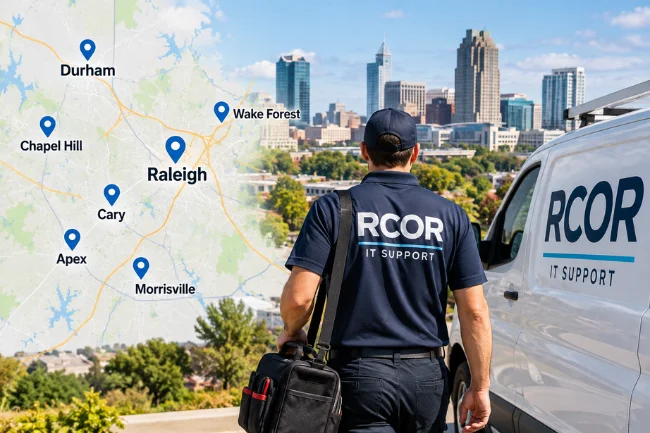
RCOR’s homepage identifies Raleigh and Durham as its core markets and also names Chapel Hill, Wake Forest, Cary, Apex, and Morrisville among its service areas.
A local presence can be useful when the problem involves physical equipment. Remote troubleshooting may help with an account issue, while a damaged network device or office wiring problem may require someone on site.
I would ask about coverage for your actual address, including satellite offices and employees working elsewhere. Confirm whether travel, on-site visits, and urgent dispatch are included in the proposed plan.
Location should be considered alongside staffing and scheduling. Ask who can attend your office, during which hours, and how the provider handles simultaneous emergencies.
What Services Does RCOR Offer?
Managed IT Services and Help Desk Support
RCOR’s managed IT page describes help desk support, monitoring, patching, network management, cybersecurity practices, and long-term planning. These are advertised capabilities; the signed agreement should identify the services purchased by your business.
I would organize a support discussion around the work your team actually does. Can employees open essential applications? Can new starters access the right files? Who handles problems involving both your network and a software vendor?
Ask how recurring issues are investigated. If the same connection fails every week, a useful service review should explain the suspected cause, the proposed fix, and the person responsible for following through.
Cybersecurity and Network Protection
RCOR advertises network security services including firewall management, intrusion detection and prevention, traffic monitoring, secure remote access, and access controls.
Those categories deserve specific questions. Which devices are covered? Who reviews alerts? What happens when suspicious activity is detected outside normal office hours? Which actions require your approval?
I would also ask how administrator accounts are protected. CISA recommends multifactor authentication for remote and privileged access and encourages businesses to use phishing-resistant methods where possible. That gives you a concrete topic to raise during a security assessment.
Cloud Management and Migration
RCOR’s managed cloud offering includes architecture, deployment, infrastructure monitoring, cost optimization, backup, and security. Its website also lists support for AWS, Azure, private cloud, and hybrid environments.
Before discussing migration, I would identify the problem you want to solve. Perhaps remote employees struggle with file access, a server needs replacement, or cloud spending has become difficult to explain.
A useful proposal should connect the suggested environment to that problem. Ask what changes for users, which applications need testing, how monthly costs will be monitored, and how the business can recover if the migration encounters trouble.
Backup and Disaster Recovery
RCOR lists backup and disaster recovery as a service. When evaluating that offering, I would ask for the exact systems covered and a description of how restoration is tested.
CISA’s ransomware guidance recommends offline, encrypted backups of critical data and regular testing of their availability and integrity. It also explains that accessible backups can be targeted by ransomware.
For a buyer, the practical question is whether a recovery exercise restores usable work. Ask to see a test report showing what was restored, how long it took, what failed, and what needs improvement.
Microsoft 365 and Collaboration Support
RCOR advertises Microsoft 365 administration, security configuration, and licensing support. Its Microsoft Teams services include deployment, integration, access setup, training, and ongoing administration.
I would examine everyday account management here. Who approves a new user? Who checks permissions when someone changes roles? Who removes access when an employee leaves?
Those questions turn a broad productivity-service description into an operating process. Ask the provider to show how requests are authorized, recorded, completed, and checked afterward.
RCOR’s Managed Services Compared With Other IT Arrangements
To decide whether RCOR’s offering fits, I would compare the proposed arrangement with the alternatives available to your business. The table below describes general operating models, rather than verified terms of an RCOR contract.
| Consideration | Managed IT provider | Break-fix support | Internal IT employee or team |
|---|---|---|---|
| Main arrangement | Ongoing services under an agreement | Assistance purchased for individual problems | Employees manage assigned technology responsibilities |
| Spending structure | Recurring fee plus agreed extras | Charges for particular jobs | Salaries, tools, training, and other employment costs |
| Routine maintenance | Included where specified | Must be arranged separately | Depends on workload and assigned duties |
| Business knowledge | Develops through onboarding and reviews | Depends on continuity between jobs | Builds through daily involvement |
| Coverage | Defined by provider staffing and contract | Depends on availability | Depends on staffing and backup coverage |
| Fit to explore | Businesses seeking ongoing external support | Businesses with occasional support needs | Businesses needing substantial dedicated expertise |
I would compare responsibility before comparing price. A low quote covering occasional troubleshooting and a broader plan covering maintenance, security, and recovery are different purchases.
If you already employ IT staff, ask RCOR whether it can support a defined portion of their workload. Document the division of duties before assuming that an external provider will automatically complement the existing team.
Which Businesses Might Consider RCOR?
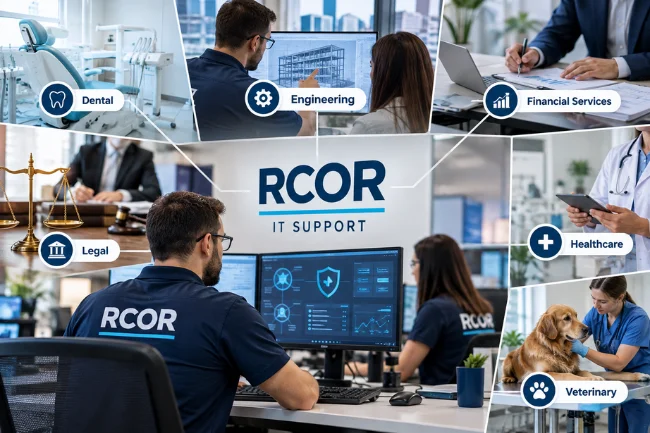
RCOR’s website lists industries including dental, engineering, financial services, legal, healthcare, and veterinary businesses. These listings show the sectors it markets to; they do not establish suitability for every organization within those sectors.
I would look closely at fit if your business has recurring support problems, several connected systems, or an office manager informally coordinating IT between other duties.
The strongest starting point is a list of your essential workflows. For an engineering firm, that might include accessing large project files. For a professional-services office, it might include secure client communications and dependable access during deadlines.
Ask for experience relevant to your applications and working environment. A reference becomes more useful when the organization has comparable systems, office locations, and support expectations.
For regulated businesses, ask which technical controls and evidence the provider will manage. Keep responsibility for organizational decisions explicit, and involve the appropriate compliance adviser when defining requirements.
How Much Does RCOR Cost?
I did not find a single public price that could reliably represent every RCOR engagement. Its managed cloud FAQ states that pricing depends on environment size and support requirements and directs prospective customers to request a custom quote.
For your own proposal, request a breakdown of recurring services, onboarding, licenses, equipment, project work, and optional charges. Ask how the bill changes when you add staff or open another office.
I would also request a first-year estimate alongside the normal monthly fee. That makes setup costs and planned projects visible before you compare providers.
Here is a hypothetical example, not an RCOR quote. A $2,000 monthly agreement plus $4,000 in onboarding costs $28,000 in the first year before other expenses. A $2,200 monthly agreement with no onboarding charge costs $26,400.
The arithmetic does not establish which proposal offers better value. It shows why the lowest monthly number needs context. Compare the scope and exclusions alongside the total.
How I Would Evaluate an RCOR Proposal
Separate Response Time From Recovery Time
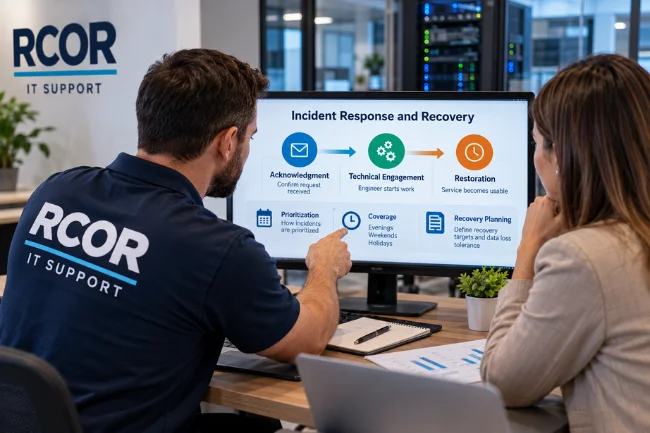
An acknowledgment tells you that someone received a request. It does not establish when an engineer starts work or when the affected service becomes usable.
I would ask the proposal to distinguish acknowledgment, technical engagement, and restoration targets. Also ask how incidents are prioritized and whether those targets apply during evenings, weekends, and holidays.
For recovery planning, specify how soon essential services need to return and how much recent work you could afford to lose. CISA’s joint MSP advisory recommends that customers include backup and recovery requirements in their contracts and clearly define security responsibilities.
Use a business example to make the answers meaningful. If your scheduling system fails at opening time, when should someone begin troubleshooting, and how will staff continue handling appointments?
Ask for Evidence You Can Understand
I would request a sample service report with client details removed. Look for explanations of unresolved issues, completed maintenance, recovery tests, and upcoming decisions.
The report should help you answer what changed and what action is needed. A page full of technical measurements has limited value if nobody explains how those measurements affect your business.
For a security discussion, NIST’s Cybersecurity Framework 2.0 provides six useful areas: Govern, Identify, Protect, Detect, Respond, and Recover. Its small-business guide can serve as a discussion prompt with a technology provider.
I would use those areas to check whether a proposal addresses ownership and incident handling as well as security tools.
Confirm Ownership and Exit Arrangements
Ask who owns your domains, cloud accounts, subscriptions, documentation, and backups. Confirm how authorized business representatives can obtain access when needed.
I would also read the cancellation and transition provisions before signing. Ask which records will be handed over, in what format, within which timeframe, and at what cost.
These questions are useful even when you expect a long relationship. They establish how the business retains control of essential information throughout the engagement.
A Responsibility Table I Would Bring to the Meeting
My reading of RCOR’s service pages left me with one practical question: how do the advertised services connect when a problem crosses several systems?
I would bring the following table to a proposal meeting and fill it in with the provider. It is my suggested evaluation tool, not RCOR’s published operating process.
| Situation | Responsibility to confirm | Evidence to request |
|---|---|---|
| An employee leaves | Who authorizes and removes access across covered systems? | Completed offboarding record |
| A suspicious login appears | Who investigates, contains the issue, and contacts your team? | Escalation procedure and sample incident record |
| An essential application fails | Who coordinates with the software vendor and updates staff? | Named contact and communication procedure |
| A restore is needed | Who performs restoration and verifies usable results? | Recovery-test report and agreed objectives |
| The agreement ends | Who transfers accounts, records, and recovery information? | Written handover terms |
I find this more useful than asking whether everything is “fully managed.” Each row requires an owner, a defined action, and evidence that the process exists.
Add one scenario specific to your business. Ask the provider to explain how it would handle that situation from the first report through verification that work can resume.
What Should the First 90 Days Establish?
If I were commissioning an engagement, I would agree on initial deliverables before work begins. These would be proposed expectations to negotiate with RCOR.
During the first month, I would want an inventory of covered systems, confirmation of authorized access, support instructions for employees, and a list of urgent findings.
During the second month, I would ask for progress on agreed priorities and evidence of a recovery test. Any discovered limitations should lead to a decision about budget, timing, or scope.
By the third month, I would want a review showing completed work, unresolved risks, recurring issues, and recommended next actions. Assign each open item an owner and a target date.
Keep the review grounded in business experience. Ask staff whether they know how to request help, whether updates are clear, and whether repeat problems are receiving follow-through.
Choosing Your Next Move
RCOR’s published offering covers several connected business technology needs, making it worth evaluating for organizations seeking IT support in the Raleigh–Durham area. My research gives a starting point for that evaluation; the proposal and supporting evidence should determine fit.
Before arranging a consultation, write down your five most disruptive technology problems and the systems you rely on each day. Bring that list, request an itemized scope, and use the responsibility table to make the conversation concrete.
Frequently Asked Questions
What is RCOR?
RCOR is an IT support and managed services provider serving businesses in Raleigh, Durham, and surrounding North Carolina communities.
Where does RCOR provide services?
Its advertised service areas include Raleigh, Durham, Chapel Hill, Cary, Apex, Morrisville, and Wake Forest. Confirm coverage for your address.
Does RCOR support small businesses?
Yes. RCOR’s About page describes network support and IT consulting designed for organizations with small-business budgets.
Does RCOR offer cybersecurity and cloud services?
Yes. Its published offerings include network security and managed cloud services, with AWS, Azure, private cloud, and hybrid support.
How much do RCOR services cost?
Request a quote for your requirements. RCOR states that managed cloud pricing depends on environment size and support needs.

Noah Sterling is a technology research writer with 8+ years of experience covering emerging technologies, software trends, digital tools, and innovation. He creates practical, research-based articles to help readers understand the evolving technology landscape.