PET heat shrink tubing insulation for robotic instruments is a thin, heat-recoverable polyester sleeve used to electrically insulate, mechanically protect, reinforce, and organize components inside or around robotic surgical instruments. PET, or polyethylene terephthalate, can be manufactured with extremely thin walls, allowing designers to add insulation without significantly increasing the diameter of a shaft, wire bundle, sensor assembly, or distal component.
That combination matters in robotic surgery, where engineers often need electrical isolation and abrasion protection inside instruments with very little available space. PET tubing can shrink tightly around metal shafts, conductors, coils, sensors, and other components while preserving a low-profile design.
Its value, however, depends on choosing the right dimensions, recovery temperature, shrink ratio, sterilization compatibility, and final-device validation. PET is useful, but it is not automatically the best heat shrink material for every robotic instrument.
Why PET Heat Shrink Tubing Fits Robotic Instrument Design
Robotic surgical instruments place unusual demands on materials.
A conventional cable may simply need electrical insulation. A robotic surgical instrument may need insulation that is thin enough to fit inside a narrow shaft, strong enough to tolerate articulation, resistant to cleaning or sterilization, and dimensionally predictable enough not to interfere with moving parts.
This is where PET becomes interesting.
Current medical PET heat shrink products are available in very small diameters and ultra-thin walls. For example, one supplier publishes wall thicknesses down to approximately 0.00015 inch, while other commercial ranges vary by diameter and construction. Published shrink ratios commonly include roughly 1.15:1, 1.5:1, and 2:1, although specialized products may differ.
When I compared current supplier specifications while researching this topic, one point stood out: there is no single universal “PET shrink temperature” or dimensional range.
Published recovery ranges vary considerably between product families. That means I would never select tubing for a robotic instrument from generic PET properties alone. The actual supplier datasheet, lot controls, processing window, and intended assembly have to drive the decision.
Where PET Insulation Can Be Used in a Robotic Instrument
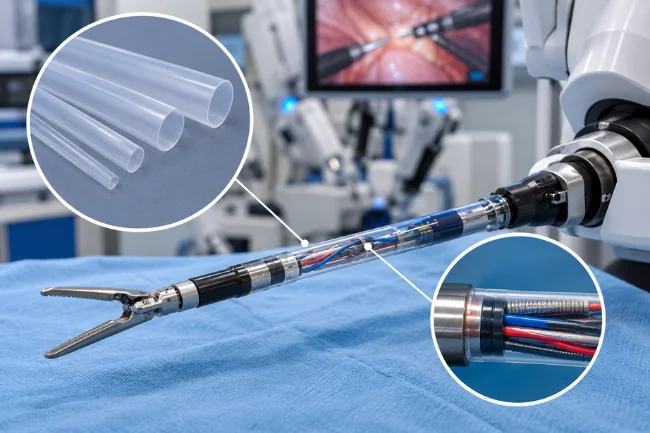
A robotic surgical tool is not one uniform insulation problem. I find it more useful to divide the instrument into functional zones.
Shaft and Conductor Insulation
PET heat shrink can cover conductive shafts, internal wires, small cable bundles, springs, or other electrically active components.
For electrosurgical tools, insulation integrity deserves particular attention because unintended electrical pathways can create safety risks. Published literature has documented insulation-related failures in robotic surgical accessories, while robotic electrosurgical designs commonly incorporate insulating components around electrically active structures.
PET’s thin wall can be useful where every fraction of a millimeter added to the outside diameter matters.
Articulation and Transition Zones
The point where a stiff section transitions to a flexible or articulated section can experience concentrated bending and mechanical stress.
A carefully selected heat shrink sleeve can reinforce a transition, retain a wire or coil, smooth a change in diameter, or protect components from abrasion.
The key is not to make the joint too stiff. Adding insulation solves little if it restricts the articulation the robotic mechanism was designed to provide.
Distal Sensors and Electronics
Modern robotic instruments may contain electrical conductors, sensing elements, or other miniature components close to the distal end.
Here, the design challenge becomes more than electrical isolation. The tubing may also need to resist abrasion, maintain a predictable recovered diameter, avoid damaging heat-sensitive components during installation, and remain stable after sterilization.
Braid, Coil, and Cable Terminations
An abrupt end to a reinforcement braid or coil can create a mechanical transition where wires may spread or the underlying tube may kink.
PET tubing is used in medical-device manufacturing for protective covering, braid or coil termination, strain relief, and encapsulation.
For robotic instruments, the same principle can be valuable anywhere small structural elements must remain captured without adding a bulky molded component.
What Makes PET Different From Other Heat Shrink Materials?
PET is not automatically superior to FEP, PTFE, or polyolefin. Each material solves a different engineering problem.
The table below gives a practical comparison. Published values vary between suppliers and sizes, so these figures should be treated as screening information rather than design specifications.
| Property | PET | FEP | PTFE | Polyolefin |
|---|---|---|---|---|
| Wall capability | Extremely thin; some medical products reach about 0.00015 in | Usually thicker than ultra-thin PET ranges | Generally thicker than PET | Thin-wall options available |
| Typical character | Thin, strong, relatively firm | Lubricious, chemically resistant, semi-rigid | Very chemically resistant, high-temperature capable | Flexible; broad shrink capability |
| Shrink ratio | Commonly lower to moderate | Often around 1.3:1–1.6:1 in medical products | Moderate | Can provide much higher ratios |
| Recovery heat | Moderate, product-dependent | Relatively high | High | Often lower than fluoropolymers |
| Surface lubricity | Limited compared with fluoropolymers | Good | Excellent | Generally good |
| Low-profile insulation | Excellent candidate | Possible, depending on wall | Less attractive where minimum wall is critical | Good in suitable constructions |
| Manufacturing aid/reflow | Common | Very common | Application-dependent | Application-dependent |
| Best reason to consider it | Minimum profile with strength | Lubricity and chemical/thermal performance | Extreme thermal/chemical requirements | Flexibility and high shrink ratios |
A Lubrizol medical-device comparison, for example, lists PET with a minimum wall around 0.00015 inch and shrink ratios around 1.1:1 to 3:1, while polyolefin offers substantially higher possible shrink ratios. Saint-Gobain and TE publish medical FEP products around a 1.6:1 shrink ratio with recovery temperatures around 210–215°C for certain product families.
That leads to an important design rule: choose the material based on the weakest constraint in the assembly, not the most impressive property on a datasheet.
If the biggest constraint is profile, PET may be attractive. If the assembly needs very high lubricity, FEP or PTFE may deserve more attention. If a large diameter transition must be covered, a higher-ratio polyolefin could make more sense.
The Specifications I Would Check Before Selecting PET Tubing
The phrase “medical PET heat shrink” does not provide enough information to release a design.
I would put at least the following parameters on the engineering review list.
| Specification | Why It Matters in a Robotic Instrument |
|---|---|
| Expanded inside diameter | Determines whether tubing can be loaded over the largest component |
| Recovered inside diameter | Determines whether it will grip the finished assembly |
| Wall thickness | Directly affects finished device profile and mechanical behavior |
| Shrink ratio | Determines the diameter range the sleeve can accommodate |
| Recovery temperature/window | Must be compatible with polymers, adhesives, sensors, coatings, and electronics |
| Longitudinal change | Can move the sleeve or expose a component during shrinking |
| Dielectric performance | Critical when PET performs an electrical insulation function |
| Tensile/mechanical performance | Affects resistance to handling and mechanical damage |
| Sterilization compatibility | Must match the device’s validated sterilization method |
| Biocompatibility documentation | Relevant when the material contributes to patient-contacting or indirectly contacting portions |
| Color/clarity | Clear tubing can assist visual inspection; colored material can aid identification |
| Dimensional tolerance | Critical for repeatability in miniature assemblies |
Expanded ID and Recovered ID Need to Be Considered Together
One common mistake is to choose tubing simply because its expanded diameter fits over the component.
It also has to recover sufficiently.
If the recovered ID remains larger than the underlying assembly, the tubing may not provide the intended retention or conformal fit. At the other extreme, choosing tubing that must undergo excessive recovery can change wall distribution and increase process variation.
For precision assemblies, I prefer selecting the smallest expanded diameter that can be loaded reliably over the component while still giving the manufacturing process adequate tolerance.
Wall Thickness Can Change More Than the Outside Diameter
In a miniature robotic instrument, an additional few thousandths of an inch may affect:
- shaft clearance;
- articulation;
- wire routing;
- insertion through another tube;
- friction;
- torque response;
- clearance around bearings or joints.
Wall thickness therefore should not be evaluated only as an insulation property.
It is a system-level mechanical dimension.
Recovery Temperature Is a System Constraint
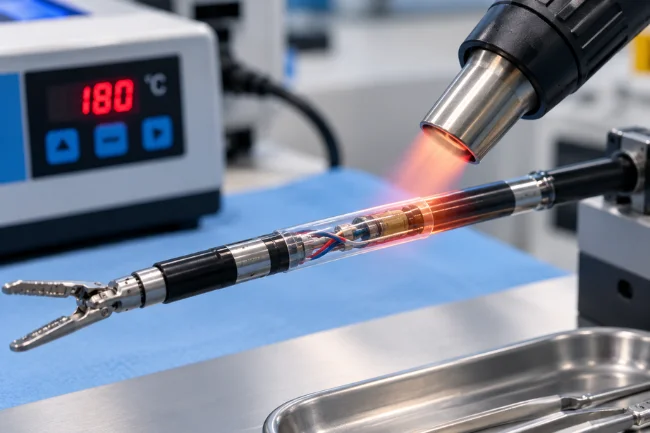
Heat shrink tubing works because the expanded polymer recovers toward a smaller diameter when sufficient heat is applied.
The mistake is assuming that because PET survives the heating process, everything underneath it will too.
A robotic instrument may contain adhesives, polymer liners, fiber optics, sensor packages, solder joints, cable coatings, or temperature-sensitive electronic components.
The allowable process temperature should therefore be determined by the most heat-sensitive part of the assembly.
Supplier values vary. AccuPath, for example, publishes a broad 90–240°C shrink-temperature range for one PET tubing family. Other PET products have different processing recommendations.
Rather than copying a generic temperature into a work instruction, I would establish a validated time-temperature-process window using the actual tubing size and complete assembly.
A metallic shaft can act as a heat sink. A tiny sensor assembly may heat rapidly. Those two parts should not automatically receive identical heating profiles.
Electrical Insulation Requires More Than a Dielectric Number
PET is often described as having good dielectric properties, and suppliers do market it for electrical insulation.
But dielectric strength from a material datasheet is not the same thing as proven insulation performance in the final robotic instrument.
The finished design can introduce:
- scratches;
- pinholes;
- sharp metal edges;
- seams or termination points;
- excessive stretching;
- heat damage;
- flex fatigue;
- fluid exposure;
- damage from cleaning or reuse.
For high-frequency electrosurgical equipment and accessories, IEC 60601-2-2 addresses basic safety and essential performance. As of 2026, the FDA lists Edition 6.1 of IEC 60601-2-2 as a recognized consensus standard.
That is why I would validate insulation after the actual manufacturing process and relevant conditioning rather than assuming the raw tubing’s dielectric specification proves device safety.
PET Heat Shrink and Instrument Miniaturization
Miniaturization is probably PET’s strongest argument in robotic instrument design.
Every layer competes for radial space.
A shaft may need room for actuation cables, electrical wiring, structural reinforcement, irrigation channels, sensors, and other mechanisms. Increasing outside diameter is not always an acceptable solution.
Ultra-thin PET can provide a protective or insulating layer with relatively little profile growth.
That can help engineers preserve internal space while maintaining separation between conductive or mechanically sensitive components.
The tradeoff is that thin insulation leaves less margin for damage. A tiny wall thickness is useful only when the manufacturing process can apply and inspect it consistently.
Sterilization Compatibility Must Match the Finished Device
Medical heat shrink is sometimes marketed as “sterilization compatible,” but that statement needs context.
Commercial PET suppliers publish compatibility with methods such as ethylene oxide, gamma radiation, or electron beam for specific products.
That does not prove that every PET formulation—or the complete robotic instrument—will perform identically after sterilization.
For a single-use device, I would evaluate the tubing after the validated sterilization dose or cycle.
For a reusable robotic instrument, the problem is harder. Repeated processing may expose the material to heat, chemicals, moisture, handling, bending, and inspection cycles. The validation program should reflect the maximum claimed number of reprocessing cycles and the actual cleaning and sterilization method.
What Biocompatibility Claims Really Mean
This is one area where marketing language frequently becomes too loose.
A supplier may provide ISO 10993 test information or USP Class VI data for a material. That documentation can be valuable, but it does not automatically make the finished robotic instrument “ISO 10993 compliant.”
ISO 10993-1:2025 frames biological safety as part of a risk-management process involving the device, its materials, intended use, and exposure.
The FDA similarly explains that it assesses the biocompatibility of the finished device, including applicable processing and sterilization, rather than evaluating raw component materials in isolation.
So when I see “meets ISO 10993” on a tubing datasheet, I treat that as supporting supplier documentation—not as the end of the biological evaluation.
ISO 13485 Does Not Certify the Tubing Itself
Another distinction is worth making.
ISO 13485:2016 is a quality-management-system standard for organizations involved in medical-device design and manufacturing. ISO confirmed the standard again in 2025, so it remains current in 2026.
If a PET tubing manufacturer operates under an ISO 13485-certified quality system, that can be an important supplier-quality signal.
It does not mean a piece of tubing itself has somehow been “ISO 13485 approved.”
For critical robotic components, I would also look at lot traceability, dimensional inspection, change notification, contamination controls, incoming inspection data, certificate availability, and the supplier’s ability to maintain tight tolerances.
Manufacturing PET Heat Shrink Into the Instrument
Applying the tubing consistently can matter as much as choosing it.
The process generally needs control over tubing position, heat distribution, exposure time, fixture design, cooling, and inspection.
Uneven heating can produce poor recovery, wrinkles, local stress, or dimensional inconsistency.
Longitudinal movement is another overlooked factor. If tubing changes length during recovery, a carefully positioned insulation boundary can move away from the location it was intended to protect.
For miniature assemblies, I would document the acceptable final position rather than relying solely on the pre-shrink placement.
Inspect the Finished Sleeve, Not Just the Raw Material
A practical inspection plan can include checks for:
- complete recovery;
- wrinkles or folds;
- splits;
- scorching;
- trapped debris;
- exposed conductive areas;
- movement from the specified location;
- unacceptable changes in OD;
- damage near sharp transitions.
Where the sleeve performs safety-critical electrical insulation, visual inspection alone may not be enough. Electrical testing should reflect the device’s applicable requirements and risk analysis.
When PET May Not Be the Right Choice
PET has genuine advantages, but good engineering also means knowing when not to use it.
I would reconsider PET if the design requires an unusually high shrink ratio, extreme continuous-temperature capability, exceptionally low surface friction, aggressive chemical resistance beyond the selected PET grade, or recovery conditions that conflict with the components underneath it.
A highly articulated location may also need more flexibility than a particular PET construction provides.
The right question is therefore not, “Is PET good?”
It is, “Does this PET tubing remain the best fit after electrical, mechanical, thermal, dimensional, sterilization, and biological requirements are considered together?”
A Better Way to Specify PET Heat Shrink for Robotic Instruments
For an actual project, I would start with the finished instrument requirements and work backward.
Define the maximum allowable OD, voltage or electrical isolation requirement, underlying component diameter, articulation demands, sterilization method, patient-contact category, expected service life, and process-temperature limit.
Then request tubing samples that bracket the target dimensions.
Run them on representative assemblies—not only smooth metal mandrels—and measure the result after recovery, sterilization or conditioning, and relevant mechanical cycling.
That approach catches interactions a datasheet cannot predict.
It also turns PET heat shrink tubing insulation for robotic instruments from a catalog selection into what it really is: a validated part of the complete device design.
FAQs About PET Heat Shrink Tubing Insulation for Robotic Instruments
What is PET heat shrink tubing used for in robotic surgical instruments?
It can provide thin electrical insulation, abrasion protection, component retention, strain relief, and reinforcement around shafts, wires, coils, sensors, and other miniature assemblies.
Is PET heat shrink tubing electrically insulating?
Yes, PET can provide strong dielectric insulation, but final electrical safety must be validated on the completed instrument rather than inferred solely from raw-material data.
How thin can medical PET heat shrink tubing be?
Some current medical suppliers publish PET heat shrink walls around 0.00015 inch, although minimum wall thickness depends on diameter, construction, tolerance, and supplier capability.
Can PET heat shrink tubing be sterilized?
Specific medical PET products are offered for EtO, gamma, and electron-beam sterilization, but compatibility must be confirmed for the selected tubing and validated in the finished device.
Is PET better than FEP heat shrink for robotic instruments?
Neither is universally better. PET is especially attractive for ultra-thin, strong insulation, while FEP can offer greater lubricity, chemical resistance, and different thermal characteristics.
Choosing PET With the Complete Instrument in Mind
PET heat shrink earns its place in robotic instrument design because it can put meaningful electrical and mechanical protection into a remarkably small amount of radial space.
The best results come from treating it as an engineered component rather than a generic sleeve.
I would define the actual dimensional, electrical, thermal, mechanical, biological, and sterilization requirements first; compare PET with realistic alternatives; then validate the selected tubing after the real assembly process.
If you’re specifying PET heat shrink tubing insulation for robotic instruments, the most useful next step is to build a requirements sheet for the exact instrument zone being insulated and request supplier data and samples against those requirements. That gives engineering teams something far more valuable than a list of impressive material properties: evidence that the insulation works in the device where it actually matters.

Noah Sterling is a technology research writer with 8+ years of experience covering emerging technologies, software trends, digital tools, and innovation. He creates practical, research-based articles to help readers understand the evolving technology landscape.