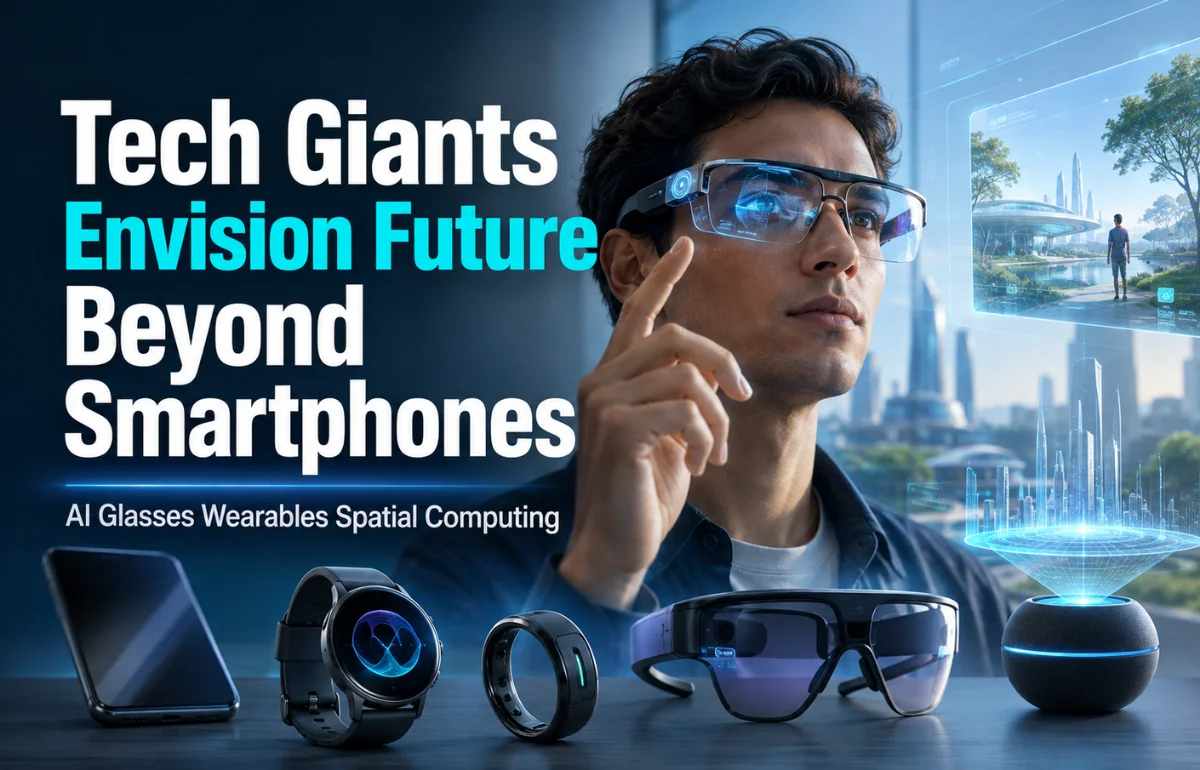
Tech giants envision future beyond smartphones describes the growing effort by companies such as Meta, Google, Apple, OpenAI, Samsung, Qualcomm, and Neuralink to create computing experiences that depend less on handheld screens. Instead of constantly opening apps on a phone, the emerging model uses AI glasses, spatial computing, voice assistants, wearable sensors, contextual AI, and eventually brain-computer interfaces to put digital help closer to the user.
I do not think this means smartphones suddenly disappear. The more realistic shift is gradual: navigation moves to glasses, AI assistance becomes ambient, authentication moves to wearables, and some communication becomes hands-free. The smartphone may first become a background computing hub before another device truly replaces it.
Why Tech Companies Are Looking Beyond Smartphones
The smartphone is still one of the most useful consumer devices ever created. The problem for technology companies is that its basic interaction model has changed relatively little: take out a rectangle, look at a screen, open an app, tap or type, then put it away.
AI is challenging that pattern.
A multimodal AI assistant can listen to speech, understand images, interpret surroundings, remember context, and respond conversationally. That makes cameras, microphones, glasses, earbuds, watches, and other wearables far more useful than they were when they could only display notifications.
When I compare the latest hardware announcements, I see the shift as less about finding one new “phone killer” and more about distributing the phone’s jobs across several devices.
That distinction matters.
The Post-Smartphone Future Is Really a Task Migration
People often ask, “What will replace smartphones?” I think a better question is: “Which smartphone tasks will leave the phone first?”
Some functions are much easier to move than others.
| Smartphone task | Likely alternative | Replacement potential |
|---|---|---|
| Navigation | AI or AR glasses | High |
| Quick AI questions | Glasses, earbuds, wearables | High |
| Photos and first-person video | Smart glasses | High |
| Calls and messages | Glasses, earbuds, watches | Medium to high |
| Authentication | Watches, rings, biometrics | High |
| Payments | Watches, rings, glasses | Medium |
| Video entertainment | XR headsets | Medium |
| Productivity | Spatial displays and AI devices | Medium |
| Social feeds | Phones or lightweight displays | Medium |
| Complex typing | Physical keyboards or other displays | Low in the near term |
This is why I expect the post-smartphone era to arrive unevenly. A pair of glasses might replace the phone for directions and quick messages while being terrible for writing a long document or browsing a detailed spreadsheet.
The winning device does not have to replace every smartphone function at once.
Smart Glasses Are Becoming the Strongest Near-Term Candidate
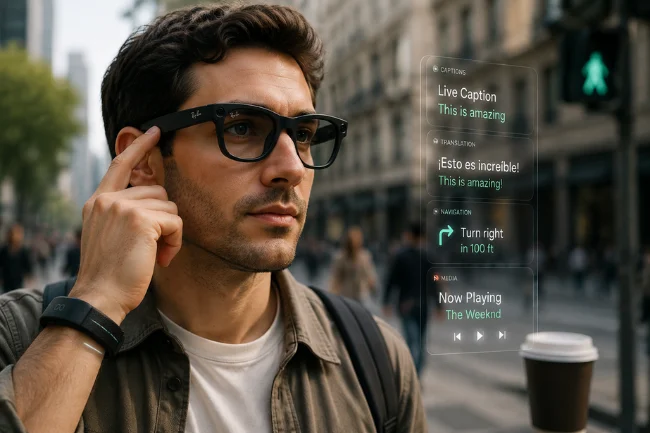
Among the technologies being developed today, smart glasses have one major advantage: people already understand how to wear glasses.
Meta has pushed this category further than simple camera eyewear. Its Meta Ray-Ban Display combines a visual display with the Meta Neural Band, allowing users to see information such as captions, translations, navigation, and media controls without continually looking at a phone. Meta also distinguishes between camera AI glasses, display AI glasses, and fuller augmented-reality glasses such as its Orion prototype.
That progression is significant.
The first generation of smart glasses mainly captured photos and played audio. The next generation can become a visual interface for AI.
Google is moving in a similar direction through Android XR. At Google I/O 2026, the company described two categories of intelligent eyewear: audio glasses and display glasses. Google says its first audio eyewear, created with Samsung and eyewear brands including Gentle Monster and Warby Parker, is scheduled for fall 2026. The glasses are designed to handle functions such as directions, messaging, photography, and Gemini assistance without requiring users to take out their phones.
The phrase “without taking out your phone” may be more important than “without owning a phone.”
That is the transition I expect first.
Spatial Computing Could Replace Screens Before It Replaces Phones
Apple is approaching the same problem from another direction.
Apple Vision Pro is not an everyday smartphone replacement. It is a spatial computing device designed to place applications and media around the user instead of containing them inside one physical display.
The current Vision Pro uses Apple’s M5 and R1 chips and allows people to navigate with their eyes, hands, and voice. Apple positions it for entertainment, communication, productivity, and spatial experiences.
Its form factor makes all-day use very different from wearing ordinary glasses, but its interface reveals something important about the future beyond smartphones.
Apps no longer need to live inside a six-inch rectangle.
A browser window could appear on a wall. Navigation could appear in a person’s field of view. A virtual monitor could follow a worker between locations.
In that sense, spatial computing is not simply a new gadget category. It is a test of what computing looks like when the screen is no longer the center of the experience.
Google and Samsung Are Building an Ecosystem, Not Just a Device
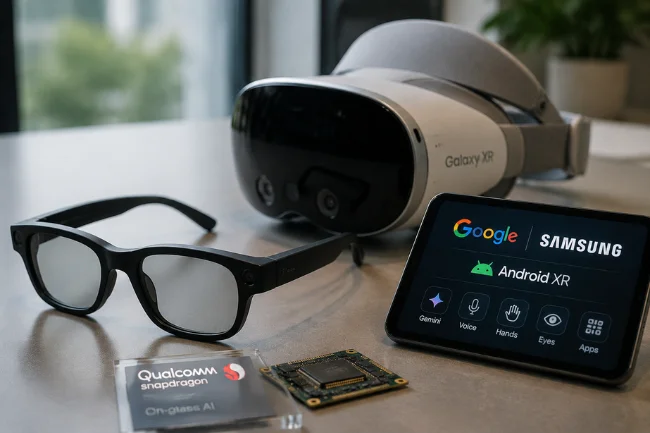
A post-smartphone platform also needs software, applications, hardware partners, developers, and AI.
That is why Android XR deserves more attention than individual headset launches.
Samsung’s Galaxy XR became the first device built around Android XR. Google describes the platform as supporting next-generation headsets and glasses, with Gemini able to understand what the user is seeing and doing. Galaxy XR already supports interaction through voice, hands, and eyes, as well as Android applications and XR-specific experiences.
This gives Google and Samsung a strategic advantage: developers do not necessarily have to begin with an empty ecosystem.
Qualcomm is also important behind the scenes. Its work on Snapdragon platforms shows another possible path: AI models increasingly running directly on glasses rather than sending every request to a smartphone or cloud server. Qualcomm demonstrated on-glass generative AI in 2025 and has continued expanding its smart-glasses ecosystem.
That could reduce latency, improve privacy in some scenarios, and make glasses less dependent on another device.
OpenAI’s Hardware Push Could Change What an AI Device Looks Like
The most interesting company in this discussion may be OpenAI because it is not starting from an established phone or eyewear business.
In 2025, OpenAI announced that io Products—the hardware company founded by Jony Ive with Scott Cannon, Evans Hankey, and Tang Tan—would merge with OpenAI. OpenAI said the team would work closely with its research, engineering, and product groups, while Ive and LoveFrom took on design and creative responsibilities.
The announcement did not define the eventual product as a smartphone replacement.
That uncertainty is precisely what makes it relevant.
AI may allow companies to design devices around intent rather than apps. Instead of unlocking a phone, finding an application, and navigating menus, a person could simply state what they want.
“Tell Sarah I will arrive in 20 minutes.”
“Remember where I parked.”
“What building am I looking at?”
“Summarize the conversation I just had.”
If AI can turn those intentions into actions reliably, interface design changes dramatically.
Brain-Computer Interfaces Are the Long-Term Possibility
Brain-computer interfaces belong in the conversation, but I would place them in a completely different time horizon from smart glasses.
Neuralink is developing implanted brain-computer interfaces initially around medical needs, including enabling people with paralysis to control computers and other devices. Its clinical work has progressed beyond laboratory demonstrations into human studies.
That does not mean consumers will soon replace smartphones with neural implants.
Medical regulation, surgery, long-term safety, ethics, privacy, security, and public acceptance make BCIs fundamentally different from buying glasses or earbuds.
Still, BCIs show the furthest possible version of the post-smartphone idea: removing the physical input device almost entirely.
How the Major Players Compare in 2026
| Company | Current direction | Role beyond smartphones | Near-term readiness |
|---|---|---|---|
| Meta | AI and display glasses | Hands-free visual AI interface | High |
| Android XR and Gemini eyewear | AI platform across glasses and headsets | High | |
| Samsung | Galaxy XR and eyewear partnership | Consumer XR hardware ecosystem | High |
| Apple | Vision Pro and spatial computing | Screen-independent computing environment | Medium |
| OpenAI | New AI-centered hardware development | Potential new AI interaction model | Developing |
| Qualcomm | XR chips and on-device AI | Infrastructure for independent smart glasses | High |
| Neuralink | Implantable BCI | Direct neural computer control | Long term |
| Microsoft | HoloLens legacy and mixed-reality expertise | Enterprise spatial computing | Limited consumer momentum |
Microsoft deserves a qualifier here. HoloLens helped establish modern mixed-reality interaction, but Microsoft identifies the November 2024 HoloLens 2 update as its final feature release, with security servicing continuing through December 2027. That makes Microsoft’s current position different from companies aggressively launching new consumer eyewear.
The Real Breakthrough Is Ambient AI
Hardware gets most of the attention, but I think ambient AI is the bigger change.
A phone generally waits for you to operate it. An ambient system can potentially understand context before you manually open anything.
Imagine glasses that know which building you are viewing, earbuds that translate a conversation, a watch that recognizes a health-related change, and an AI assistant that understands how those pieces of information relate.
This creates a new computing model: fewer explicit app interactions and more contextual assistance.
It also creates serious privacy questions.
Always-available cameras, microphones, location information, eye tracking, biometric signals, and eventually neural information can produce extremely sensitive datasets.
The companies that solve the technical problem without solving the trust problem may still fail.
What Must Improve Before Smartphones Can Fade Into the Background?
Several obstacles remain.
Battery life
People expect phones to last through most of a day. Lightweight glasses have much less room for batteries, processors, displays, radios, and cooling.
Comfort
A technically impressive wearable will struggle if users dislike wearing it for eight hours.
Social acceptance
People need to feel comfortable around cameras and microphones worn on another person’s face.
Privacy
Users need understandable controls over what is captured, processed, stored, and shared.
Independence
A supposed smartphone replacement is not really replacing the smartphone if it needs a phone nearby for connectivity or heavy processing.
Applications
Consumers also need compelling reasons to change habits. Better navigation, translation, AI assistance, photography, accessibility, and communication are stronger selling points than simply recreating smartphone apps on a smaller display.
My View: The Smartphone Will Become Less Visible Before It Becomes Obsolete
When I look at the current market, I do not see one device ready to eliminate smartphones.
I see something more believable.
The phone is beginning to lose its monopoly on personal computing.
Smart glasses can take over visual assistance. Earbuds can become conversational AI interfaces. Watches and rings can handle identification, health information, and payments. XR devices can replace traditional monitors in selected settings. AI can connect these interfaces without requiring users to manually manage every application.
For a period, the smartphone may remain in a pocket as the battery, network connection, processor, identity store, or fallback screen behind these experiences.
Eventually, more processing can move onto wearables themselves. Qualcomm has already demonstrated AI processing that can run directly on smart-glasses hardware, illustrating how that dependency could shrink over time.
That is why “beyond smartphones” should not be interpreted as “no smartphones tomorrow.”
It means computing is escaping the phone.
What to Watch Next
The best way to follow this transition is to watch everyday behavior rather than futuristic demos.
I would pay particular attention to whether consumers begin using glasses for navigation, messaging, photography, translation, AI assistance, and notifications without instinctively reaching for their phones.
If those habits change, the post-smartphone era will already have started—even while billions of smartphones remain in use.
Frequently Asked Questions
What does “tech giants envision future beyond smartphones” mean?
It refers to major technology companies developing AI glasses, spatial computing, wearables, ambient assistants, and other interfaces that could reduce people’s dependence on traditional smartphones.
Will smart glasses replace smartphones?
Smart glasses may replace specific phone functions first, such as navigation, photography, messaging, translation, and AI assistance, rather than replacing the entire smartphone immediately.
Which companies are working on technology beyond smartphones?
Major players include Meta, Google, Samsung, Apple, OpenAI, Qualcomm, Neuralink, and Microsoft, although their technologies and levels of readiness differ considerably.
What technology is most likely to replace smartphones?
AI-powered smart glasses currently appear to be one of the strongest near-term candidates because they combine cameras, audio, AI assistance, and potentially displays in an everyday wearable form.
When will smartphones become obsolete?
There is no reliable date. A more realistic scenario is that smartphones gradually move into the background as wearables and AI devices take over more individual tasks.
The Next Computing Era May Already Be Starting
The future beyond smartphones is unlikely to arrive with one dramatic product launch. It is more likely to emerge as dozens of small behaviors move away from the phone.
That is what makes the current race important.
Meta is putting displays into everyday eyewear. Google and Samsung are building an AI-centered XR ecosystem. Apple is redefining spatial interfaces. OpenAI is exploring new AI-native hardware. Qualcomm is shrinking the computing needed inside wearables, while Neuralink is testing the farthest edge of human-computer interaction.
The useful next step is simple: watch which devices make you reach for your phone less often. The company that consistently removes that habit may be the one that defines what comes after the smartphone.

Noah Sterling is a technology research writer with 8+ years of experience covering emerging technologies, software trends, digital tools, and innovation. He creates practical, research-based articles to help readers understand the evolving technology landscape.