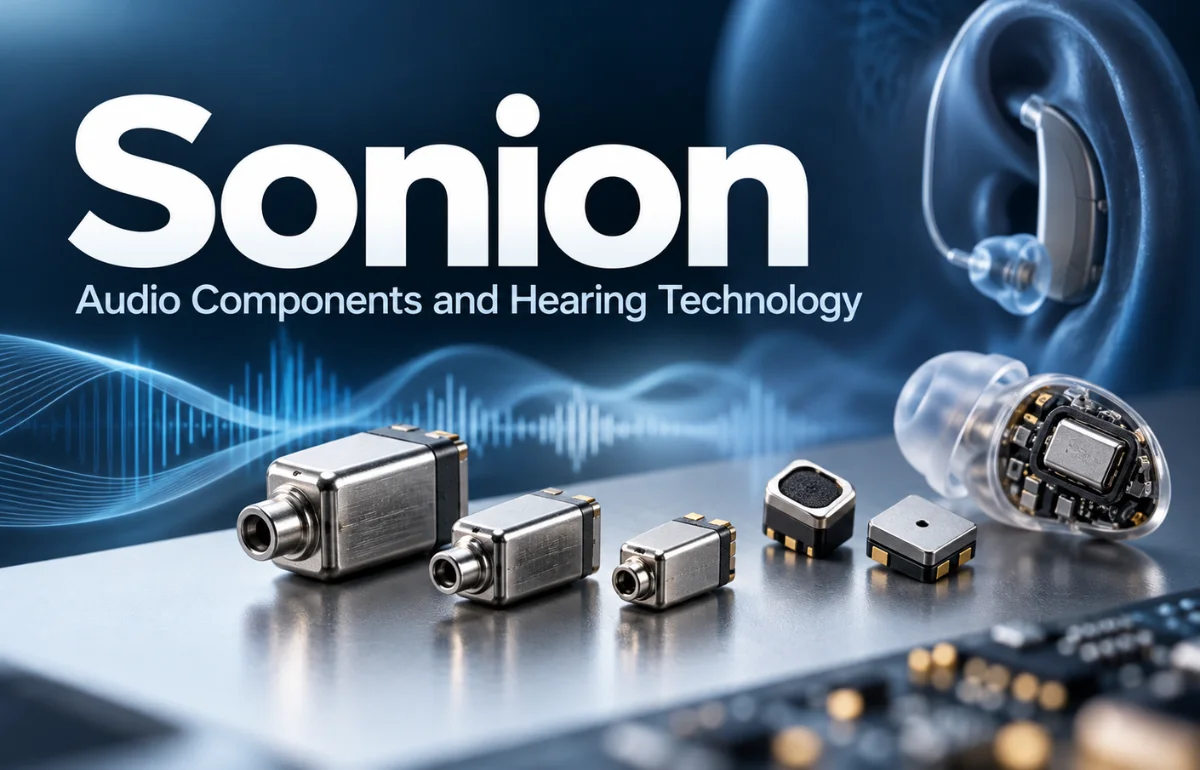
Sonion is a Denmark-based company that designs and manufactures miniature acoustic and electromechanical components for hearing aids, professional in-ear monitors, and other specialized audio devices. Its best-known products include balanced-armature receivers, tiny microphones, receiver-in-canal assemblies, and precision connectors. Rather than selling hearing aids directly to consumers, Sonion supplies the technology that other companies build into finished products.
I find the easiest way to understand Sonion is to picture the sound-producing and sound-capturing parts hidden inside a device that fits behind or inside the ear. Those parts may be smaller than a fingernail, yet they help determine how clearly a person hears speech or music.
This article explains what Sonion makes, how its technology works, and what its name actually means when it appears on an audio specification sheet.
What Kind of Company Is Sonion?
Sonion operates in the business-to-business market. Its customers are mainly manufacturers and developers who need small, efficient, repeatable acoustic components for finished devices.
Founded in Roskilde, Denmark, in 1974 by Jørgen Weber Jensen and Jens-Jørn Stockholm, the company grew alongside the demand for smaller and more capable hearing instruments.
Sonion says its components help more than 50 million people each year, a company-reported figure that reflects the reach of devices incorporating its technology rather than direct retail customers.
Sonion has been owned by Novo Holdings A/S since September 2014. Its manufacturing operations are centered on facilities in Ho Chi Minh City and Vung Tau, Vietnam, while its business spans hearing health and professional audio.
End users may recognize the hearing-aid or earphone brand but never see the supplier responsible for an essential internal component.
What Products Does Sonion Make?
Sonion’s portfolio covers much more than miniature speakers. It includes technologies that capture sound, reproduce sound, connect hardware, and support communication features.
| Product category | What it does | Typical application |
|---|---|---|
| Balanced-armature receivers | Turn electrical signals into sound | Hearing aids, in-ear monitors |
| MEMS and electret microphones | Convert incoming sound into electrical signals | Hearing instruments and audio devices |
| Receiver-in-canal (RIC) systems | Package a receiver with a housing and connection arrangement | RIC hearing aids |
| Connector systems | Link small components and replaceable assemblies | Hearing aids and specialized communications |
| Telecoils and NFMI antennas | Receive magnetic signals or support short-range links | Compatible hearing and wireless devices |
| Sensors and micro-mechanical parts | Enable voice pickup, controls, and other functions | Earbuds, headsets, hearing instruments |
Balanced-Armature Receivers
A receiver is the miniature loudspeaker inside a hearing aid or earphone. Sonion specializes in balanced-armature designs, which move a small armature in a magnetic field to drive a diaphragm and create sound.
The advantage is not that every balanced-armature receiver sounds better than every other driver. It is that this approach can deliver useful acoustic output from a remarkably compact package.
Manufacturers can select different models for power, bandwidth, physical size, and integration requirements.
Sonion offers single- and dual-receiver designs for hearing instruments, along with full-range, bass, midrange, and treble-oriented products for professional audio. It also lists electrostatic tweeters and other specialized receiver solutions.
Miniature Microphones
Microphones perform the reverse task: they capture surrounding sound and convert it into signals that a hearing device can process.
Sonion supplies miniature electret and MEMS microphones, including designs aimed at low power consumption and tight packaging constraints.
For a hearing aid, microphone performance influences the quality of the signal entering the processing system. But background-noise reduction and speech enhancement also depend on microphone placement, multiple-microphone arrangements, and the finished device’s software.
RIC Assemblies, Connectors, and Controls
RIC means receiver-in-canal. In this hearing-aid configuration, a small receiver sits in or near the ear canal and connects to the body of the instrument through a thin wire assembly.
Sonion supplies ready-made and customized RIC solutions, including steel- and plastic-based systems.
Its connector products help manufacturers manage small, detachable electrical connections.
Sonion also makes telecoils, near-field magnetic induction antennas, dampers, buttons, switches, and volume controls.
How Does Sonion Technology Work Inside a Hearing Aid?
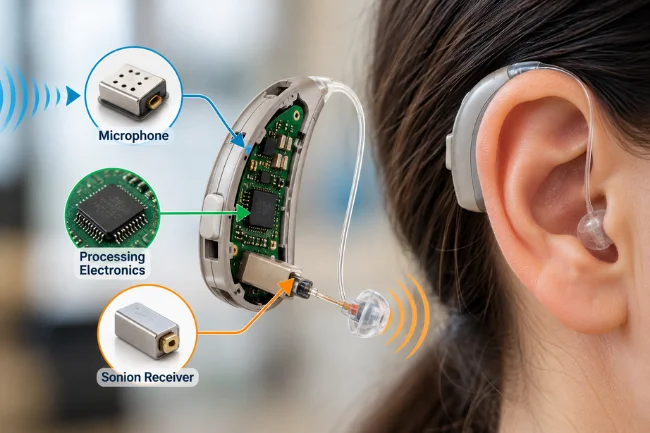
I think of a hearing aid as a chain of decisions rather than a single clever speaker. Each stage affects what reaches the listener.
First, one or more microphones pick up sounds such as conversation, traffic, and background noise. Next, the hearing aid’s processing electronics analyze those signals and apply amplification or other adjustments according to its design and fitting.
The processed electrical signal reaches a miniature receiver. The way the device fits the ear also affects the result.
A Sonion component may operate at the input stage, output stage, or within the supporting hardware.
It does not, by itself, determine the device’s hearing-loss prescription, noise-management software, or wireless features.
Why Acoustic Packaging Matters
A useful but often overlooked detail is that the receiver does not operate in isolation.
The sound outlet, tubing, damper, ear tip, housing volume, and seal can influence frequency response and perceived bass or treble.
For instance, changing a receiver without considering its acoustic pathway may alter the sound in an unintended way.
A component that performs beautifully on a laboratory fixture may behave differently once assembled into a real earphone or fitted to an individual ear.
This is why I treat the receiver model as one part of a system, not a shortcut to predicting the final listening experience.
Sonion Balanced Armature vs. Dynamic and Electrostatic Drivers
People researching Sonion earphone drivers often want to know whether balanced armatures are superior to conventional dynamic drivers.
The sensible answer depends on the intended product, enclosure, tuning, and performance target.
| Driver type | General strengths | Main design considerations |
|---|---|---|
| Balanced armature | Compact size; flexible use in multi-driver layouts; efficient operation in suitable designs | Acoustic damping, frequency shaping, and careful integration are often needed |
| Dynamic driver | Can provide broad-range sound from one diaphragm; common in bass-focused earphones | Diaphragm size, enclosure, ventilation, and tuning affect performance |
| Electrostatic-style miniature tweeter | Useful for specialized high-frequency reproduction in compatible multi-driver systems | Requires appropriate electrical drive and crossover integration |
A well-tuned single-driver earphone can outperform a poorly integrated multi-driver product.
Adding more receivers introduces extra challenges, including phase alignment, crossover behavior, and manufacturing consistency.
Why Sonion Matters in Hearing Healthcare

For people with hearing loss, the essential question is not which component supplier has the most impressive brochure.
It is whether a properly selected and fitted device helps them understand important sounds comfortably.
In its March 2026 fact sheet, the World Health Organization projected that nearly 2.5 billion people could have some degree of hearing loss by 2050, with more than 700 million requiring hearing rehabilitation.
Small receivers and microphones can support discreet hearing-aid designs, but miniaturization creates trade-offs.
Engineers must balance output, battery consumption, feedback risk, durability, comfort, and internal space.
A person with greater amplification needs may require a different receiver or fitting arrangement from someone with milder hearing loss.
Sonion’s component range gives manufacturers options across these design requirements.
Still, users should judge a hearing aid by professional assessment, real-world comfort, speech understanding, aftercare, and whether its settings suit their hearing profile—not by the supplier name alone.
Sonion in Professional In-Ear Monitors and Earphones
Sonion also has a presence in professional audio, especially in-ear monitors, often shortened to IEMs.
These are compact earphones used by performers, audio professionals, and enthusiasts who want detailed sound or reliable monitoring.
An IEM designer may combine several miniature drivers, assigning different frequency ranges to different units.
A bass driver handles lower frequencies, a midrange unit helps reproduce voices and instruments, and a tweeter covers upper-frequency detail.
Sonion supplies components for such systems, including balanced-armature and specialized high-frequency options.
But there is a distinction between a driver supplier and an earphone brand.
Two manufacturers may use similar Sonion components yet produce noticeably different results because their housings, nozzles, crossovers, and sound targets differ.
If a product advertises Sonion drivers, I would regard that as useful information about its component selection.
I would not treat it as proof that the earphone is neutral, comfortable, durable, or worth its price.
Independent measurements, fit, listening preferences, and warranty support remain relevant.
How to Read Sonion Receiver Specifications
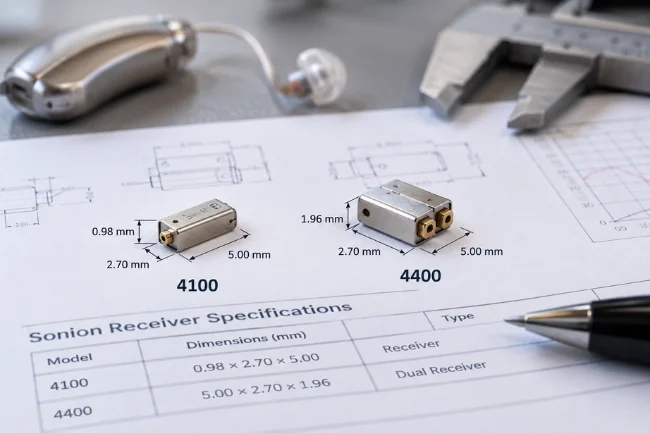
Technical datasheets become much easier to understand once you know which numbers answer practical questions.
Size and Physical Fit
Dimensions influence whether a receiver fits the available space and how much room remains for wiring and acoustic routing.
For example, Sonion lists its 4100 receiver at 0.98 × 2.70 × 5.00 mm and its 4400 dual receiver at 5.00 × 2.70 × 1.96 mm.
These measurements show how different designs solve different packaging problems.
Output, Sensitivity, and Distortion
Sensitivity describes how much acoustic output a receiver produces under specified electrical and test conditions.
Maximum output indicates a different limit, while distortion measurements help show how faithfully it reproduces a signal at particular levels.
I would never compare headline decibel figures without checking the frequency, input level, acoustic coupler, and test setup.
Sonion lists an output figure of up to 143 dB SPL for its 2000 receiver, but that is a component capability under specified conditions, not a recommended listening level.
Impedance and Power Requirements
Electrical impedance affects how a receiver interacts with the circuit driving it.
Engineers must also consider power use, heat, and the available battery budget.
For multi-driver earphones, crossover design and the combined electrical load are part of the calculation.
A smaller receiver is not automatically more efficient, and a higher output rating is not automatically better.
The correct choice depends on the product’s intended acoustic target and safe operating limits.
What Manufacturers Should Check Before Choosing Sonion Components
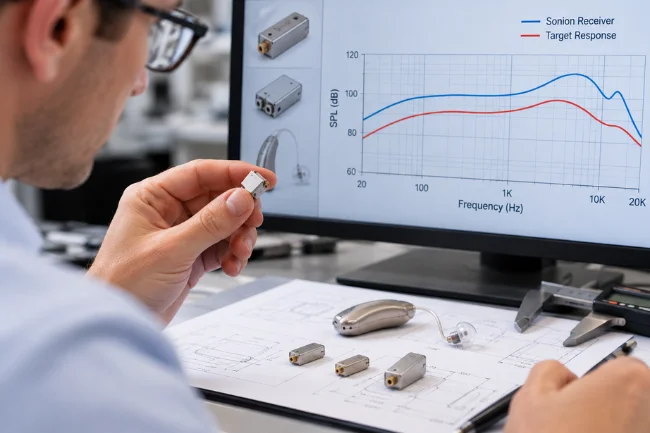
Choosing a micro-acoustic component is a development decision, not simply a catalog purchase.
Based on how these systems work, I would organize an evaluation around four questions.
Does It Meet the Acoustic Goal?
Start with the desired frequency response, sound pressure capability, distortion, and use environment.
A speech-focused hearing instrument and a stage-monitoring earphone need different performance priorities.
Will It Work in the Real Housing?
Review the receiver’s dimensions, sound outlet, electrical contacts, mechanical tolerances, moisture protection, and assembly method.
Test a prototype with the actual ear coupling or nozzle, rather than relying on a loose component alone.
Can It Be Manufactured and Serviced Reliably?
Consider production consistency, cable strain relief, replacement procedures, parts traceability, and the likelihood of wax or debris obstructing an acoustic outlet.
These issues may matter more to long-term ownership than a modest improvement in a laboratory measurement.
Is There Clear Documentation and Support?
Ask for current datasheets, application guidance, sample availability, environmental specifications, and compliance information relevant to the final market.
Sonion offers application engineering and customized component solutions, but requirements and commercial terms should be confirmed directly.
A particularly useful practice is to evaluate the complete assembled signal path—not just the receiver—after design changes.
That approach can catch changes caused by a different damper, ear tip, cable, or connector before they reach customers.
Quality, Manufacturing, and Sustainability
High-volume miniature manufacturing depends on repeatability.
A small dimensional variation, weak connection, or contamination in an acoustic channel can cause an outsized change in performance.
Sonion states that its corporate quality procedures follow ISO 9001:2015 requirements.
It also lists ISO 14001:2015 environmental-management and ISO 45001:2018 occupational-health-and-safety certifications for its two Vietnam production facilities.
These certifications describe management systems and processes.
They should not be interpreted as independent proof that any particular earphone sounds better or that every finished hearing aid meets the same performance standard.
The company also discusses reducing waste and its environmental footprint.
When assessing a supplier’s sustainability claims, I prefer specific evidence—such as documented facility certifications, material compliance, and measurable progress—over broad language about being green.
What Sonion Cannot Tell You About a Finished Device
This is the detail I wish more product descriptions explained: the presence of a respected component is not the same thing as a validated finished product.
A Sonion microphone cannot compensate for poor signal processing. A capable receiver cannot correct an uncomfortable fit. A premium tweeter cannot rescue a badly designed crossover.
For hearing aids, clinical fitting, audiological needs, safety limits, and follow-up care remain central.
For earphones, overall tuning, measured performance, isolation, listening volume, and comfort deserve equal attention.
There is also no dependable way to identify a hidden component simply by looking at the earphone shell.
Manufacturer specifications or reliable teardown evidence are more useful than online guesses, and component revisions may vary between production runs.
Where Sonion Technology May Go Next
The likely direction of micro-acoustics is continued pressure to fit more functionality into smaller spaces.
Hearing devices and wearables increasingly need to balance sound quality, power efficiency, comfort, and connectivity.
Sonion’s existing portfolio already includes MEMS microphones, miniature receivers, bone-conduction-related voice-pickup sensors, and biometric-sensor solutions for receiver-in-canal devices.
These product areas show how acoustic components can be combined with features beyond basic amplification.
I expect manufacturers to keep pursuing better integration and serviceability, but future product claims should be judged against published specifications and demonstrated benefits.
Smaller hardware is meaningful only when it supports a better experience for the person wearing it.
Frequently Asked Questions About Sonion
What is Sonion best known for?
Sonion is best known for miniature balanced-armature receivers, microphones, and other components used in hearing aids and professional in-ear audio products.
Is Sonion a hearing aid brand?
No. Sonion primarily supplies components to manufacturers; it does not generally market finished consumer hearing aids under its own name.
Where is Sonion based?
Sonion originated in Roskilde, Denmark, and operates manufacturing facilities in Ho Chi Minh City and Vung Tau, Vietnam.
Are Sonion drivers good for earphones?
Sonion drivers are established options for earphone designers, but sound quality depends on the complete design, tuning, fit, and implementation.
Who owns Sonion?
Sonion has been owned by Danish investment company Novo Holdings A/S since September 2014.
Final Thoughts
Sonion is one of the companies working behind the scenes to make modern hearing and personal audio devices possible.
Its expertise lies in miniature receivers, microphones, and tightly engineered supporting parts, not in selling a complete listening experience on its own.
If you’re researching hearing aids, compare professionally fitted devices around your needs.
If you’re evaluating earphones or designing audio hardware, start with the full system and its measured performance.
To explore specific components, consult Sonion’s current product catalog and technical documentation before drawing conclusions from a driver name alone.

Noah Sterling is a technology research writer with 8+ years of experience covering emerging technologies, software trends, digital tools, and innovation. He creates practical, research-based articles to help readers understand the evolving technology landscape.