Thomsonkids.com is a multi-topic digital publication that shares articles about technology, business, finance, education, health, lifestyle, travel, and other everyday interests. Despite the word “kids” in its name, the website currently functions as a general information blog rather than a dedicated children’s learning platform.
Visitors can browse topic categories, read explainers, discover practical ideas, and explore commentary on subjects ranging from digital tools to personal decisions. Its official About Us page describes a broad editorial mission, while its homepage displays articles for adult readers as well as education-related material.
Understanding this distinction matters because older references to Thomson Kids describe a different, child-focused service associated with the same domain. I examined the site’s current pages and historical records to separate what is visible today from what belongs to its past.
Thomsonkids.com at a Glance
At first glance, the name suggests worksheets, educational games, or activities for young children. That impression does not match the current homepage. Instead, I found an online magazine-style collection of posts organized around several interests.
The site’s About Us page identifies it as a digital media publication. Its stated purpose is to make information accessible and help readers understand changing topics without demanding specialist knowledge.
You do not need to create an account to read the publicly accessible articles I reviewed. However, that observation is not a promise that every future feature or page will remain free.
The publication also has a contact page, an editorial policy, and privacy information that readers can consult directly.
What stands out to me is breadth, not specialization. One visitor might arrive for an article about artificial intelligence; another might discover a finance explainer or a travel-related post.
That flexibility is useful, provided the reader checks whether a particular article offers dependable evidence.
Why Does a General Publication Have “Kids” in Its Name?
The naming question deserves an answer because it can lead readers in the wrong direction.
In July 2020, Singapore’s Thomson Medical Group announced that Thomson Kids Pte Ltd would focus on children’s development and learning support.
Contemporary reporting described plans for structured educational programmes supported by psychologists, speech and language therapists, and teachers.
A Thomson Kids Specialised Learning handout carrying a 2022 copyright notice listed www.thomsonkids.com as its website.
That is direct historical evidence that the address appeared in materials for the learning service. It is not proof that today’s publisher and the earlier service have the same management.
By October 2026, the accessible domain presents itself as a broad digital publication. Its pages and subject matter should therefore be evaluated on their present content, not simply on the meaning of the name or an old search result.
| Question | Earlier Thomson Kids references | Thomsonkids.com today |
|---|---|---|
| Primary focus | Children’s learning and developmental support | General-interest articles across multiple subjects |
| Typical audience | Parents and children seeking learning assistance | Readers looking for information, trends, and explainers |
| Evidence | 2020 company reporting and a 2022 handout | Current homepage, About Us, and editorial pages |
| Key caution | Older service details may be outdated | A similar name does not establish current corporate affiliation |
I would not use an old programme brochure to confirm a present-day class, fee, phone number, or booking option.
Anyone searching for the historical learning centre should verify the current provider independently before sharing a child’s information or arranging services.
What Kind of Content Can You Find on Thomsonkids.com?
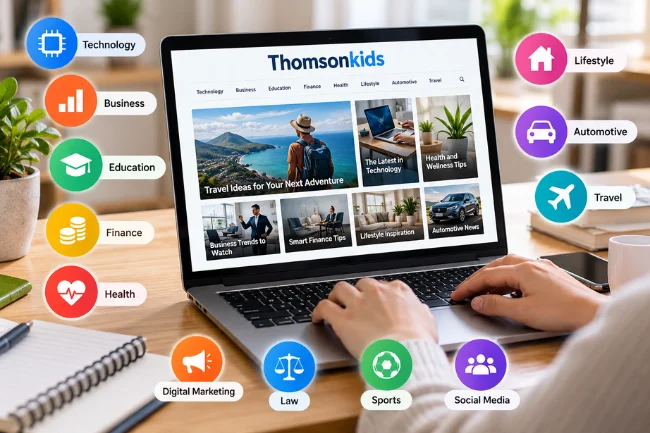
The website’s main menu highlights technology, business, education, finance, health, lifestyle, automotive subjects, and travel.
Its wider article archive also contains subjects such as digital marketing, law, sports, and social media. Here is how I would approach those areas as a reader.
Technology and Digital Tools
Technology is one of the clearest themes on the homepage. Articles discuss online tools, AI-assisted image editing, digital services, and the practical side of new software.
These subjects can be helpful when someone wants an initial explanation before deciding whether to explore a product further.
For example, a recent homepage item discusses making targeted changes to an AI-generated portrait.
That is a different kind of content from a technical manual: it introduces a task and the problems a user might encounter rather than documenting every feature of a particular application.
My advice is to use such material as an introduction. For pricing, compatibility, privacy settings, or software updates, I would then check the developer’s own documentation.
Business, Finance, and Work
The business and finance sections cover company-related stories, professional issues, payment systems, and financial concepts.
Readers may find background information that helps them recognize terminology or frame more specific questions.
The challenge is that financial and business claims can age quickly. A concept explainer may remain useful for years, while a recommendation about a particular service, investment, or regulation might require confirmation on the day it is used.
I look for the difference between explaining how something works and telling readers what they should do with their money.
The second requires stronger evidence and, sometimes, professional advice.
Education and Learning
The education archive includes articles about online learning, virtual classrooms, and gamification. These are broad educational trends rather than an up-to-date catalogue of specialist classes for children.
Parents and teachers can still use that content to generate discussion ideas. An article on learning through games, for instance, might suggest questions worth asking about motivation, participation, or screen time.
But a general education article is not an educational assessment.
Where a child has persistent learning or communication difficulties, a qualified professional can help identify appropriate support.
Health, Lifestyle, and Travel
Health-related posts address wellness and healthcare topics, while lifestyle and travel categories cover day-to-day interests and planning considerations.
The range makes it possible to discover an unfamiliar subject without visiting a separate website immediately.
There is a clear limit, though. General information cannot establish whether a medical test, treatment, or destination is right for a particular person.
For health decisions, I would confirm medical claims through established clinical sources and consult a qualified professional.
Travel advice also benefits from a date check. Entry rules, prices, transport schedules, and availability can change after an article is published.
How Is the Website Organized?
The layout follows a recognizable online-publication pattern. A reader can enter through the homepage, choose a topic from the menu, open individual articles, or move into older posts through the archive and pagination links.
Article listings show headlines and, on many posts, an author label and publication date.
Those small details are useful. They help me distinguish a recent post about a fast-changing tool from an older explainer that may need updating.
There is also a mix of broad category names and more specific sections.
If I am searching for one topic, I prefer opening the relevant category rather than scrolling through every homepage post. If I know the subject already, a targeted search can be faster than browsing.
One practical detail: a polished layout is not a substitute for evidence. Readability matters, but it does not automatically tell us whether the research behind an article is reliable.
Who Is Thomsonkids.com Most Useful For?
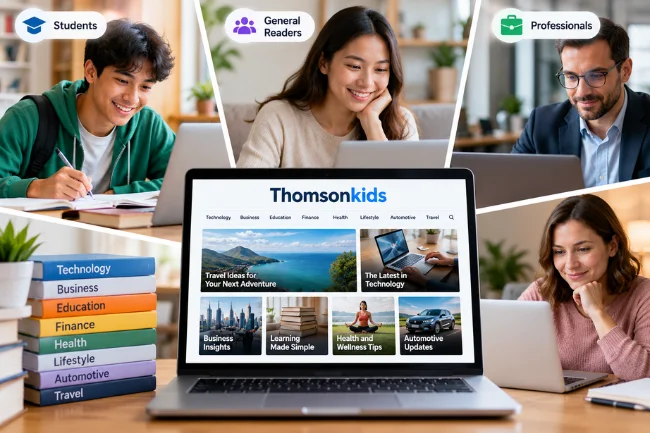
I see the strongest fit with curious general readers who want a quick orientation before consulting specialist material.
Students may use an article to identify unfamiliar terms. Professionals might scan a technology or business post for context. Everyday readers may find a subject they were not originally searching for.
The website is less suitable as a single, definitive authority on an important medical, financial, or legal decision.
It is also not something I would present to parents as a confirmed current enrolment portal for the earlier Thomson Kids learning centre.
That does not make the publication irrelevant.
It simply means its best use is discovery, explanation, and context. The value depends on the particular article, not on treating the entire domain as equally authoritative on every subject.
Is Thomsonkids.com Reliable? My Practical Assessment
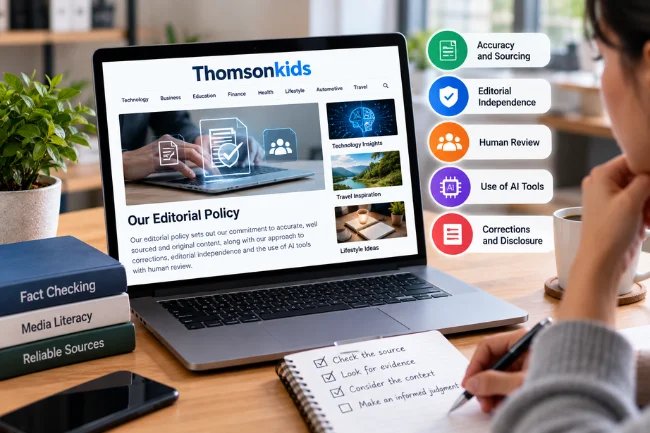
A website’s trustworthiness is not a simple yes-or-no label. I prefer to ask what evidence supports the specific page I am reading.
What Its Editorial Policy Actually Says
The site’s editorial policy sets out expectations for accuracy, sourcing, originality, corrections, editorial independence, and disclosure of promotional material.
It also acknowledges that AI tools may be used within content workflows, with human review remaining the stated responsibility of the publisher.
These are useful commitments. They tell readers what the publication says it expects from contributors.
Still, a published policy is not independent verification that every article follows those standards. I would judge individual claims against the sources provided.
A Five-Question Check I Use Before Trusting an Article
I find that five questions reveal more than a site’s design or a confident headline.
First, who wrote the piece, and is relevant expertise established? A visible byline is helpful, but a name alone does not prove subject expertise.
Second, when was it published or substantially updated? Age matters differently for an explanation of basic concepts than for advice about a new app or current legislation.
Third, where did the factual claims come from? Look for original studies, official guidance, primary documents, or credible reporting rather than a chain of websites repeating one another.
Fourth, can I separate facts from recommendations? Opinion is not necessarily a problem, but it should be identifiable as opinion.
Fifth, what would happen if the advice were wrong? The more consequential the decision, the more independent checking I want to do.
This approach is especially helpful on a multi-niche publication because the evidence needed for a travel tip differs from the evidence needed for a health claim.
Privacy and Reader Safety
The site’s privacy policy says it may collect information visitors submit, technical usage details, and data associated with cookies or analytics.
It also discusses third-party services and the handling of information concerning children.
I recommend reading that policy before submitting contact details or subscribing to communications.
Avoid including sensitive medical, financial, or children’s information in a general inquiry unless it is genuinely necessary and the recipient has been verified.
The presence of a privacy policy is a transparency measure; it does not, by itself, prove that every possible data practice has been independently audited.
How to Get Better Value From Each Visit
Rather than reading every article the same way, I use a simple purpose-based approach.
It helps me decide how much verification I need and what to do next.
| What you’re trying to do | Best use of the website | Sensible next step |
|---|---|---|
| Understand an unfamiliar term | Read an introductory explainer | Confirm key definitions with a specialist source |
| Explore a digital tool | Learn the problem it addresses | Check the tool provider’s current features and terms |
| Research a health or money topic | Gather questions and vocabulary | Consult authoritative guidance or a professional |
| Find travel or lifestyle ideas | Collect possibilities | Verify current rules, costs, and availability |
| Locate historical Thomson Kids services | Understand the name’s earlier context | Confirm the current provider through official channels |
For me, the most useful habit is keeping two questions separate: “Did this article explain the subject clearly?” and “Have I verified the claims I might act on?”
A piece can succeed at the first without fully satisfying the second.
Can Writers or Businesses Contribute?
Thomsonkids.com’s Contact Us page welcomes inquiries from readers, writers, organizations, and potential partners.
It mentions article proposals, correction requests, editorial questions, advertising, and collaboration opportunities.
That should not be confused with an open promise to publish any submitted article. The page states that contributions undergo editorial review and that submitting material does not guarantee acceptance.
If I were pitching the publication, I would start with a specific topic, explain why its audience would care, and show what evidence or expertise I could bring.
A useful contribution should answer a real reader question, not merely provide a place to insert promotional links.
For businesses, I would ask how sponsored material is identified and what editorial controls apply before agreeing to a placement.
Those details are more meaningful than unverified traffic estimates or third-party promotional scores.
What Thomsonkids.com Does Well—and Where Caution Helps
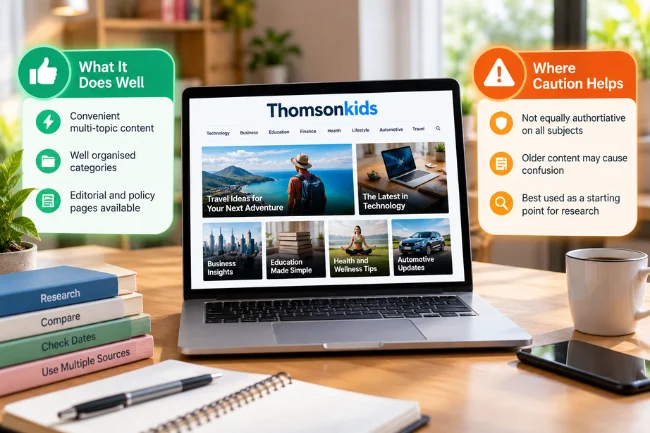
The site’s main advantage is convenience. Readers can sample several subjects in one place, and its categories make exploration relatively straightforward.
Its public editorial, contact, and privacy pages also provide starting points for understanding how it presents itself.
Its broad scope is also the main limitation.
No general-interest publication should be presumed equally authoritative in clinical medicine, investing, legal matters, and software security simply because it publishes on all four.
Another limitation is the name itself. Older material connected with a specialist children’s service can appear alongside the current publication in search results.
Without checking dates and identities, readers could misunderstand what the present site offers.
I would describe Thomsonkids.com as a starting point for research rather than the endpoint for decisions with serious consequences.
That is a more useful assessment than calling every article reliable or dismissing the entire website.
Frequently Asked Questions
What is Thomsonkids.com used for?
It is currently used to publish general-interest articles and explainers across technology, business, education, health, finance, lifestyle, and other topics.
Is Thomsonkids.com a website for children?
Despite its name and historical association with children’s learning, the current website presents itself as a multi-topic publication, not a dedicated children’s platform.
Is Thomsonkids.com free to use?
The publicly available articles I reviewed were readable without a paid subscription. Access terms could change, so check the website for current conditions.
Is Thomsonkids.com connected to Thomson Medical Group?
Older Thomson Kids materials linked the domain to a Thomson Medical Group learning service; I could not verify an ongoing corporate connection with today’s publisher.
Can I submit an article to Thomsonkids.com?
Its Contact Us page invites contributor proposals, but submissions are reviewed and publication is not guaranteed.
Final Thoughts
Thomsonkids.com makes more sense once you separate its current identity from the older children’s learning references attached to its name.
Today, it is a broad online publication offering accessible articles on subjects that many readers encounter in daily life.
I would begin with the topic category that matches my question, check the author and publication date, and follow the evidence before making an important decision.
Visit the official website to explore the latest articles, and use its contact page if you need to clarify information directly with the publisher.

Noah Sterling is a technology research writer with 8+ years of experience covering emerging technologies, software trends, digital tools, and innovation. He creates practical, research-based articles to help readers understand the evolving technology landscape.