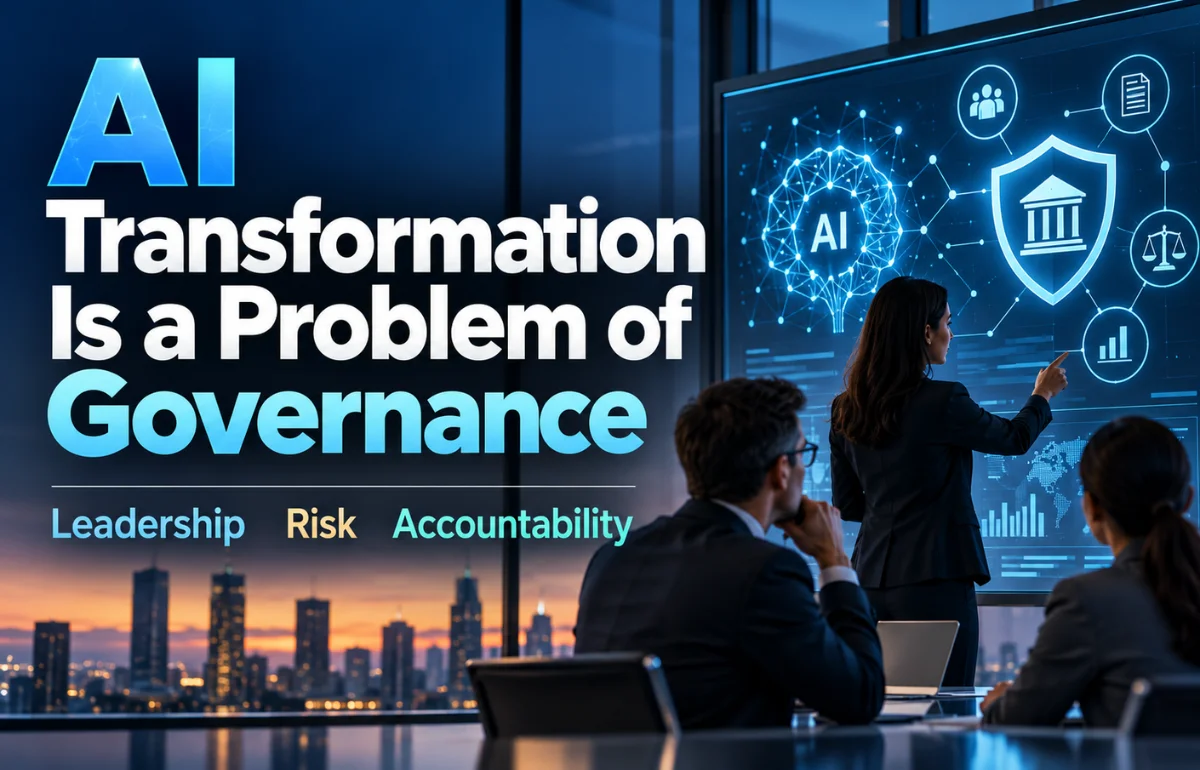
AI transformation is a problem of governance because the hardest part of using artificial intelligence is not installing software or training a model. It is deciding who controls the technology, what decisions it can make, which risks are acceptable, and who answers when something goes wrong. AI governance is the system of policies, responsibilities, checks, and human oversight that makes those decisions accountable. Without it, even technically impressive AI can produce unfair outcomes, expose sensitive data, or automate bad business practices.
I see this as a leadership question before a coding question. A company may build a remarkably accurate prediction tool, but accuracy alone cannot tell its executives whether the prediction should determine someone’s job, medical treatment, or access to credit. Those choices require judgment, clear rules, and a way to challenge mistakes.
What Does “AI Transformation Is a Problem of Governance” Mean?
AI transformation means changing how an organization works by using artificial intelligence in its products, decisions, and everyday operations. Governance determines the boundaries of that change: who approves a system, who may use it, what evidence is required, and when it must be stopped.
The phrase does not mean technology is irrelevant. Models still need reliable data, testing, cybersecurity, and skilled developers. But technical quality and organizational responsibility are different things. A model can work exactly as designed while pursuing a goal that should never have been chosen.
Imagine a bank using AI to prioritize loan applications. Engineers can measure predictive accuracy. The bank’s leaders must decide whether the system treats applicants fairly, explains adverse decisions, protects financial information, and offers meaningful human review. If those questions have no owner, the bank has an organizational problem, not merely a software problem.
Why AI Transformation Fails Without Good Governance

AI Amplifies Existing Incentives
Organizations already reward particular behaviors: lowering costs, increasing sales, processing cases quickly, or reducing staff workload. AI can scale those priorities across thousands of decisions. If the underlying incentives are poorly chosen, automation makes the consequences wider and harder to spot.
I would ask one question before approving a use case: What behavior will this system reward, even when nobody is watching? A customer-service chatbot optimized only for speed may discourage complex complaints. A hiring tool trained on historical selections may reproduce old recruitment preferences.
Decision-Making Becomes Less Visible
A traditional decision might pass through a manager who can explain the reasoning. An AI-supported decision can involve data pipelines, vendor models, automated rules, and staff accepting recommendations without questioning them.
That creates an accountability gap. When an answer is wrong, the developer may blame the data, the business team may blame the vendor, and the vendor may point to how the tool was configured. Governance prevents this handoff by assigning responsibility before deployment.
The Pace of Adoption Outruns the Rules
Employees can start using public AI assistants before legal, security, and procurement teams even know which tools are in use. This is often called shadow AI. Sensitive documents may be uploaded, generated claims may be published, and automated workflows may gain permissions nobody formally approved.
AI Governance vs. AI Management: What Is the Difference?
These terms overlap, but they answer different questions. AI management runs the work; AI governance sets the authority, limits, and accountability under which that work happens.
| Area | AI Management | AI Governance |
|---|---|---|
| Main question | How do we build and operate it? | Should we use it, and under what conditions? |
| Typical owner | Product and engineering teams | Executives, risk leaders, and accountable business owners |
| Main activities | Model development, testing, deployment, maintenance | Policy, approvals, risk tolerance, oversight, escalation |
| Success measure | Performance, reliability, efficiency | Appropriate outcomes, compliance, fairness, public trust |
| Failure response | Debug or retrain the system | Decide whether to restrict, suspend, remedy, or retire it |
The Five Governance Challenges Behind Responsible AI
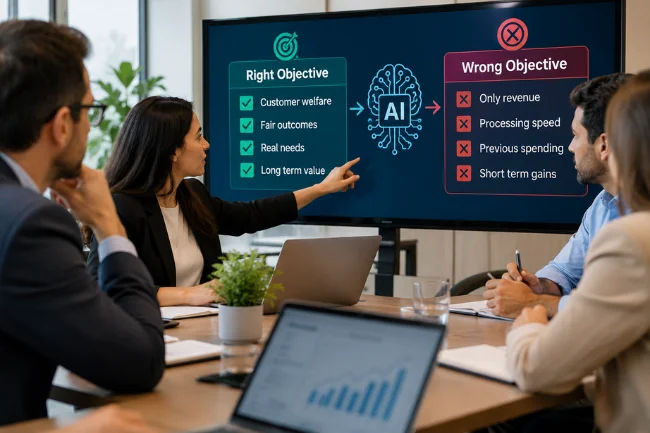
1. Choosing the Wrong Objective
Every AI system optimizes something. The critical question is whether that target represents what people actually care about. Revenue is not customer welfare; claim-processing speed is not fairness; previous spending is not necessarily medical need.
Leaders should approve the intended outcome and examine harmful shortcuts before development starts. I would document not just the main metric, but the outcomes the system must not sacrifice to improve it.
2. Bias Hidden Inside Data and Design
Algorithmic bias is not always an obvious programming error. It can emerge from incomplete datasets, unequal access to services, historical discrimination, misleading labels, or a model that performs differently across groups.
Responsible AI requires testing in the real context of use. Overall accuracy can hide serious failures affecting smaller populations. Fairness assessments should examine who benefits, who is excluded, and whether there is a fair way to contest the result.
3. Ownership Without Authority
Naming an “AI owner” accomplishes little if that person cannot access audit results, order a pause, or require a correction. Accountability needs decision rights and escalation paths.
For consequential systems, I recommend separating the team that builds the model from the person who accepts the remaining business risk. Independent review becomes especially useful when launch deadlines and safety concerns conflict.
4. Transparency That Stops at a Disclosure
Telling users “AI was involved” may be necessary, but it is rarely enough. People also need an understandable explanation of the decision, a route to correct inaccurate information, and a real person who can reconsider the outcome when appropriate.
5. Privacy, Security, and Third-Party Dependence
AI applications can expose personal data, confidential records, or internal systems. Generative AI introduces additional concerns, including prompt injection, unreliable outputs, and agents that may take actions through connected tools.
A purchased product is not automatically a governed product. Organizations still need vendor due diligence, contract terms, permissions, incident notification, retention limits, and a clear exit plan if the service becomes unsafe or unavailable.
This is why AI transformation is a problem of governance: someone must govern the decisions and permissions, not just the model.
Two Real Examples of Governance Failure

Amazon’s Experimental Recruiting Tool
In 2018, Reuters reported that Amazon had abandoned an experimental AI recruiting project after its models showed bias against women. The system learned patterns from historical resumes in a field where men had been heavily represented. Amazon said the tool was not used to evaluate job candidates in practice.
The lesson is not simply to collect more data. Recruitment leaders must decide what qualifies someone for a role, which historical patterns are inappropriate, what fairness tests are required, and who can reject a model despite promising efficiency.
Healthcare Risk Scores That Measured Spending
A 2019 study published in Science examined a widely used healthcare algorithm that used future medical spending as a proxy for health needs. Researchers found that, at the same risk score, Black patients were substantially sicker than White patients. Changing the objective to better reflect illness reduced the bias.
This case exposes a deeper governance failure: the organization can choose an attractive metric that does not represent its real purpose. Before approving a model, I would ask whether its target would still make sense to the person affected by the decision.
What Good AI Governance Looks Like in Practice
Two established resources can help teams move beyond broad ethical promises.
The NIST AI Risk Management Framework organizes work around four functions: Govern, Map, Measure, and Manage. Governance cuts across the other three. It encourages organizations to understand context, evaluate risk, and continually respond to findings. The framework is voluntary, not a certification or a universal checklist.
ISO/IEC 42001 sets requirements for an AI management system: the organizational policies, processes, controls, and continual improvement needed to manage AI responsibly. It can help embed oversight into routine business operations rather than treating safety as a one-off launch review.
How to Build an AI Governance System That Actually Works
Start With a Complete Inventory
List every AI application used by employees, vendors, and customer-facing products. For each, record its purpose, data sources, provider, business owner, affected users, and whether it makes or merely recommends decisions.
Classify Use Cases by Their Consequences
Not every use deserves the same oversight. Summarizing public meeting notes creates different risks from screening job candidates or recommending medical treatment. Assess possible harm, reversibility, the sensitivity of data, scale, and the people affected.
High-impact use cases should require more rigorous testing, senior approval, documentation, and frequent review. Low-impact tools can follow a lighter process so that governance does not become an obstacle to ordinary productivity.
Assign a Named Owner and an Independent Challenger
Each significant system needs a business owner responsible for outcomes, not just uptime. Engineering should own technical performance; privacy and security teams should assess their domains; legal and compliance teams should examine applicable obligations.
I also want a designated challenger: someone empowered to ask for stronger evidence, delay launch, or escalate a concern. Without that role, everyone may assume someone else has checked the difficult questions.
Set Measurable Conditions for Launch
Replace vague promises such as “the system should be fair” with tests tied to the actual use case. Define acceptable error rates, subgroup performance checks, privacy controls, escalation thresholds, and required human review.
Build an Appeal and Correction Path
A human-in-the-loop process is meaningful only when the human has time, information, authority, and training to disagree. A rubber-stamp approval screen is not a safeguard.
Give affected people a way to challenge consequential outputs. Track complaints and reversals, because they can reveal patterns that ordinary performance dashboards miss. Make it clear how errors will be corrected and, where appropriate, how harm will be remedied.
Monitor the System After Deployment
Models, users, and operating conditions change. Review accuracy, fairness, unexpected behavior, security incidents, and vendor updates at a frequency appropriate to the risks. Reassess systems when their purpose, data, permissions, or audience changes.
I would also create a stop rule before launch. For example, repeated harmful outcomes or a serious data exposure should trigger immediate escalation and possible suspension, not a debate about whether the quarterly review is due.
Test Who Can Reverse an AI Decision
Here is a practical exercise I find more revealing than another policy statement: choose one high-stakes AI decision and trace how it could be reversed. Can the affected person complain? Can staff find the relevant records? Who can override the result? Can the organization repair the impact?
I call this the reversal test. It is my suggested governance exercise, not a formal standard. If nobody can answer those questions clearly, the organization may have automated authority faster than it built accountability.
Governing Generative AI and Autonomous Agents

Generative AI deserves its own operating rules. A chatbot can confidently produce false information, invent citations, or expose sensitive content in responses. NIST’s Generative AI Profile addresses risks specific to these systems, including fabricated or misleading outputs.
AI agents add another layer because they can use tools, retrieve files, send messages, or act within business applications. The governance question changes from “What might it say?” to “What is it allowed to do?”
I would limit permissions to necessary tasks, require confirmation for consequential actions, log tool usage, and test behavior against malicious or confusing instructions. Human oversight should become stronger as a system gains the ability to move money, alter records, or affect people’s rights.
AI Laws and Standards Businesses Should Watch in 2026
Governance is broader than compliance, but ignoring the law is not an option. Requirements vary by location, sector, AI use, and whether an organization develops or deploys the system.
In the European Union, the AI Act applies through a phased timeline. Prohibitions and certain general obligations began in February 2025, while general-purpose AI rules began in August 2025. The Act became broadly applicable in August 2026, with exceptions.
Following the July 2026 AI Omnibus changes, requirements for certain stand-alone high-risk systems are scheduled for December 2, 2027; those for high-risk AI embedded in regulated products are scheduled for August 2, 2028.
These deadlines do not erase existing privacy, consumer-protection, employment, or anti-discrimination obligations. Businesses should map the laws relevant to each use case and obtain qualified legal advice where needed.
How Can You Measure Whether AI Governance Is Effective?
A policy is useful only if behavior changes. I prefer a small set of indicators tied to real decisions rather than a dashboard filled with activity counts.
| Governance Indicator | What It Reveals |
|---|---|
| Percentage of AI systems inventoried | Whether oversight covers actual usage |
| High-risk systems with named owners | Whether responsibility is assigned |
| Incidents and time to resolve them | Whether problems are detected and corrected |
| Appeals and overturned decisions | Whether people can challenge outcomes |
| Tests completed after major changes | Whether assurance continues after launch |
Avoid treating low incident counts as proof of safety. A system without reporting channels can appear flawless precisely because nobody can report a problem. Review these metrics alongside interviews, audits, and evidence from affected users.
The Future of AI Transformation Depends on Trust
More capable AI will make governance less optional, not less necessary. When systems can coordinate tasks and take actions autonomously, organizations must make authority visible: what was delegated, to which system, under whose supervision, and with what limits.
Conclusion
AI transformation is a problem of governance because technology can automate decisions but cannot decide which outcomes society or an organization should accept. That responsibility remains human.
My advice is to begin with one consequential AI use case. Identify its owner, assess the people it affects, define when it must stop, and run the reversal test. If the answers are unclear, fix the decision process before expanding the technology.
Frequently Asked Questions
Why is AI transformation a governance problem?
Because organizations must decide who controls AI, how risks are managed, and who is accountable when automated decisions cause harm.
What is the main purpose of AI governance?
Its purpose is to make AI use responsible, transparent, lawful, and aligned with organizational goals and the interests of affected people.
Who is responsible for AI governance in a company?
Senior leadership holds overall accountability, while business owners, developers, risk teams, and legal specialists carry defined responsibilities.
How is AI governance different from AI ethics?
AI ethics describes principles such as fairness and respect; AI governance turns those principles into enforceable policies, decisions, and controls.
Can small businesses implement AI governance?
Yes. A simple AI inventory, clear usage policy, named owner, data safeguards, and review process are practical places to start.

Noah Sterling is a technology research writer with 8+ years of experience covering emerging technologies, software trends, digital tools, and innovation. He creates practical, research-based articles to help readers understand the evolving technology landscape.