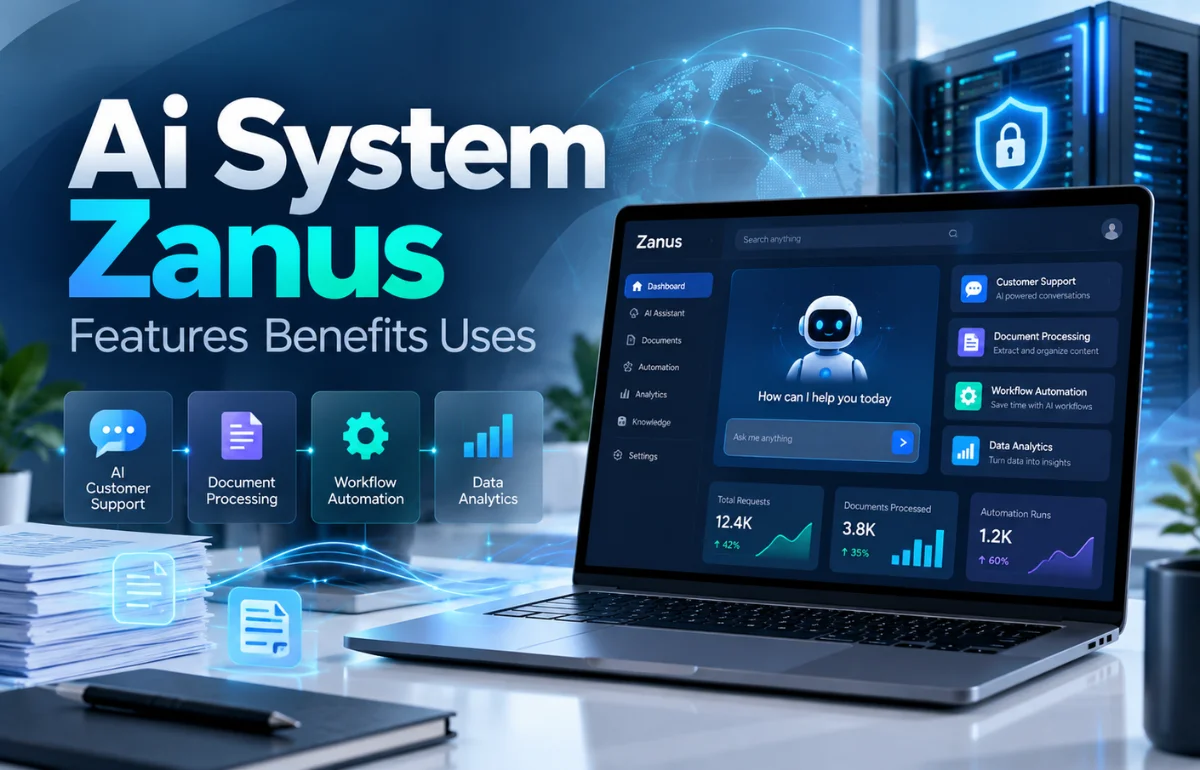
AI System Zanus refers to the artificial intelligence technology developed by Zanus AI, a company offering business automation software and private AI infrastructure. The system helps organizations manage customer conversations, process documents, automate repetitive tasks, and retrieve information from company-approved knowledge sources. Its products include Front Office AI for customer interactions, Back Office AI for internal operations, and on-premises AI servers for businesses requiring greater control over their data.
Unlike a basic chatbot that mainly responds to questions, Zanus AI is designed to support actual business workflows, including appointment scheduling, customer support, document processing, and operational coordination.
In this article, I’ll explain how the technology works, where it could be useful, and what businesses should examine before adopting it.
What Is AI System Zanus?
Ai System Zanus is a business-focused artificial intelligence ecosystem that combines AI assistants, workflow automation, organizational knowledge management, and deployment options.
The product’s official name is Zanus AI, although people searching for its AI system may use the phrase Ai System Zanus.
Developed by a technology company headquartered in Fort Lauderdale, Florida, Zanus AI aims to make artificial intelligence useful across everyday business activities rather than limiting it to text generation.
For example, a business might use the platform to answer customer questions, schedule meetings, prepare quotations, or search internal documents without switching between several disconnected applications.
The distinction I find especially useful is that Zanus AI offers both hosted software and separately purchased private infrastructure.
These are different approaches to using artificial intelligence, and choosing between them affects costs, maintenance, security responsibilities, and operational flexibility.
How Does AI System Zanus Work?
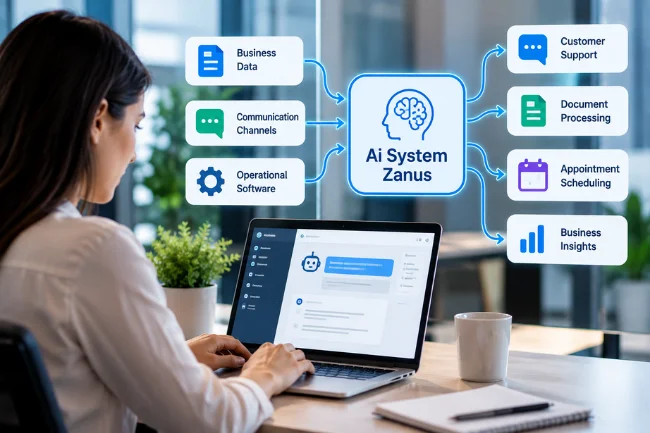
The technology connects artificial intelligence models with business information, communication channels, and operational software.
Instead of answering questions using only general model knowledge, its business applications are designed to reference information supplied and approved by the organization.
1. Connecting Business Knowledge
The process begins with information such as product catalogs, company policies, customer service procedures, internal documents, and frequently asked questions.
Depending on the product and configuration, this information can become part of a searchable knowledge library.
When someone asks a question, the AI can retrieve relevant material and use it to prepare a response.
This approach is commonly associated with retrieval-augmented generation, or RAG, which helps language models work with external knowledge sources.
2. Understanding Requests and Generating Responses
When a customer or employee submits a request, the system interprets the language and determines what information or action is needed.
A customer asking about appointment availability might trigger a calendar-related workflow, while an employee asking about a company procedure might receive an answer based on an approved document.
Zanus describes verification mechanisms intended to connect answers with authorized sources.
However, source-based verification reduces certain risks rather than guaranteeing that every response will be correct.
3. Performing Business Actions
Some requests require more than generating text.
For instance, a system may need to prepare a quotation, create a support ticket, update customer information, or draft an email.
Zanus AI promotes these capabilities through integrations and automation tools.
For sensitive activities, human approval remains valuable. An AI-generated quotation should not automatically become a binding business commitment without appropriate authorization.
The Three Main Components of Zanus AI
Understanding the product structure makes it easier to identify which capabilities a business actually needs.
Front Office AI: Managing Customer Interactions
Front Office AI handles activities involving customers and prospective customers.
According to the official Zanus AI website, its advertised capabilities include telephone assistance, website conversations, customer follow-ups, appointment bookings, product demonstrations, and quotation preparation.
The company also advertises multilingual interactions across up to 40 languages, although language availability and included allowances may depend on the purchased service.
Imagine a customer contacting a home-services company outside normal working hours.
Instead of receiving no response, the customer could explain the problem to an AI assistant, provide contact information, and request an appointment.
The business could then review the conversation and take over when necessary.
This makes Front Office AI particularly relevant to businesses where delayed responses can mean missed opportunities.
Back Office AI: Supporting Internal Operations
Back Office AI focuses on administrative and operational work performed within an organization.
Its advertised capabilities include reviewing documents, preparing reports, organizing tasks, processing business correspondence, and supporting scheduled workflows.
The platform also describes a verification system that connects generated answers to approved information.
Consider a purchasing department comparing quotations from multiple suppliers.
An AI system could extract information from documents, organize the differences, and prepare a comparison for an employee to review.
I see this as one of the more practical applications of business AI: reducing time spent organizing information while keeping important decisions in human hands.
Private AI Servers: Greater Infrastructure Control
Zanus also offers on-premises AI hardware through its Airtight AI server product family.
Unlike its hosted services, these systems are designed to run AI models locally using dedicated hardware.
The company’s private infrastructure includes server equipment, AI software, and options for industry-specific applications.
An organization may choose this approach when internal policies restrict the use of external cloud processing.
However, the distinction matters: not every Zanus service automatically becomes fully local merely because a company purchases a private server. Deployment arrangements must be confirmed for each product.
Key Features of AI System Zanus
Several capabilities distinguish this business-oriented platform from ordinary conversational AI tools.
Business Process Automation
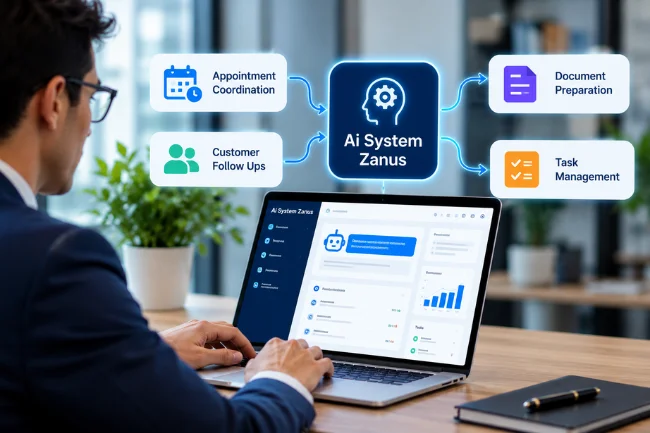
Zanus AI is designed to support repeatable operations such as appointment coordination, customer follow-ups, document preparation, and task management.
Automating these activities may reduce administrative effort, particularly when staff regularly handle similar requests.
The real benefit depends on whether those processes are consistent enough to automate reliably.
Knowledge-Based AI Assistance
A business assistant becomes more useful when it can access relevant organizational information.
For example, a support assistant should answer questions using a company’s actual return policy rather than producing a plausible but incorrect explanation.
Zanus emphasizes approved knowledge sources and source verification within its applications.
Businesses still need to maintain those sources because outdated information can produce outdated answers.
Software Integration
Many organizations already depend on customer relationship management platforms, calendars, email systems, and inventory software.
Zanus describes connectors intended to work with existing applications.
This could reduce the need to replace established tools, although compatibility, synchronization, permissions, and additional integration work should be checked before purchase.
Human Approval and Operational Oversight
Not every AI-generated action should happen automatically.
A useful automation system must distinguish between preparing an action and authorizing it.
For example, drafting a customer response is relatively low-risk. Issuing a refund, modifying a contract, or confirming an expensive order requires stronger controls.
Zanus describes approval workflows and access-management features, making governance an essential part of evaluating its products.
Practical Applications Across Different Industries
The value of AI System Zanus depends on how closely its capabilities match an organization’s daily work.
Healthcare Administration
Healthcare providers could potentially use appropriately configured AI tools to answer general service questions, coordinate appointments, and organize administrative documents.
However, patient information requires appropriate privacy protections, and medical decisions should remain with qualified professionals.
A vendor’s privacy claims alone do not establish compliance with healthcare regulations.
Retail and E-Commerce
Online retailers frequently receive repeated questions about product availability, delivery policies, returns, and order status.
AI customer support could help address straightforward inquiries while directing complicated complaints to employees.
Integration with current inventory data would be essential to avoid giving customers incorrect availability information.
Real Estate
Real estate agencies could use AI to handle initial property inquiries, collect viewing preferences, and coordinate appointments.
Agents would remain responsible for verifying property information, negotiating terms, and managing transactions.
Professional Services
Law firms, accounting practices, consultants, and other professional organizations often manage large document collections.
Knowledge-based AI may help organize documents, locate internal procedures, and prepare preliminary summaries.
Confidentiality and professional review must remain central to these workflows.
Benefits of Using AI System Zanus
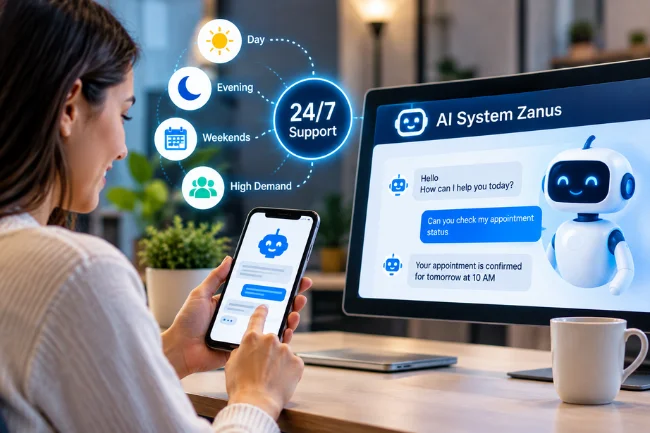
The strongest potential benefit is not simply faster writing. It is reducing the number of disconnected actions required to complete routine business work.
Improved Response Availability
Customer questions do not always arrive during business hours.
An automated assistant can potentially provide initial responses during evenings, weekends, or periods of heavy demand.
That does not mean every customer issue should be resolved by AI. Easy access to human assistance remains necessary.
Reduced Administrative Work
Employees spend considerable time copying information, preparing similar documents, updating records, and finding answers to recurring questions.
Automating selected tasks can free time for work requiring judgment and relationship-building.
I would measure this benefit using actual staff hours saved rather than accepting general productivity promises.
More Consistent Information
When employees rely on different files or outdated instructions, customers can receive contradictory answers.
A shared, maintained knowledge library may improve consistency.
However, consistency only helps when the underlying information is accurate.
Greater Data Control Options
Private AI infrastructure gives organizations an alternative to relying exclusively on hosted AI services.
It can support local processing and tighter infrastructure control when properly configured.
That advantage comes with responsibilities for backups, maintenance, cybersecurity, physical security, and disaster recovery.
Zanus AI Cloud vs. Private AI Servers
Choosing between hosted AI and private infrastructure is one of the most consequential decisions for a prospective buyer.
| Feature | Hosted Zanus AI | Private Zanus AI Servers |
|---|---|---|
| Deployment | Vendor-managed cloud environment | Customer premises |
| Hardware ownership | Not required | Organization owns hardware |
| Setup | Generally simpler to start | Requires hardware deployment |
| Data processing | Hosted infrastructure | Local for supported on-premises workloads |
| Maintenance | Primarily vendor-managed | Shared or customer-managed responsibilities |
| Pricing structure | Subscription and applicable usage charges | Hardware purchase and applicable services |
| Best suited for | Businesses seeking simpler adoption | Organizations requiring infrastructure control |
Neither option is automatically superior.
A small company may prefer hosted software because it avoids purchasing and maintaining specialized hardware.
A larger organization handling highly sensitive information may find local infrastructure more appropriate.
My preferred starting point would be the actual data requirements and workload, not the assumption that owning hardware always saves money.
How Much Does AI System Zanus Cost?
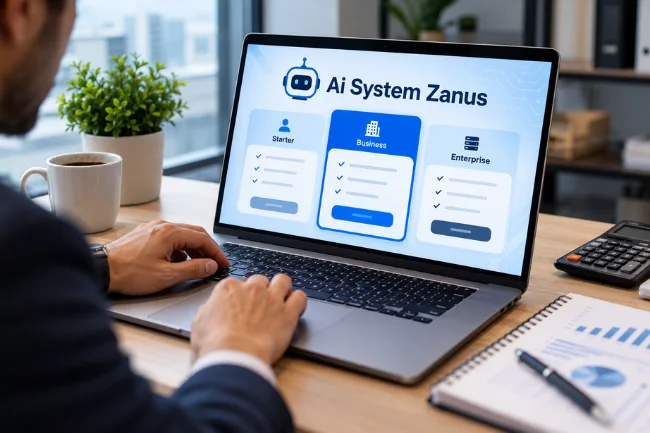
Zanus AI pricing depends on the selected product, service plan, deployment arrangement, and required capacity.
The company describes a per-company pricing approach for its hosted software rather than a conventional per-employee licensing model.
Its Front Office pricing pages have also described onboarding charges, usage allocations, and AI capacity credits.
However, some older indexed pages contain plan details that differ from newer materials. The current Front Office pricing page loads live information, so archived figures should not be treated as binding quotations.
The company’s Back Office pricing page was still describing its catalog as being finalized when reviewed in October 2026.
Private AI servers are generally priced through customized quotations based on computing requirements and configuration.
Before committing, I would request a written estimate covering implementation, renewals, usage limits, support, hardware warranty, and potential expansion.
A low advertised subscription price means little if essential functions require expensive additional services.
Is Zanus AI Secure and Reliable?
Security is a major consideration whenever artificial intelligence accesses customer records, financial documents, or internal business information.
According to the company’s enterprise trust information, hosted customers use isolated tenants, with access controls, audit trails, and data export capabilities.
Zanus also states that customer data is not used to train a shared global AI model.
These are vendor-reported safeguards and should be verified through contracts, technical documentation, and appropriate assessments.
One particularly relevant detail is that Zanus reported its SOC 2 Type II examination as underway rather than completed on its published trust page.
A buyer should therefore request current evidence instead of assuming certification.
Can Zanus AI Produce Incorrect Answers?
Yes. No generative AI platform should be assumed incapable of errors.
Even when responses are checked against approved documents, problems can result from outdated records, misunderstood questions, incomplete information, or incorrect source interpretation.
The NIST AI Risk Management Framework provides a useful reference for organizations evaluating AI reliability and associated risks.
In practice, I would require human review for medical, legal, financial, and other high-impact outputs.
How Does Zanus AI Compare With Traditional Business Software?
Traditional business software generally provides structured tools that employees operate directly.
Business-oriented AI systems attempt to perform portions of those activities through natural-language requests and automated workflows.
| Consideration | Traditional Business Software | Zanus AI Approach |
|---|---|---|
| User interaction | Forms, menus, and dashboards | Conversational requests and dashboards |
| Routine workflows | Manually operated or rule-based | AI-assisted automation |
| Knowledge retrieval | Keyword search or document browsing | Contextual answers from business knowledge |
| Customer communication | Primarily employee-driven | Automated support with human escalation |
| Accuracy risks | Data-entry and workflow errors | Data errors plus AI interpretation errors |
This comparison describes the general operating approaches, not independently measured product performance.
Businesses should also remember that modern CRM and enterprise software platforms already include AI features.
The deciding question is whether Zanus offers a meaningful improvement over tools already available within the organization.
How I Would Evaluate AI System Zanus Before Buying
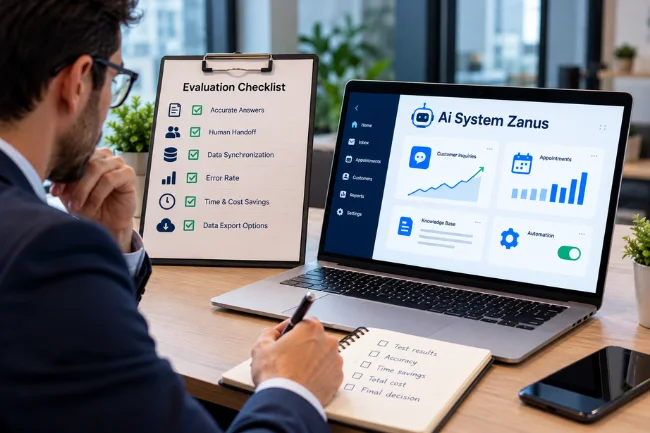
A convincing demonstration is useful, but a controlled business trial reveals far more.
I would begin with one measurable process instead of attempting to automate an entire organization immediately.
For example, a company might test incoming customer inquiries over a limited evaluation period.
The evaluation would focus on the following questions:
- Does the AI provide correct answers using approved company information?
- Can customers reach an employee when the system cannot help?
- Are appointments and customer records synchronized accurately?
- How frequently does the AI misunderstand requests or require correction?
- Does the saved employee time justify the total service cost?
- Can the company export its information and discontinue the service without losing essential records?
A Practical 30-Day Evaluation Scorecard
A useful pilot should measure performance rather than rely on impressions.
| Measurement | What I Would Track |
|---|---|
| Answer accuracy | Correct responses out of reviewed interactions |
| Escalation quality | Requests transferred appropriately |
| Time saved | Verified reduction in employee work |
| Completion rate | Tasks completed without correction |
| Operating cost | Total cost per successfully handled request |
I would also test unusual requests deliberately.
For instance, a customer might ask for a nonexistent product, request an unauthorized discount, or provide conflicting appointment details.
These situations reveal whether the assistant follows established boundaries.
This testing approach is particularly useful because a system can perform well during ordinary demonstrations while struggling with unexpected real-world conditions.
Limitations and Challenges Businesses Should Consider
Despite its potential, AI System Zanus is not a universal solution for every organization.
Implementation Still Requires Preparation
Business automation depends on clear procedures, reliable information, and properly configured integrations.
If a company has contradictory policies or disorganized customer records, adding AI will not automatically solve those problems.
Preparation and ongoing knowledge maintenance remain necessary.
Automation Does Not Eliminate Accountability
A business remains responsible for its communications, customer treatment, security obligations, and operational decisions.
Automated outreach also requires attention to applicable consent, privacy, and communication regulations.
Human oversight should be designed into the workflow rather than added only after something goes wrong.
Long-Term Costs Require Realistic Analysis
Private servers eliminate some recurring cloud usage fees, but they still require electricity, cooling, maintenance, backups, and eventual hardware replacement.
Hosted platforms avoid many infrastructure responsibilities but introduce subscription and service dependencies.
The most economical choice depends on workload size, usage patterns, and operational needs.
Recognition and Developments in 2026
Zanus AI has attracted industry recognition for its enterprise AI technology and private infrastructure.
On April 8, 2026, TMCnet included Zanus AI among its Enterprise AI Product of the Year Award recipients.
More recently, on October 13, 2026, TMC announced Zanus AI’s on-premises server as a recipient of its Physical AI Product of the Year Award.
These awards can be verified through TMCnet’s published announcements.
Industry recognition provides useful context, but it should not replace independent reliability testing, security assessments, or customer references.
Is AI System Zanus Worth Considering?
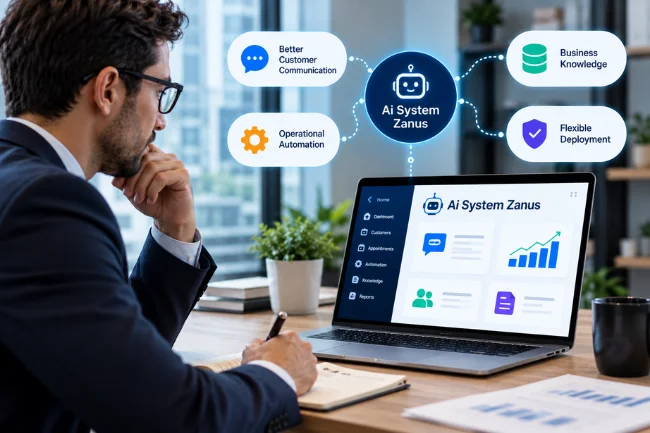
I believe Zanus AI deserves consideration from organizations looking to connect customer communication, business knowledge, and routine operational automation.
Its combination of hosted applications and optional private infrastructure gives businesses different ways to approach AI adoption.
Still, I would not choose it based solely on automation claims, awards, or the promise of eliminating manual work.
The strongest purchasing decision comes from evaluating a real business process, measuring results, checking data protections, and comparing total costs with existing alternatives.
For some organizations, a focused AI assistant may be sufficient. Others may benefit from a more integrated business AI environment.
Final Thoughts
AI System Zanus represents a business-focused approach to artificial intelligence that extends beyond ordinary question-answering tools.
Its Front Office, Back Office, and private infrastructure offerings address different operational needs, from customer engagement to internal knowledge management.
Before adopting the platform, explore the official demonstrations, request current pricing and security documentation, and test its performance on a clearly defined business task.
The goal should be measurable improvements in accuracy, efficiency, and service quality—not automation simply for its own sake.
Frequently Asked Questions About AI System Zanus
1. What is AI System Zanus used for?
AI System Zanus is used for business automation, customer support, document processing, knowledge retrieval, appointment scheduling, and other AI-assisted operations.
2. Is Zanus AI free to use?
Zanus advertises a seven-day free trial for its Front Office service without requiring a credit card. Continued use and other products may involve charges.
3. Can Zanus AI work without an internet connection?
Its supported on-premises AI server configurations can operate locally without internet access. The standard hosted services require connectivity.
4. Is Zanus AI suitable for small businesses?
Potentially, especially for businesses handling frequent customer inquiries or repetitive administrative tasks. Suitability depends on pricing, workload, and integration requirements.
5. Is Zanus AI better than ChatGPT?
They serve different purposes. ChatGPT is a general-purpose AI assistant, while Zanus AI focuses on integrated business workflows and private AI infrastructure. The better choice depends on specific requirements.

Noah Sterling is a technology research writer with 8+ years of experience covering emerging technologies, software trends, digital tools, and innovation. He creates practical, research-based articles to help readers understand the evolving technology landscape.