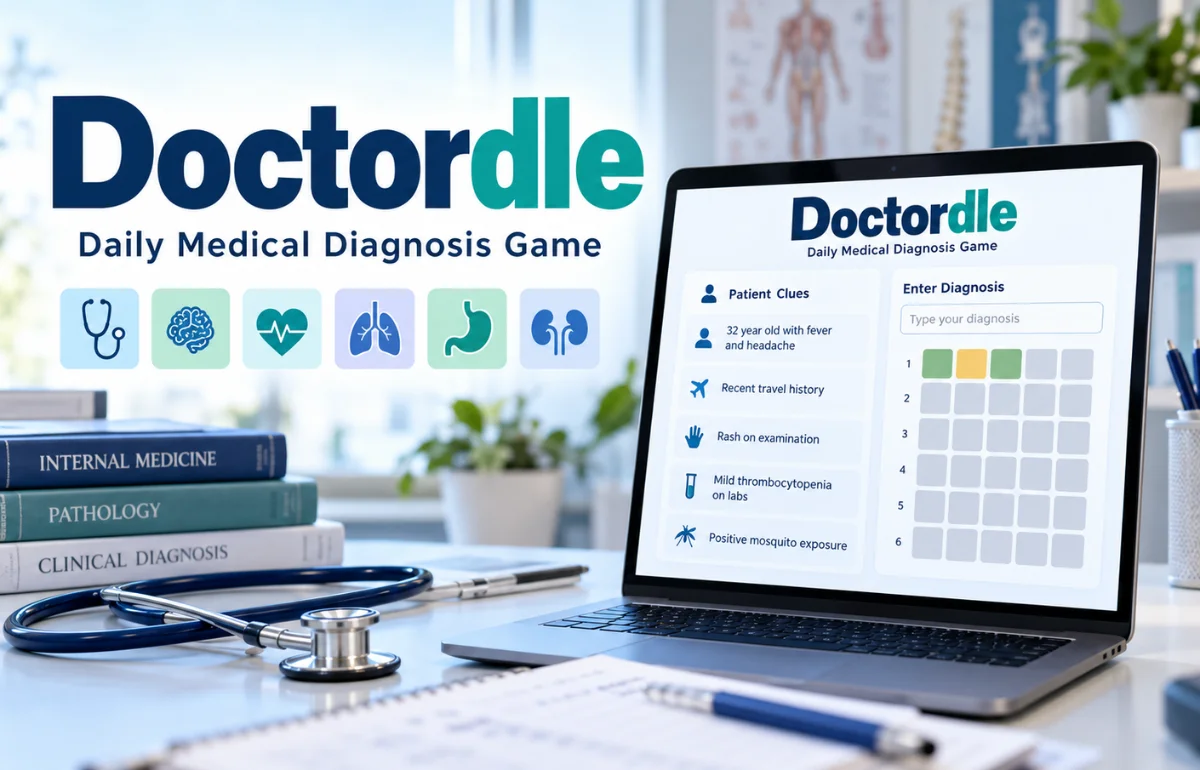
Doctordle is a browser-based medical diagnosis guessing game in which players read a short patient scenario and try to identify the condition behind it. Each daily puzzle begins with limited information, such as a patient’s age, symptoms, or reason for seeking care. An incorrect guess reveals another clue, and the player has up to six attempts to solve the case.
Think of it as a medical mystery with Wordle’s daily-puzzle rhythm, rather than a spelling challenge. Anyone can try it, although medical students and healthcare enthusiasts may recognize some clinical patterns more quickly. The game is designed for entertainment and learning, not for diagnosing real patients.
What Makes Doctordle Different From an Ordinary Word Game?
In Wordle, I look for letters and their positions. In Doctordle, the useful information is clinical: a symptom that develops suddenly, a relevant medical history, or a laboratory result that changes which diagnosis seems most plausible.
The task is not to spell the answer through elimination. It is to interpret a short, deliberately incomplete story.
A clue can make several conditions seem possible. The next clue may strengthen one explanation or undermine it completely.
I find that decision point more interesting than simply recognizing a medical term: should I commit to a guess now, or acknowledge that I need more evidence?
The original game at doctordle.org was released on July 17, 2025, according to its developer’s press kit. Its publicly listed team includes medical students, a developer, a medical education editor, and an Anki tag integrator.
How to Play Doctordle
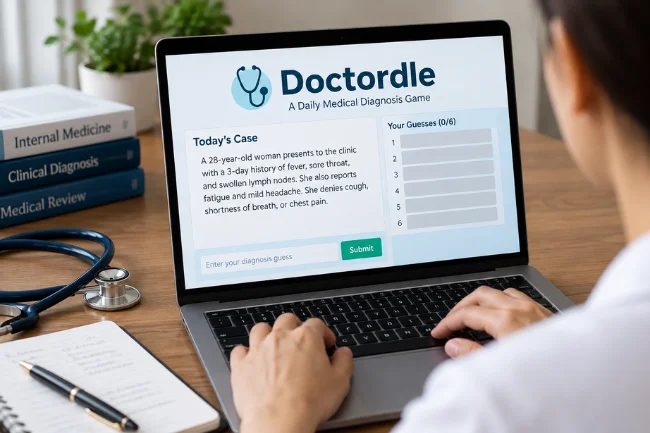
Read the Opening Case Carefully
Open the daily game and examine the first patient presentation. It may mention age, how long symptoms have lasted, or the setting in which the person seeks care.
Do not rush past these details. Duration and progression can sometimes be more revealing than the most dramatic symptom.
I suggest mentally separating what the case actually says from what I merely assume.
If the prompt mentions a cough, for instance, that does not automatically establish its cause. A useful first reading identifies the facts without filling in missing information.
Enter a Possible Diagnosis
Type a condition into the diagnosis field and submit it. This is not a five-letter guessing grid; the expected response is the name of a medical condition.
If the answer is incorrect, the case advances and provides another piece of information.
You have six attempts in the original daily format. An early correct answer feels rewarding, but an early random guess is rarely informative.
Reassess When a Clue Appears
Additional clues may introduce history, examination findings, or test results.
Instead of reading each detail independently, ask how it changes the overall picture. Does it fit the first diagnosis? Does it point toward an alternative? Is it truly distinctive, or could it occur in many conditions?
A wrong guess does not need to end the learning. It can expose an assumption I failed to notice.
Review the Answer and Your Results
After the round, read the diagnosis summary rather than immediately closing the page.
The original website says its summaries use AI and publicly available medical literature, so I treat them as starting points for learning, not unquestionable clinical references.
The site also offers statistics and optional free accounts for keeping progress across devices.
Its Anki-related buttons can help learners locate relevant material in an existing AnKing deck. They copy search tags; they do not automatically teach or verify every detail of the case.
Doctordle vs. Wordle vs. Medical Flashcards
These formats share the pleasure of finding an answer, but they train different habits.
| Feature | Doctordle | Wordle | Medical Flashcards |
|---|---|---|---|
| Main task | Infer a diagnosis from a case | Identify a hidden word | Recall a stored fact or concept |
| Information received | Clinical clues revealed over turns | Letter-position feedback | Questions and answers, sometimes with images |
| Typical approach | Compare competing explanations | Eliminate letter combinations | Retrieve and review knowledge |
| Daily structure | Daily case, with archived cases available | Daily word puzzle | Usually learner-controlled |
| Best use | Light clinical reasoning practice and entertainment | Wordplay and vocabulary logic | Organized study and spaced review |
I would not call one a replacement for the others.
Doctordle encourages interpretation; flashcards are useful for recalling facts; Wordle tests a different kind of pattern recognition.
The Reason Some Cases Feel Harder Than Others
Symptoms Rarely Belong to One Condition
A headache, cough, fever, or stomachache may appear in a wide range of conditions.
That is why the opening clue can feel frustratingly broad. Many diagnoses fit until something more specific arrives.
The useful question is not simply, “What disease can cause this?”
It is, “Which explanation best fits the particular combination of details presented?”
The second question naturally narrows the possibilities without pretending that one symptom proves an answer.
A Memorable Clue Can Mislead Me
An unusual detail can dominate my attention even when the remaining information points elsewhere.
Clinical reasoning researchers describe related problems as anchoring and premature closure: becoming attached to an early explanation and failing to revise it adequately when new evidence appears.
These problems are recognized in clinical reasoning research, although a recreational puzzle cannot reproduce the full complexity of diagnosing patients.
Medical Vocabulary Can Be a Barrier
Words such as “dyspnea,” “acute,” and “bilateral” may be familiar to trainees but confusing to new players.
They mean shortness of breath, a relatively sudden or short-duration presentation, and involvement of both sides, respectively, although the exact meaning still depends on context.
I recommend looking up unfamiliar terms after the round if doing so during play spoils the challenge.
Learning three useful words from a missed puzzle is a worthwhile result even when the guess counter says otherwise.
My Practical Strategy for Making Better Guesses
Build a Small Differential, Not a Long Wish List
A differential diagnosis is a group of possible explanations for a patient’s findings.
For gameplay, I recommend keeping two or three plausible candidates in mind instead of generating ten rare possibilities. This makes new clues easier to evaluate.
Start with what the puzzle actually gives you: the dominant symptom, duration, relevant context, and any distinguishing feature.
Avoid adding imaginary test results or assuming that an omitted symptom is absent.
Use My 3–2–1 Clue Check
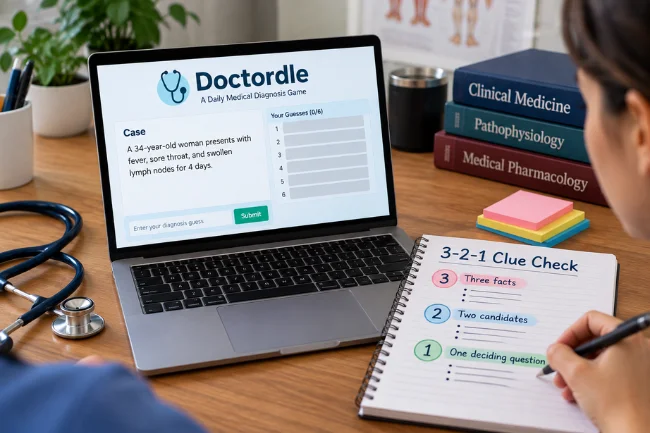
Here is a simple reading framework I recommend for puzzle play. It is my editorial technique, not an official Doctordle feature or a clinically validated diagnostic rule.
- Three facts: Identify the three most informative details explicitly stated in the case.
- Two candidates: Name two explanations that reasonably fit those facts.
- One deciding question: Ask what missing clue would most clearly distinguish those explanations.
After another clue appears, repeat the check.
Notice Negative Evidence, but Do Not Invent It
If a clue explicitly says there is no fever, that may affect which explanation looks persuasive.
But if the case simply never mentions fever, I cannot assume the patient does not have one.
Missing information and a confirmed negative finding are different things.
This small distinction improves puzzle reasoning.
Judge a Clue by How Much It Changes the Possibilities
Not all clues deserve equal weight.
A common symptom may match several candidates. A distinctive test result could separate them more sharply.
I try to ask whether a clue merely repeats what I already suspect or genuinely shifts the balance.
I also avoid equating speed with understanding.
Guessing correctly on the first attempt can involve luck; explaining why an answer fits is a stronger personal learning target.
A Fictional Example of the Reasoning Process
Imagine a made-up Doctordle-style case that begins, “An adult develops repeated sneezing and a runny nose.”
Several possibilities come to mind, including an allergy and a respiratory infection.
Nothing in that opening line is enough to establish a medical diagnosis.
Now imagine a second clue: the symptoms repeatedly begin while cleaning a dusty room.
A third adds itchy eyes.
In this deliberately simplified puzzle, an allergic explanation becomes more plausible, and allergic rhinitis might be the intended answer.
Notice what changed.
I did not need a long list of disease names. I needed to recognize the relationship between the symptoms and the setting, then update my initial possibilities as information arrived.
This is an original illustrative example, not an actual daily case and certainly not advice for evaluating a real person.
Actual symptoms can have different causes and require appropriate medical assessment.
Can Doctordle Help Medical Students Learn?
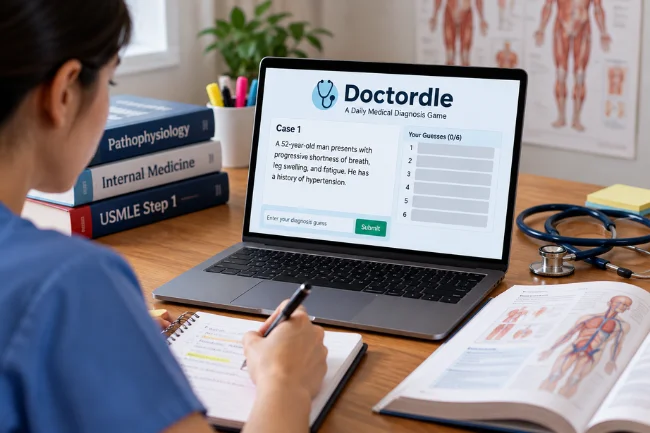
It can provide an engaging supplement, but the distinction between enjoyable practice and proven educational benefit matters.
Reading a case, attempting an answer, and reviewing a missed concept resembles retrieval practice, an approach used in medical education.
A 2024 randomized study involving family physicians and residents found that scheduled repetition improved learning and later knowledge transfer compared with no repetition.
That research does not prove Doctordle itself improves exam results, diagnostic accuracy, or patient care.
I would be cautious about anyone making that leap.
A short game cannot reproduce the complexity of patient interviews, physical examinations, investigations, supervision, or clinical responsibility.
For a medical student, I suggest treating each round as an invitation to revisit one concept.
If the answer surprises you, look up the condition in a trusted textbook or medical reference.
The original site’s Anki tags may help users with a compatible AnKing collection locate related revision cards for USMLE Step 1 or Step 2 topics.
For a reader without medical training, the benefit is simpler: encounter unfamiliar terminology, practice careful reading, and enjoy solving a mystery.
Where Can You Play Doctordle, and Are the Websites the Same?
This is a detail worth checking before you bookmark a result.
Several websites use the Doctordle name, but their features and operators are not necessarily identical.
The developer press kit identifies doctordle.org as the website of the game released in July 2025; other sites describe themselves as separate projects.
| Website | Features Described by the Site | What to Keep in Mind |
|---|---|---|
| doctordle.org | Daily cases, archive, optional account and Anki-related tags | Original release documented in its press kit |
| doctordle.app | Fictional six-clue puzzles with plain-language explanations and reference links | States that its early puzzle bank is not claimed to be clinician-reviewed |
| doctordle.net | Daily diagnosis game, endless practice and themed case pages | Describes itself as independent from doctordle.org |
| doctordle.online | Daily cases, unlimited formats and specialty editions | A separate website with its own stated features |
I would compare the address bar, the site’s About page, and its privacy statement rather than assuming a feature mentioned in one review applies everywhere.
An archive, account system, specialty mode, or clue mechanism on one site might behave differently on another.
For readers interested primarily in the original daily game, doctordle.org is the clearest starting point.
Is Doctordle Safe and Medically Accurate?
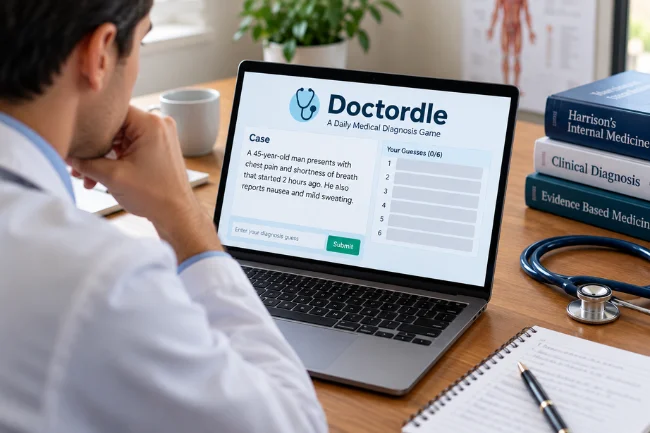
The biggest boundary is straightforward: a correct puzzle answer is not a clinical diagnosis.
Real healthcare involves far more information than a fictional case and is affected by context, probability, testing, and professional judgment.
Doctordle’s own site says its content is entertainment rather than medical advice.
I would also distinguish a sourced explanation from an independently verified medical lesson.
The original site’s diagnosis summaries are described as AI-generated using public medical literature.
That can help introduce a topic, but I would cross-check any important health claim through reputable sources such as MedlinePlus or a qualified clinician.
Privacy deserves some attention, too.
The original site’s September 2026 privacy policy says accounts may collect details such as name, email address, and profession, along with gameplay data.
It also mentions cookies, analytics tools, and advertising technologies.
A free account can be convenient, but I recommend reviewing those terms before signing up.
Finally, avoid typing private real-life symptoms or identifying patient information into a recreational game.
If you are worried about your health, seek professional medical guidance.
If symptoms suggest an emergency, contact local emergency services rather than continuing a puzzle.
How I Would Turn a Daily Puzzle Into a Useful Habit
I recommend keeping the routine brief.
Spend a minute reading the scenario, make deliberate guesses, and reserve a little time afterward to understand the reveal.
A small review note can help: record the clue that changed your mind, the answer you initially preferred, and one concept to revisit.
After a week, look for patterns.
Perhaps you routinely overlook symptom duration, or perhaps unfamiliar terminology causes avoidable mistakes.
For extra practice, use the original game’s archive rather than searching for today’s answer.
Solving older cases makes the process more repeatable, while looking up the solution beforehand removes the central reasoning challenge.
If I were measuring improvement, I would value clearer explanations and fewer repeated errors over a perfect streak.
Final Thoughts
Doctordle turns the question “What’s the diagnosis?” into an accessible daily mystery.
Its appeal comes from gradual clues, the temptation to guess early, and the satisfaction of revising an idea when new evidence appears.
I think its best role is a short, enjoyable reasoning exercise, with reliable medical resources available whenever a topic deserves deeper study.
Try a daily case at doctordle.org, read the explanation after you finish, and see whether you can identify one new thing you learned.
That is a more lasting reward than the guess count alone.
Frequently Asked Questions About Doctordle
Is Doctordle Free to Play?
Yes. The original daily game and archived cases can be played in a web browser without paying or creating an account.
How Many Guesses Do I Get in Doctordle?
You have up to six attempts to identify the intended diagnosis. An incorrect guess reveals additional information about the case.
Is Doctordle Suitable for People Without Medical Training?
Yes. Anyone interested in medical mysteries can try it, although some terminology and cases may be challenging for beginners.
Can I Play Previous Doctordle Puzzles?
Yes. The original website has a numbered archive of earlier daily cases, which is useful for additional practice.
Is Doctordle a Real Medical Diagnosis Tool?
No. Its cases are designed for entertainment and learning, not for diagnosing symptoms, selecting treatment, or replacing a healthcare professional.

Noah Sterling is a technology research writer with 8+ years of experience covering emerging technologies, software trends, digital tools, and innovation. He creates practical, research-based articles to help readers understand the evolving technology landscape.