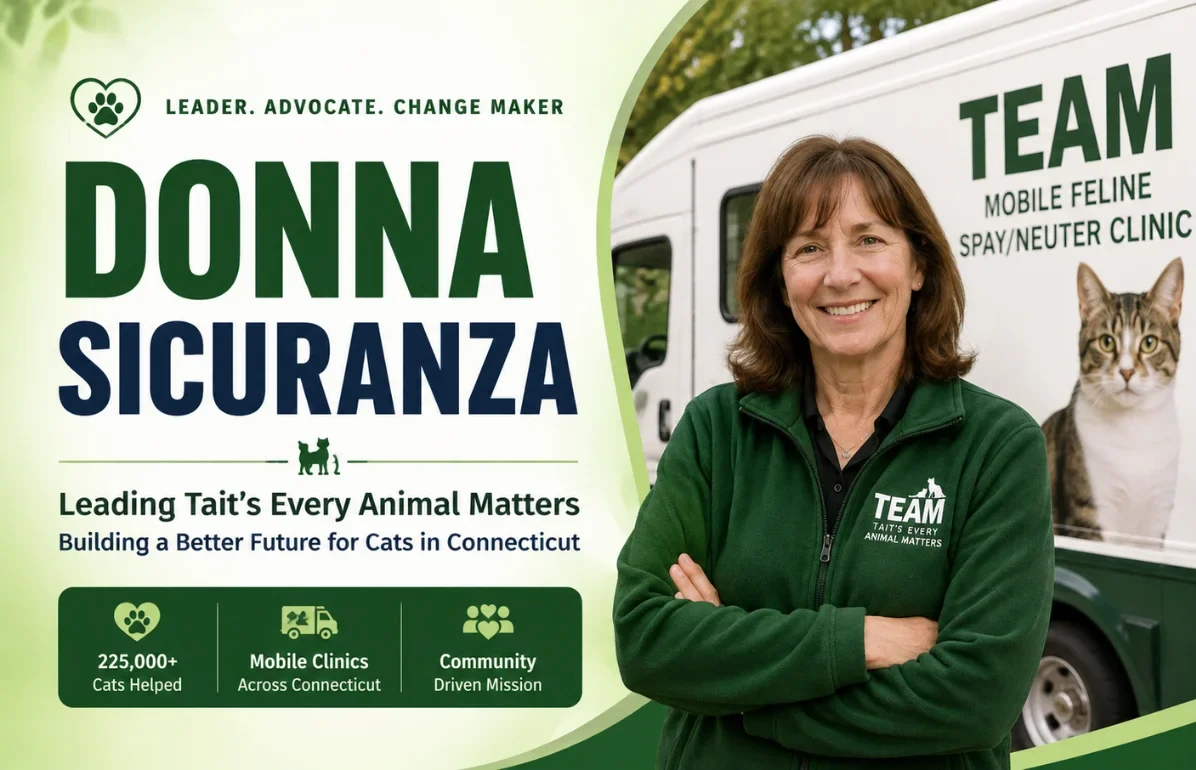
Donna Sicuranza is a Connecticut nonprofit executive best known for leading Tait’s Every Animal Matters (TEAM), the Westbrook-based animal-welfare charity behind the TEAM Mobile Feline Spay/Neuter Clinic. TEAM’s current staff page lists the Executive Director as Donna Sicuranza Marconi, while earlier TEAM publications and news reports use Donna Sicuranza. Her public work is closely tied to affordable spay/neuter services, vaccination access, feral-cat programs, and the long-running effort to reduce feline overpopulation across Connecticut.
When I reviewed the public record, the clearest picture was not of a celebrity-style public figure but of a working nonprofit leader whose career has been built around one practical idea: make preventive veterinary care easier for cat caretakers to reach.
Donna Sicuranza at a Glance
| Detail | Publicly documented information |
|---|---|
| Known professionally as | Donna Sicuranza; current TEAM staff listing uses Donna Sicuranza Marconi |
| Current role | Executive Director, Tait’s Every Animal Matters (TEAM) |
| Base | Westbrook, Connecticut |
| Main field | Nonprofit leadership and animal welfare |
| Best-known program | TEAM Mobile Feline Spay/Neuter Clinic |
| Clinic launched | 1997 |
| Reported cumulative impact | More than 225,000 cats sterilized and vaccinated since 1997 |
| Earlier professional background | Writing, editing and public relations are reported in professional listings |
| Public-policy involvement | Represented TEAM at a Connecticut Animal Population Control Program working-group meeting in 2019 |
TEAM says its veterinarians have sterilized and vaccinated more than 225,000 cats since 1997 and that domestic and feral cats from Connecticut are eligible to use the mobile clinic. The organization describes the program as Connecticut’s first and only mobile spay/neuter and vaccination clinic for cats.
Who Is Donna Sicuranza?
Donna Sicuranza’s public identity is centered on Tait’s Every Animal Matters rather than on personal publicity. Today, the organization lists Donna Sicuranza Marconi as Executive Director. A 2019 TEAM newsletter, however, identifies Donna Sicuranza as Executive Director and editor of the organization’s newsletter. Older Connecticut news coverage also quotes Donna Sicuranza as a TEAM spokesperson.
I find that name variation worth addressing because it can confuse someone doing a simple Google search. The safest way to read the record is to follow the organization, role and timeline rather than assume every name variation represents a different person.
What is well documented is her long association with TEAM’s feline-welfare work. The organization’s current staff page says most of its small team has been with the program for more than 25 years, and Donna is listed at the top of its administrative staff.
How TEAM’s Mobile Clinic Began
To understand Donna Sicuranza, I think it helps to understand the problem TEAM was trying to solve in the 1990s. A Connecticut Magazine feature reported that veterinarian John Caltabiano received repeated calls from people dealing with unwanted litters, feral cats and other feline-overpopulation problems. Sicuranza, who was then working in journalism and public relations, described how those calls revealed a recurring need for affordable sterilization services.
The TEAM mobile clinic went on the road in 1997. According to TEAM’s own 2019 newsletter, the clinic was established by Caltabiano and Donna Sicuranza to make spay/neuter services more affordable and accessible. On its first day, the staff altered 12 cats aboard a 22-foot vehicle.
The program did not stay small. By July 2001, local reporting said TEAM had sterilized more than 40,000 cats. In 2019, TEAM celebrated its 200,000th sterilization surgery. The current organization website now reports more than 225,000 cats sterilized and vaccinated since 1997.
TEAM’s Growth: Then and Now
| Period | What the public record shows |
|---|---|
| 1997 | Mobile clinic launched; 12 cats treated on the first day in a 22-foot unit |
| 2001 | More than 40,000 cats sterilized since launch |
| 2019 | 200,000th sterilization surgery completed; TEAM described two custom-built clinic vehicles |
| 2026 | TEAM reports more than 225,000 cats sterilized and vaccinated since 1997 |
| Current model | Mobile spay/neuter and vaccination services at multiple Connecticut locations |
When I put those milestones side by side, the scale is easier to understand. The 225,000 figure represents decades of repeated clinic days, scheduling, veterinary work, transport, public communication, and follow-up.
What Donna Sicuranza Actually Does at TEAM
An Executive Director at a small nonprofit usually has a wider job than the title suggests. TEAM’s site does not publish a detailed job description for Sicuranza, so I would not pretend to know every part of her day-to-day workload. Still, the public record shows several areas where her role is visible.
She has served as an organizational spokesperson, appeared in TEAM publications, edited the TEAMWORKS newsletter, and represented the nonprofit in public-facing discussions. Her position also places her on the administrative side of an operation that depends on scheduling, donor support, program communication, veterinary staffing, and mobile-service logistics.
The distinction between administrative and medical leadership is clear on TEAM’s current staff page. Donna Sicuranza Marconi is listed as Executive Director, while Art Heller, DVM, is listed as Medical Director. Sicuranza’s public role is nonprofit leadership, not veterinary practice.
Her Communications Background Is More Relevant Than It Looks
Professional listings associate Donna Sicuranza with an earlier career in writing, editing, and public relations. LinkedIn’s indexed profile also connects her with Trinity College-Hartford, although a complete education history is not visible in the public search result. Because education details are repeated inconsistently across secondary websites, I would treat specific degree claims cautiously unless confirmed by a primary record.
What is easier to verify is that communications have been part of her work for years. In the 2019 TEAMWORKS issue, Sicuranza is identified as the editor and writes directly to readers about the organization’s goals and programs.
While researching this profile, I found this detail more useful than generic claims about “leadership.” Communication is operational in a nonprofit. Someone has to explain why a program matters, make services understandable, maintain donor trust, and turn statistics into a mission people can support.
Sicuranza’s visible editorial and spokesperson work shows that communication has been part of her public role.
A First-Person Story That Explains Her Animal-Welfare Approach
One of the strongest experience signals I found is not a résumé item. It is a short story Sicuranza wrote in TEAM’s 2019 newsletter about a feral cat she called Sobie.
She described feeding the cat near her farm and hoping to trap him for neutering. Before she could do so, the cat was hit by a car. Sicuranza wrote that stories like Sobie’s helped inspire the TEAM Incentive Program for feral cats. TEAM said the incentive program had assisted more than 320 feral cats by 2019.
That detail adds something many Donna Sicuranza biographies miss. It connects a formal animal-welfare program to a documented personal experience rather than simply describing her as an “animal advocate.”
TEAM continues to advocate Trap, Neuter and Release, commonly shortened to TNR. Its current website says feral cats are accepted aboard the mobile clinic and qualifying caretakers may receive a partial rebate.
Donna Sicuranza’s Role Beyond the Clinic
Sicuranza’s work has also intersected with statewide animal-population discussions. Connecticut Department of Agriculture records list Donna Sicuranza of Tait’s Every Animal Matters among attendees at an Animal Population Control Program Working Group meeting in June 2019. Other attendees included state officials, animal-control professionals, veterinarians and animal-rescue representatives.
I would not overstate what those minutes prove: attending a working-group meeting is not the same as holding public office or setting state policy.
But it is credible evidence that her role extended beyond internal nonprofit administration and into wider discussions about animal population control in Connecticut.
That is a more useful expertise signal than simply calling someone “influential.” It shows where the person actually appeared in the professional ecosystem.
What TEAM Looks Like in 2026
A profile of Donna Sicuranza should not stop in 2019. As of August 2026, TEAM remains active, and its website lists mobile clinic locations across Connecticut, including Middletown, Torrington, Waterford, Newington, and Enfield, among others. Locations are subject to change, so residents are told to call for current scheduling.
The current service page lists a $245 spay or neuter package that includes vaccinations, a nail trim, and ear-mite treatment when needed. Cats and their caretakers must be Connecticut residents, and feral cats may qualify for a partial rebate.
Public nonprofit data compiled from TEAM’s recent filings adds another present-day snapshot. Cause IQ lists the Vernon Tait All Animal Adoption Preservation Team as a 501(c)(3) organization formed in 1993 and reports that it treated 2,720 animals in fiscal year 2025. That annual figure should not be confused with the 225,000-plus cumulative total TEAM reports since 1997.
The newer records add context many short biographies miss: Sicuranza is attached to an organization that is not only historically notable. It is still operating a defined veterinary program and reporting ongoing animal-care activity.
Why Preventive Cat Care Is Central to Her Work
TEAM’s stated goal is simple: spay or neuter as many cats as possible before they reproduce. That wording explains why Sicuranza’s career is best understood through prevention rather than rescue alone.
Spay/neuter programs address reproduction before unwanted litters add pressure to households, rescue networks or unmanaged outdoor colonies. For feral-cat caretakers, TEAM promotes TNR: trapping cats humanely, sterilizing them and returning them to their established location.
The mobile model adds another layer. Instead of requiring every caretaker to reach one fixed veterinary facility, TEAM brings scheduled services to communities around the state. Its current website lists numerous Connecticut stops for the clinic.
Accessibility does not solve every animal-welfare problem, but it addresses a very practical one: distance.
What Is Not Publicly Confirmed About Donna Sicuranza
There is a surprising amount of low-quality biography content online that fills gaps with confident-sounding personal details. I would avoid that approach.
I did not find a reliable primary source that publicly confirms Donna Sicuranza’s date of birth, age, personal net worth, or a complete education history. Some secondary profiles publish such details or mix information from similarly named people, which is where entity errors can happen.
For an authoritative article, I would rather say what is known and leave private or unverified details alone.
The documented story is already substantial: long-term nonprofit leadership, the creation and growth of a mobile feline clinic, a first-person account connected to feral-cat advocacy, and participation in state animal-population discussions.
Why Donna Sicuranza’s Work Still Matters
What stands out to me after comparing older reporting with TEAM’s current information is continuity.
In 2001, Sicuranza was explaining why rural communities and feral-cat populations needed accessible services. In 2019, she was writing about the 200,000-surgery milestone and the people behind it. In 2026, TEAM still lists her in executive leadership while the clinic continues serving Connecticut cats.
She is a nonprofit leader whose public legacy is tied to sustained, preventive animal-welfare work rather than personal fame.
For the most current information about Donna Sicuranza or TEAM’s services, I recommend checking the organization’s official staff and mobile-clinic pages before relying on third-party biography sites.
Frequently Asked Questions
Who is Donna Sicuranza?
Donna Sicuranza is the Executive Director associated with Tait’s Every Animal Matters (TEAM), a Connecticut nonprofit operating a mobile feline spay/neuter and vaccination clinic.
Is Donna Sicuranza the same as Donna Sicuranza Marconi?
TEAM’s current staff page uses Donna Sicuranza Marconi, while earlier TEAM material identifies Donna Sicuranza as Executive Director; the organizational record points to the same professional identity.
What is Donna Sicuranza known for?
She is best known for long-term leadership of TEAM and its effort to make feline spay/neuter and vaccination services more accessible across Connecticut.
How many cats has TEAM helped?
TEAM currently reports that its veterinarians have sterilized and vaccinated more than 225,000 domestic and feral cats since 1997.
Where is Tait’s Every Animal Matters located?
TEAM is headquartered in Westbrook, Connecticut, while its mobile clinic travels to scheduled locations in communities around the state.

Evelyn Hartwell is a biography writer and historical researcher with over 5 years of experience exploring the lives, achievements, and personal journeys of notable individuals. She focuses on creating well-researched, engaging biographies by analyzing reliable sources and presenting accurate life stories with meaningful context.