
Wuschitz is a family surname documented in Austrian genealogical records. In contemporary searches, the name is especially associated with Stefanie Wuschitz, an Austrian artist, researcher, and founder of the feminist art and technology collective Mz* Baltazar’s Laboratory. Her work connects digital art, open-source technology, inclusive makerspaces, and questions about who controls the tools people use. Wuschitz is not, by itself, the name of a software product, scientific theory, or technology company.
I find the distinction useful because someone searching for Wuschitz may be looking for a family name, a person’s biography, or an explanation of feminist hacking. These subjects overlap, but they are not interchangeable. This article covers the surname first, then examines Stefanie Wuschitz’s education, research, influential projects, and the wider relevance of her ideas.
What Does the Name Wuschitz Mean?
The safest definition is also the simplest: Wuschitz is a surname, not an ordinary English word with a fixed dictionary meaning. The genealogy platform Geneanet indexes the spelling in records connected with Vienna and identifies Woschitz and Wutschitz as possible spelling variants.
Those records show that the name has a documented connection with Austria. They do not establish a single birthplace for every family bearing it, an agreed linguistic derivation, or a reliable translation. I would be cautious of websites that assign the surname an elaborate symbolic meaning without citing a historical name dictionary or original records.
Historical surnames often changed spelling as they moved between languages, regions, and record keepers. That possibility makes variant searches useful, but a similar spelling does not prove that two people share the same ancestry. Even a genealogy database’s result count measures its own indexed material, not the number of living people with the surname.
Wuschitz, Stefanie Wuschitz, and Mz* Baltazar’s Laboratory: What Is the Difference?
| Search term | What it refers to | Best place to start |
|---|---|---|
| Wuschitz | A family surname found in historical records | Genealogy indexes and original civil or church documents |
| Stefanie Wuschitz | An Austrian media artist and academic researcher | University biographies, publications, and her projects |
| Mz* Baltazar’s Laboratory | A feminist art and technology collective associated with her work | The collective’s official website and workshop history |
This distinction prevents an easy mistake: treating a surname as if it were a branded movement or assuming every result about Wuschitz refers to the same individual.
Who Is Stefanie Wuschitz?
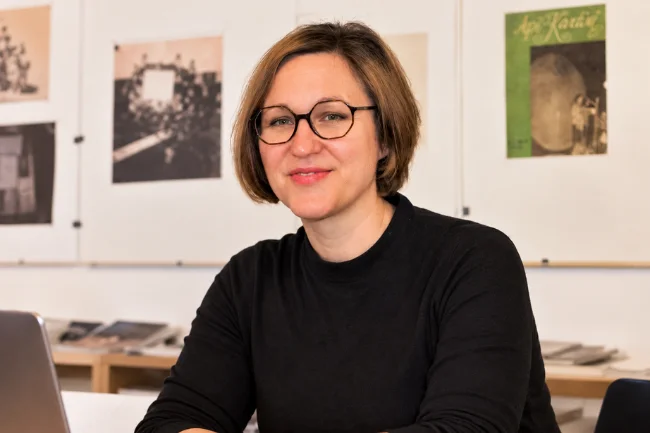
Stefanie Wuschitz, born in 1981, is a Vienna-based artist and researcher whose practice crosses media art, critical technology studies, animation, and collaborative making. Her focus is not simply on building electronic objects. She asks who can design technology, whose knowledge counts, and what social or environmental costs are hidden inside devices.
According to her Berlin University of the Arts profile, she completed a degree in Transmedia Arts in Vienna in 2006 and a master’s program at New York University in 2008. She then worked as a Digital Art Fellow at Umeå University in Sweden. In 2014, she completed doctoral research on feminist hackerspaces at the Vienna University of Technology.
Her later positions included research affiliations in Vienna, Berlin, and international academic networks. These experiences help explain why her projects combine the language of exhibitions with the methods of workshops, field research, and academic publishing.
What stands out to me is the continuity of her questions. The tools and materials change, but her central concern remains the relationship between technical power and everyday participation.
How Mz* Baltazar’s Laboratory Began
A major part of Wuschitz’s public work is Mz* Baltazar’s Laboratory, a feminist collective that brings art, science, electronics, and learning into the same room. Its official history traces the project’s founding to 2008, when Wuschitz was in Sweden. Institutional biographies often refer to the collective’s establishment in 2009, while the laboratory’s history dates its dedicated hackerspace in Vienna to 2011.
These dates describe stages in the initiative’s development rather than necessarily conflicting accounts. The early idea became an organized network of workshops and then a physical space for making and exhibiting work.
The name was inspired by Professor Balthazar, a cartoon inventor who solved problems through experimentation. The collective adapted that imaginative spirit but put a new question at the center: What happens when people who feel excluded from mainstream technical spaces create their own environment?
Crucially, the founders did not assume women needed simpler technology. The premise was that a different social setting could make complex tools easier to approach, question, and reshape. The lab hosted creative workshops across international cities and developed exhibition and discussion programs in Vienna.
That approach challenges the belief that technical expertise only comes from a formal engineering qualification. A maker can begin with curiosity, practical experience, an artistic idea, or knowledge gained from a community.
What Is Feminist Hacking in Wuschitz’s Work?
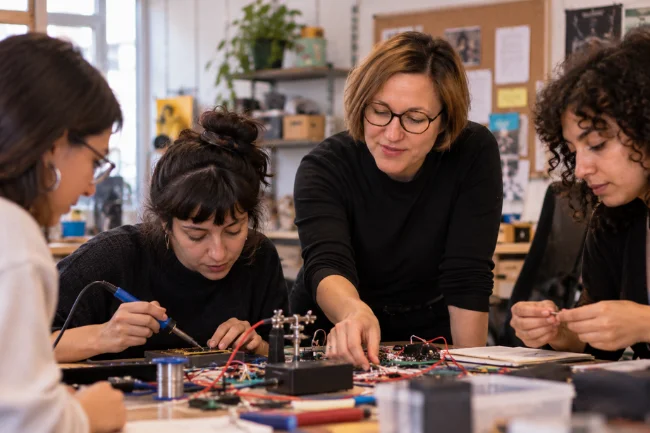
Here, hacking means experimenting with, modifying, and understanding technological systems. It does not mean stealing passwords or breaking into private accounts. Feminist hacking adds questions about access, representation, power, consent, and working conditions.
In the projects associated with Wuschitz, people might build circuits, dismantle discarded electronics, create interactive installations, or share technical skills. But the resulting object is only one part of the work. How participants collaborate, credit one another, and choose materials matters too.
I think of this as three connected layers. The first concerns access: who feels able to enter a workshop and participate? The second concerns authorship: who gets to influence a design and receive recognition? The third concerns responsibility: where do the components come from, and what happens when the finished object is discarded?
Conventional Maker Culture and Feminist Hacking Compared
| Question | A conventional, output-focused approach | The feminist-hacking emphasis in Wuschitz’s work |
|---|---|---|
| What is success? | A working prototype or impressive technical result | A functioning creation and a more inclusive process |
| Who is the expert? | Often the person with established technical skills | Expertise can also come from lived experience and shared learning |
| How are materials chosen? | Availability, price, and performance | Those factors plus sourcing, repair, waste, and labor |
| Who receives credit? | The lead designer or inventor | Collaborators, communities, and contributors |
This comparison describes priorities, not a rule that every mainstream makerspace is exclusionary. Many traditional workshops already practice openness and ethical design. Wuschitz’s contribution is to make those questions a deliberate part of the creative method.
Major Projects and Research Contributions
Clay PCB: Rethinking the Circuit Board
One of the clearest examples is Clay PCB, developed through a larger collaboration involving Wuschitz and artist-researcher Patrícia J. Reis. A printed circuit board, or PCB, usually supports electrical components using an industrially manufactured substrate and conductive pathways.
The team’s Clay PCB project instead explored wild clay collected in Austria, fired using a wood fire, conductive tracks made with silver recovered from existing material, and components reused from older electronics. The resulting open-source microcontroller demonstrates that a circuit can also become an artistic question about extraction, waste, and local resources.
I would not describe clay electronics as a proven mass-market replacement for conventional circuit boards. Industrial electronics must satisfy requirements for durability, consistency, heat, and electrical performance that an experimental artwork does not automatically meet.
Its value lies elsewhere: the project makes normally invisible decisions about materials visible. When viewers can identify the clay, recycled parts, and human labor in a device, the familiar idea of technology as a sealed black box becomes harder to sustain.
The Women* Who Made It: Listening to Makers
In 2021, Wuschitz co-authored a peer-reviewed study in Sustainability that examined the experiences of ten women* attending Schmiede, a ten-day maker festival with an unusually balanced gender mix.
Rather than assuming that simply inviting a broader range of participants would solve exclusion, the authors examined mentorship, motivations, sexism, belonging, and barriers to participation. Their findings provide a useful reminder: a welcoming creative community requires more than an open door.
The sample was small and specific, so it should not be treated as a global survey of all makerspaces. Its strength is the detail of individual experiences and the practical questions it raises for organizers.
The NENEK Project: Recognizing Everyday Expertise
Another revealing example is the NENEK Project in Indonesia. Wuschitz worked with Cindy Lin and the art, science, and technology initiative Lifepatch on research involving older women and the knowledge they passed between generations.
Lifepatch’s project documentation describes visits, conversations, and efforts to understand techniques, social relationships, and forms of mutual support. The work took place around 2014 and 2015 in Yogyakarta and challenged a narrow definition of technology as something limited to computers and machines.
A grandmother’s practical knowledge may involve organizing resources, maintaining relationships, adapting tools, or solving problems with what is available. Such knowledge is often overlooked in innovation narratives that focus entirely on new inventions. I see NENEK as a particularly useful link between technical research and cultural memory.
Salon of Open Secrets: Making Electronics’ Hidden Costs Visible
The Austrian Science Fund supported Salon of Open Secrets, a citizen-science project running from November 2022 through October 2023. Its premise was straightforward: phones and laptops contain valuable materials, but their extraction, manufacture, and disposal carry consequences that are easy to ignore.
Wuschitz and Reis explored alternative hardware, locally available resources, and ways to bring non-specialists into the discussion. The work joined public participation with artistic investigation rather than leaving the issue entirely to industry experts.
Wuschitz’s Research on Digital Colonialism
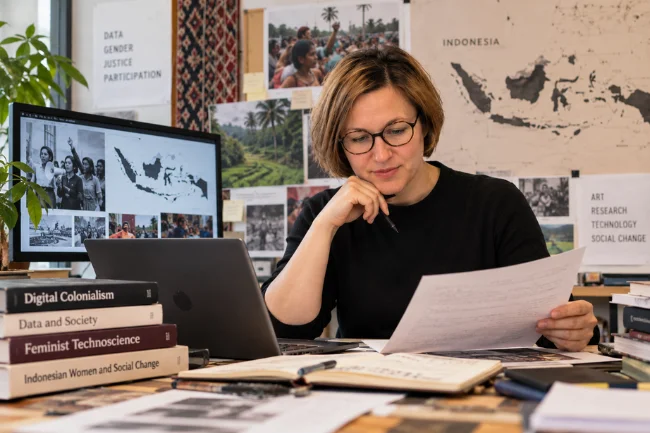
Her research also extends beyond physical devices. The Austrian Science Fund lists Strategies Against Digital Colonialism as an ongoing project scheduled from November 2023 to October 2027. It examines questions about data, gendered violence, historical anti-colonial movements, and contemporary digital activism in Indonesia.
Digital colonialism is a framework for examining how powerful institutions or companies gain control over data, infrastructure, and digital value, sometimes at the expense of the communities producing them. It is an analytical concept rather than a claim that every online service operates in the same way.
Wuschitz’s project draws connections between Indonesian women’s organizing histories and present-day struggles over digital power. It uses interviews, archival material, visual art, and animation to communicate complex findings. The research description also identifies privacy protection as a reason to explore artistic forms of storytelling.
This is a noteworthy shift in scale. Earlier projects ask who can make a circuit or enter a laboratory. This research asks who owns the information circulating through entire digital systems. Both questions concern participation, but one focuses on tangible hardware while the other focuses on data and history.
A Book That Connects the Ideas
Wuschitz and Reis brought many of these themes together in Hardware and Eco-Feminist Art: Hacking and Artistic Practices Towards Ethical Technology. The scholarly open-access edition is listed with a 2025 publication date, while Columbia University Press, which distributes a paperback edition, lists July 2026.
That publication-date distinction matters when checking bibliographies: different formats can carry different dates without representing unrelated books. The text examines material extraction, care, local knowledge, collaborative survival, and experiments with ethical hardware.
I find the book especially useful as a bridge between an individual artwork and a broader research method. Instead of presenting one unusual circuit board as a complete solution, it places experimental hardware inside a conversation about how technological systems could be made more accountable.
Why Wuschitz’s Ideas Matter Beyond Art Galleries
You do not need to work in media art to apply the questions raised by this research. A school buying electronics, a community workshop teaching coding, or a company prototyping a product can all examine the relationship between technical results and the conditions of production.
For example, I would use five questions to review a technology workshop or design project. Who is missing from the planning discussion? Can beginners contribute without embarrassment? Are materials repairable or reusable? Do all contributors receive appropriate credit? And can participants understand what data, if any, the finished system collects?
These questions are my practical synthesis of the themes across the research, not a checklist published or endorsed by Wuschitz. They make the subject useful for teachers, designers, makerspace organizers, and readers who want to look beyond an attractive prototype.
There is also a limit worth acknowledging. Ethical goals can conflict: a locally available material may fail durability tests, while a repairable device may still need components with difficult supply chains. Treating sustainability as an ongoing design process is more credible than declaring any electronic object completely harmless.
The larger lesson is that transparency creates room for improvement. Once the people, materials, and decisions behind a device become visible, users can ask better questions about them.
How to Research Wuschitz Without Confusing the Facts
Because Wuschitz is both a surname and part of a prominent researcher’s name, search results can mix unrelated kinds of evidence. For family history, start with historical registration documents and carefully compare dates, places, and spelling variants. A database entry is a lead to investigate, not proof of an entire family tree.
For Stefanie Wuschitz’s career, university biographies help establish academic milestones. Funding-agency records clarify project titles and dates. The lab’s website explains its own development, while peer-reviewed articles and publisher catalogs verify particular claims about research and publications.
I also check whether a project is described as completed or ongoing. An announced research objective is not the same as a published finding. That distinction is especially relevant to work scheduled to continue through 2027.
Frequently Asked Questions About Wuschitz
What is Wuschitz?
Wuschitz is a surname documented in Austrian genealogical records and is also the surname of artist and researcher Stefanie Wuschitz.
Where does the surname Wuschitz come from?
Historical records connect it with Austria, including Vienna, but a precise linguistic origin or single family birthplace is not firmly established.
Who is Stefanie Wuschitz?
She is an Austrian media artist and researcher known for feminist hacking, digital art, open-source technology, and Mz* Baltazar’s Laboratory.
What is Mz* Baltazar’s Laboratory?
It is a feminist art and technology collective that organizes experimentation, exhibitions, and shared learning around technology and creative practice.
Why is Stefanie Wuschitz significant in technology research?
Her work connects inclusive making, ethical hardware, environmental responsibility, and research into how social power shapes digital systems.
Final Thoughts
Wuschitz may begin as a name search, but the documented work of Stefanie Wuschitz opens onto larger questions about the design and ownership of technology. Her projects show why participation, materials, culture, and history belong in the same conversation as technical performance.
For a closer look, start with Mz* Baltazar’s Laboratory’s official history, read the published makerspace research, and explore the Clay PCB project. Those primary sources offer a stronger foundation than unsupported claims about the surname or the person behind it.

Evelyn Hartwell is a biography writer and historical researcher with over 5 years of experience exploring the lives, achievements, and personal journeys of notable individuals. She focuses on creating well-researched, engaging biographies by analyzing reliable sources and presenting accurate life stories with meaningful context.