Ruschek is primarily a rare family name found in German-speaking and Central European records rather than the name of one famous person, technology, philosophy, or widely recognized brand. Genealogical sources classify Ruschek as a surname, while historical documents connect it with people in Germany, Austria, Hungary, the United States, and several other countries. One surname reference describes it as a German topographic name associated with someone who lived near a reed bed.
When I researched Ruschek across surname databases, historical archives, professional websites, sports records, and library catalogs, one thing became clear: a search for “Ruschek” can lead to several completely unrelated people. Understanding that distinction is essential if you are researching the name, tracing family history, or trying to identify a particular Ruschek.
Ruschek at a Glance
This distinction may sound simple, but it solves most of the confusion surrounding the keyword.
What Does Ruschek Mean?
The clearest published surname explanation I found comes through FamilySearch, which cites the Dictionary of American Family Names. It classifies Ruschek as German and gives it a topographic interpretation associated with a person living near a reed bed. The same entry connects the name with Rusch and mentions the related form Rüscher.
A topographic surname is a family name that originally described where a person lived. Many European surnames developed in this way. Instead of referring to an occupation such as a baker or smith, they might identify someone by a hill, forest, river, field, or another feature of the landscape.
That does not mean every person called Ruschek today descends from one individual who lived beside reeds. Surname development is rarely that neat.
Names can change through dialect, migration, clerical spelling, marriage records, transliteration, and the movement of families between countries. For a rare surname, even one altered letter can send genealogical research down an entirely different path.
Is the Origin of Ruschek Completely Settled?
I would not describe the etymology as completely settled.
FamilySearch provides a published German interpretation, but another surname database, Forebears, lists the name without assigning its own meaning. This is a good example of why I prefer to distinguish between a documented interpretation and absolute certainty.
For family-history research, the meaning of a surname is usually less valuable than evidence connecting specific people across generations.
Birth certificates, church registers, marriage records, census records, immigration documents, military files, property records, and contemporary newspapers can tell you far more about a particular Ruschek family than a general surname definition can.
How Rare Is the Ruschek Surname?
Ruschek is genuinely uncommon.
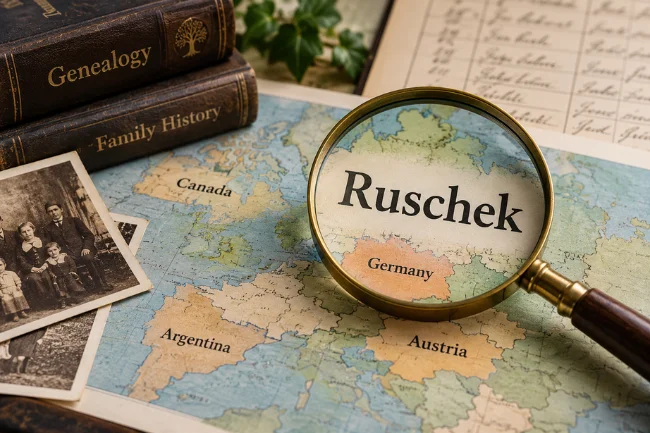
Forebears estimates that approximately 34 people in its surname-distribution dataset bear the exact spelling Ruschek. It identifies Germany as both the country with the greatest number and the highest density, recording 26 examples in Germany, five in Argentina, two in Austria, and one in Canada in the distribution data displayed on its page.
Those numbers should be treated as estimates rather than a global census.
FamilySearch, for example, reports tens of thousands of historical-record search results associated with the surname. That figure does not mean tens of thousands of living people currently have the name. One person can appear in multiple records, and the database covers records accumulated across generations.
This distinction is often missed when surname statistics are repeated online.
A “record match” and a “living surname bearer” are completely different measurements.
Where Is the Ruschek Name Found?
Current surname-distribution data points most strongly toward Germany. Forebears specifically places most of its German occurrences in Bavaria, followed by Baden-Württemberg and Hesse. It also records the exact surname in Argentina, Austria, and Canada.
Historical records broaden the picture.
FamilySearch surfaces Ruschek records involving people born in Germany and Austria as well as families documented later in the United States. Examples in its searchable material include twentieth-century census entries from New Jersey and Ohio.
This pattern makes sense for genealogy.
A surname’s present-day distribution does not necessarily show where every branch originated. Migration can carry a rare family name thousands of miles away while the spelling stays intact—or changes slightly after arrival.
Ruschek and Similar-Looking Surnames
Rare names create another research problem: similar spelling does not prove common ancestry.
Forebears lists forms that are phonetically or visually close to Ruschek, including Rutschek, Ruscheck, Rauschek, Rushek, Roschek, Rusczek, and others. The database itself cautions that phonetically similar names are not automatically related.
That warning matters.
I would never merge records for “Ruschek” and “Ruscheck,” for example, merely because they look similar. I would first look for a continuous documentary trail linking the same family, location, spouse, parents, occupation, or dates.
A Useful Rule for Genealogy
Treat spelling variation as a clue, not proof.
Older handwritten records can easily produce transcription differences. The same individual may even appear under slightly different spellings in separate documents.
But two similar surnames from different regions may also have completely independent histories.
Antal Ruschek: The Most Significant Historical Name-Bearer
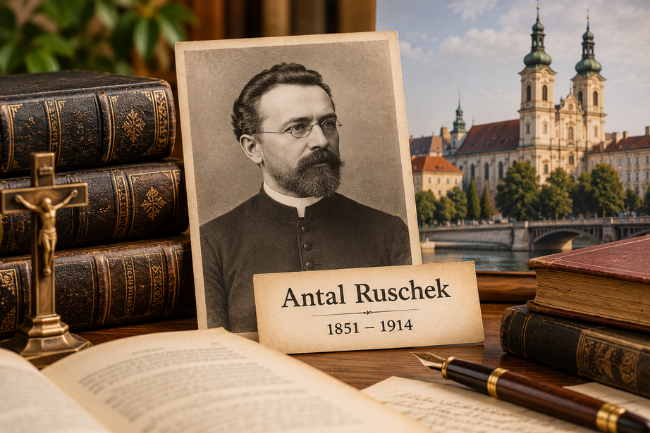
One of the strongest historical references attached to the surname is Antal Ruschek, a Hungarian Catholic writer and clergyman who lived from 1851 to 1914.
Hungary’s electronic library catalog identifies Ruschek Antal with those dates and lists him as an editor of an 1892 commemorative publication connected with Győr.
More importantly, surviving catalog records show that he was an active author rather than simply a name appearing in a directory.
Google Books catalogs his 1887 work concerning Catholic journeymen’s associations in Hungary, while the Central Library of the Hungarian Piarist Order records several works connected with him. These include A keresztény nő, published in the late 1890s, a collection of occasional church sermons from 1901, and translation work.
A Hungarian-language periodical from 1898 also discussed Ruschek Antal’s works, providing contemporary evidence of his literary presence.
What interests me here is that Antal Ruschek offers something many modern surname pages lack: a verifiable historical trail across library catalogs, digitized books, and period literature.
That makes him far safer to profile than attempting to construct a biography from scattered social-media results.
Wolfgang Ruschek and German Football
The surname also appears in professional football history through Wolfgang Ruschek.
The German Football Association’s official data center lists Wolfgang Ruschek, born May 4, 1952, as a defender in the VfR Wormatia Worms squad for the 1979–80 season of the 2. Bundesliga Süd.
Wormatia’s own archive records four league appearances for him during that season.
There is even match-level evidence. The DFB record for Wormatia Worms against SV Darmstadt 98 on November 3, 1979, shows Ruschek entering as a substitute in Wormatia’s 3–1 victory.
An archived Wormatia publication also associates him with a 1979 move from SpVgg Neckarelz.
These details are useful because they demonstrate why a search for “Ruschek” cannot safely be turned into one generic biography. A football researcher and someone studying nineteenth-century Hungarian religious literature are looking for entirely different people.
Modern Professionals With the Ruschek Surname
The family name remains in use today, including among professionals in law, public participation, health care, technology, and industry.
Anke Ruschek
Anke Ruschek is a lawyer in Weimar, Germany.
Her professional website identifies her as a specialist lawyer for tenancy and condominium ownership law and also lists social law and contract law among her practice areas. According to her published career history, she studied law in Jena from 1994 to 1999, completed her legal training afterward, and founded Anwaltskanzlei Ruschek in May 2005.
This is a separate modern professional identity and should not be confused with any other person sharing the surname.
Stefanie Ruschek
Stefanie Ruschek is associated with professional moderation and public-participation processes in Germany.
The Netzwerk Demokratie und Beteiligung describes her Mannheim-based office, shr moderation, as working in participation related to spatial planning and says she has been designing participation processes since 2002.
Her role is independently visible in municipal records. For example, the City of Offenbach identifies Stefanie Ruschek as moderator of a January 19, 2026 public event concerning aircraft-noise legislation.
Again, the important SEO and research lesson is identity separation.
Other Current Uses of the Name
The surname appears across additional professions.
The official voestalpine Railway Systems website, for example, lists Christian Ruschek in sales for WS Service GmbH in Austria.
A pharmacy in Babenhausen identifies pharmacist Marie-Therese Ruschek in connection with Apotheke auf der Wies.
These references do not establish that any of these people are related. They simply confirm that the surname remains in active use.
Ruschek: One Keyword, Several Possible Search Intents
This is where I think the existing information online often falls short.
Most pages try to make a short keyword look more definite than it really is. With Ruschek, the better approach is to identify the searcher’s likely intent.
That is a more useful way to understand the keyword than assuming Google users all want the same answer.
Is Ruschek a Method, Technology, or Philosophy?
I found no reliable academic, scientific, technical, or institutional evidence showing that “Ruschek” is the established name of a recognized method, technology, psychological framework, philosophy, or scientific principle.
The verifiable evidence is much stronger for the surname interpretation.
That does not mean someone could never use Ruschek as a product name, company name, project, or proprietary system. A surname can obviously be used commercially.
But such a use would need to be verified independently rather than presented as the general meaning of the word.
For readers, this distinction is valuable: when an unfamiliar term appears online, repetition across low-quality pages does not make a definition authoritative.
Why Search Results for Ruschek Can Be Misleading
Rare surnames expose a weakness in search-based research.
When a keyword has limited search volume, search engines may return whatever indexed pages contain the term, even when those pages concern unrelated people.
That can produce a page containing a lawyer, another containing a footballer, a historical book, a company employee, a genealogy entry, and a social profile—all for the same one-word search.
The dangerous mistake is combining those facts.
If one page says Ruschek worked in law and another says Ruschek played professional football, there is no basis for concluding they describe the same person.
I use a simple identity test before connecting information:
1. Match the full name
A surname alone is rarely sufficient.
2. Match location
Weimar, Mannheim, Austria, Hungary, and Worms may immediately separate different individuals.
3. Match dates
Someone publishing books in 1887 clearly cannot be the same person appearing in a twenty-first-century professional directory.
4. Match occupation
Profession is one of the strongest disambiguation signals for a rare surname.
5. Prefer original or institutional sources
Official sports databases, library catalogs, professional websites, government pages, and historical archives generally provide stronger evidence than an unsourced biography page.
What Genealogists Should Know About Ruschek
If Ruschek appears in your family tree, I would begin with known relatives rather than trying to prove a connection to a notable Ruschek.
Start from a documented parent, grandparent, or great-grandparent and work backward through records.
FamilySearch indicates that its collections contain a substantial number of historical results associated with the surname, including census, passenger, military, and other genealogical records.
Look particularly closely at:
- Birth and baptism registers
- Marriage certificates
- Death and burial records
- Census returns
- Immigration and passenger lists
- Naturalization documents
- Military records
- Historical address books
- Church registers
- Newspaper announcements
Also record every spelling exactly as it appears.
A variation that initially looks like a clerical mistake may later help explain how one branch of a family moved between languages or countries.
What Makes the Ruschek Name Interesting?
The interesting part of Ruschek is not that it belongs to one internationally famous dynasty.
It is almost the opposite.
The surname provides a compact example of how a rare European family name can leave traces in completely different historical settings: nineteenth-century Hungarian publishing, German professional football, modern German law, municipal public participation, Austrian industry, and immigrant records.
That scattered footprint is useful for understanding how surnames behave.
Names travel independently of fame. They survive migration, changes in occupation, language borders, political boundaries, and generations of record-keeping.
For someone studying family history, that is often far more valuable than a simplified “surname meaning” paragraph.
Common Mistakes When Researching Ruschek
The first mistake is assuming every Ruschek is related.
Shared surnames can suggest a possible connection, but documentary evidence is still required.
The second is confusing database estimates. Forebears’ estimated number of surname bearers cannot be directly compared with FamilySearch’s number of historical record matches because they measure different datasets and different things.
The third mistake is treating similar spellings as interchangeable.
Ruscheck, Rutschek, Rushek, Roschek, Rusczek, and other comparable forms deserve investigation, but similarity alone does not establish a genealogical relationship.
The fourth is building biographies from search snippets.
With an uncommon surname, a single incorrect merge can create an entirely fictional person while every individual fact appears superficially plausible.
Accuracy depends on keeping identities separate.
Frequently Asked Questions About Ruschek
What is Ruschek?
Ruschek is primarily a rare surname with documented German and Central European connections, rather than the name of one universally recognized person or concept.
What does the surname Ruschek mean?
A surname reference cited by FamilySearch describes Ruschek as a German topographic name associated with someone who lived near a reed bed. (FamilySearch)
Is Ruschek a German surname?
Ruschek is strongly associated with Germany in current surname-distribution data, although historical records also connect the name with Austria, Hungary, the United States, Argentina, and elsewhere. (Forebears)
Who was Antal Ruschek?
Antal Ruschek (1851–1914) was a Hungarian Catholic writer and clergyman whose works and editorial activity are preserved in Hungarian library and historical catalogs. (National Széchényi Library)
Is everyone named Ruschek related?
Not necessarily. A shared rare surname can justify further genealogical research, but family relationships should be established through historical records rather than the surname alone.
Final Takeaway
Ruschek is best understood as a rare family name with a documented presence across German-speaking and Central European history. Its online footprint includes historical author Antal Ruschek, footballer Wolfgang Ruschek, modern professionals such as Anke and Stefanie Ruschek, and numerous genealogical records.
What makes the name challenging is also what makes it interesting: there is no single “Ruschek” behind every search result.
If you are researching your own Ruschek ancestry, the most productive next move is to start with the oldest confirmed relative you know, record their dates and location, and then trace the documentary evidence backward. That approach is far more reliable than trying to connect your family immediately with a famous or searchable name-bearer.

Evelyn Hartwell is a biography writer and historical researcher with over 5 years of experience exploring the lives, achievements, and personal journeys of notable individuals. She focuses on creating well-researched, engaging biographies by analyzing reliable sources and presenting accurate life stories with meaningful context.