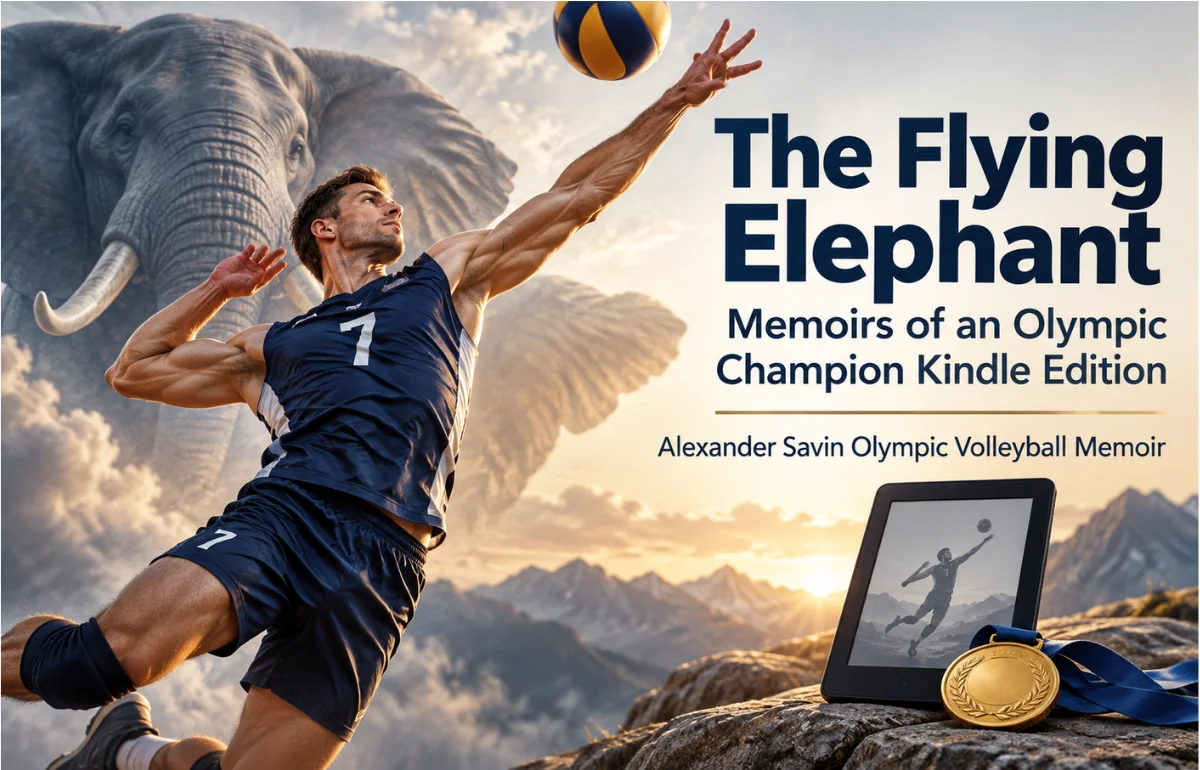
The Flying Elephant memoirs of an Olympic champion Kindle edition is the digital version of The Flying Elephant: Memoirs of an Olympic Champion, a sports memoir associated with Soviet volleyball player Alexander Savin. The book follows the career and sporting world of an athlete who won Olympic silver with the Soviet Union at Montreal 1976 and Olympic gold at Moscow 1980. It is more than a record of medals. The title also connects to Soviet volleyball, elite training, team pressure, sporting identity, and the experience of competing during a politically charged era. For readers considering the Kindle version, the main questions are what the memoir covers, who Savin was, what the digital edition may include, and whether it is suitable for their reading interests.
What Is The Flying Elephant: Memoirs of an Olympic Champion About?
At its core, The Flying Elephant is a sports memoir about Alexander Savin’s life in elite volleyball.
Savin competed as a middle blocker for the Soviet Union and represented his country at two Olympic Games. Olympedia records his silver medal at the 1976 Montreal Olympics and his gold medal at the 1980 Moscow Olympics. The same source lists him with one Olympic gold and one Olympic silver medal.
The book is therefore relevant to several types of readers:
- Volleyball fans
- Olympic-history enthusiasts
- Readers of athlete memoirs
- Students of Soviet sports history
- Coaches and athletes interested in elite competition
- Readers who enjoy biographies built around personal experience
The most interesting part of the story is the contrast between Savin’s two Olympic appearances. In 1976, the Soviet team reached the final but finished with silver. Four years later, the team won gold on home soil in Moscow.
That progression creates a natural narrative: expectation, disappointment, preparation, pressure, and eventual victory.
Alexander Savin’s Volleyball Career
Alexander Savin was born in Taganrog in 1957 and began developing as a volleyball player in the Soviet Union. His playing position was middle blocker, a role that requires timing, height, fast reactions, and strong coordination with the setter and defensive system.
The International Volleyball Hall of Fame identifies Savin as a major figure in the Soviet team’s return to Olympic success. Its profile notes that he played all five matches at Montreal in 1976 and all six matches at Moscow in 1980.
His Olympic record can be summarized simply:
| Olympic Games | Team result | Savin’s significance |
|---|---|---|
| Montreal 1976 | Silver medal | Played throughout the tournament and reached the final |
| Moscow 1980 | Gold medal | Helped the Soviet Union win the tournament on home soil |
Savin’s career also extended beyond those two Olympic tournaments. His wider honours included success at the World Cup, World Championship, and European Championship level. That broader record matters because the memoir is not only about two isolated Olympic appearances. It belongs to a long period of international dominance by Soviet men’s volleyball.
Why the 1976 and 1980 Olympics Matter
The two Olympic tournaments give the book a stronger emotional structure than a simple victory story.
At Montreal in 1976, the Soviet Union was one of the leading volleyball teams in the world. The team performed strongly throughout the tournament but lost the gold-medal match to Poland. According to the Volleyball Hall of Fame account, Poland won a close five-set final.
That result would have been difficult for a team accustomed to success. A silver medal is an extraordinary achievement for most athletes, but elite sporting cultures often judge competitors against the highest possible standard. For a national team expected to win, second place can feel like failure.
The 1980 Moscow Games created a different kind of pressure. The Soviet Union was hosting the Olympics, which meant the team faced the expectations of spectators, officials, media, and the wider political system. The International Volleyball Hall of Fame records that the Soviet team eventually defeated Bulgaria in the final.
This makes Savin’s Olympic story useful for readers who want to understand how athletes respond to setbacks. The story is not simply about winning once. It is about returning to competition after disappointment and handling the demands of performing at home.
Soviet Volleyball and the Historical Setting
A major reason to read this memoir is the historical setting.
Savin competed during the Cold War, when international sport often carried political meaning. Matches between the Soviet Union and other major volleyball nations were athletic contests, but they could also be interpreted as demonstrations of national strength and organizational success.
The Soviet sporting system emphasized structured training, national representation, discipline, and collective performance. Volleyball fitted naturally into that system because success depended on coordination rather than individual action alone.
That background gives the memoir several layers:
- The personal story of a professional athlete.
- The story of a team trying to maintain international dominance.
- A record of Soviet sports culture.
- A window into international competition during the Cold War.
- A reflection on how athletes represented more than themselves.
The 1980 Moscow Olympics were also affected by the political climate of the period, including the Western boycott. That context should not overwhelm the sporting story, but it helps modern readers understand why the tournament carried such unusual symbolic weight.
I find this historical layer especially valuable when reading sports biographies. A medal table tells us who won. A memoir can help explain what it felt like to train, travel, compete, and live inside the system behind that result.
What Readers May Learn From the Memoir
Because this is presented as a memoir rather than a conventional third-person biography, readers may expect a more personal account of elite sport.
A standard sports biography usually organizes a subject’s life from the outside. It collects dates, statistics, career milestones, and interviews. A memoir begins with memory and personal perspective. That can reveal details that do not appear in official records.
Discipline and preparation
Olympic success is built over many years. Training involves repetition, physical conditioning, technical drills, recovery, travel, and strict routines.
A memoir from an Olympic athlete can make that preparation more understandable. Instead of seeing only the final match, readers can consider the daily habits behind it: how athletes handled fatigue, maintained concentration, and continued training after setbacks.
Teamwork
Volleyball is not an individual sport. Even a highly skilled middle blocker depends on the setter, outside hitters, opposite, libero, coach, and defensive system.
That makes team relationships central to any serious volleyball memoir. A player’s achievements are connected to communication, trust, role acceptance, and shared responsibility.
Pressure
Representing the Soviet Union at the Olympics involved more than personal ambition. Athletes competed for national pride and under the scrutiny of a large sporting institution.
The pressure could come from many directions:
- Coaches demanding technical precision
- Teammates relying on consistent performance
- Supporters expecting victory
- Officials measuring results
- The athlete’s own fear of making a decisive mistake
These pressures are familiar to modern athletes, even when the political environment is different.
Failure and recovery
Savin’s silver medal in 1976 gives the memoir a useful emotional balance. A book about an Olympic champion can easily become a celebration of success. The earlier defeat makes the story more human.
Readers can ask practical questions: How does an athlete process a lost final? How does a team rebuild confidence? What changes between one Olympic cycle and the next? How does a player remain motivated after reaching the highest level?
Those questions are often more valuable than a simple list of medals.
Reported Book Details
Online descriptions associate the English-language edition with a substantial page count and a large collection of photographs. Some descriptions report approximately 514 pages and more than 240 photographs.
These details should be checked against the current retailer listing before purchase because Kindle metadata can change. Digital editions may also display page counts differently depending on the device, application, or edition format.
| Detail | Reported information | What to verify |
|---|---|---|
| Title | The Flying Elephant: Memoirs of an Olympic Champion | Exact title and subtitle |
| Author | Alexander Savin | Author spelling and edition credit |
| Subject | Volleyball memoir and Olympic history | Description and sample |
| Format | Kindle edition | Availability in your country |
| Length | Approximately 514 pages | Current Kindle and print length |
| Photographs | More than 240 reported | Whether images are included in the digital edition |
| Language | English edition reported | Translation and language listing |
| Historical focus | Soviet-era international volleyball | Contents and publication details |
The reported photograph collection could be one of the edition’s strongest features. Archival sports images can show uniforms, courts, team formations, equipment, training environments, and the visual culture of an earlier era.
Kindle Edition Versus Print Edition
The Kindle format may be practical for readers who want to carry a long sports memoir on a phone, tablet, or e-reader. Adjustable font size can make the text easier to read, and search tools are useful when returning to names, tournaments, or locations.
The main trade-off concerns photographs. A large photo collection may be more satisfying in a high-resolution print edition, especially if the images are central to the book’s historical value.
| Kindle edition | Print edition |
|---|---|
| Portable and easy to store | More substantial physical reading experience |
| Adjustable text size | Fixed page layout |
| Searchable text | Easier to browse visually |
| Useful for travel and quick reference | Potentially better for viewing photographs |
| May display images differently by device | Usually preserves the intended page design |
| Availability and price may change by region | May be harder to find or more expensive to ship |
When I evaluate a digital sports book, I look at more than the title and price. I also consider how much of the book depends on photographs, charts, page design, or archival presentation.
For a text-heavy memoir, Kindle is usually convenient. For a photograph-rich historical volume, I would compare the digital sample with the print edition before deciding.
What to Check Before Buying
The phrase “Kindle edition” does not guarantee that every edition has identical content. Retail listings can vary by country, publication date, translation, and format.
Before buying, check:
- The exact author name.
- The edition title.
- Language.
- Publication date.
- Publisher or imprint.
- Page or print length.
- Sample pages.
- Photograph availability.
- Current price.
- Device compatibility.
- Whether the edition is available in your region.
- Whether the images appear clearly on your preferred device.
The sample is particularly useful. It can show whether the translation reads naturally, whether the formatting is clean, and whether photographs are included in a useful resolution.
A book described as having hundreds of photographs may still provide a different reading experience in digital form. The images could be full-page, embedded between chapters, or reproduced at a smaller size. The listing or sample should answer that question.
Who Should Read The Flying Elephant?
This memoir is likely to appeal most strongly to readers with an interest in volleyball or Olympic history.
Volleyball fans
Volleyball supporters may enjoy the opportunity to look back at a different era of the sport. The game, training systems, equipment, and international competitions of Savin’s time were not identical to those of today.
Olympic-history readers
Readers researching the 1976 Montreal and 1980 Moscow Olympics may find the memoir useful as a personal complement to official records and statistics.
Sports-memoir readers
The book may suit readers who prefer first-person accounts of discipline, competition, ambition, and disappointment.
Athletes and coaches
Players and coaches may appreciate the discussion of team responsibility, preparation, pressure, and the mental demands of competing for a national side.
Sports historians
The combination of personal memory, Soviet volleyball, international competition, and archival photographs gives the book potential value beyond entertainment.
Readers who want fast match reports or modern technical analysis may find it less suitable. This is not primarily a coaching manual, a rulebook, or a tournament statistics guide.
Why This Book Still Has Value Today
Modern sports coverage is often immediate and data-driven. Fans can track player statistics, watch highlights, follow live commentary, and access interviews within minutes.
That makes historical memoirs valuable in a different way. They preserve the human experience behind a sporting era that can otherwise become abstract.
A box score may tell us that a team won. A memoir can help readers think about:
- The daily routine behind the result.
- The relationships within the team.
- The emotional effect of losing a final.
- The expectations attached to national representation.
- The way athletes remember their younger selves.
- The difference between public success and private pressure.
The photographs may add another layer by connecting names and results with real people, venues, uniforms, and moments.
For me, that is the strongest reason to consider The Flying Elephant. Its importance is not limited to whether a reader already knows every detail of Soviet volleyball. It may also serve as a record of how sport, memory, identity, and history overlap.
Is The Flying Elephant Kindle Edition Worth Reading?
For the right reader, yes.
The book appears most worthwhile if you want a combination of Olympic biography, volleyball history, Soviet sports culture, and personal reflection. Its central sporting arc is compelling: silver in 1976, followed by gold in 1980.
I would be more cautious if you are looking for a heavily researched academic history, a modern volleyball tactics book, or a short and fast-paced competition narrative. The available descriptions do not provide enough detail to judge the full writing style, translation quality, or chapter-by-chapter depth without consulting the actual edition.
The best approach is to check the current sample and metadata before purchasing. If the sample reads well and the photographs display clearly on your device, the Kindle edition may be a convenient way to explore Savin’s career.
Frequently Asked Questions
Who wrote The Flying Elephant: Memoirs of an Olympic Champion?
The memoir is associated with Alexander Savin, a former Soviet volleyball player and Olympic champion.
What is The Flying Elephant memoir about?
It focuses on Savin’s volleyball career, Olympic experiences, Soviet sports culture, elite training, teamwork, and the pressure of international competition.
What Olympic medals did Alexander Savin win?
Savin won silver with the Soviet Union at Montreal 1976 and gold at Moscow 1980.
Is The Flying Elephant available as a Kindle edition?
An English Kindle edition has been reported, but availability, price, and format details should be checked on the current retailer page.
Does the book contain photographs?
Online descriptions report more than 240 photographs, although readers should confirm that the Kindle edition includes the same photographic material.
Final Thoughts
The Flying Elephant memoirs of an Olympic champion Kindle edition offers more than a digital copy of an athlete’s career story. It connects Alexander Savin’s Olympic journey with the history of Soviet volleyball, the emotional cost of elite competition, and the changing meaning of sporting memory.
Its strongest appeal lies in the contrast between the 1976 silver medal and the 1980 Olympic victory. That arc gives the memoir a clear human theme: talented athletes can experience disappointment, return to the work, and compete again under even greater pressure.
If you are interested in volleyball, Olympic history, or sports biographies, review the latest edition details and sample pages before buying. That small check will help you decide whether the Kindle format provides the reading and photographic experience you want.

Evelyn Hartwell is a biography writer and historical researcher with over 5 years of experience exploring the lives, achievements, and personal journeys of notable individuals. She focuses on creating well-researched, engaging biographies by analyzing reliable sources and presenting accurate life stories with meaningful context.