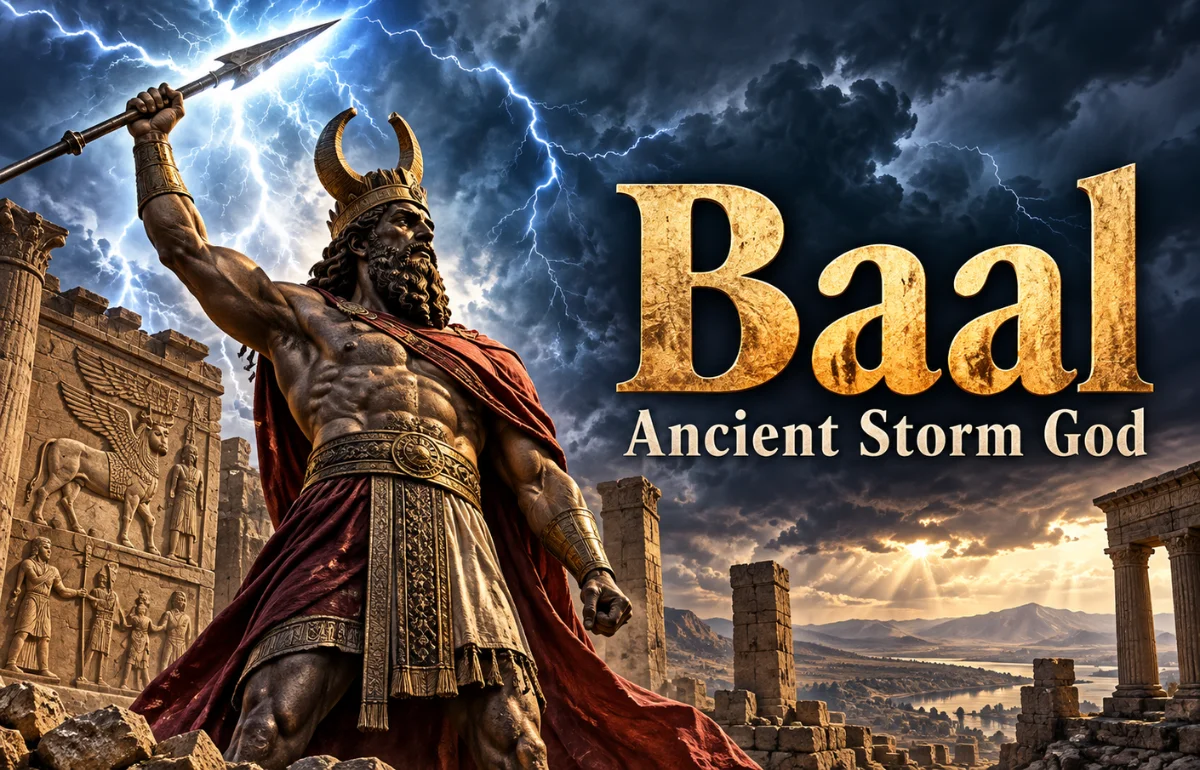
Baal was a major deity in the religions of ancient Canaan and neighboring parts of the Near East, especially associated with storms, rainfall, agricultural prosperity, and divine kingship. The name Baal comes from a Semitic word meaning “lord,” “master,” or “owner.” It could describe several local gods, but its best-known use refers to Baal Hadad, the storm god celebrated in ancient Ugaritic mythology. His worship mattered in societies where seasonal rain could decide whether a family harvested grain or faced hunger.
Many people first encounter Baal in the Bible, where worship of him is condemned as a rival to worship of Israel’s God. Yet archaeological finds tell a broader story. The mythology, archaeology, and biblical accounts each reveal a different side of his history.
What Does the Name Baal Mean?
In several Northwest Semitic languages, baʿal meant “lord” or “master.” It was a title before it was understood as the identifying name of a particular god. Ancient writers could use it for a divine patron of a town, a sacred mountain, or another specific place.
That explains a detail that is easy to overlook: a reference to “Baal” does not always identify exactly the same deity, in exactly the same period, with exactly the same religious practices. Context matters.
The word also appears in compound names and place names. For example, Baal-Berith means “lord of the covenant,” while Baal-Zephon associates the deity with Mount Zaphon. Different spellings—Baal, Ba’al, and Baʿal—generally reflect attempts to represent the original Semitic consonant in English.
I begin with the word’s meaning because ancient references do not always describe the same god.
Who Was Baal in Ancient Canaanite Religion?
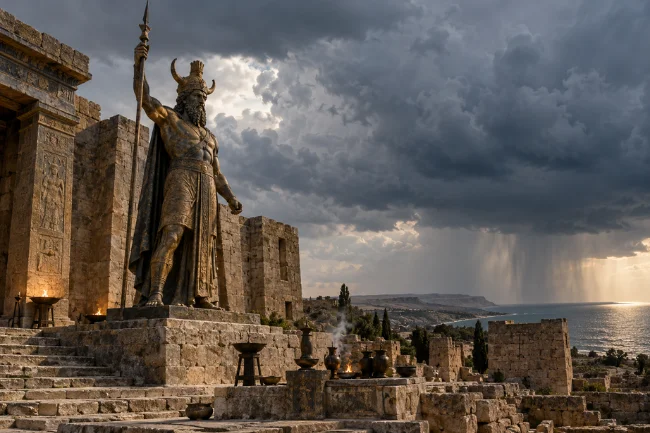
Baal Hadad was among the most prominent gods of the Canaanite religious world. He was particularly important at Ugarit, an ancient trading city on the coast of what is now Syria. There, he appears in stories about conflict, royal power, rain, and the preservation of an ordered world.
Why Was Baal Associated With Rain and Fertility?
Agriculture along the eastern Mediterranean coast depended heavily on seasonal rainfall. Much of the Levant relied on winter rains for crops.
In that environment, a storm god represented more than dramatic weather. Baal’s thunder could announce the rain that made barley and wheat grow. His power was also associated with vegetation and the fertility of the land, not simply with human reproduction, as some popular summaries imply.
To an ancient farmer, Baal represented a pressing question: would enough rain arrive?
How Did Baal Relate to El, Anat, and the Other Gods?
Canaanite religion was not organized around a single, universally fixed family tree. At Ugarit, El is an elder authority; Baal is a warrior seeking royal power.
Anat, a formidable goddess often described as Baal’s sister, helps him in crucial episodes. Asherah, called Athirat in Ugaritic texts, is closely associated with El. Other significant figures include Yamm, the sea god; Mot, associated with death; and Kothar-wa-Hasis, a divine craftsman.
Some texts call Baal a son of Dagan, while others emphasize El’s authority. The traditions resist a tidy family diagram.
Where Did Baal Worship Begin, and How Did It Spread?
Baal’s storm-god traditions overlap with those of Hadad, called Adad in Mesopotamian contexts.
Baal worship became prominent among Canaanite and Phoenician communities in the Levant. Trade and political contact carried these ideas widely, though local rituals differed.
Why the Discovery of Ugarit Changed Everything
An accidental discovery near Ras Shamra in 1928 led to excavations beginning in 1929. Archaeologists uncovered ancient Ugarit, including temples associated with Baal and Dagan and a remarkable collection of clay tablets.
Ugaritic tablets, written in alphabetic cuneiform, preserve Late Bronze Age myths.
Before those discoveries, biblical references strongly shaped many readers’ picture of Baal. The tablets made it possible to hear something closer to the religious world of his own worshippers, although even these texts mostly preserve the concerns of literate and elite communities.
The Baal Cycle: The Most Famous Myth About Baal
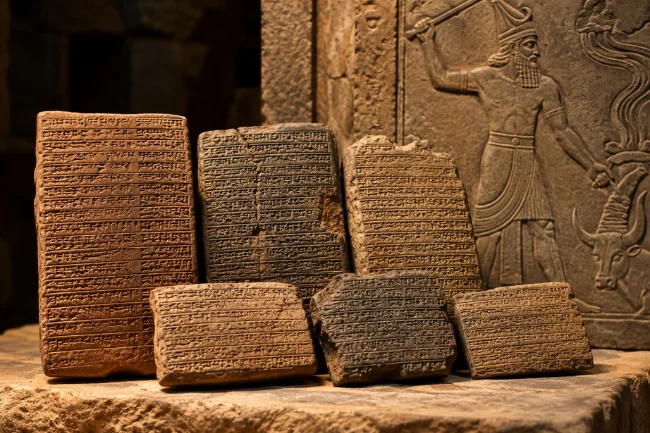
The Baal Cycle is a collection of mythological narratives preserved on six Ugaritic tablets. It is not a biography or a historical account of actual divine battles. Instead, it explores who should rule, how disorder threatens life, and why an effective ruler matters.
Baal’s Conflict With Yamm, the Sea
Yamm represents the sea and a threatening power within the divine world. When he demands submission, Baal refuses. The craftsman Kothar-wa-Hasis equips him with weapons, and Baal defeats his rival.
In a coastal society, his victory could symbolize order triumphing over uncontrollable forces.
This makes Baal both a weather god and a guardian of order.
The Palace on Mount Zaphon
After Baal’s victory, the question of his royal status remains important. A magnificent palace is constructed for him on Mount Zaphon, identified with Jebel Aqra near the Syrian coast.
The palace is a sign of recognized kingship, not merely an impressive residence. Its precious materials and divine craftsmanship signal status.
I see the palace as the second half of his victory: kingship requires recognition.
Baal, Mot, and the Threat of Death
The story later turns to Mot, a figure associated with death and the underworld. Baal’s encounter with Mot brings a crisis, and Anat takes an active role in confronting the power that threatens him.
The text links Baal’s absence or defeat with a loss of life-giving abundance. He eventually resumes his position, and the challenge to his authority is overcome.
It is tempting to summarize the story as a simple annual cycle in which Baal dies every summer and is reborn when winter rain returns. Some scholars have interpreted it that way, but the surviving tablets are damaged, and that reading is debated. A more careful description is that the myth connects divine conflict with the vulnerability of life, rainfall, and political order.
How Was Baal Worshipped?
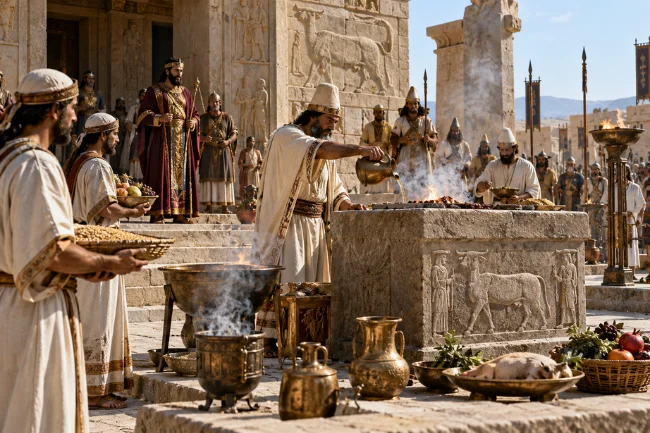
Worship varied across places and centuries. At Ugarit, archaeological remains include a temple traditionally identified with Baal, while ritual texts and other records point to an organized religious life involving offerings, ceremonies, and priestly activities.
Across Phoenician cities, religious practice also included temples, incense, libations, animal sacrifices, and gifts. Rulers also held important religious roles.
What Would Worship Have Meant to Ordinary People?
For someone concerned about a harvest, Baal’s perceived ability to provide rain was practical rather than abstract. Farmers needed dependable growing seasons; leaders wanted security and prosperity; communities hoped for protection from calamity.
I would not invent a typical daily ritual: temples, inscriptions, and literary tablets tell us more about official religion than household customs.
Was Human Sacrifice Part of Baal Worship?
Biblical passages, including Jeremiah 19:5, accuse people of offering children to Baal. These accusations are important evidence for the religious arguments preserved in the Bible, but they do not establish that every community worshipping a deity called Baal practiced human sacrifice.
The separate, difficult debate about child sacrifice in ancient Carthage often concerns Baal Hammon and Tanit, not automatically the Ugaritic storm god. I would resist merging these different regions, periods, and divine names into one sensational claim.
What Did Baal Look Like? Symbols and Archaeological Evidence
One of the clearest representations is the limestone stele often called Baal with the Thunderbolt, excavated at Ras Shamra in 1932 and now held by the Louvre in Paris.
The figure advances with one arm raised, wearing a distinctive crown and carrying weapons associated with strength and lightning. A spear-like object includes a vegetal element, connecting destructive force with life-giving growth. A much smaller figure is commonly interpreted as a king receiving divine protection.
The Louvre records the stele as approximately 144 centimeters tall. Its inventory number, AO 15775, gives readers a way to find the exact artifact rather than rely on unattributed online illustrations.
Bulls, thunderbolts, raised weapons, mountains, and storm clouds also belong to the broader visual language associated with Near Eastern storm gods. A bull image alone does not prove Baal is depicted.
Were There Different Gods Called Baal?
Yes. Sometimes “Baal” was a title for a local manifestation of a storm deity; in other settings, it formed part of the name of a deity with a distinct cult and history.
| Name or title | Association | Why the distinction matters |
|---|---|---|
| Baal Hadad | Storms, rain, royal power; especially in Ugaritic tradition | The best-known Baal of the mythological tablets |
| Baal-Zephon | Mount Zaphon and its sacred geography | A place-linked title, not necessarily a separate god |
| Baal-Berith | “Lord of the covenant,” mentioned in Judges | Shows the use of Baal in localized divine titles |
| Baal-Zebub | Deity of Ekron mentioned in 2 Kings | Connected to later traditions about Beelzebub |
| Baal Hammon | Major deity associated especially with Carthage | Must not be treated as identical to Baal Hadad |
These distinctions matter when reading both ancient texts and modern articles. A claim made about one title may not apply to another.
Why Does the Bible Speak So Strongly Against Baal?
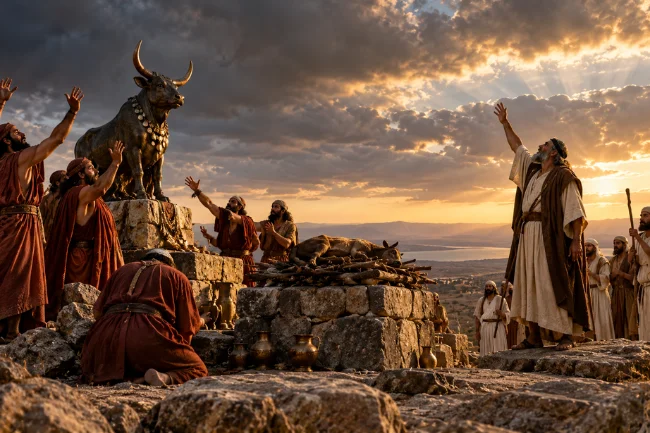
The Hebrew Bible repeatedly presents worship of Baal as a threat to Israel’s loyalty to Yahweh, the God of Israel. Books such as Judges, Kings, Hosea, and Jeremiah describe conflict over religious allegiance.
In 1 Kings 18, the prophet Elijah challenges prophets of Baal on Mount Carmel during the reign of King Ahab. The story contrasts Baal’s silence with Yahweh’s response and the return of rain.
The rain matters to the story’s argument. A deity acclaimed for controlling storms is challenged precisely over the power he is supposed to possess. The narrative is theological and literary as well as situated in a recognizable ancient political landscape.
What About Jezebel and King Ahab?
The biblical account connects Ahab’s court and Queen Jezebel with the promotion of Baal worship. The Omride dynasty is historical, but the story’s dramatic details lack independent confirmation.
I distinguish the biblical author’s argument from what archaeology can establish.
Did Israelites Ever Use the Name Baal Positively?
Personal names provide a less obvious complication. Names such as Jerubbaal and Eshbaal show that the element baal circulated in early Israelite naming traditions.
Scholars debate what these names imply. In some contexts, the term may have functioned as an honorific meaning “lord,” rather than proving devotion to a foreign deity. Later biblical traditions often treat Baal more consistently as a religious rival. Language and religious identity were evidently more complicated than a sharp modern division suggests.
Is Baal the Same as Satan or Beelzebub?
Not in the original Canaanite setting. Baal Hadad was worshipped as a powerful storm god within a polytheistic religious system, not described by his followers as the Christian devil.
The name Baal-Zebub appears in 2 Kings 1 in connection with Ekron. Later forms, including Beelzebub or Beelzebul, appear in Jewish and Christian religious traditions with associations involving demonic power.
Reading these traditions back into Bronze Age worship erases centuries of change. Modern fantasy, horror, and gaming references often combine these traditions, which is why readers can encounter dramatically different versions of the same name.
What Can We Actually Know About Baal? A Useful Evidence Check
I rely on a simple distinction when evaluating dramatic claims about ancient religion: what does a source demonstrate, and what remains an interpretation?
| Evidence | What it helps establish | What it cannot prove on its own |
|---|---|---|
| Ugaritic mythological tablets | Baal’s stories, rivals, divine roles, and royal imagery | That every worshipper understood each story identically |
| Temples, objects, and inscriptions | Cult places, visual symbols, and some religious activities | A complete account of private or everyday worship |
| Biblical texts | Israelite and Judean religious arguments about Baal | A neutral description of all Canaanite practices |
| Later demonological traditions | How the name changed in subsequent religions | The original meaning of Baal Hadad in Ugarit |
A striking image or hostile accusation is not automatically a universal historical fact.
For reliable starting points, I recommend the Metropolitan Museum of Art’s account of Canaanite gods, the Louvre’s record of the Baal stele, and the French Ministry of Culture’s Ugarit overview. They allow readers to check specific claims against documented texts and artifacts.
Why Baal Still Matters Today
Baal connects ancient mythology, biblical religion, and Mediterranean archaeology.
His stories reveal how people used weather and conflict to think about survival and kingship. The discovery of Ugarit shows how a single archaeological breakthrough can broaden our understanding of texts preserved elsewhere. His later reputation shows how religious names change meaning.
For me, the most revealing lesson is that a familiar name can carry several different histories. Asking which Baal, in which place, and according to which source usually produces a better answer than relying on a single popular description.
Final Thoughts
Baal was neither merely a biblical villain nor simply a fictional storm warrior. He was a significant ancient deity whose stories, worship, and later reputation help explain the religious world of the Levant. If you want to explore further, start with the Ugaritic Baal Cycle and compare it with the relevant biblical passages and museum evidence. The differences are often as revealing as the similarities.
Frequently Asked Questions About Baal
What is Baal the god of?
Baal Hadad was primarily associated with storms, rain, and agricultural fertility, and he also appeared as a warrior and divine ruler.
What does Baal mean in English?
Baal comes from a Semitic term meaning “lord,” “master,” or “owner”; it could function as both a title and a divine name.
Who worshipped Baal?
Baal was worshipped by communities in ancient Canaan and the wider Levant, including people of Ugarit and various Phoenician cities.
Why was Baal condemned in the Bible?
Biblical writers portrayed worship of Baal as competing with the exclusive allegiance they urged toward Yahweh, the God of Israel.
Is Baal the same as Beelzebub?
No. Beelzebub developed through later traditions connected with Baal-Zebub, while Baal Hadad was the ancient storm god.

Evelyn Hartwell is a biography writer and historical researcher with over 5 years of experience exploring the lives, achievements, and personal journeys of notable individuals. She focuses on creating well-researched, engaging biographies by analyzing reliable sources and presenting accurate life stories with meaningful context.