Peitner is an uncommon European surname, or family name, documented in historical records from German-speaking Central Europe and beyond. It is not an established English word or a recognized technology or business concept. Genealogical references associate it with German and Austrian naming traditions, although the precise meaning of every Peitner family line remains uncertain.
One proposed interpretation connects the name with a hillside or mountain slope; another published interpretation suggests an occupation involving soldering. More importantly, an Austrian state archive record from 1742 explicitly groups Peitner with the spellings Peithner and Peintner.
That gives researchers something firmer than an attractive origin story: a dated historical reference that can guide family-history research.
If you found Peitner on an old certificate, a genealogy website, or a relative’s document, I would begin with the person and location attached to that record. A surname’s general history is useful, but it cannot establish your family’s ancestry by itself.
Peitner at a Glance
| Question | Evidence-based answer |
|---|---|
| What is Peitner? | An uncommon surname found in historical records |
| Where is it associated with? | German-speaking Central Europe, with records elsewhere |
| Does it have one proven meaning? | No; published explanations require careful interpretation |
| Are Peitner and Peintner related spellings? | An Austrian archive groups them in one 1742 entry |
| Is every Peitner part of one family? | Not demonstrated; relationships require individual records |
| Best place to start researching? | Birth, marriage, death, parish, and migration records |
What Does the Name Peitner Mean?
Surnames usually began as practical identifiers. Someone might be known by a trade, a parent’s given name, a home village, or a distinctive feature of the landscape.
Only later did such descriptions become inherited family names.
Peitner presents a small but significant challenge: a plausible linguistic explanation is not the same as a documented origin for a particular family.
I found that distinction especially useful when comparing surname references with actual archival entries.
The Hillside or Mountain-Slope Interpretation
FamilySearch’s Peitner surname page presents a topographic interpretation connected to Middle High German līte, meaning a mountain slope or spur, with an ending indicating someone associated with that place.
In everyday language, this would suggest a person who lived on or near sloping ground.
That makes sense as a type of surname in parts of Bavaria and Austria, where landscape-based descriptions were common.
But there is a caution worth making clear: FamilySearch’s Leitner page displays the same etymological wording.
The close match suggests researchers should check whether a surname explanation has been associated with a spelling through database matching rather than assume a separate etymological demonstration exists for Peitner.
I would therefore describe the slope explanation as a published interpretation, not a proven translation that fits everyone named Peitner.
The Possible Occupational Interpretation
The same FamilySearch entry also gives an Ashkenazic Jewish occupational interpretation based on the Yiddish verb leytn, meaning “to solder.”
Under that reading, the name could refer to work involving the joining of metal parts.
However, this explanation also appears in the Leitner entry. It does not establish that a particular Peitner ancestor was Jewish, practiced metalworking, or adopted a name for that reason.
Those details need evidence from the family’s own records.
The most responsible answer to “What does Peitner mean?” is that several explanations are published, but the correct origin of an individual lineage remains a research question.
Where Does the Peitner Surname Come From?
Bavaria and Austria are sensible starting points for investigating German-language surname traditions.
Tyrol, including areas historically connected with today’s northern Italy, is especially interesting because regional documents preserve related spellings over several centuries.
Still, a family name is not a passport.
Finding an Austrian reference does not prove that every modern bearer came from Tyrol, and a German-looking spelling does not rule out later residence in Bohemia, Hungary, Croatia, or the United States.
The Alpine Connection
Historical Tyrol crossed boundaries that do not perfectly match modern national borders.
That matters when searching records: an ancestor’s birthplace may now be listed under Italy even though an older document uses an Austrian administrative description.
The Tyrolean State Archive’s family-history guidance recommends establishing the precise parish and working backward through church books, especially marriage registers.
I consider that much more reliable than starting with a modern map and guessing where a surname “must” have begun.
Evidence Outside the Alps
Geneanet’s Peitner surname index includes references to a Joannes Michael Peitner marriage in 1759 and an Andreas Peitner marriage in 1808 in collections identified with the Karlovy Vary region of today’s Czech Republic.
These are database entries to verify against the underlying records, not proof that the two men were related.
FamilySearch’s historical-record search also displays a Berlin birth and baptism entry for Charlotte Henriette Peitner in 1810 and a Boston tax-record entry for Geo Peitner in 1860.
Together, these examples demonstrate why a single-place origin story is too narrow for genealogical research.
The 1742 Record That Connects Three Spellings
One of the strongest specific pieces of evidence I found is in the Austrian State Archives.
An archival file dated July 5, 1742 is catalogued under “Peithner (Peitner, Peintner)” and concerns Joseph Anton, an official of the collegiate chapter at Innichen in the Puster Valley.
The catalogue describes a grant of noble status with the designation “von Peintnern zu Sternfeld.”
Its reference number is AT-OeStA/AVA Adel HAA AR 696.10. The file is described as comprising 25 folios.
This entry matters for two reasons.
First, it is a dated institutional source rather than an unsourced website claim. Second, it explicitly records the three spellings together in the same description.
What it does not demonstrate is equally important.
It does not show that Peitner, Peithner, and Peintner are interchangeable in every location or period.
Nor does a noble-status file make everyone with a similar surname a descendant of that particular person.
For a researcher, the archive provides a lead to test with parish, marriage, estate, and family records—not a ready-made family tree.
Peitner, Peintner, and Other Similar Names
Anyone looking into rare Central European surnames soon encounters alternative spellings.
Clerks wrote unfamiliar names as they heard them, spelling conventions changed, and records moved between German, Latin, and other languages.
The trick is to search broadly without merging unrelated people too quickly.
| Spelling | How I would treat it in research |
|---|---|
| Peitner | Start with this exact spelling and preserve it in transcriptions |
| Peithner | Strong historical lead because it appears alongside Peitner in the 1742 archive entry |
| Peintner | Also appears in that archive entry; investigate shared places and relatives |
| Leitner | A separate established surname whose published meaning overlaps; do not assume a family connection |
| Paintner, Pointner, Pittner | Possible search alternatives in particular records, not automatically proven variants |
Why One Extra Letter Matters
Consider Peitner and Peintner. The inserted n looks minor, but in family history a single letter can change which archive results you find.
The 1742 catalogue shows a documented historical association; it does not authorize changing one person’s legal surname to another spelling without evidence.
I prefer keeping the spelling exactly as written in each source, then adding alternate versions to a separate research note.
That preserves the original evidence while allowing for sensible search experiments.
How Rare Is Peitner Today?
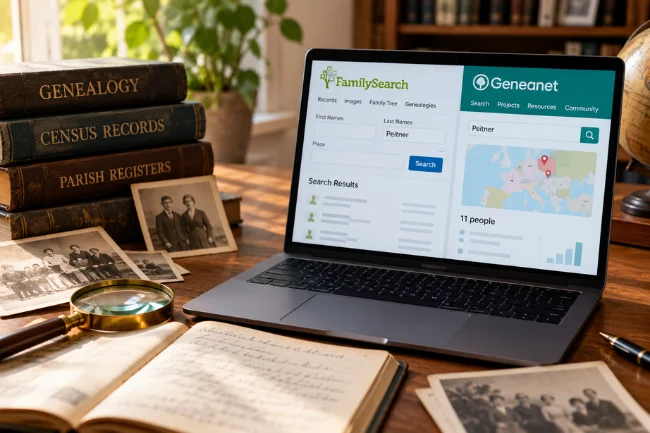
Available genealogy databases suggest that the exact spelling is uncommon.
Geneanet’s surname page reports 11 people bearing Peitner in the entries used for its geographical display and ranks the name within its own database.
That is a platform-specific count, not a worldwide population estimate.
FamilySearch shows only a handful of Peitner profiles in its country summary, yet its wider historical search displays far more matching records.
Those two figures measure different things.
A searchable record can mention a person more than once, include spelling matches, or represent an event rather than a unique individual.
I would avoid any article that turns an unqualified search-result count into a claim about how many Peitners are alive today.
A trustworthy global total would require a clearly defined source, date, coverage, and method.
Rarity creates both difficulties and opportunities.
Fewer exact-name results can make promising records easier to spot, but incomplete indexing means a missing search result does not prove that a family never lived in a particular area.
How to Research Your Peitner Family History
The best approach begins close to home, with details you can verify.
You do not need a spectacular historical discovery on day one. One accurately documented parent-child connection is more valuable than ten speculative generations.
Begin With a Known Relative
Write down the full name, approximate birth and death dates, spouse, religion if known, and every confirmed place of residence for the oldest relative in your family whose identity is certain.
Next, gather available birth certificates, marriage entries, obituaries, family letters, photographs with inscriptions, and immigration documents.
Record where each piece of information came from, including a link, archive reference, or image number.
Work From Marriage Records Toward Earlier Generations
I place special value on marriages because they may name both spouses, their parents, witnesses, home villages, and sometimes occupations.
A witness or godparent can provide the crucial clue when two people have similar names.
The Tyrolean State Archive explicitly recommends moving from one generation to the previous one and identifies marriage books as an efficient route.
For Catholic or Protestant lines in the region, Matriken Tirol Online provides access to digitized parish records, subject to privacy restrictions.
For records elsewhere in Austria, Germany, Italy, and several neighboring countries, Matricula Online is another useful portal.
Coverage depends on the participating archive, denomination, locality, and period; not every register is indexed by personal name.
Search by Place, Not Just Surname
Once you know a town, identify its historical parish and jurisdiction.
Search adjacent villages if the family does not appear where expected. Border changes, administrative reorganizations, and overlapping parish boundaries can explain why a record seems to be missing.
Search Peitner first, then examine Peithner and Peintner where the context supports them.
Try approximate years rather than insisting on one exact birthday.
FamilySearch’s research advice likewise recommends name variants, flexible searches, and inspecting original images where available.
Build a Record-Based Timeline
I recommend a simple chronological table for each person: event, date, place, exact spelling, named relatives, and source.
If the timeline places one individual in two distant towns on the same day, you may have combined two different people.
Do not rely solely on automated hints.
Compare ages, spouses, occupations, witnesses, and addresses. A match based on a surname alone is usually too weak to support a relationship.
Two Overlooked Sources Worth Checking
Parish books are a starting point, not the whole story.
Property records can connect an ancestor to a specific farm or house, while tax registers may distinguish residents who share a name.
The Tyrolean State Archive’s Maria-Theresian tax-register resource covers a survey compiled from 1774 to 1784 and includes a surname index linked to locations.
Its limits are especially revealing: the index covers relevant household property holders, not every resident, and the geographical coverage is incomplete.
That means absence from the index is not evidence that a Peitner family was absent from the region.
It may simply mean that the individual did not fall within the register’s scope.
Older marriage contracts, land transfers, probate inventories, and military papers may also help identify a parent or distinguish cousins.
These sources become essential when the same given names repeat through several generations.
Common Mistakes When Reading Peitner History Online

The first is treating a surname dictionary as a personal ancestry report.
Even a well-regarded reference explains possible linguistic roots, not the faith, occupation, residence, or genetic background of a particular ancestor.
The second is assuming that similar names prove blood relationships.
The documented Peitner–Peithner–Peintner connection is a reason to investigate a spelling, not an automatic link between all families using it.
The third is confusing a search index with a verified primary document.
Typed transcriptions can contain mistakes. Whenever possible, check the scanned page, surrounding entries, and the name of the original record collection.
The fourth is assuming that a historical coat of arms belongs to everyone with the surname.
Heraldic rights and noble grants concern particular people or lines; a matching surname alone is not proof of entitlement or descent.
Finally, be cautious of modern web pages presenting Peitner as a software platform, productivity method, or universal symbol without identifiable evidence.
If the context really is a brand or username, check that specific organization or account rather than forcing a genealogical meaning onto it.
What the Name Can—and Cannot—Tell You
Peitner can offer a starting clue about language, historical spelling, and places worth searching.
Its appearance in eighteenth- and nineteenth-century records shows that this is not merely a newly invented internet word.
But it cannot, on its own, tell you whether your family was noble, Jewish, German, Austrian, or related to someone in an archival catalogue.
Those claims require a continuous chain of records connecting real individuals across generations.
I find that the most rewarding family histories often begin with modest facts: an address on a marriage certificate, a witness in a baptismal register, or an unfamiliar village written beside a grandparent’s name.
Those details give a surname its human history.
Conclusion
Peitner is a documented but uncommon surname with historical links to Central European records and a particularly useful 1742 Austrian archive entry connecting three spellings.
Proposed meanings exist, yet no short definition can replace research into a specific family line.
If the name appears in your family, start with one confirmed ancestor, find an original marriage or baptism record, and record the spelling exactly.
That single reliable document is the strongest next step toward discovering where your Peitner story began.
Frequently Asked Questions About Peitner
What does Peitner mean?
Peitner is a surname. Published explanations suggest a landscape-based meaning or a possible occupational connection, but neither identifies the origin of every family.
Is Peitner a German or Austrian surname?
It is associated with German-speaking Central Europe, particularly German and Austrian records, although individual families may have lived elsewhere.
Are Peitner and Peintner the same name?
An Austrian archive lists Peitner, Peithner, and Peintner together in a 1742 record, but a shared spelling history does not prove all bearers are related.
How common is the last name Peitner?
It appears uncommon in genealogy databases. Available database totals should not be mistaken for a verified count of living people worldwide.
Where can I find Peitner family records?
Start with FamilySearch and Geneanet, then check original parish registers through Matricula Online or regional archives such as the Tyrolean State Archive.

Evelyn Hartwell is a biography writer and historical researcher with over 5 years of experience exploring the lives, achievements, and personal journeys of notable individuals. She focuses on creating well-researched, engaging biographies by analyzing reliable sources and presenting accurate life stories with meaningful context.