
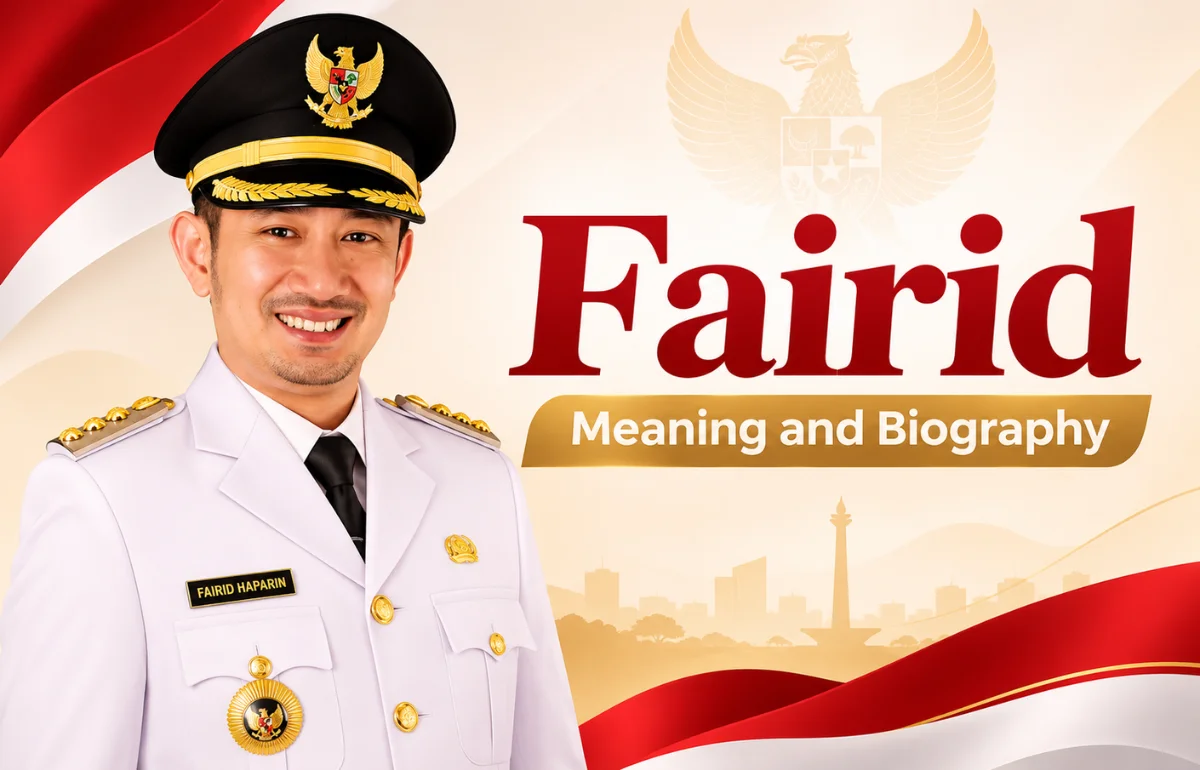
Fairid is an uncommon personal name that appears in different cultural and linguistic contexts. It is particularly associated with Fairid Naparin, an Indonesian politician who serves as the mayor of Palangka Raya, Central Kalimantan, for the 2025–2030 term. The name is sometimes connected to the Arabic name Farid, which means “unique,” “precious,” or “incomparable,” although the exact origin of the spelling Fairid remains uncertain.
Beyond its possible meaning, Fairid has gained recognition through Indonesian politics, regional leadership, and public administration.
When I examined the available information, I noticed that searches for Fairid often combine personal-name definitions with information about Fairid Naparin. Understanding the distinction helps explain the name’s background, cultural associations, and public significance.
What Is Fairid and Why Is It Significant?
Fairid is primarily used as a given name. Unlike widely recognized names with extensively documented linguistic histories, its exact spelling has limited authoritative etymological information.
Its visibility comes partly from people who carry the name, particularly Indonesian political figure Fairid Naparin.
He has represented Palangka Raya in local government and participated in political activities involving economic development, infrastructure, public services, and community organizations.
The name also raises questions about pronunciation, cultural background, and possible relationships with names used across the Middle East and Asia.
I find that separating these subjects provides a more accurate understanding than treating every online reference to Fairid as describing the same thing.
There are three useful distinctions:
- Fairid is a personal name used by real individuals.
- Farid is a documented Arabic name with a recognized meaning.
- Fairid Naparin is a public official whose biography and political career can be independently researched.
These distinctions matter because similar spellings do not automatically establish identical origins or meanings.
Fairid Name Meaning and Origin
Does Fairid Have an Arabic Origin?
Fairid is sometimes presented as a name of Arabic origin. However, the strongest linguistic evidence concerns the related spelling Farid rather than Fairid itself.
According to the name reference Behind the Name, Farid comes from the Arabic word فريد and means “unique” or “precious.”
The meaning is connected to the Arabic root associated with being singular, individual, or unlike others.
Farid and Fareed are recognized spelling variations in several languages. Related forms also occur in Persian, Urdu, Bengali, and other linguistic traditions.
The extra letter in Fairid makes the spelling distinctive, but I would not assume that every person named Fairid has a name directly derived from Farid.
Personal names can develop through family preferences, regional pronunciation, local spelling practices, or deliberate adaptations.
Without family records or a reliable linguistic source, the exact history of a particular spelling may remain unknown.
Does Fairid Mean Warrior or Knight?
Some online baby-name websites describe Fairid as meaning “warrior” or “knight.”
For example, an Ask Oracle name entry associates the spelling with bravery and chivalry.
However, established Arabic references give Farid the meaning “unique” or “incomparable,” not warrior or knight.
This difference deserves attention.
A name website may present an appealing interpretation without demonstrating its historical source. That does not necessarily mean the interpretation is impossible, but it should not be repeated as a verified linguistic fact.
I consider “unique” the better-supported meaning for Farid. Whether that meaning applies specifically to Fairid depends on the name’s actual origin.
Does Fairid Appear in Other Languages?
Interestingly, the lowercase spelling fairid also appears in an Irish dictionary.
The Ó Dónaill Irish–English dictionary identifies it as an equivalent of farradh, a word associated with being beside or in someone’s company.
That dictionary reference concerns Irish vocabulary, not the documented origin of Fairid as a personal name.
This is a useful example of why identical spellings found in different languages should not automatically be treated as related.
A word, surname, personal name, and online username may look identical while having completely different histories.
How Do You Pronounce Fairid?
Pronunciation depends on the individual and the language being spoken.
Some English-language naming sources suggest pronouncing Fairid as “FAIR-id,” emphasizing the first syllable.
By contrast, the established Arabic name Farid is generally pronounced with emphasis on the second syllable, approximately “fa-REED.”
I would avoid assuming that Fairid Naparin or another person uses either pronunciation without confirmation.
Names frequently change pronunciation when they move between languages, especially when local spelling conventions differ.
Fairid vs. Farid and Other Similar Names
The following comparison explains the most relevant differences.
| Name | Linguistic background | Meaning or relationship |
|---|---|---|
| Fairid | Exact origin not firmly established | Uncommon personal-name spelling |
| Farid | Arabic | Unique, precious, incomparable |
| Fareed | Arabic/Urdu transliteration | Recognized variation of Farid |
| Fərid | Azerbaijani | Azerbaijani form of Farid |
| Ferid | Used in several regional traditions | Related form of Farid |
| Farida | Arabic | Feminine form associated with uniqueness |
These names may share linguistic connections, but their usage differs by region.
For anyone researching a family name, I recommend checking the original language and family history instead of relying exclusively on a modern name generator.
Who Is Fairid Naparin?
<Entity category=”people” value=”Fairid Naparin” disambig=”Indonesian politician and mayor of Palangka Raya”/>
Fairid Naparin is an Indonesian politician and the mayor of Palangka Raya, the capital of Central Kalimantan province.
Born on August 28, 1985, in Banjarmasin, South Kalimantan, he entered local politics and became mayor following the 2018 regional election.
He served during the 2018–2023 term and returned to the position for 2025–2030 after winning the 2024 election alongside deputy mayor Achmad Zaini.
His background is documented in an alumni profile published by Diponegoro University.
Unlike broad online descriptions of the Fairid name, his public career can be checked against educational records, election announcements, and contemporary news coverage.
Early Life and Family Background
Fairid Naparin is the son of Abdul Razak and Zaidah. He is the second of three siblings.
His father, Abdul Razak, served as regent of West Kotawaringin from 2000 to 2005.
This family background placed Fairid within a household familiar with regional political administration.
However, family connections alone do not explain an individual’s political career. Elections, organizational experience, and public responsibilities also shape a politician’s path.
Fairid’s early education took place in Central Kalimantan.
He completed primary school at SD Percobaan Langkai 6 Palangka Raya in 1997 and graduated from SMP Negeri 2 Palangka Raya in 2000.
He subsequently attended SMA Negeri 1 Palangka Raya before completing secondary education at SMA Negeri 1 Pangkalan Bun in 2003.
Educational Qualifications
In 2008, Fairid graduated from Diponegoro University with a bachelor’s degree in economics.
His university’s alumni profile identifies his academic background with the Faculty of Economics and Business and its management program.
An economics education can provide a foundation for understanding financial planning, resource allocation, and organizational decision-making.
Nevertheless, academic qualifications do not automatically establish political effectiveness.
I believe a public official’s performance should ultimately be evaluated through measurable results, administrative accountability, and the quality of services delivered to residents.
Marriage and Personal Life
Fairid married Avina Triani Almira in December 2021.
According to his university biography, Avina is a granddaughter of H. M. Said, a former governor of South Kalimantan.
Although family connections attract attention in political biographies, I consider his public responsibilities and documented actions more relevant to understanding his significance.
His professional identity is primarily associated with municipal leadership and regional political organizations.
Fairid Naparin’s Political Career
Fairid’s political career includes leadership within the Golkar Party and involvement in community organizations.
His university profile records leadership positions connected to the local Golkar organization, the Indonesian Mosque Council, and the Dayak Customary Council.
These activities illustrate his involvement in institutions extending beyond city hall.
Political Career Timeline
| Year or period | Documented milestone |
|---|---|
| 1985 | Born in Banjarmasin, South Kalimantan |
| 2008 | Graduated from Diponegoro University |
| 2017 | Began serving in a leadership role within the Dayak Customary Council |
| 2018 | Elected mayor of Palangka Raya |
| 2018–2023 | Served his first mayoral term |
| 2024 | Won another mayoral election with Achmad Zaini |
| 2025–2030 | Second mayoral term |
The timeline shows how his political career developed across multiple years rather than emerging from a single election.
The 2018 Mayoral Election
Fairid won the 2018 Palangka Raya mayoral election with 50,438 votes, according to the biographical information published by Diponegoro University.
He entered the mayor’s office at a relatively young age, making him part of a generation of Indonesian politicians who assumed substantial administrative responsibilities early in their careers.
His first term covered a period when local governments faced demanding questions about infrastructure, public services, and changing economic conditions.
Understanding his record requires examining decisions made during that term rather than treating election success as proof of every subsequent achievement.
The 2024 Election and Return to Office
Fairid returned to electoral competition in 2024 with Achmad Zaini as his running mate.
The pair won the election and were selected to lead Palangka Raya for the 2025–2030 period.
According to the Palangka Raya City General Elections Commission, the pair received 81,472 votes.
Official election documentation identifies this as approximately 64% of valid votes.
When I compare that figure with the 2018 total, the difference is 31,034 votes.
That is a straightforward numerical comparison, not necessarily evidence of an equivalent increase in popular support. Electorate size, voter participation, and the political environment can change between elections.
Still, the result establishes an important fact: Fairid secured another mandate to lead the city.
Fairid Naparin’s Leadership Priorities in 2026
As of November 2026, Fairid’s administration has publicly addressed several areas of municipal development.
I find it useful to distinguish announced priorities from completed achievements because the two are often confused in political coverage.
Economic Development and Small Businesses
Supporting micro, small, and medium enterprises has featured in his administration’s economic agenda.
In May 2026, ANTARA reported cooperation involving the Palangka Raya government, the Financial Services Authority, and regional banking institutions.
The collaboration aimed to strengthen local economic activity, financial literacy, and access to banking services.
In July 2026, the administration also promoted the Palangka Raya Fair as an opportunity for small businesses to introduce products and reach additional customers.
Another initiative involved subsidized financing through the UMKM KEREN credit program in cooperation with Bank Kalteng.
These policies address a practical challenge: small businesses frequently need affordable financing and broader access to markets.
However, their long-term value depends on actual participation, loan accessibility, repayment conditions, and business outcomes.
Infrastructure and Drainage Improvements
Municipal infrastructure is another visible area of attention.
In January 2026, Fairid visited traditional market areas, including Pasar Kahayan and Pasar Besar, to examine commercial facilities and drainage conditions.
The administration identified drainage improvements and market organization as areas requiring attention.
Road infrastructure also appeared among the city’s stated development priorities in July 2026.
For residents, the effectiveness of these initiatives ultimately depends on improvements they can observe: passable roads, functioning drains, safer public spaces, and fewer disruptions to daily activity.
I would measure infrastructure policies through completed projects and maintenance records rather than announcements alone.
Healthcare and Public Information
Healthcare has also appeared prominently in the administration’s 2026 agenda.
In January, ANTARA reported Fairid’s emphasis on improving public health services, including attention to the development of the Menteng community health center.
Later, in October 2026, the city government announced measures to strengthen public information services across healthcare facilities.
The initiative involved expanding the role of public information officers within health centers and hospitals.
These measures are relevant because accessible information helps residents understand available services and administrative procedures.
The larger question is whether improvements translate into shorter delays, better facilities, and more reliable patient experiences.
Education and School Facilities
School infrastructure represents another area where municipal policy can have a direct effect on families.
In September 2026, ANTARA reported that the Palangka Raya government was identifying the needs of 13 schools for priority infrastructure improvements.
School revitalization can involve buildings, classroom conditions, sanitation, safety, and other facilities that influence learning environments.
I regard the identification of schools as a starting point rather than proof that all renovation work has been completed.
Parents and education professionals have good reasons to seek information about budgets, implementation schedules, and the condition of facilities after improvements.
Administrative Performance
In September 2026, Fairid appointed 12 officials to definitive administrative positions within the municipal government.
The appointments were presented as part of efforts to improve responsiveness and institutional performance.
Administrative leadership matters because municipal programs rely on individual departments to translate decisions into services.
Clear responsibilities, transparent procedures, and measurable departmental targets can make a substantial difference.
Ultimately, the public benefit of personnel changes depends on the quality of administration that follows.
How Should Fairid Naparin’s Performance Be Evaluated?
Political biographies often concentrate on electoral victories, family backgrounds, and positive statements about development.
Those details help explain a politician’s career, but they do not provide a complete assessment of public performance.
For a more meaningful evaluation, I would examine five practical questions.
First, are infrastructure projects completed within published budgets and schedules?
Second, do small-business financing programs reach eligible residents, including entrepreneurs without established banking relationships?
Third, have healthcare improvements increased access and service quality?
Fourth, are schools receiving the resources and maintenance they require?
Finally, can residents access reliable government information and raise concerns through effective public channels?
These questions create a clearer distinction between political visibility and administrative achievement.
A mayor may announce numerous initiatives, but long-term outcomes require sustained implementation.
Independent reporting, official budget documents, procurement information, and residents’ experiences can collectively provide a stronger assessment.
I also recommend examining several years of evidence rather than judging an entire administration by one favorable or unfavorable news report.
Why Is Information About Fairid Sometimes Confusing?
Searching for Fairid can produce different kinds of results because the term is not exclusive to one subject.
Some websites explain a possible baby-name meaning. Others discuss Fairid Naparin’s political activities. Linguistic databases may contain the same letters in unrelated contexts.
Similar spellings can create additional confusion.
For example, Farid is an established Arabic name, while Fariid and Fairide also appear as names of unrelated digital applications.
These references should not be combined into a single identity or company.
When I research an unfamiliar name, I use three checks: the full spelling, the subject’s location or background, and the credibility of the source.
A university biography is useful for educational and career details. An election commission is more appropriate for certified voting results. A dictionary is better suited to linguistic meaning.
Matching the evidence to the question prevents surprisingly common errors.
What Makes the Name Fairid Distinctive?
The most noticeable characteristic of Fairid is its uncommon spelling.
Compared with Farid or Fareed, the additional vowel makes the name visually recognizable in written text.
That distinctiveness may appeal to families interested in less conventional names, but rarity does not necessarily prove a particular historical meaning.
Names acquire personal significance through family traditions, cultural experiences, and the people who carry them.
Fairid Naparin provides one documented example of how a relatively unfamiliar name can become associated with public leadership.
Nevertheless, I would avoid suggesting that everyone named Fairid shares his cultural background, profession, or beliefs.
A name offers a clue to identity, not a complete explanation of someone’s life.
Frequently Asked Questions About Fairid
1. What does Fairid mean?
The exact meaning is not firmly established. It may relate to the Arabic name Farid, which means “unique,” “precious,” or “incomparable.”
2. Who is Fairid Naparin?
Fairid Naparin is an Indonesian politician serving as mayor of Palangka Raya, Central Kalimantan, for the 2025–2030 term.
3. Is Fairid an Arabic or Indonesian name?
Fairid is used as a personal name in Indonesia and may be connected to Arabic naming traditions, but its precise linguistic origin is unconfirmed.
4. How do you pronounce Fairid?
Some English-language sources suggest “FAIR-id.” Actual pronunciation may vary by person and language.
5. What is Fairid Naparin known for?
He is known for serving as mayor of Palangka Raya and for his involvement in local government, political organizations, and municipal development programs.
Final Thoughts
Fairid is a distinctive name with an interesting but not fully established linguistic background. Its possible connection to the Arabic name Farid offers one explanation, while Fairid Naparin’s political career provides a well-documented example of its use.
What stands out to me is the importance of distinguishing name meanings, personal identities, and verifiable public records.
For anyone researching Fairid Naparin, I recommend starting with official election records, his university biography, and reliable reporting on Palangka Raya’s development. Those sources offer a stronger foundation for understanding both his career and the public responsibilities associated with his name.

Evelyn Hartwell is a biography writer and historical researcher with over 5 years of experience exploring the lives, achievements, and personal journeys of notable individuals. She focuses on creating well-researched, engaging biographies by analyzing reliable sources and presenting accurate life stories with meaningful context.