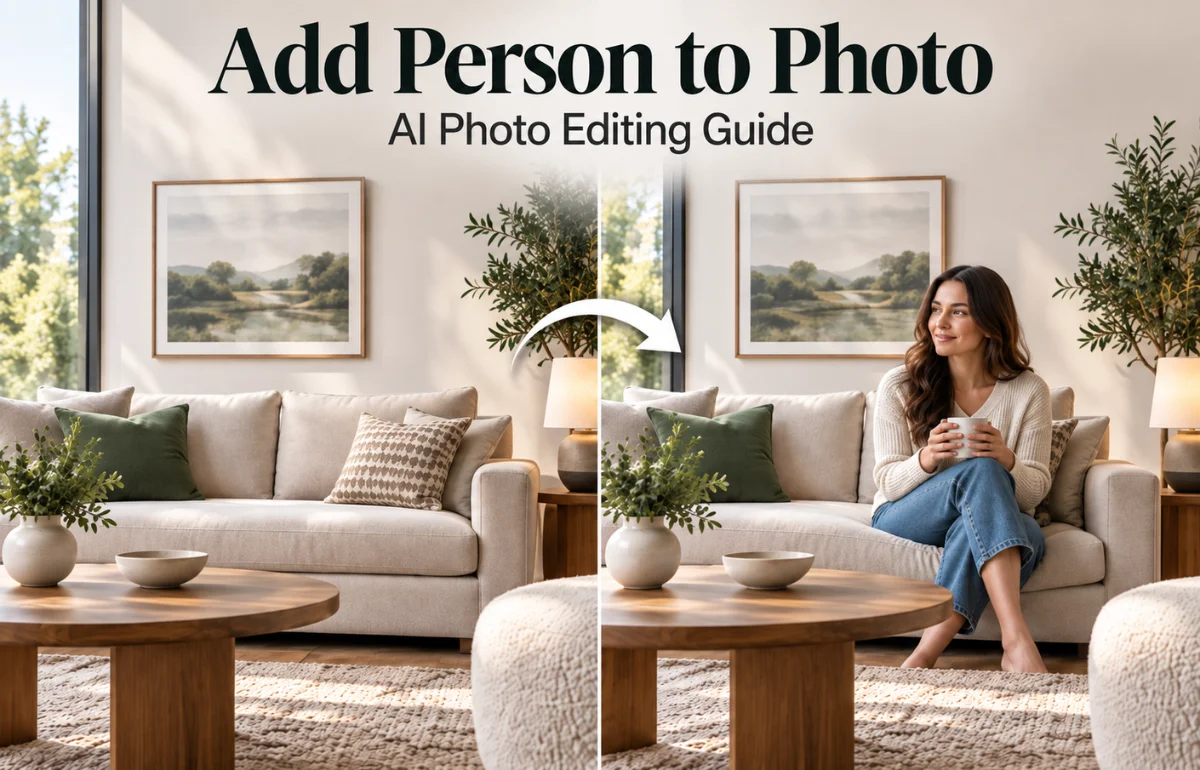
Launching a targeted seasonal campaign on a Shopify storefront often forces a painful operational trade-off for beauty merchants. A brand manager finalizing a fall serum collection or an organic scalp oil line might have flawless product packaging renders, pristine studio bottles, and polished bathroom vanity backgrounds, yet lack contextual lifestyle imagery showing an actual customer interacting with the routine.
Organizing emergency location photoshoots, securing salon models, and booking studio lighting on a two-week turnaround consistently burns thousands of dollars while stalling vital marketing momentum. In contrast, deciding to add person to photo elements via modern AI compositing allows growth teams to merge realistic human figures into existing high-resolution backdrops, accelerating asset testing across collection headers and paid ad creative without scheduling physical reshoots.
The operational objective for direct-to-consumer founders is not merely decorating white catalog space, but solving genuine creative bandwidth constraints. When you strategically add person to photo compositions across digital touchpoints, your marketing department can test diverse consumer demographics, regional styling preferences, and complex salon environments rapidly.
However, learning when and how to add person to photo scenes requires careful commercial evaluation rather than blind tool adoption. This buyer guide breaks down the core technical criteria, organizational profiles, structured production playbooks, and critical operational boundaries required before committing design resources to composite workflows.
Defining the Buyer Dilemma: When Does Your Haircare Brand Need to Add Person to Photo Visuals?
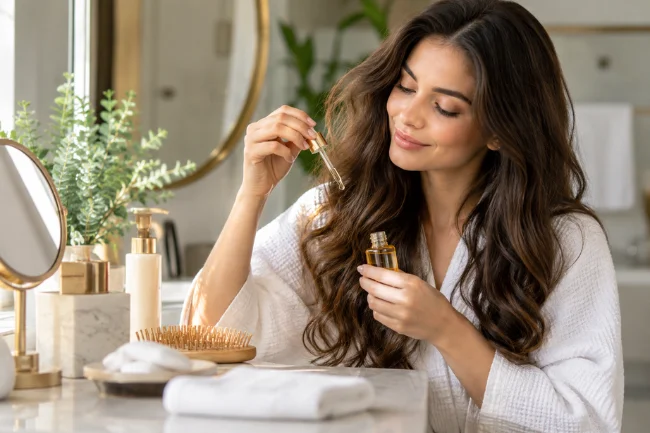
Before integrating composite tools into your store workflow, merchandising teams must determine whether their primary hurdle is an absolute shortage of raw visual concepts or an execution bottleneck around localized customer representation. The challenge is rarely generating another sterile studio render of a hair mist bottle; rather, it centers on illustrating practical usage context across diverse hair textures, ambient bathroom environments, and professional styling moments.
If your e-commerce catalog already boasts sharp macro captures of pumps, dropper tips, and amber glass bottles, choosing to add person to photo setups overcomes the financial drag of commissioning an entire physical set simply to capture an over-the-shoulder application shot.
Deciding to add person to photo compositions resolves this friction by treating your verified catalog environments as modular visual foundations. Instead of discarding an approved marble countertop background or an airy morning bathroom scene, teams that add person to photo imagery can insert a relevant model directly into the existing spatial frame.
This proves especially decisive when adapting a core domestic product listing for international Shopify storefronts, where representing regional styling routines and varied hair profiles determines on-page conversion.
Nevertheless, operational leaders must weigh recurring tool licensing and QA review hours against traditional freelance retainers. Choosing to add person to photo assets functions effectively when your pipeline needs iterative variations of validated concepts.
If your marketing calendar demands twelve distinct lifestyle variations of an anti-frizz serum across Instagram ads, TikTok feeds, and email banners within forty-eight hours, workflows that add person to photo plates eliminate substantial studio overhead.
Conversely, if your goal is an avant-garde hero editorial requiring bespoke structural hairstyling that defies standard visual logic, relying on tools to add person to photo layouts cannot substitute for manual commercial photography.
Core Evaluation Criteria: Lighting Alignment, Edge Fidelity, and Strand-Level Blending
Haircare marketing demands uncompromising visual authenticity because consumer scrutiny fixates precisely on realistic hair behavior, scalp partings, and delicate light interaction. When auditing potential platforms to add person to photo assets, creative directors must evaluate tools against three non-negotiable technical benchmarks:
| Evaluation Benchmark | Technical Requirement | Consequence of Failure |
|---|---|---|
| Lighting Angle & Color Balance | Matched Kelvin temperature and specular directional highlights across face and background | Figure appears detached, creating an amateur cutout aesthetic on PDPs |
| Strand-Level Edge Fidelity | Natural semi-transparency along flyaways, baby hairs, and textured curls | Blocky, pixelated halos that trigger consumer distrust in product efficacy |
| Spatial Depth & Contact Realism | Accurate ground contact shadows and perspective occlusion behind vanity items | Model seems to hover unnaturally above flooring or behind counters |
First, directional lighting alignment dictates whether an inserted figure belongs in the original environment when you add person to photo scenes. If your background bathroom plate features harsh morning sunlight entering from a high right-hand window, an inserted figure illuminated by diffuse frontal studio light instantly breaks visual continuity. Advanced workflows analyze source highlights, ensure matching shadow gradients across cheekbones and shoulders, and harmonize ambient color bounce from nearby tiles or wooden shelves.
Second, fine strand fidelity represents the ultimate litmus test for haircare products whenever you add person to photo imagery. Standard image background cutouts often butcher frizzy textures, coils, and fine flyaways, producing rigid edges that signal synthetic manipulation.
A reliable solution must preserve individual strand semi-transparency, allowing background bathroom tiles or plant foliage to show naturally through loose hair contours. When operators execute a workflow to add person to photo assets, the software must synthesize accurate edge feathering rather than pasting a cardboard silhouette.
Finally, spatial depth and believable contact shadows anchor the newcomer into the three-dimensional scene. An individual positioned behind a vanity sink must be naturally occluded by foreground cosmetics bottles, while cast shadows from arms and shoulders must fall organically across countertops. Without correct scale estimation relative to known objects—such as standard 250ml shampoo bottles or mirror frames—any effort to add person to photo environments collapses buyer confidence.
Assessing Team Profiles: Solo DTC Operators vs. High-Volume Haircare Studios
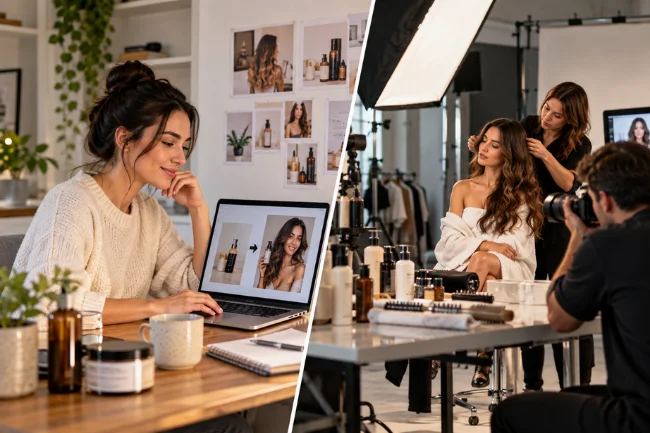
Different e-commerce operations encounter vastly different returns on investment when deciding to add person to photo techniques. Determining where your organization sits clarifies resource allocation:
The Lean DTC Founder
Solo founders and small marketing teams managing single-brand Shopify stores typically operate under stringent capital limits. Hiring professional hair stylists, purchasing studio rental blocks, and managing casting calls for every seasonal routine launch is economically prohibitive.
For this profile, utilizing Pikvee to add person to photo materials democratizes access to polished lifestyle imagery. By relying on software to add person to photo setups, a single founder can pair standard packshots with clean interior scenes, populating collection pages and retargeting ads with relatable models applying leave-in conditioners without incurring four-figure production bills.
The Scaling Mid-Market Beauty Brand
Mid-market brands managing extensive catalogs across shampoos, deep-conditioning masks, and scalp scrubs face intense content turnaround demands. Their creative teams produce dozens of weekly visual iterations for TikTok Shop placements, Meta campaigns, and promotional email sequences.
Here, adopting tools to add person to photo elements serves as a rapid creative multiplier. In-house designers can add person to photo variants by repurposing a single approved autumn lifestyle backdrop across several audience segments, positioning different demographic figures into the scene to evaluate which customer persona yields the highest click-through rate.
High-Volume Enterprise Studios and Agencies
Enterprise agencies servicing multiple multinational haircare accounts operate with established art directors, dedicated retouchers, and generous production retainers. For these teams, decisions to add person to photo assets do not replace flagship brand campaigns. Instead, it functions as a rapid pre-visualization and mock-up mechanism.
Art directors test model poses, spatial blocking, and lighting palettes using synthetic blending before booking high-stakes celebrity shoots. Furthermore, once hero photography concludes, agencies deploy Pikvee to add person to photo renders for downstream secondary assets, expanding localized lifestyle variants across global distribution channels while maintaining pristine brand guidelines.
Recommended Deployment: Where Pikvee Drives Clear Production Lift
To maximize capital efficiency, growth teams should deploy composite image generation across structured, high-velocity marketing use cases rather than ad-hoc experiments. Integrating Pikvee into established Shopify operations unlocks measurable lift across three core digital touchpoints:
▼
▼
▼
When building high-converting Shopify product detail pages, visual hierarchy requires lifestyle validation alongside functional claims. If you sell a heat-protectant spray, showing a model holding the applicator near styled, glossy hair immediately communicates usage context. By instructing the editing pipeline to add person to photo backdrops featuring modern vanity mirrors, merchandising teams can assemble rich PDP galleries in an afternoon.
A structured production playbook requires disciplined prompt preparation. Rather than entering vague requests to add person to photo scenes, specify precise environmental coordinates:
- Define the model’s physical stance relative to foreground furniture: “Position a woman with 3C curly hair on the left side of the marble vanity, looking slightly toward the mirror.
- Match ambient illumination parameters: “Align facial lighting with the soft, diffused 4500K morning window light entering from the left frame.”
- Enforce identity and scene protection: “Preserve all foreground haircare bottles, mirror reflections, and background subway tiles without alteration; generate soft contact shadows along the forearm resting on the counter edge.”
Deploying this systematic framework ensures that your creative department uses Pikvee to add person to photo assets predictably. When teams systematically add person to photo visuals with verified parameters, they shorten asset creation cycles from weeks to minutes while upholding high aesthetic standards.
Non-Fit Boundaries: Scenarios Where Synthetic Person Insertion Falls Short
A balanced buyer decision requires defining clear operational boundaries where algorithmic compositing must not be applied. Synthetic figure placement is an efficiency framework, not a universal remedy for every commercial challenge.
First, regulatory and before-and-after compliance represent an absolute boundary. If your haircare brand markets clinical hair regrowth serums, anti-dandruff solutions, or intense color-depositing dyes, using synthetic generation to illustrate product efficacy invites severe regulatory scrutiny.
Advertising standards boards and platform policies strictly penalize misleading visual claims regarding physical hair transformation. Demonstrating genuine clinical efficacy requires authenticated, unmanipulated human photography tracking verified test subjects over time. Attempting to add person to photo mockups to simulate follicle densification or gray-coverage results undermines brand legitimacy and invites legal liability.
Second, tactile close-ups highlighting specialized salon techniques cannot be replicated reliably through composite generation. Intricate French braiding tutorials, precision shear cutting, or balayage foil placement require hyper-accurate hand-to-hair mechanical interactions.
While generative algorithms excel at placing a figure naturally within an ambient bathroom or living space, they frequently struggle with complex finger interlacing, tension dynamics, and macro hair texture separation. When your content demands instructional pedagogical clarity, booking a licensed stylist and a physical production crew remains irreplaceable.
Finally, luxury editorial campaigns built around distinctive haute-couture identities demand custom artistic vision. High-end salon brands command premium prices by cultivating bespoke visual languages, avant-garde art direction, and unique physical sets that deliberately challenge conventional photography conventions. In these premium contexts, choosing to add person to photo presets dilutes brand exclusivity.
For everyday e-commerce velocity, seasonal catalog adaptation, and dynamic digital advertising, choosing to add person to photo visuals provides unmatched speed and cost efficiency. By establishing rigorous quality benchmarks, understanding your operational scale, and honoring the practical boundaries of synthetic editing, your haircare brand can add person to photo assets with confidence, building an agile, sustainable visual production pipeline across all sales channels.

Noah Sterling is a technology research writer with 8+ years of experience covering emerging technologies, software trends, digital tools, and innovation. He creates practical, research-based articles to help readers understand the evolving technology landscape.