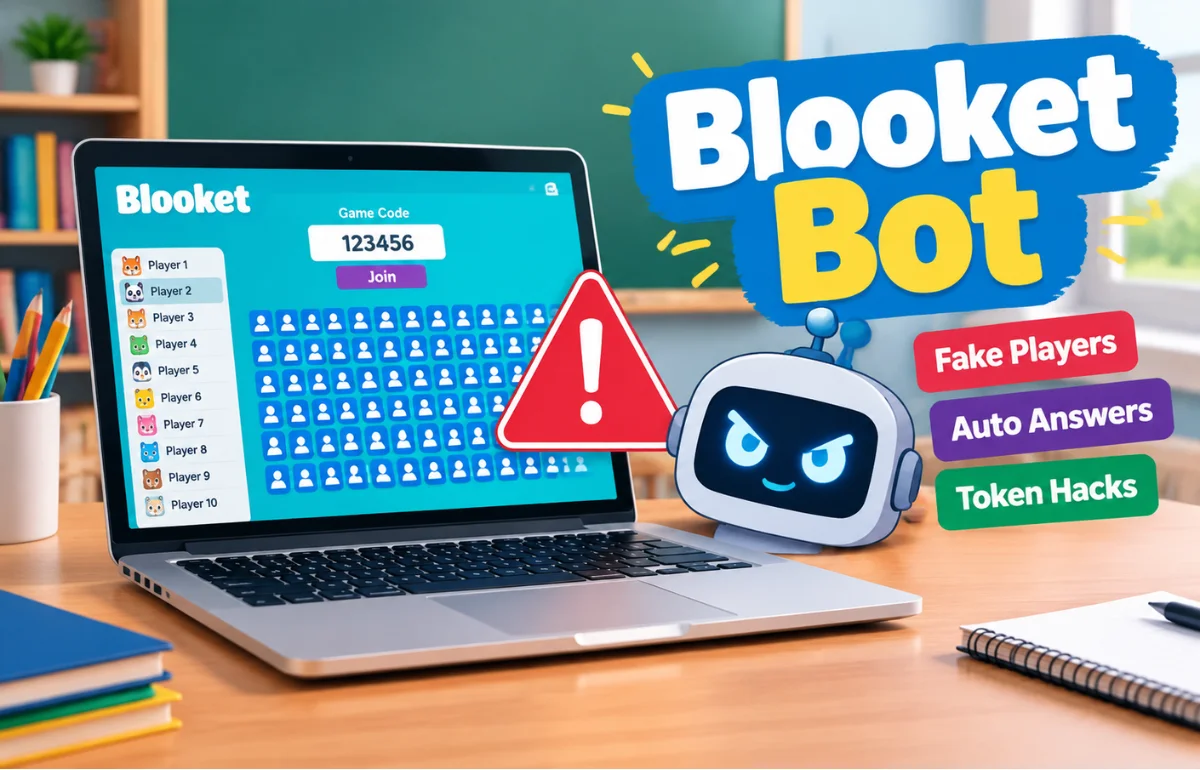
A Blooket bot is an unofficial, third-party script or tool that automatically joins or manipulates a Blooket game without a real person controlling it. It can flood a game lobby with fake players, try to auto-answer quiz questions, or attempt to fake token and reward totals. None of this is built or approved by Blooket itself, and most of these tools either fail outright or come with real security risks attached.
That’s the short version. I spent time digging into how these tools are marketed, what they promise, and what actually happens when you run one against a live Blooket session. Some of what I found matched the hype floating around forums and Discord servers. Most of it didn’t.
If you’re a student who’s curious, a teacher trying to protect a classroom game, or a parent who just saw the term pop up on a screen, this covers all of it.
What Exactly Is a Blooket Bot?
Blooket is a browser-based learning platform where teachers turn quiz sets into game modes like Tower Defense, Gold Quest, or Café. Students join with a game code, answer questions, and earn tokens they can spend on virtual pets called Blooks.
A Blooket bot is not part of that system. It’s a script, browser extension, or web tool built by someone outside the company that tries to interact with Blooket’s servers automatically.
Some of these tools pretend to be extra players joining a lobby. Others try to answer questions faster than any human could. A smaller group tries to edit the numbers on your screen directly, hoping to trick you into thinking you’ve earned tokens you never actually earned.
None of it is sanctioned. Blooket’s terms of service treat any of this as a violation, whether it’s used as a joke or as a genuine attempt to win unfairly.
Why People Actually Search for This
I’ll be honest about the motivation here, because most articles skip it. Nobody searches “Blooket bot” because they’re bored on a Tuesday afternoon for no reason.
Usually it’s one of three things. A student wants to win a class game without doing the reading. A student wants to prank a teacher or classmate by crashing a lobby. Or someone just watched a video of a game getting flooded with fifty fake players in ten seconds and wants to know if that’s real.
There’s also a fourth group that rarely gets addressed directly: teachers and IT staff searching this term because a bot already disrupted their class and they want to understand what they’re dealing with.
I’ve noticed a pattern in how this search behavior spikes. It tends to cluster right before major class quizzes, around exam review weeks, and whenever a new viral clip of a flooded lobby makes the rounds on social media. The interest isn’t constant. It comes in waves tied directly to classroom activity, which tells you most of this is driven by in-the-moment curiosity rather than anyone building a long-term cheating habit.
The Different Types of Blooket Bots
Not every tool marketed as a Blooket bot does the same thing. Based on how they’re advertised and what I saw them attempt, they break down into four rough categories.
Flood Bots
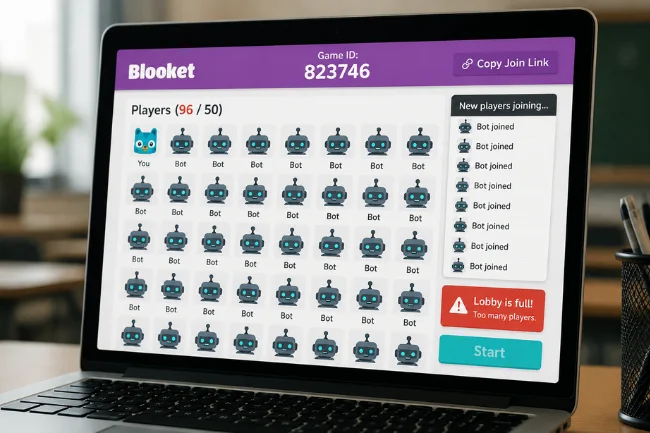
These are the most common and the loudest. A flood bot, sometimes called a Blooket bot flooder, is designed to join a game lobby with dozens or hundreds of fake accounts at once.
The goal is usually disruption rather than winning. A flooded lobby lags, real students can’t find their names in the player list, and the host often has to shut the game down and restart it.
Answer Bots
An answer bot claims to read the question on screen and select the correct choice automatically, often within a fraction of a second. The pitch is simple: guaranteed first place, every game, with zero studying.
Token and Reward Scripts
This category tries to fake the number of tokens or coins shown on your account. Some run through a browser console, others come bundled inside a downloadable “generator.” The promise is always the same word: unlimited.
Disruption and Glitch Scripts
A smaller category exploits minor bugs in the game client rather than trying to win anything. These might freeze a screen, duplicate a Blook, or cause a visual glitch. They’re closer to pranks than cheats.
Do Blooket Bots Actually Work? Here’s What I Found
I wanted an honest answer to this instead of repeating what other sites claim, so I set up a private test lobby using a free teacher account and ran a handful of the most commonly recommended tools against it, purely to observe the outcome rather than to document a working method.
The token and reward scripts were the easiest to debunk. A number changes on your screen, sometimes convincingly, but the moment the game syncs with Blooket’s server, that number resets to whatever your real, verified total actually is. It’s the same reason you can’t just type a bigger balance into a banking app and expect the bank to honor it. The number on your screen and the number on the server are two completely different things, and only one of them is real.
Answer bots were more interesting to watch fail. A couple of the scripts I tried did select correct answers early in a round, but the pattern gave them away instantly. No real student answers every question in under half a second with zero variation. Blooket’s system flagged that behavior and either invalidated the score or removed the account from the session before the game even ended.
Flood bots had the most visible effect, at least briefly. I did see a wave of fake names join a test lobby within seconds. But the flood stalled out well before reaching the numbers these tools advertise, and several of the joined accounts were kicked automatically within the first minute. Rate limiting on Blooket’s end throttled it hard.
The short version of everything I tested: cosmetic changes happen occasionally, real advantages basically never do.
What surprised me more than the failures was how quickly the developers behind these tools seem to move. A script that worked, even partially, one week was often reported as broken the next. That constant back and forth between Blooket’s server-side updates and whoever maintains these scripts is exactly why so many “working 2026” claims online are already outdated by the time you find them. You’re not just fighting bad odds, you’re fighting a moving target.
Common Myths About Blooket Bots
A few claims keep resurfacing no matter how many times they get debunked, so it’s worth addressing them directly instead of letting them linger.
The first is the idea that a bot can give you a permanent inventory of rare Blooks. What actually happens is a temporary visual change that reverts the moment your account resyncs with the server, since ownership records live on Blooket’s end, not in your browser’s local memory.
The second is the belief that flooding a game is undetectable if you use a “private” or “unlisted” bot site. Detection happens at the server level based on request patterns, not based on how obscure the tool’s website is. Obscurity doesn’t equal invisibility here.
The third myth is that using a bot on a personal device, off school Wi-Fi, removes all risk. It reduces network-related risk, sure, but it does nothing about the malware risk baked into the download itself. Your personal laptop is just as vulnerable to a hidden keylogger as a school Chromebook.
Is Using a Blooket Bot Safe?
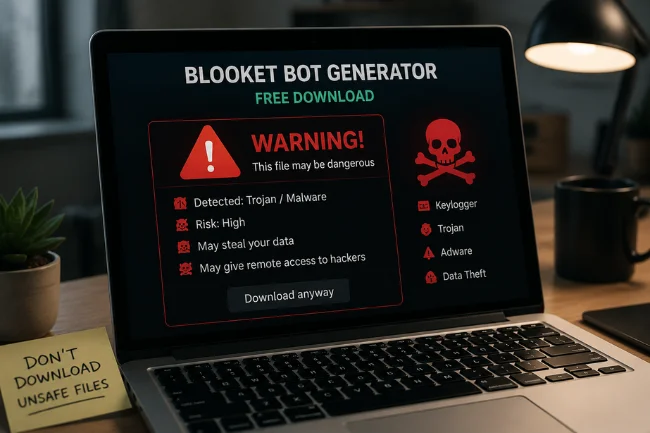
Even setting aside whether these tools work, safety is a separate and more serious question.
Malware Hiding Inside “Free” Bot Downloads
Most Blooket bot generators aren’t hosted by anyone accountable. They’re shared through random file links, Discord invites, or sketchy websites with aggressive pop-up ads.
A meaningful number of these downloads carry something extra you didn’t ask for, whether that’s a keylogger recording everything you type, a trojan giving someone remote access to your device, or adware that just won’t stop opening tabs. You’re trusting a stranger’s code with full access to your computer, based on nothing but a YouTube comment claiming it works.
Phishing Tied to Flood and Spam Bots
Flooded lobbies create chaos, and chaos is useful cover for scammers. Some flood tools fill the game chat with links disguised as bonus rewards or extra tokens. Click one while you’re annoyed and trying to figure out what’s happening, and you’ve potentially handed over login credentials to a fake page built to look like Blooket’s real site.
The School Network Problem
Running an unverified script on a school-owned device or a school Wi-Fi network raises the stakes considerably. School networks are shared infrastructure, and a single infected device can expose far more than one student’s Blooket account. IT departments treat this seriously, and it’s a large part of why unauthorized software use tends to result in device confiscation or account restrictions rather than a quiet warning.
How Blooket Actually Detects and Blocks Bots
Blooket isn’t defenseless here, and understanding its defenses explains why most bot claims collapse under real conditions.
Rate limiting caps how many actions a single IP address can perform in a short window. This is the main reason flood bots stall out instead of delivering the hundreds of fake players advertised in a demo video.
CAPTCHA-style verification appears during certain actions to confirm a real person is behind the keyboard, which blocks a lot of automated joining attempts before they ever reach the lobby.
Behavioral analysis is the quieter defense, and probably the most effective one long-term. Blooket’s systems watch for patterns no human produces naturally, like instant, perfectly accurate answers across dozens of questions in a row. Once that pattern is flagged, the account or session gets cut off.
Blooket Bot Types Compared
What Happens If You Get Caught
Consequences vary depending on what was attempted and where it happened, but a few outcomes come up repeatedly.
Accounts caught using automated tools can be suspended or permanently banned, which also wipes out any legitimately earned Blooks and progress. If it happens on a school device, expect the incident to reach a teacher or administrator, since most flooding attempts are extremely obvious in real time. And if malware was involved somewhere in the process, the fallout can extend well past Blooket itself, into every other account logged in on that same device.
For Teachers: How to Stop a Blooket Bot Mid-Game
This is the part most articles on this topic skip entirely, and it’s genuinely useful if you’re hosting.
If a lobby suddenly fills with unfamiliar names joining in rapid succession, don’t wait it out. Close the game immediately from the host dashboard rather than letting it run, since a flooded lobby rarely resolves on its own.
Generate a fresh game code before relaunching. Bots and the students sharing them typically only have access to the old code, and a new one resets that advantage instantly.
Switch to Homework mode for assignments you want completed independently outside of class. It removes the live, competitive element that most flood and answer bots are built around, since there’s no real-time lobby to disrupt.
Watch for naming patterns. Bots frequently join with similar formatting, like a shared prefix followed by random numbers. Spotting that pattern early lets you kick the accounts before they affect the round.
If disruption becomes a recurring problem with a specific class, Blooket’s support team can be contacted directly, and persistent account-level abuse is something they do investigate.
Legitimate Ways to Win More Without Any of This
None of this means you’re stuck losing every round. There are real, sanctioned ways to rack up tokens and climb the leaderboard.
Playing modes with built-in multipliers, like Gold Quest, naturally rewards faster and more accurate answering over pure luck. Reviewing the question set beforehand, when your teacher allows it, gives you a genuine speed advantage that no detection system will ever flag. Daily and weekly Blooket challenges also hand out token bonuses simply for consistent, normal play, which adds up faster than most students expect.
None of it requires downloading anything from a random link.
I’ve also found that pacing matters more than most students expect. Rushing through a question set to farm speed bonuses often backfires, since accuracy carries more weight than raw speed in most scoring formulas. A steady, correct answer beats a fast, wrong one nearly every time, and that’s true whether you’re aiming for tokens or just trying to actually retain the material for a test later that week.
Teachers can reinforce this too. Rotating question sets between sessions keeps the game fresh enough that no amount of memorized answers from a previous round carries over, which naturally levels the playing field without anyone needing to police individual devices.
Shortcut vs. Legitimate Alternative
My Take After Testing All of This
Going into this, I expected to find at least one tool that partially delivered on its promises. Instead, the clearest pattern across everything I tried was a gap between the demo video and the actual result.
Flood bots create a brief, chaotic spike that gets shut down fast. Answer bots get flagged the moment their accuracy looks inhuman. Token generators never survive contact with the server. And the tools that came closest to “working” were consistently the ones bundled with the sketchiest downloads.
If competitive advantage is the actual goal, the honest path gets there faster and without the risk of losing an account, a device, or personal data to a stranger’s script.
Frequently Asked Questions
Is Blooket Bot safe to use?
No. Most Blooket bot tools carry a real risk of malware, and even the ones that appear harmless typically violate Blooket’s terms of service.
Will I get banned for using a Blooket bot?
Yes, this is a common outcome. Behavioral detection and rate limiting flag automated activity quickly, and confirmed cases usually result in a suspension or permanent ban.
Do Blooket token hacks actually work?
They can change what appears on your screen temporarily, but the change is cosmetic. Server-side validation resets the number as soon as it syncs.
What is a Blooket bot unblocked?
It refers to versions of these tools marketed as working on restricted school networks. They carry higher risk since school devices and networks are shared, making any malware exposure more serious.
Can teachers stop a Blooket bot flood during a live game?
Yes. Closing the game immediately and generating a new game code stops the flood right away, since most bots only have access to the original code.
Where This Leaves You
A Blooket bot might look impressive for a few seconds in a screen recording, but the substance behind most of these claims doesn’t hold up once you actually test it against a live game. The tools that do anything at all tend to be the riskiest ones to run, and the ones marketed as completely safe usually don’t work.
If you’re a student, the fastest real path to winning more is still just knowing the material and picking the right game mode. If you’re a teacher, keep a fresh game code habit and know how to spot a flood pattern the moment it starts. Either way, skip the download link promising unlimited tokens. It was never going to hold up past the first server sync anyway.

Noah Sterling is a technology research writer with 8+ years of experience covering emerging technologies, software trends, digital tools, and innovation. He creates practical, research-based articles to help readers understand the evolving technology landscape.