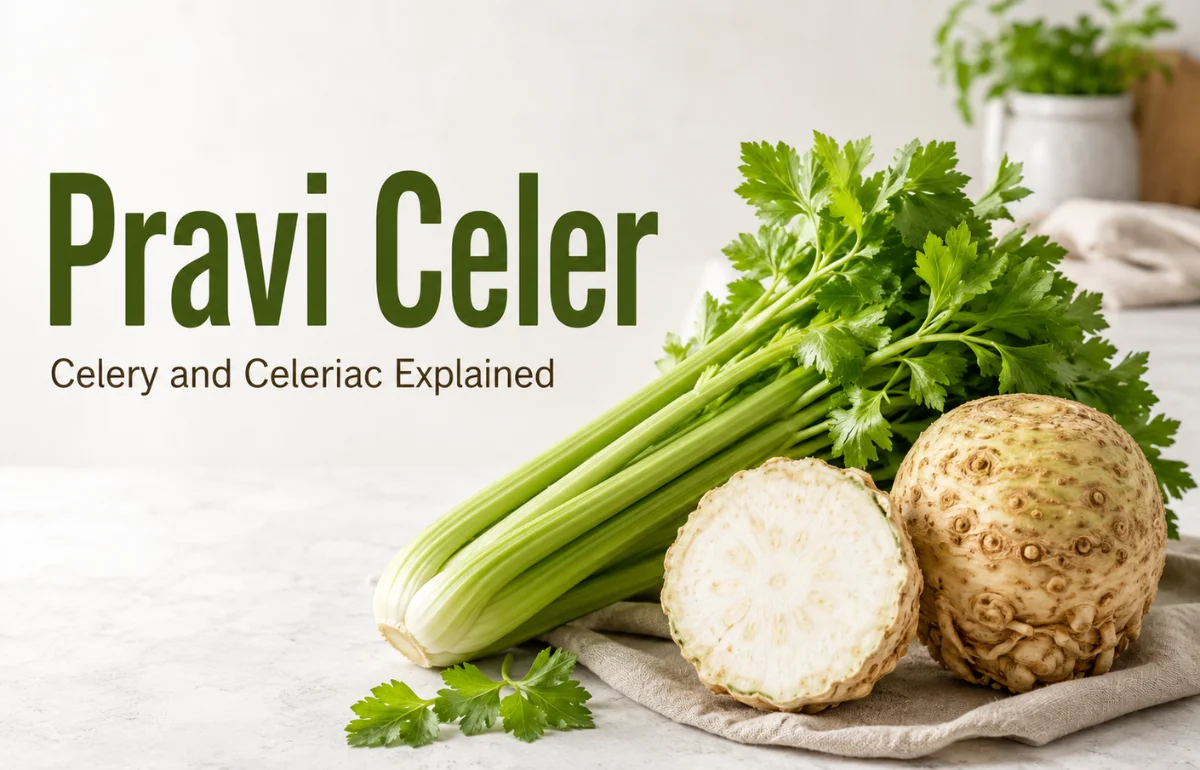
Pravi Celer is a Croatian common name for Apium graveolens, the plant species that includes the familiar forms we know as stalk celery, leaf celery, and celeriac or celery root. In simple English, the phrase can be understood as “true celery” or “real celery.” It does not refer to a completely separate vegetable, and it should not automatically be translated as celeriac.
That distinction matters because I found plenty of online explanations that blur together celery and celery root. The Flora Croatica Database lists pravi celer as a Croatian common name for Apium graveolens, while botanical references from Kew recognize Apium graveolens as the accepted species. Celeriac belongs within that same species but is a cultivated form selected for its enlarged, edible base.
If you have encountered Pravi Celer in a Balkan recipe, garden reference, market, or translated ingredient list, the surrounding context usually tells you which form of celery is intended.
What Does Pravi Celer Mean?
The phrase is easier to understand once it is separated from the vegetable varieties themselves.
“Celer” refers to celery, while “pravi” carries the sense of something real, genuine, proper, or true. In Croatian botanical usage, Pravi Celer is one of the common names recorded for Apium graveolens. Other Croatian names listed for the plant include vrtni celer and mirisavi celer.
This makes the term different from a formal botanical variety name.
Pravi Celer is not a second species sitting beside ordinary celery. The underlying species is Apium graveolens, a member of the Apiaceae family. Kew’s Plants of the World Online recognizes Apium graveolens as an accepted species with a native range extending from parts of Macaronesia and North Africa through Europe toward the western Himalayas.
Where confusion begins is cultivation.
People have selected different forms of the same plant for different useful characteristics. Some are grown mainly for crisp stalks, some for strongly flavored leaves, and others for the large swollen base we call celeriac.
Is Pravi Celer the Same as Celeriac?
Not exactly.
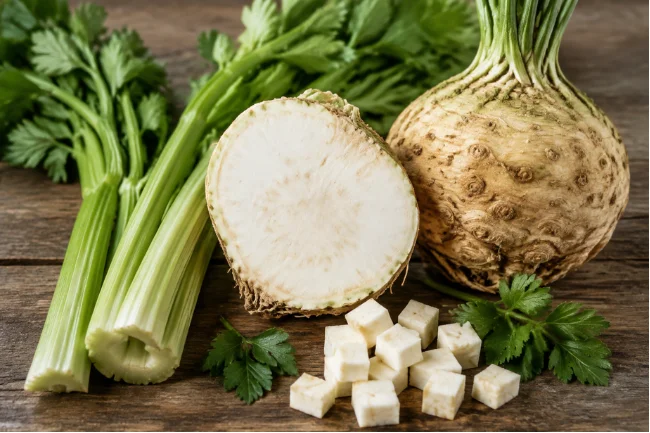
Celeriac is closely related to the celery sold in bunches at supermarkets because both come from Apium graveolens. However, celeriac has been cultivated primarily for its swollen, rounded base rather than long, tender stalks.
Botanical references have historically used names such as Apium graveolens var. rapaceum for celeriac. Kew currently treats that varietal name as a synonym associated with the accepted species Apium graveolens.
So if someone says Pravi Celer and points to a knobbly celery root, they may indeed mean celeriac in that particular culinary context. But translating every occurrence of Pravi Celer as “celeriac” can create an inaccurate impression.
I find the following comparison much more useful than trying to force one English translation onto every recipe.
| Form | Main part used | Appearance | Typical flavor and use |
|---|---|---|---|
| Stalk celery | Leaf stalks | Long, crisp green or pale stalks | Fresh, herbal; salads, soups, stocks, snacks |
| Leaf celery | Leaves and thin stems | Smaller stalks with abundant leaves | Stronger celery aroma; soups, broths, seasoning |
| Celeriac | Enlarged stem base/root area | Round, rough, knobbly bulb-like base | Earthy and celery-like; mash, soup, roasting, salads |
| Pravi Celer | Common name for Apium graveolens | Depends on the cultivated form | Meaning depends on botanical or culinary context |
The practical takeaway is simple: identify the part of the plant the recipe expects rather than relying on the phrase alone.
What Does Pravi Celer Taste Like?
The flavor depends heavily on the form you are using.
Fresh stalk celery is crisp, juicy, slightly bitter, grassy, and aromatic. Darker leaves generally have a more concentrated celery character, which is why a small amount can noticeably change a broth or stew.
Celeriac is different. It retains the recognizable celery aroma but combines it with an earthier, denser character. Once cooked, its flavor becomes milder and slightly sweet, making it useful in purées, soups, roasted vegetable dishes, and mixed mashes.
This is one reason substitutions can disappoint.
If a recipe relies on celery leaves to perfume a soup, replacing them with a large quantity of celeriac changes both the texture and flavor. Likewise, if a dish expects chunks of celeriac, ordinary celery stalks will provide aroma but not the same body.
How Pravi Celer Is Used in the Kitchen
Celery is one of those ingredients that often works quietly in the background. You may not always identify it immediately in the finished dish, but you notice when its herbal aroma is missing.
When I evaluate a recipe containing Pravi Celer, I first look at how the ingredient is prepared. “Leaves,” “stalks,” “root,” “grated,” or “diced” usually gives a better translation clue than the ingredient name by itself.
Soups and Broths
Celery leaves and stalks work especially well in soups because their aroma disperses into the cooking liquid.
They can be added alongside carrots, onions, parsley root, meat, beans, or other vegetables. In long-cooked dishes, I prefer using the more aromatic leaves and inner stems sparingly rather than relying only on mild supermarket stalks.
Celeriac can also go into broth, but it contributes more substance. Cubes of peeled celeriac soften during cooking while retaining an earthy celery flavor.
Roasted Celeriac
If the Pravi Celer mentioned in your recipe clearly refers to celery root, roasting is one of the easiest ways to use it.
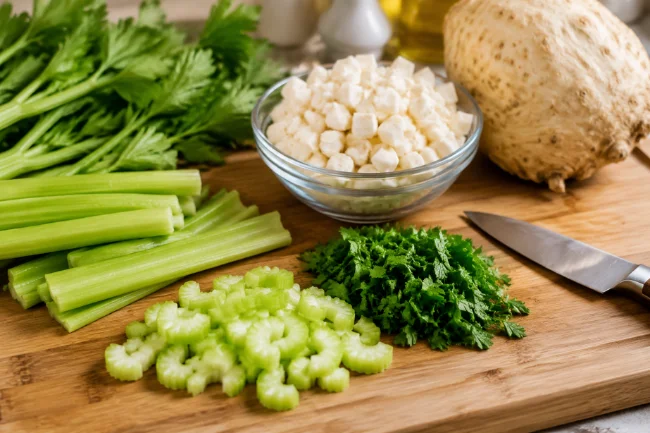
Cut away the rough exterior, slice the interior into cubes or wedges, coat lightly with oil, and roast until browned outside and tender inside.
The result is much closer to a root-vegetable side dish than conventional stalk celery.
Raw Salads
Both forms can be eaten raw, although they behave differently.
Stalk celery adds crunch and freshness. Peeled celeriac can be shredded finely and paired with acidic ingredients such as lemon juice, mustard, yogurt, or vinegar.
Acid is particularly useful with freshly cut celeriac because the exposed flesh can discolor after cutting.
Mashed or Puréed
Celeriac can be boiled or steamed and mashed on its own, but I find its flavor especially approachable when combined with potato.
The potato gives familiar softness, while the celeriac contributes fragrance and a lighter, more vegetal character.
Using the Leaves
Celery leaves are often discarded even though they can be one of the most aromatic parts of the plant.
I use the same general principle I would use with parsley: tender leaves can go into soups, stocks, sauces, salads, or finishing mixtures, while tougher leaves are better suited to long cooking.
They can also be dried for later use, although the flavor changes and becomes less fresh.
How to Know Which Pravi Celer to Buy
If you are shopping from an English-language supermarket or greengrocer, “Pravi Celer” probably will not appear on the label.
Instead, identify what your recipe physically requires.
| If the recipe says or shows… | Look for… | Best substitute if unavailable |
|---|---|---|
| Long stalks | Celery | Fennel stalks may provide crunch, but flavor differs |
| Strong leafy celery | Leaf celery or celery with abundant dark leaves | Celery leaves plus parsley |
| Large round root, grated or cubed | Celeriac/celery root | Parsnip or turnip for texture, plus celery for aroma |
| Celery added whole to stock | Stalk or leaf celery | Standard supermarket celery |
| “Pravi Celer” with no further description | Check recipe photos and preparation instructions | Choose based on the part being chopped, grated, or cooked |
A substitution does not need to imitate every quality at once.
For example, parsnip can provide the dense texture of celeriac but not its celery aroma. Combining a root vegetable with a small amount of ordinary celery can sometimes get closer to the intended result than either ingredient alone.
How to Choose and Store It
For stalk celery, I look for firm stalks that snap rather than bend, with leaves that appear fresh rather than limp or yellowing.
For celeriac, appearance can be misleading. Its exterior is naturally rough and irregular, so a smooth skin is not the goal. What matters more is that the vegetable feels heavy and firm for its size and does not have large soft or rotten areas.
Store stalk celery chilled and protected from excessive moisture loss.
Celeriac generally stores longer than delicate leafy celery. Once cut, however, the exposed flesh should be refrigerated and covered.
Another practical tip: do not peel celeriac as lightly as you would a potato. Its exterior can contain deep creases and fibrous root material, so I cut away the rough outer layer with a sturdy knife until the pale interior is exposed.
Can You Grow Pravi Celer at Home?.
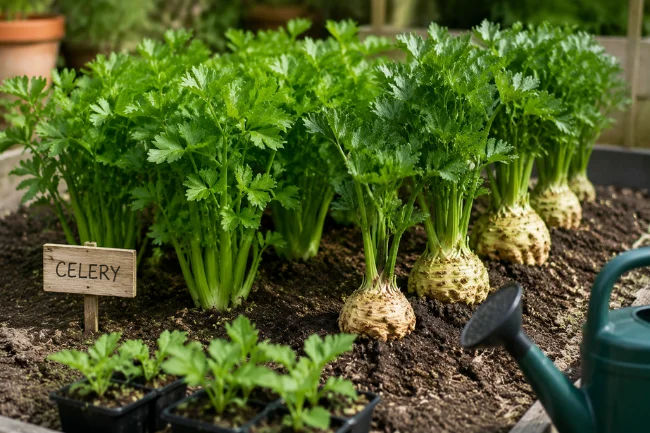
Yes, although the growing method depends on which cultivated form you want.
Celeriac is particularly slow-growing. The Royal Horticultural Society recommends fertile, moisture-retentive soil and full sun, and emphasizes that consistent soil moisture is important throughout its long growing period. Exposure to cold conditions early in development may also encourage premature flowering.
Because celeriac takes time to develop a substantial base, it is commonly started from seed before the main outdoor growing season in cooler climates.
Ordinary stalk celery also dislikes repeated drying out. If I were choosing between the two for a small garden, I would base the decision on how I actually cook: stalk celery is useful for frequent small harvests, while celeriac makes more sense if I regularly prepare soups, roasts, winter vegetables, and purées.
For either one, reliable moisture matters more than occasional heavy watering followed by long dry periods.
Is Pravi Celer Healthy?
Pravi Celer should be viewed first as a nutritious food ingredient, not as a medicinal cure.
Celery and celeriac contribute water, dietary fiber, vitamins, minerals, and naturally occurring plant compounds, although their nutritional profiles are not identical. Stalk celery contains far more water by weight, while the dense edible portion of celeriac provides a different balance of carbohydrate, fiber, vitamins, and minerals.
For precise nutrient comparisons, databases such as USDA FoodData Central are more reliable than broad claims circulating on food blogs because values can be tied to a specific food form and serving size. FoodData Central is maintained by the USDA Agricultural Research Service as a comprehensive food-composition resource.
I would be cautious with claims that celery “detoxes” the body, treats kidney problems, lowers blood pressure by itself, or cures inflammation.
A vegetable can be a useful part of a balanced diet without needing to function like a medicine. That distinction makes health information both more credible and more useful.
One Safety Detail That Is Easy to Miss
Celery can cause significant allergic reactions in susceptible people.
This is not merely a theoretical concern. Celery is one of the allergens that must be declared when used as an ingredient in foods sold under European Union allergen-labeling rules.
That includes celery-derived ingredients, so someone with a diagnosed celery allergy should not assume celeriac is safe simply because it looks different from stalk celery.
Soups, stocks, seasoning blends, sauces, and prepared foods are also worth checking because celery may be present without being visually obvious.
Why the Name Causes So Much Confusion Online
The biggest problem I found while researching Pravi Celer was not a lack of information. It was the mixing together of three different questions:
- What does the phrase mean linguistically?
- Which botanical species does the common name refer to?
- Which cultivated form does a particular cook or recipe intend?
Those questions do not always produce the same English word.
Botanically, the Croatian Flora database links pravi celer to Apium graveolens.
Culinarily, however, a recipe may specifically expect celery stalks, leaves, or celeriac. That is why context matters more than a rigid translation.
This distinction is useful beyond this one ingredient. Traditional food names often develop locally, while modern supermarket terminology tries to place every product into a single standardized category.
Recipes do not always cooperate with that system.
A Simple Way to Think About Pravi Celer
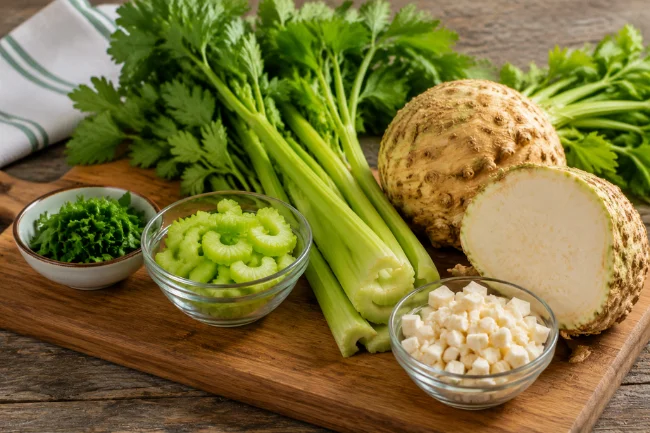
Pravi Celer is best understood as a common name connected with the celery species Apium graveolens, not as the scientific name of a mysterious Balkan vegetable.
Celeriac can absolutely be the intended ingredient in a particular dish, but it is one cultivated form within the wider celery species rather than the automatic translation of Pravi Celer.
When you encounter the term in a recipe, check which plant part is being used. Stalks suggest conventional celery, leafy bunches may indicate leaf celery, and a large knobbly base points to celeriac.
Once that distinction is clear, the ingredient becomes much easier to buy, substitute, grow, and cook with.
If you have an old Croatian, Serbian, Bosnian, or family recipe that lists Pravi Celer without explaining the form, compare the preparation instructions and recipe photo before shopping. That small check can prevent the most common mistake: buying celery root when the dish really needs aromatic leaves and stalks, or doing the reverse.
Frequently Asked Questions
What is Pravi Celer in English?
Pravi Celer can be translated approximately as “true celery” or “real celery.” Botanically, the Croatian common name is associated with Apium graveolens.
Is Pravi Celer the same as celery root?
Not always. Celery root, or celeriac, is a cultivated form of Apium graveolens, while Pravi Celer can refer more broadly to the celery species.
Can Pravi Celer be eaten raw?
Yes. Celery stalks and leaves can be eaten raw, and peeled celeriac is commonly shredded or sliced for raw salads.
What can I substitute for Pravi Celer?
For stalks or leaves, use ordinary celery. If the recipe calls for celeriac, a combination of parsnip or turnip for texture and celery for aroma can work when celeriac is unavailable.
Is celeriac safe for someone with a celery allergy?
No assumption of safety should be made. Celeriac comes from the celery species, and celery is a recognized food allergen that requires declaration in the EU.

Dr. Hannah Collins is a nutrition and diet specialist with 13+ years of experience helping people make informed food choices and develop healthier eating habits. She shares evidence-based nutrition guidance focused on balanced diets, meal planning, healthy lifestyles, and sustainable wellness.