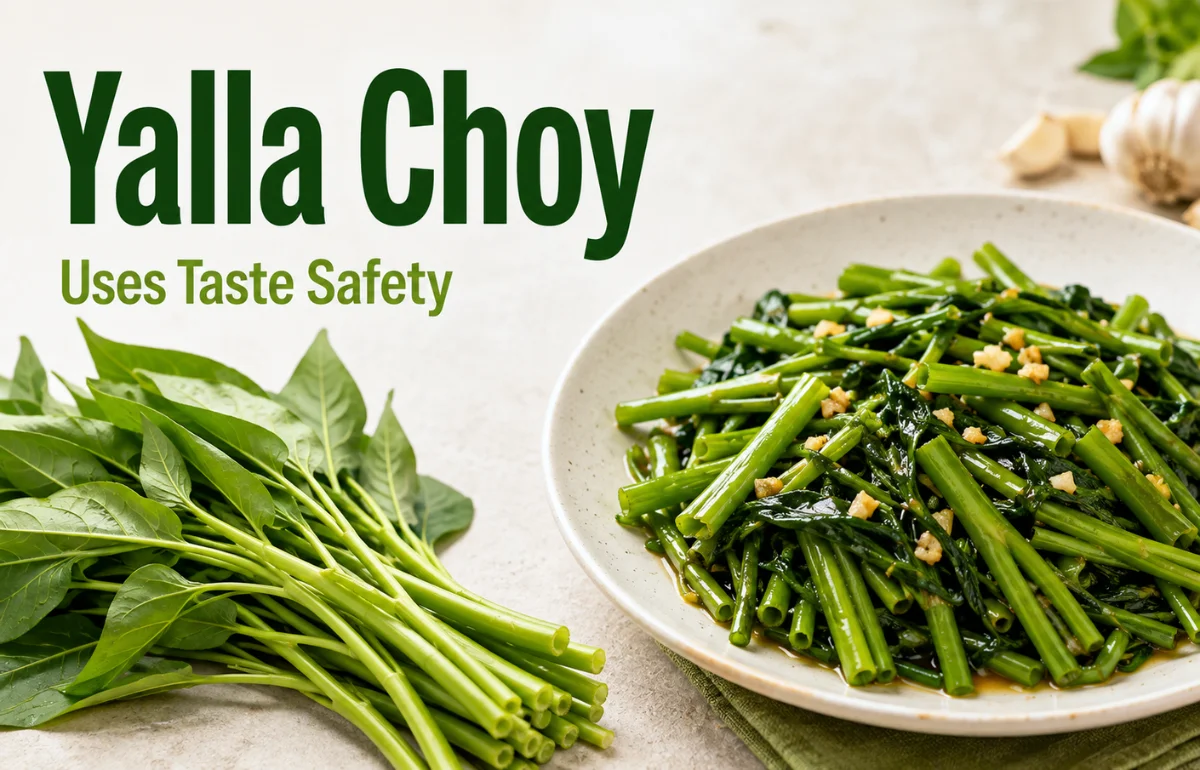
Yalla Choy is a nonstandard name that recent online articles sometimes use for water spinach, a leafy vegetable with the scientific name Ipomoea aquatica. The plant is better known as water spinach, ong choy, kangkong, kangkung, swamp cabbage, or water convolvulus, depending on the country and community. It has long, hollow stems, tender green leaves, and a mild flavor that works especially well in quick stir-fries, soups, and coconut-based dishes.
When I researched the phrase “Yalla Choy,” I could not find it listed as an established botanical or agricultural name in authoritative plant references. For accuracy, I would treat it as an informal internet label rather than a separate vegetable variety. If you are shopping for it, asking for water spinach, ong choy, or kangkong will usually be more useful. Agricultural sources consistently identify the vegetable as Ipomoea aquatica and place it in the morning glory family.
Is Yalla Choy the Same as Water Spinach?
In most online content using the phrase as a food name, Yalla Choy refers to water spinach. The wording is confusing because “Yalla Choy” is not one of the standard common names used by botanists, agricultural agencies, or most Asian food markets.
It may be a misspelling, a newly coined label, or a phrase repeated from another website. I have therefore used the recognized vegetable name throughout this guide whenever botanical accuracy matters.
Water spinach is not the same plant as ordinary spinach. It belongs to the Convolvulaceae family, which also includes morning glories and sweet potatoes. True spinach, Spinacia oleracea, belongs to another plant family. The shared word “spinach” describes how the greens are eaten rather than a close botanical relationship.
Common names you may see
| Name | Common context | Meaning |
|---|---|---|
| Water spinach | General English name | Ipomoea aquatica |
| Ong choy or ong choi | Cantonese-speaking communities and Asian markets | The same vegetable |
| Kangkong or kangkung | The Philippines, Malaysia, Indonesia, and parts of the Pacific | The same vegetable |
| Water convolvulus | Botanical and older English references | The same vegetable |
| Swamp cabbage | Informal English name | The same vegetable |
| Yalla Choy | Recent, nonstandard online usage | Usually presented as water spinach |
Names vary by language and region, so a produce label may not use the term you searched. The scientific name is the clearest way to confirm the plant. Government and university references recognize names such as ong choy, rau mong, kangkong, water spinach, and water convolvulus.
How to Identify Yalla Choy Correctly
The easiest feature to check is the stem. Water spinach has long, hollow, jointed stems that feel crisp when fresh. The leaves grow alternately along those stems and may look narrow, spear-shaped, or arrowhead-shaped.
Fresh bunches should have lively green leaves and firm stems. A few small holes in the leaves are not unusual, but widespread yellowing, slime, a sour smell, or collapsed stems usually signals age.
I recommend cutting through one stem when identification is uncertain. A clearly hollow center is a strong clue. Bok choy has thick, solid leaf stalks, while choy sum generally has solid stems and may include small yellow flowers.
Yalla Choy Compared With Other Asian Greens
| Vegetable | Botanical identity | Identification | Flavor and common use |
|---|---|---|---|
| Water spinach or Yalla Choy | Ipomoea aquatica | Long, hollow stems with narrow or arrow-shaped leaves | Mild and slightly earthy; stir-fries and soups |
| Bok choy | Brassica rapa group | Thick, solid stalks with spoon-shaped leaves | Mild and cabbage-like; braises and stir-fries |
| Choy sum | Brassica rapa group | Slender, solid stems, often with yellow flowers | Sweet and lightly mustard-like; blanching and stir-frying |
| True spinach | Spinacia oleracea | Soft, solid stems with broad, tender leaves | Mineral and slightly sweet; salads and sautés |
Water spinach can trail across wet ground or float in waterways. Its stems can produce roots at their joints, which helps explain its ability to spread rapidly in warm freshwater environments. University and government plant references use the hollow stems, variable arrow-like leaves, trailing growth, and rooting nodes as key identification features.
What Does Yalla Choy Taste Like?
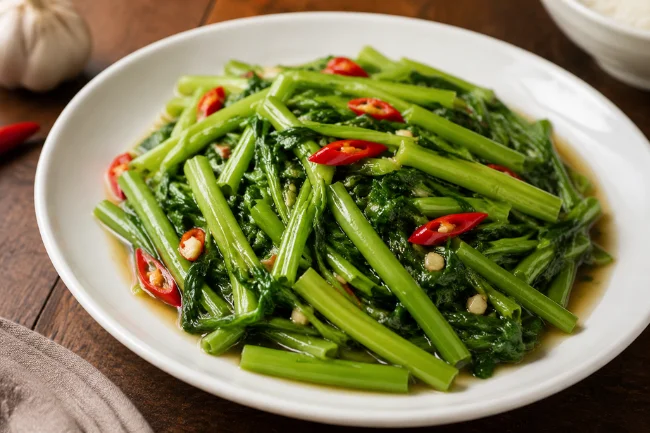
Water spinach tastes greener and milder than its name may suggest. The leaves soften quickly, while the hollow stems keep a pleasant snap when cooked briefly.
I would not describe good-quality water spinach as strongly peppery. Its flavor is closer to a gentle leafy green with a faint earthy or mineral edge. Garlic, ginger, fermented bean curd, shrimp paste, chili, soy sauce, fish sauce, and coconut milk all pair well with it.
Texture is one of its biggest attractions. A well-cooked plate gives you silky leaves and juicy, crisp stems in the same bite. Overcooking removes that contrast and can make the vegetable watery.
Nutrition and Potential Health Benefits
Yalla Choy, when the term refers to water spinach, is a leafy vegetable that provides fiber and a range of micronutrients. Research literature describes water spinach as containing vitamins, minerals, protein, fiber, carotenoids, and other naturally occurring plant compounds.
The sensible health message is broader than any single nutrient claim: eating water spinach can add vegetable variety, fiber, and micronutrients to a balanced diet. Fiber supports normal digestive function and can help make meals more satisfying.
Green leaves also contain carotenoids and other antioxidant compounds. These compounds are scientifically interesting, but they do not turn one vegetable into a treatment for inflammation, diabetes, cancer, or another disease.
I would avoid the exaggerated “superfood” claims found in thin online articles. Water spinach can be nutritious without being presented as a cure or medical solution.
Cooking method also matters. Boiling, blanching, steaming, microwaving, and stir-frying can affect texture and the concentration or retention of certain compounds. Nutrient levels may also differ according to the variety, growing conditions, freshness, storage, and serving size.
A Practical Nutrition Perspective
Rather than comparing Yalla Choy with kale or ordinary spinach to find a nutritional winner, I see it as another useful green to rotate into meals. Dietary variety allows people to obtain different combinations of fiber, vitamins, minerals, and plant compounds.
The sauce and cooking method can change the final dish substantially. A light garlic stir-fry is different from kangkong cooked with a generous amount of salty paste, oil, or coconut milk.
Neither preparation needs to be judged by the vegetable alone. The quantity, seasoning, accompanying protein, and rest of the meal all matter more than a “superfood” label.
How to Select, Clean, and Store It
At the market, look for crisp stem tips, green leaves, and a freshly cut base. Very thick lower stems can be fibrous, while younger upper stems are usually more tender.
Water spinach grows in aquatic or semiaquatic conditions, so careful washing is worthwhile. I recommend trimming the dry base, cutting the bunch into manageable lengths, and washing it in several changes of cool water.
Lift the greens out of the water instead of pouring the entire bowl through a colander. Sand and grit are more likely to remain at the bottom of the bowl.
Drain the vegetable thoroughly before stir-frying. Water clinging to the leaves cools the pan and encourages steaming, which can leave the finished dish soft and watery.
Store the unwashed bunch loosely wrapped in the refrigerator and use it while the leaves and stems are still firm. A University of Hawaii food guide also notes that trimmed kangkong stems can be placed upright in a small amount of clean water.
How to Cook Yalla Choy Without Making It Soggy
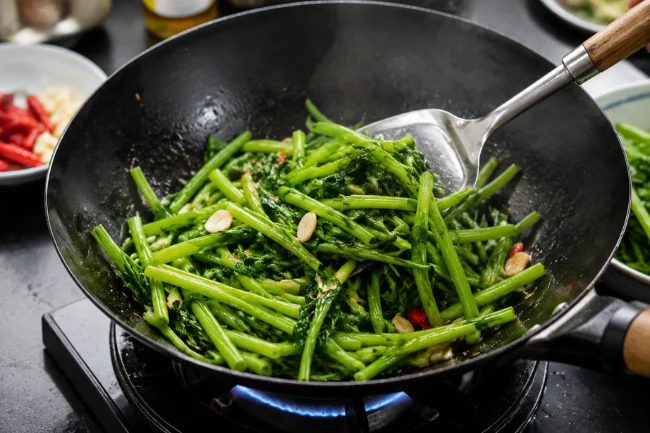
High heat and short cooking are the basic rules. Because the stems take longer to soften than the leaves, I separate them or add the stem-heavy pieces first.
Heat a wok or wide skillet, add oil and aromatics, and cook the stems briefly before adding the leaves. Toss only until the leaves wilt and the stems become bright and just tender.
The process takes minutes rather than the long simmer used for tougher greens. If the pan is overcrowded, cook the vegetable in batches so the heat stays high.
Simple Garlic Water Spinach
For a straightforward version, use a bunch of cleaned water spinach, several sliced garlic cloves, neutral cooking oil, and a small amount of soy sauce or salt.
Cook the garlic briefly without allowing it to burn. Add the stems and toss them over high heat, followed by the leaves.
Remove the pan from the heat as soon as the leaves collapse and the stems are tender-crisp. Chili, sesame oil, oyster sauce, fermented tofu, or a squeeze of citrus can be added according to the meal.
Other Useful Preparations
Water spinach works in clear broths, noodle soups, curries, omelets, and coconut-milk dishes. Add it close to the end of cooking so the leaves stay green and the stems retain some structure.
It can also be blanched and dressed with sesame, soy sauce, garlic, vinegar, or chili oil. The hollow stems absorb thin sauces particularly well.
Some food traditions use young kangkong in fresh salads. Thorough washing and a trustworthy source are essential for any vegetable grown in or around water, however, so cooking is the more cautious general choice. The University of Hawaii’s Pacific Food Guide recognizes both fresh and cooked uses.
Where to Buy Yalla Choy
You are more likely to find this vegetable at an Asian supermarket, Southeast Asian grocery, farmers’ market, or specialist produce seller than in a conventional supermarket.
Do not rely only on the label “Yalla Choy.” Ask for water spinach, ong choy, kangkong, kangkung, rau muống, or water convolvulus. Keeping the scientific name, Ipomoea aquatica, on your phone can help when pronunciation or spelling varies.
If fresh water spinach is unavailable, select a substitute based on the dish. Choy sum gives a similar tender-crisp quality, while ordinary spinach provides soft leaves but not the characteristic hollow stems.
Bok choy is useful when you need a substantial, crunchy vegetable, although its thick stalks and cabbage-like flavor create a different result.
Ornamental morning glory plants should not be treated as a culinary substitute simply because they belong to the same botanical family. Buy greens that are clearly identified and sold for food use.
Can You Grow Yalla Choy at Home?
This is where casual food advice can become misleading. Water spinach is a vigorous aquatic or semiaquatic plant, and its legal status varies by location.
In the United States, Ipomoea aquatica is listed as a federal noxious weed. Federal guidance states that importing it or transporting it between states without a permit is illegal. Individual states may impose additional restrictions on possession, cultivation, sale, or movement.
Florida, for example, lists water spinach as a prohibited aquatic plant as well as recognizing its federal status. Its ability to create spreading growth in waterways is the main regulatory concern.
That does not mean every bunch found in a permitted market is illegal. Licensed production and regulated commercial sales may exist in certain locations.
It does mean buyers should not casually order seeds, move live cuttings across state lines, or plant water spinach beside ponds and drainage channels without checking the rules.
I would verify the current requirements with the relevant state agriculture department before growing it rather than relying on a seed-marketplace description.
Why the Name Matters
The naming problem is more than an SEO detail. A reader searching for Yalla Choy may assume it is a newly discovered superfood or a separate Asian vegetable.
That assumption is not supported by the authoritative botanical and agricultural references I reviewed. Those sources recognize Ipomoea aquatica as water spinach and list established alternatives such as ong choy and kangkong.
Clear naming helps shoppers find the right ingredient, cooks choose suitable recipes, and readers avoid confusing it with bok choy, choy sum, ordinary spinach, and ornamental morning glory.
My practical rule is simple: use “Yalla Choy” when answering the search query, but pair it immediately with water spinach, ong choy, kangkong, and Ipomoea aquatica.
That approach serves the reader’s search intent without reinforcing an uncertain label as an established botanical fact.
FAQs About Yalla Choy
What is Yalla Choy?
Yalla Choy is a nonstandard online name usually used for water spinach, or Ipomoea aquatica, a hollow-stemmed leafy vegetable popular in Asian cooking.
Is Yalla Choy the Same as Ong Choy?
Yes. When Yalla Choy refers to water spinach, ong choy is an established market and culinary name for the same vegetable.
What Does Yalla Choy Taste Like?
It has mild green leaves and crisp, juicy stems, with a fresher and less bitter flavor than many stronger leafy greens.
Can Yalla Choy Be Eaten Raw?
Young water spinach is eaten raw in some traditions, but careful washing and a reliable source are essential; cooking is the safer general choice.
Is Yalla Choy Legal to Grow in the United States?
Water spinach is federally regulated as a noxious weed, and growing or transporting it may require a permit or be prohibited under state rules.
The Most Useful Next Step
Look for water spinach, ong choy, or kangkong at a reputable Asian market. Check for hollow stems, wash the bunch thoroughly, and cook it quickly with garlic before exploring regional recipes.
The vegetable deserves attention for its texture, versatility, and cultural importance—not because of inflated superfood promises or an uncertain internet name.

Dr. Hannah Collins is a nutrition and diet specialist with 13+ years of experience helping people make informed food choices and develop healthier eating habits. She shares evidence-based nutrition guidance focused on balanced diets, meal planning, healthy lifestyles, and sustainable wellness.