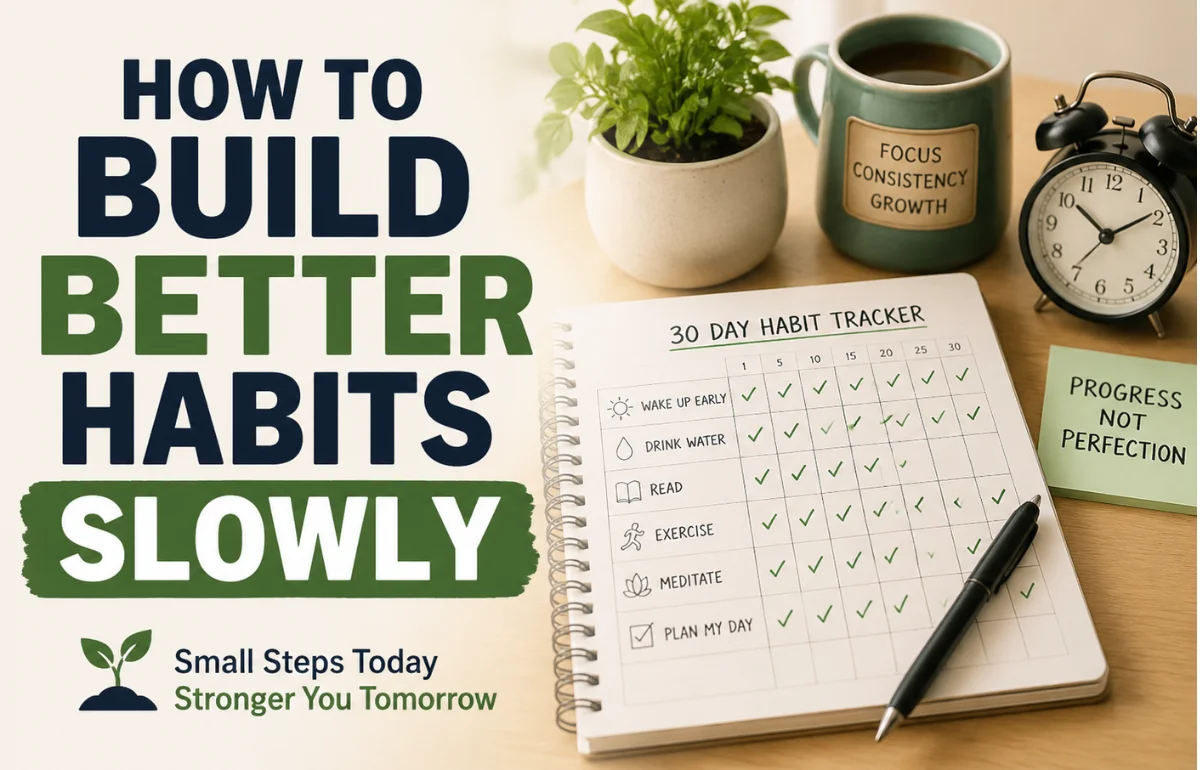
Learning how to build better habits slowly means choosing a small behavior, attaching it to a reliable cue, repeating it until it feels familiar, and increasing the difficulty only when the current version is easy to maintain.
A habit is not simply something you do often. It is a behavior that becomes easier to start because your brain begins connecting it with a specific time, place, feeling, or previous action.
The slow approach works because it reduces resistance, protects consistency, and gives the behavior time to become part of normal life. Instead of trying to transform everything in one week, I recommend building one repeatable action that still works on busy, stressful, or low-energy days.
Why Slow Habit Building Works Better Than a Dramatic Reset
Big changes can feel exciting because they create a sense of immediate progress. The problem is that excitement is temporary, while the new routine may demand more time, energy, planning, and self-control than daily life can support.
Habit formation is usually gradual. Research suggests that repeating a behavior in a stable context strengthens the link between the situation and the action, making the behavior more automatic over time.
One widely cited real-world study found substantial variation in how long this process took, which is why the popular “21-day habit” rule is too simplistic. (Wiley Online Library)
| Fast habit overhaul | Slow habit building |
|---|---|
| Changes several behaviors at once | Focuses on one core behavior |
| Relies heavily on motivation | Relies on cues and repetition |
| Uses an ideal daily target | Uses a minimum sustainable target |
| Treats missed days as failure | Treats missed days as feedback |
| Measures intensity | Measures consistency and recovery |
Start With a Behavior, Not a Vague Goal
“Get healthier,” “be productive,” and “improve my life” are goals, not habits. They describe a direction but do not tell you what to do at 7:30 on a Tuesday morning.
A usable habit is visible and specific. You can tell whether it happened.
Instead of “read more,” choose “read one page after I get into bed.”
Instead of “exercise regularly,” choose “walk for five minutes after lunch.”
Instead of “be more organized,” choose “write tomorrow’s three priorities before closing my laptop.”
When I evaluate a habit, I use one question: Could a camera record the action? If the answer is no, the behavior is probably too vague.
Choose One Habit That Solves a Real Problem
A habit becomes easier to maintain when it connects to something you genuinely care about. Social pressure can make a goal sound respectable, but it does not always create durable commitment.
Ask what problem the habit will reduce.
A five-minute evening tidy may reduce morning stress. Preparing a water bottle may reduce the chance of forgetting to drink during a busy afternoon. Writing one sentence may help you restart a neglected creative practice.
This gives the habit a practical purpose. You are not adding another task to your life simply because successful people supposedly do it. You are creating a behavior that makes part of your own life easier or better.
Make the First Version Almost Too Easy
The first version of a habit should be small enough to survive a bad day.
This does not mean the final goal must stay small. It means you are training the starting pattern before increasing the workload.
A common mistake is choosing the full desired behavior as the entry point. Someone who wants to meditate for 20 minutes starts with 20 minutes. Someone who wants to run three miles starts with three miles.
The plan works while enthusiasm is high, then collapses when normal life returns.
I prefer a three-level habit design:
| Habit level | Purpose | Reading example | Exercise example |
|---|---|---|---|
| Minimum | Keeps the habit alive | Read one paragraph | Do two squats |
| Normal | Provides meaningful progress | Read five pages | Walk for 15 minutes |
| Bonus | Allows optional extra effort | Read a full chapter | Complete a longer workout |
The minimum protects continuity, the normal version creates progress, and the bonus version uses high-energy days without raising tomorrow’s requirement.
Your minimum version should feel almost too easy. That is a useful feature, not a weakness.
When a behavior is easy to begin, you have fewer opportunities to negotiate with yourself. Once you have started, you may naturally do more, but completing the minimum should still count as success.
Attach the Habit to a Stable Cue
Motivation asks, “Do I feel like doing this?”
A cue asks, “What happens next?”
A stable cue can be a time, location, existing routine, or recurring event. Examples include finishing breakfast, arriving home, turning on your computer, brushing your teeth, or placing your phone on charge.
The cue should already happen reliably. “After I feel motivated” is not a cue. “After I pour my morning coffee” is.
A useful formula is:
If or when [specific cue] happens, I will [small behavior] in [specific place].
For example:
“When I place my lunch plate in the sink, I will walk outside for five minutes.”
These if-then plans, often called implementation intentions, connect a situation with a planned response and can improve the chances that intentions become action. (Cancer Control)
Use One Cue, Not a Cloud of Reminders
Too many reminders create noise.
A calendar alert, sticky note, phone notification, habit-tracking app, and accountability message can make a simple behavior feel like a complicated project.
Start with one primary cue and one backup reminder. The cue starts the behavior; the backup only catches a disrupted routine.
For example, finishing dinner may be your cue to prepare tomorrow’s lunch. A later phone reminder can serve as a backup when dinner happens away from home.
Reduce Friction Before You Add Discipline
People often assume consistency is a character test. I see it more as a design test.
Friction is anything that makes the habit harder to begin. It may involve finding equipment, deciding what to do, clearing space, opening several apps, changing clothes, traveling somewhere, or remembering the next action.
Remove one point of friction before asking for more willpower.
Put the book on your pillow.
Leave your walking shoes near the door.
Open the writing document before ending the workday.
Prepare healthy food where it is easy to see and reach.
Block distracting websites before a study session begins.
I also use what I call a “friction budget.” Every habit can tolerate only so many small obstacles before it becomes easy to postpone.
A two-minute behavior with six setup steps is not truly a two-minute habit. When measuring the size of a habit, include the preparation, decisions, travel, cleanup, and recovery it requires.
Make the Unwanted Habit Slightly Less Convenient
When replacing an unwanted habit, do not rely only on telling yourself to stop. Create a better default by adding a small amount of friction to the old behavior.
Move social media apps off your home screen. Keep tempting snacks out of immediate reach. Charge your phone outside the bedroom. Log out of the website you open automatically.
You do not need to make the behavior impossible. Even a brief pause can interrupt an automatic response and give you time to make a more deliberate choice.
Repeat the Habit Before Expanding It
A habit should grow after it becomes stable, not merely because a calendar says a week has passed.
I recommend using a two-week ease test. Keep the current version until you can complete it for roughly two weeks without frequent negotiation, dread, or recovery from overexertion.
Then increase only one variable.
You might add two minutes, one page, one repetition, or one extra day per week. Do not increase duration, frequency, and difficulty at the same time.
This is the part of how to build better habits slowly that many people miss: progression should be earned by stability.
Increase by the Smallest Meaningful Amount
Suppose you are walking for five minutes after lunch. A jump to 30 minutes may turn a stable habit into a scheduling problem.
Moving from five to seven minutes preserves the cue while keeping resistance low.
The increase may seem insignificant, but that is the point. You are trying to strengthen the routine without forcing your brain to treat it as a completely new demand.
Slow growth also gives you permission to stop expanding when the habit already serves its purpose. Not every useful behavior needs to become more intense.
A ten-minute daily walk that continues for years may be more valuable than an ambitious workout plan abandoned after three weeks.
Track Proof, Not Perfection
Tracking can help, but only when it answers a useful question.
Do not turn a simple habit into an administrative burden. A check mark can record whether the behavior happened. A one-sentence note can explain why it did not.
Track three things:
- Did I complete the minimum?
- What cue started the behavior?
- What caused a miss or delay?
This turns tracking into diagnosis rather than judgment.
After a few weeks, patterns begin to appear. Perhaps weekends lack the usual cue. Perhaps the habit becomes difficult after poor sleep. Perhaps travel removes access to the equipment you normally use.
Once you see the pattern, you can modify the system instead of blaming your personality.
Measure Recovery Speed
One of the best indicators of a durable habit is not how long you avoid missing it. It is how quickly you return.
A missed day is an event. Missing repeatedly without adjusting the system is a pattern.
Create a recovery rule before you need it:
“If I miss the habit, I will complete the minimum version at the next available cue.”
This rule prevents guilt from turning one interruption into abandonment.
It also removes the temptation to compensate. You do not need to read 50 pages because you missed yesterday’s five pages. You only need to restart the normal pattern.
Protect the Habit During Low-Energy Days
A habit built only for your best days is not yet reliable.
Plan for tired evenings, rushed mornings, travel, illness, deadlines, family demands, and unexpected changes. Decide what the habit will look like when your capacity drops.
For writing, the low-energy version may be one sentence. For fitness, it may be gentle mobility. For learning, it may be reviewing one flashcard.
I call this the “continuity version.” The workload shrinks, but the pathway stays familiar.
This is not about forcing yourself to be productive when you genuinely need rest. It is about distinguishing between the size of the habit and the existence of the habit.
You can reduce the effort without abandoning the routine entirely.
Avoid These Slow-Habit Mistakes
Starting Too Many Habits Together
Several tiny habits can still create a large mental load.
Begin with one behavior that has a clear cue. Add another only when the first habit no longer requires much planning or internal debate.
Making the Minimum Secretly Difficult
“Just do a short workout” may still involve changing clothes, driving to a gym, warming up, exercising, showering, and returning home.
Count the full startup cost, not only the visible activity.
Expanding Because You Had One Good Week
A few energetic days do not always mean the habit is ready to grow. Check whether the routine also works on busy and tiring days.
Increase it only after the current version feels stable under normal conditions.
Using Guilt as a Habit Strategy
Guilt may produce one intense burst of action, but it does not create a dependable cue or a sustainable routine.
When the habit breaks, look for the design problem. The action may be too large, the cue may be unreliable, or the environment may contain too much friction.
Expanding to Compensate for Missed Days
Do not increase a habit to make up for previous failures.
Return to the minimum, rebuild stability, and expand from evidence rather than emotion. Consistency grows through calm repetition, not punishment.
A Simple 30-Day Slow Habit Plan
Days 1–7: Establish the Starting Pattern
Define one tiny behavior, one reliable cue, and one location.
Remove obvious friction and complete only the minimum version. Your goal is to learn how the behavior fits into your day.
Days 8–14: Observe Without Expanding
Keep the behavior unchanged.
Notice when it feels easy, when it gets delayed, and what breaks the cue. Do not increase the target simply because the first week went well.
Days 15–21: Improve the Environment
Prepare materials earlier, adjust the timing, reduce setup steps, or create a backup cue.
The aim is to make the current behavior easier to repeat, not to make it more impressive.
Days 22–30: Test One Small Increase
Make one small increase if the current version feels stable.
Add a few minutes, pages, repetitions, or another suitable unit. Keep everything else the same so you can see whether the adjustment is sustainable.
You can also maintain the original version if it still requires considerable effort. The aim is not to finish 30 days with a dramatic result. The aim is to leave with a routine you can continue on day 31.
Frequently Asked Questions
How long does it take to build a good habit?
There is no fixed timeline. The time varies by person, behavior, and context, so focus on consistent repetition rather than a 21-day deadline.
Is it better to build one habit at a time?
Usually, yes. Focusing on one habit reduces planning pressure and helps you identify which cues and adjustments are working.
What is the easiest way to make a habit stick?
Attach a very small action to a reliable existing cue, reduce the setup effort, and repeat it in a consistent context.
What should I do after missing several days?
Restart with the minimum version at the next available cue. Avoid compensating with extra work or waiting for a perfect restart date.
Can tiny habits really create major changes?
Yes, when they are repeated and gradually expanded. Their value comes from creating a dependable pattern that can support larger actions later.
Build a Habit You Can Still Do Next Month
The best answer to how to build better habits slowly is to make the behavior clear, small, cued, easy to begin, and flexible enough for real life.
Do not rush to prove how much you can do. Build evidence that you can start, repeat, recover, and return.
Choose one habit today. Shrink it to a minimum version, attach it to something you already do, and repeat it without increasing the difficulty for the next seven days.

Emily Carter is a personal growth writer with 9 years of experience creating practical content about confidence, mindset, productivity, habits, goal setting, and self-improvement. She focuses on helping readers build positive routines, develop self-awareness, and make meaningful changes through simple, actionable strategies.