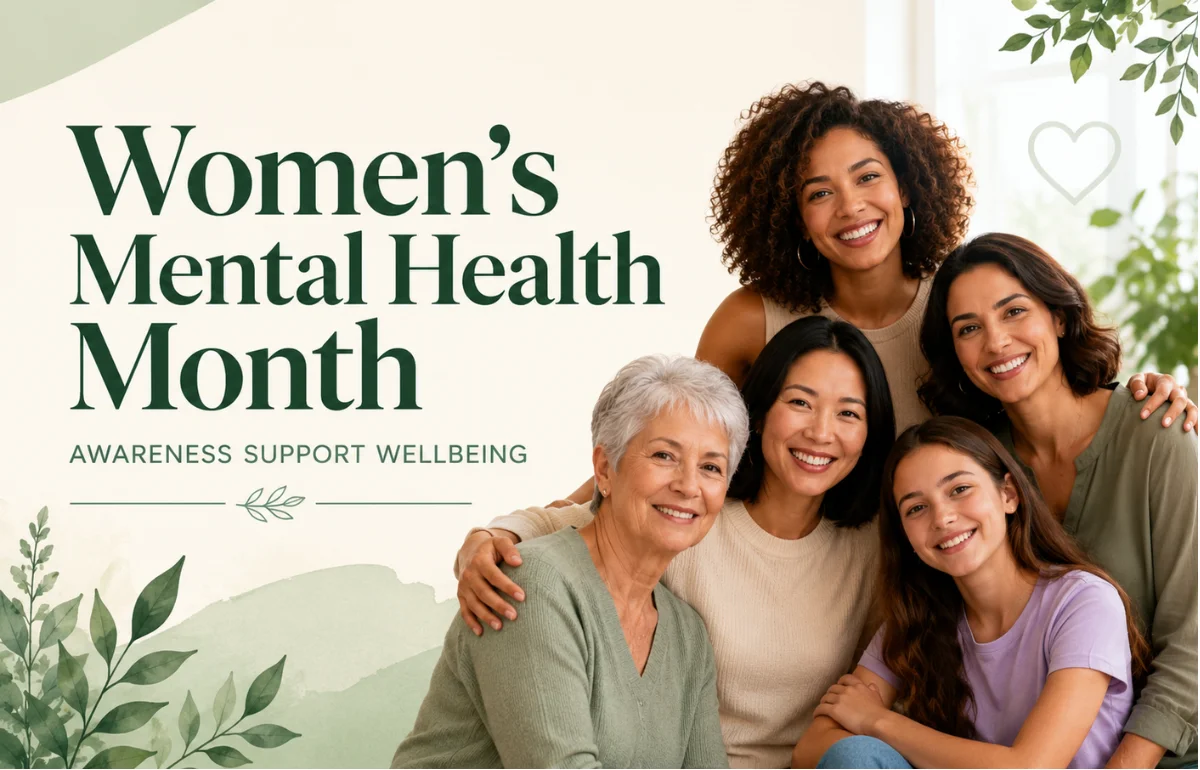
Women’s Mental Health Month is a commonly used name for the focus on women’s emotional and psychological well-being during May, which is officially recognized in the United States as Mental Health Awareness Month. It is a time to discuss concerns that may affect women differently, including depression, anxiety, trauma, eating disorders, perinatal conditions, premenstrual dysphoric disorder, and mood changes during perimenopause.
While reviewing official public-health calendars for this article, I found a distinction many pages miss: federal agencies recognize Mental Health Awareness Month in May and National Women’s Health Week, but “Women’s Mental Health Month” is often used as an umbrella phrase rather than the title of a separate federal observance. In 2026, National Women’s Health Week ran from May 10 through May 16.
That distinction does not make the topic less meaningful. It makes accurate information more important.
When Is Women’s Mental Health Month?
Women’s mental health month is observed informally throughout May, alongside Mental Health Awareness Month. It gives health professionals, workplaces, families, and communities a natural opportunity to discuss women’s mental health without reducing the subject to one diagnosis or life stage.
May also includes National Women’s Health Week, led by the U.S. Department of Health and Human Services Office on Women’s Health. The observance begins on Mother’s Day and addresses physical, mental, and emotional well-being across the lifespan.
| Observance | Timing | Main purpose |
|---|---|---|
| Mental Health Awareness Month | Every May | Builds understanding of mental health, early support, treatment, and recovery |
| Women’s Mental Health Month | Commonly discussed during May | Focuses on conditions, life stages, social pressures, and care barriers affecting women |
| National Women’s Health Week | Begins on Mother’s Day in May | Encourages women to prioritize physical, mental, and emotional health |
I prefer this transparent explanation because it answers the date question without overstating the official status of the women-specific phrase.
Why Women’s Mental Health Needs Focused Attention
Mental health is not determined by gender alone. Biology, personal history, relationships, income, safety, discrimination, physical health, and access to care all shape well-being.
However, some conditions are more common in women, while others are connected to reproductive stages that only some women experience. The National Institute of Mental Health identifies depression, anxiety disorders, and eating disorders as more common in women. It also highlights perinatal depression, premenstrual dysphoric disorder, and perimenopausal depression as conditions linked to periods of hormonal change.
The World Health Organization reports that women are affected by anxiety disorders more often than men and that depression affects more women than men.
These patterns do not mean every woman will develop a mental health condition. They do mean screening, research, education, and treatment should account for sex-related biology and gender-related experiences.
A More Useful Way to Understand Women’s Mental Health
I find it helpful to view women’s mental health through three connected layers: the body, the surrounding context, and access to appropriate care.
The Body
Hormonal changes can influence mood, sleep, energy, concentration, and stress sensitivity. Researchers are still studying why reproductive hormone changes trigger major symptoms in some women but not others.
NIMH notes that the menstrual cycle, postpartum period, and menopause transition involve hormonal shifts associated with certain mood disorders.
Hormones are not the explanation for every emotional difficulty. A thoughtful assessment may also consider thyroid problems, anemia, medication effects, sleep disorders, chronic pain, substance use, and other physical conditions.
The Context
Women may face unequal caregiving demands, workplace pressure, financial insecurity, violence, discrimination, social isolation, or expectations about being endlessly capable.
The Office on Women’s Health identifies poverty, violence, stress at home, and caregiving as risk factors that can affect women’s mental health. WHO also emphasizes that gender roles and social conditions influence health opportunities and outcomes.
A mental health plan that ignores living conditions can become a list of coping tips for a problem that also requires safety, practical support, medical care, or workplace change.
The Care
Women need care that is evidence-based, respectful, affordable, and appropriate to their life stage.
That may include psychotherapy, medication, peer support, lifestyle changes, treatment for a related medical condition, or a combination. Good care should not dismiss symptoms as “just hormones,” but it should not ignore hormonal timing either.
Mental Health Concerns Across a Woman’s Life
Women’s Mental Health Month becomes more useful when it explains how needs may change over time.
| Life stage or situation | Concerns that may arise | Helpful next steps |
|---|---|---|
| Puberty and adolescence | Anxiety, depression, eating disorders, self-harm, bullying, and body-image distress | Speak with a trusted adult, pediatrician, school counselor, or licensed professional |
| Menstrual years | PMS, PMDD, cyclical anxiety, irritability, and sleep changes | Track symptoms across at least two cycles and discuss the pattern with a clinician |
| Pregnancy and postpartum | Perinatal depression, anxiety, intrusive thoughts, trauma, and sleep disruption | Contact an obstetric or mental health provider; urgent symptoms need immediate help |
| Infertility or pregnancy loss | Grief, shame, relationship strain, depression, and anxiety | Seek grief-informed or reproductive mental health support |
| Perimenopause and menopause | Mood changes, sleep problems, anxiety, depression, and cognitive complaints | Request an assessment that considers mental health and menopause symptoms |
| Later life | Bereavement, loneliness, caregiving stress, chronic illness, and medication effects | Review physical health, medicines, social support, sleep, and mental health together |
WHO estimates that mental disorders affect about 10% of pregnant women and 13% of women after childbirth worldwide, primarily through depression, with higher estimates in some lower-resource settings.
The Office on Women’s Health states that roughly one in five women experience mental health problems during pregnancy or within the first year after birth. Figures vary because studies use different definitions and populations.
Signs That Deserve Attention
A difficult week does not automatically mean someone has a mental illness. Persistent or severe changes deserve attention, especially when they interfere with work, relationships, sleep, parenting, self-care, or physical health.
Common warning signs include:
- Persistent sadness, emptiness, hopelessness, or irritability
- Excessive worry, panic, fear, or a constant sense of danger
- Loss of interest in activities that usually feel meaningful
- Major changes in sleep, appetite, energy, or concentration
- Intrusive thoughts, compulsive behavior, or traumatic memories
- Increased alcohol or drug use
- Withdrawal from people or daily responsibilities
- Feeling unable to cope, function, or stay safe
I would not rely on an arbitrary rule such as waiting several weeks before seeking help. Severity matters as much as duration.
Suicidal thoughts, psychosis, mania, thoughts of harming a baby, an inability to care for oneself, or immediate danger require urgent professional support.
In the United States, people can call, text, or chat 988 for 24-hour crisis support related to mental health or substance use.
How to Use Women’s Mental Health Month Practically
Awareness has value when it makes support easier to reach. Rather than treating May as a month for slogans, I recommend using it to complete one action that can continue after the calendar changes.
Start With a Personal Check-In
Ask what has changed over the past few weeks or months.
Consider mood, sleep, worry, concentration, appetite, physical symptoms, social connection, alcohol use, workload, safety, and the timing of symptoms in relation to menstruation, pregnancy, postpartum recovery, or menopause.
A brief symptom record can reveal patterns that are hard to remember during an appointment.
Prepare Better Questions for an Appointment
Instead of saying only, “I feel stressed,” bring two or three concrete examples.
You might explain that you are waking at 3 a.m., avoiding social plans, having panic symptoms before work, feeling depressed before each period, or struggling with frightening thoughts after childbirth.
Ask whether a medical condition could be contributing, whether symptoms fit a reproductive-life-stage pattern, which treatments have evidence for your situation, and when the plan should be reviewed.
Make Workplaces and Communities More Supportive
Employers can offer confidential benefits, flexible scheduling, parental leave, manager training, and clear routes to professional support.
Community organizations can host clinician-led education, share culturally relevant resources, provide childcare during events, and make information accessible to people with disabilities or limited English proficiency.
The goal is not to push women to disclose private information. It is to reduce practical and social barriers to care.
What Gender-Responsive Mental Health Care Looks Like
Gender-responsive care is not simply therapy marketed to women. It considers how biology, identity, trauma, relationships, caregiving, culture, safety, and health-care experiences may affect symptoms and treatment.
A qualified provider should listen without assuming every problem is hormonal. The provider should also understand that reproductive events can matter clinically.
Care may coordinate psychiatry, primary care, obstetrics and gynecology, menopause care, nutrition services, substance-use treatment, or trauma support.
Coordination is valuable when symptoms overlap with pain, sleep disruption, pregnancy, medication changes, or chronic illness.
Where the Conversation Still Falls Short
Many articles repeat that women should practice self-care. Rest, movement, nutritious food, boundaries, and social connection can help, but they cannot replace safe housing, fair pay, protection from violence, affordable treatment, or appropriate clinical care.
Intimate partner violence is one issue awareness campaigns often understate. WHO reports a strong connection between domestic violence and poor mental health and warns that some survivors experience services as unhelpful or retraumatizing.
The conversation also needs room for women who are Black, Indigenous, Asian, Latina, disabled, LGBTQ+, rural, older, uninsured, or living in humanitarian settings.
Culture, bias, income, and geography can change how the same symptoms are recognized and treated.
Maternal mental health deserves serious attention, but it is not the whole story. Women’s emotional well-being also includes people without children and those dealing with infertility, loss, caregiving, career pressure, illness, or aging.
Five Meaningful Ways to Observe the Month
- Schedule an overdue mental or physical health appointment.
- Learn the warning signs of depression, anxiety, trauma, PMDD, and perinatal conditions.
- Ask a friend how she is doing, then listen without rushing to offer solutions.
- Review whether your workplace provides accessible, confidential support.
- Share one reliable resource from a recognized health agency instead of an unsourced statistic.
Frequently Asked Questions
What month is Women’s Mental Health Month?
It is commonly observed in May alongside Mental Health Awareness Month and National Women’s Health Week.
Is Women’s Mental Health Month an official national observance?
The phrase is widely used, but federal sources formally identify Mental Health Awareness Month and National Women’s Health Week as the established May observances.
Why is women’s mental health different?
Women may experience different patterns of depression, anxiety, trauma, eating disorders, caregiving stress, and hormone-related conditions across the lifespan.
What color represents women’s mental health awareness?
The green ribbon is internationally associated with general mental health awareness, but there is no universally official color for a separate women-specific month.
How can I support Women’s Mental Health Month?
Share reliable information, check in without judgment, improve access to professional care, and support year-round policies that reduce barriers.
A Month for Awareness, a Year for Action
Women’s Mental Health Month should be more than a seasonal campaign. Its value is helping people recognize symptoms earlier, ask better questions, find appropriate care, and understand that mental health is shaped by biology and everyday circumstances.
Choose one practical next step today: record your symptoms, book an appointment, check on someone you care about, or review the support available in your workplace or community.

Sophia Bennett is a mental health writer with 8 years of experience creating thoughtful, research-informed content about emotional wellbeing, stress management, mindfulness, self-care, and healthy coping strategies. She focuses on making mental wellness topics easier to understand while encouraging readers to seek support from qualified mental health professionals when needed.