
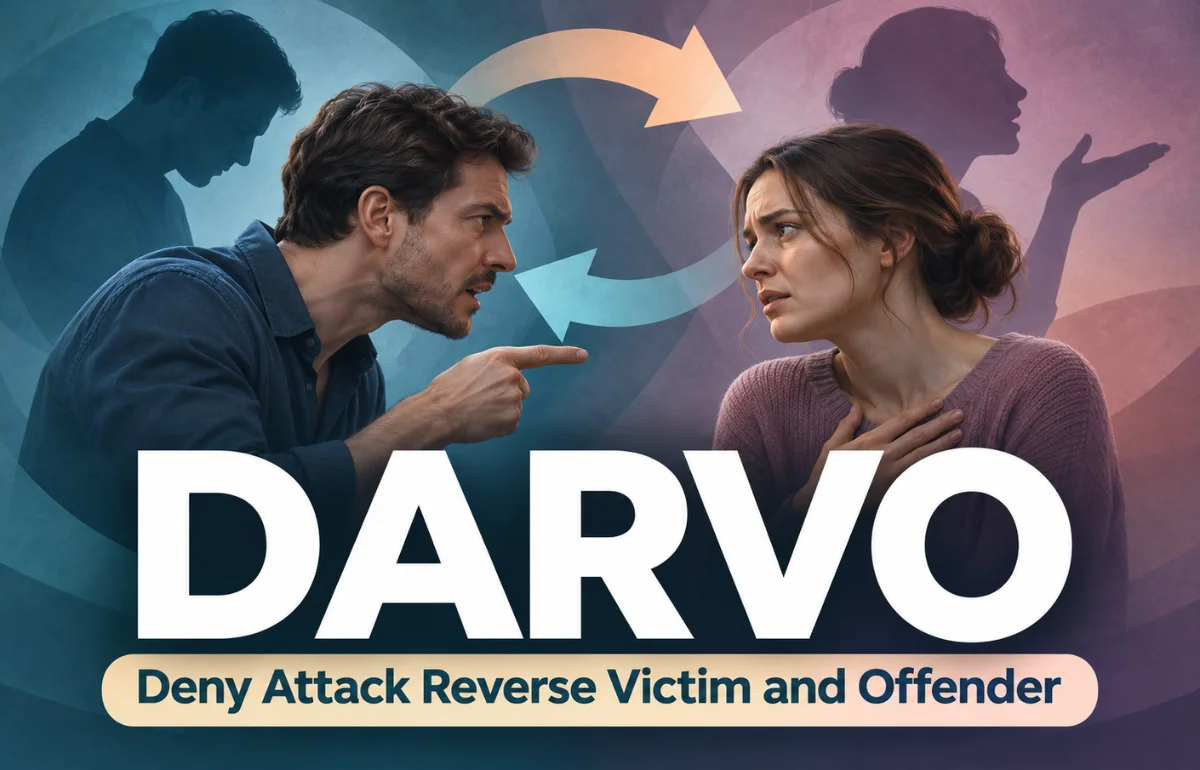
DARVO is a pattern of psychological manipulation in which someone confronted about harmful behavior denies what happened, attacks the person raising the concern, and reverses the roles of victim and offender. The acronym stands for Deny, Attack, and Reverse Victim and Offender.
Instead of addressing the original complaint, the person redirects attention toward how unfairly they claim to have been treated. The person who spoke up may end up defending their character rather than discussing the harm.
DARVO can appear in romantic relationships, families, workplaces, and institutions. Recognizing it can help people identify blame-shifting, but the pattern alone does not prove an underlying accusation is true. The central question is whether a response addresses the concern fairly or turns accountability into a personal attack.
Imagine telling a partner, “You shared something private after promising not to.” Minutes later, you’re apologizing for being suspicious and cruel. The privacy breach has disappeared from the conversation. That reversal is what makes DARVO worth understanding.
What Does DARVO Stand For?
Psychologist Jennifer J. Freyd introduced the concept in 1997 while examining responses to wrongdoing and betrayal. Her explanation of DARVO describes three connected moves. They may arrive in one sentence or unfold across a longer argument.
D: Deny the Behavior
The first move rejects the allegation or minimizes its impact: “That never happened,” “You’re exaggerating,” or “It wasn’t a big deal.”
Sometimes the denial changes shape when evidence appears. An outright denial becomes an argument that the conduct was harmless or justified.
A denial isn’t automatically manipulation. People can disagree about facts or genuinely remember events differently. I look for what follows: curiosity about the concern, or an effort to shut the concern down at any cost.
A: Attack the Person Raising the Concern
The conversation shifts from conduct to credibility. Rather than explaining what happened, the person calls the other party dishonest, unstable, oversensitive, disloyal, or vindictive.
An attack can sound polished rather than openly insulting. “Everyone knows how dramatic you are” still invites an audience to dismiss the speaker without examining the complaint.
RVO: Reverse Victim and Offender
Finally, the accused person presents themselves as the injured party. The original complainant becomes the supposed aggressor: “I can’t believe you’d accuse me,” or “You’re the one emotionally abusing me by bringing this up.”
This is more than changing the subject. It changes who is expected to apologize.
The person seeking accountability is pushed into proving they are not cruel, while the original behavior goes unexamined.
How DARVO Works in a Real Conversation
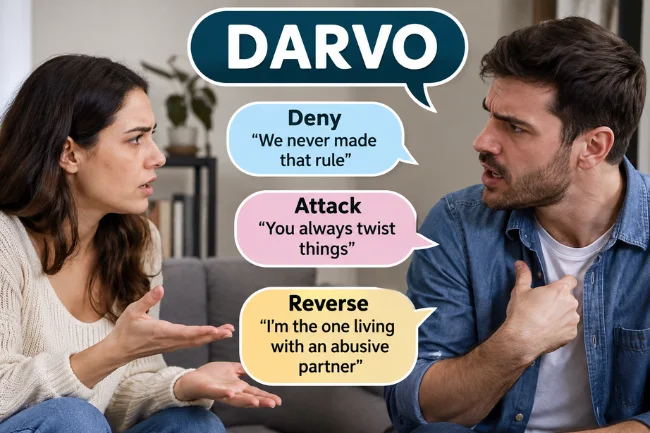
Consider a fictional disagreement about money. One partner discovers that a shared savings account was used without an agreed discussion.
Concern: “We agreed to talk before making a large withdrawal. Why didn’t we?”
Deny: “We never made that rule.”
Attack: “You always twist things because you’re obsessed with control.”
Reverse: “I’m the one living with an abusive, controlling partner. You owe me an apology.”
Notice the destination. The conversation starts with a concrete financial decision and ends with the person who raised it defending their personality.
Whether the withdrawal was justified still needs to be established; the reversal itself offers no answer.
Here is a useful comparison between blame-shifting and a response that remains open to accountability.
| Situation | DARVO-style response | Accountable response |
|---|---|---|
| A hurtful remark | “You’re lying about what I said. You’re trying to ruin me.” | “I remember it differently, but I want to understand what hurt you.” |
| A broken agreement | “You’re controlling for even questioning me.” | “I didn’t follow our agreement. Let’s discuss what happened.” |
| A workplace complaint | “That employee is unstable and attacking my reputation.” | “The complaint deserves a fair, documented review.” |
The accountable responses do not require automatic agreement. They preserve room for facts, boundaries, and responsibility.
Common DARVO Examples in Everyday Life
DARVO in Romantic Relationships
A partner raises repeated insults during arguments. The other partner denies using insulting language, says the complaint proves the first partner is too sensitive, then claims to be the actual victim of constant criticism.
In an emotionally abusive relationship, that pattern may discourage future complaints. The person raising concerns learns that speaking up comes with a painful detour into defending themselves.
DARVO in Families
An adult child tells a parent that childhood humiliation still affects them. The parent responds, “I did everything for you. You’re ungrateful, and now you’re hurting me with these accusations.”
Families can disagree about memory and intention.
The warning sign is not disagreement alone; it’s refusing to engage with the described impact while recasting the conversation as an attack on the parent.
DARVO at Work
An employee reports repeated inappropriate comments. Instead of examining the remarks, a supervisor says the employee is incompetent and suggests the report is retaliation for critical feedback.
The professional response is to investigate the allegation and any counterclaim independently.
A counterclaim should not automatically erase or discredit the original report.
Institutional DARVO
An organization may deny a credible complaint, question the complainant’s motives, and portray itself as the victim of a reputation-damaging campaign.
Freyd calls this institutional DARVO when the reversal comes from an institution or occurs with institutional complicity.
The stakes can be high because institutions may control records, complaint procedures, and access to decision-makers. Fair processes require more than persuasive statements from powerful parties.
Why Is DARVO So Confusing and Effective?

DARVO interrupts the ordinary logic of problem-solving. A person expects to discuss an incident; suddenly, their honesty and intentions are on trial.
That creates several pressures at once.
First, the discussion becomes emotionally expensive. Defending yourself against an accusation of cruelty may feel more urgent than returning to the original issue.
Second, bystanders can be influenced by confident counteraccusations.
In 2020 experimental research, Sarah Harsey and Jennifer Freyd found that participants reading DARVO responses in fictional abuse scenarios judged victims more negatively and perpetrators as less responsible or abusive on several measures.
A second experiment suggested that learning about DARVO reduced some of these effects.
A 2023 study involving 230 university students likewise found that a DARVO response in a fictional sexual-assault scenario affected perceptions of the accused person’s credibility and responsibility.
These are useful findings, not a universal lie detector. The studies tested reactions to written scenarios, not whether a particular person’s real-world accusation is true.
Third, repeated reversals may leave someone questioning whether raising reasonable concerns is itself harmful. That uncertainty can make silence feel easier than another confrontation.
DARVO vs. Gaslighting, Defensiveness, and Genuine Disagreement
People often use these terms as though they mean the same thing. They overlap, but the differences matter.
| Pattern | Main feature | What distinguishes it |
|---|---|---|
| DARVO | Denial, personal attack, and reversal of victim/offender roles | Moves blame onto the person raising the concern |
| Gaslighting | Undermining someone’s trust in their perceptions or memory | Focuses on destabilizing their sense of reality |
| Ordinary defensiveness | Protecting oneself during criticism | May involve excuses without the full role reversal |
| Genuine disagreement | Different interpretations of an event | Can remain respectful and evidence-focused |
DARVO can include gaslighting, particularly when someone repeatedly tells another person that their accurate recollections are imaginary.
But not every disagreement about memory is gaslighting, and not every defensive reply is DARVO.
The National Domestic Violence Hotline’s explanation of gaslighting emphasizes the erosion of confidence in one’s perceptions.
I find one distinction especially helpful: disagreement stays attached to the question; manipulation tries to make the person asking the question the problem.
How to Recognize a DARVO Pattern Without Jumping to Conclusions
A dramatic argument isn’t sufficient evidence. Before applying the label, examine the sequence rather than a single sentence.
Ask yourself: What specific behavior was raised? Was that behavior denied or minimized? Did the reply attack someone’s credibility? Did the person accused of harm claim that the complaint itself made them the real victim?
Then check what happened afterward. Could both parties discuss evidence? Was there room for correction or apology?
Did the conversation repeatedly return to insults and counteraccusations instead?
I think of this as a three-column conversation audit:
- Original concern: Write one factual sentence about what happened or was alleged.
- Actual response: Record the person’s words as accurately as possible, without interpreting motives.
- Unanswered question: Identify what still needs a fair answer.
For example: “My colleague disclosed a private message; they called me disloyal; I still need to know who received the message.”
This keeps separate the event, the reaction, and the missing information.
Importantly, Freyd explicitly cautions that DARVO is not proof of guilt.
Someone who is wrongly accused can still respond with attacks and role reversal. Likewise, an accurate complaint deserves evidence and due process, not unquestioning acceptance simply because someone uses the term.
How to Respond to DARVO While Protecting Yourself
Return to the Original Issue
If the discussion is safe, use a short statement: “We can discuss how you feel about my question, but I still want to address what happened to the money.”
Avoid debating every insult. An endless argument about whether you’re selfish, dramatic, or unfair can swallow the issue you originally raised.
Set a Boundary You Can Control
A boundary describes what you will do, not what the other person must feel.
For example: “I will continue this conversation when we can speak without name-calling.”
You don’t need to persuade someone to accept the DARVO label. Naming a pattern can help privately, while arguing over terminology may simply produce another detour.
Keep a Clear Record Where Safe
For ongoing problems, save relevant messages, note dates, and distinguish quotations from your interpretation.
The National Domestic Violence Hotline’s documentation advice stresses preserving details and keeping records somewhere an abusive person cannot access.
Don’t secretly record conversations without checking local laws, and don’t collect evidence in ways that increase your risk.
If your devices or accounts may be monitored, seek advice about safer options before storing sensitive information.
Get an Outside Perspective
Talk with someone who can listen without immediately deciding who is right.
A counselor, trained advocate, union representative, or appropriate workplace reporting channel may help, depending on the circumstances.
A useful outside question is, “What would a fair response to the original concern look like?”
That keeps attention on conduct and evidence rather than on who seems most upset.
Prioritize Safety Over Winning an Argument
If someone threatens, intimidates, stalks, or controls you, arguing more effectively may not solve the problem.
Consider a personalized safety plan and contact a local domestic-abuse service or emergency help if needed.
Leaving, confronting, documenting, or reporting can carry different risks. A trained advocate can help you consider options without assuming one choice fits every situation.
The National Domestic Violence Hotline offers guidance on safety planning; people outside the United States should use appropriate local services.
What If I Recognize DARVO in My Own Reactions?
This question deserves a place in the discussion.
When confronted, I might feel misunderstood, embarrassed, or unfairly judged; feelings alone do not settle whether my response is fair.
A more responsible approach is to separate three things: what I believe happened, how the other person experienced it, and whether I acted respectfully while disagreeing.
I can say, “I don’t agree with that description, but I shouldn’t have insulted you.”
Accountability doesn’t mean confessing to something that didn’t happen. It means avoiding personal attacks, considering evidence, and taking responsibility for the part of the interaction I can honestly own.
An apology is more meaningful when it identifies conduct, avoids blaming the other person for causing it, and is followed by changed behavior.
If the pattern repeats, professional support may help address the underlying conflict.
How to Support Someone Who Describes DARVO
When a friend brings you a confusing exchange, resist the urge to diagnose the other person from a few screenshots.
You can take the concern seriously without claiming certainty about everything that happened.
Try asking, “What did you originally want addressed?” and “What support would be helpful right now?”
Listen without turning the disclosure into an interrogation. Don’t pressure the person to confront, forgive, leave, or report before considering safety.
If you’re responsible for a workplace or institutional complaint, separate fact-finding from reputation management.
Preserve evidence, limit retaliation, allow responses from all relevant parties, and use a process that does not automatically privilege the more powerful voice.
Final Thoughts
DARVO matters because it can turn a request for accountability into a struggle over who deserves sympathy.
Recognizing the pattern makes it easier to separate facts from personal attacks without treating a label as proof.
If a conversation keeps reversing responsibility, write down the original concern, decide what response would be fair, and consider asking a trusted person or qualified professional for perspective.
Clarity and safety matter more than winning the argument.
Frequently Asked Questions About DARVO
What is a simple example of DARVO?
Someone accused of breaking a promise says it never happened, calls the accuser dishonest, and then claims to be the victim of an unfair attack.
Is DARVO a form of gaslighting?
DARVO can involve gaslighting, but they are not identical. DARVO reverses blame; gaslighting undermines confidence in someone’s perception of reality.
Do narcissists use DARVO?
Some people with narcissistic traits may use DARVO, but the behavior is not exclusive to them and cannot establish a personality-disorder diagnosis.
Can DARVO happen in friendships or at work?
Yes. DARVO can occur wherever someone answers a complaint with denial, credibility attacks, and an attempt to portray themselves as the injured party.
What is the best way to respond to DARVO?
Return to the original issue, avoid debating personal insults, document patterns safely, and seek independent support if the behavior continues.
Disclaimer
This article is for educational purposes only and is not a substitute for professional mental health advice. Recognizing DARVO does not prove someone is abusive or establish a psychological diagnosis. If you’re experiencing emotional distress or abuse, consider seeking support from a qualified mental health professional.

Sophia Bennett is a mental health writer with 8 years of experience creating thoughtful, research-informed content about emotional wellbeing, stress management, mindfulness, self-care, and healthy coping strategies. She focuses on making mental wellness topics easier to understand while encouraging readers to seek support from qualified mental health professionals when needed.