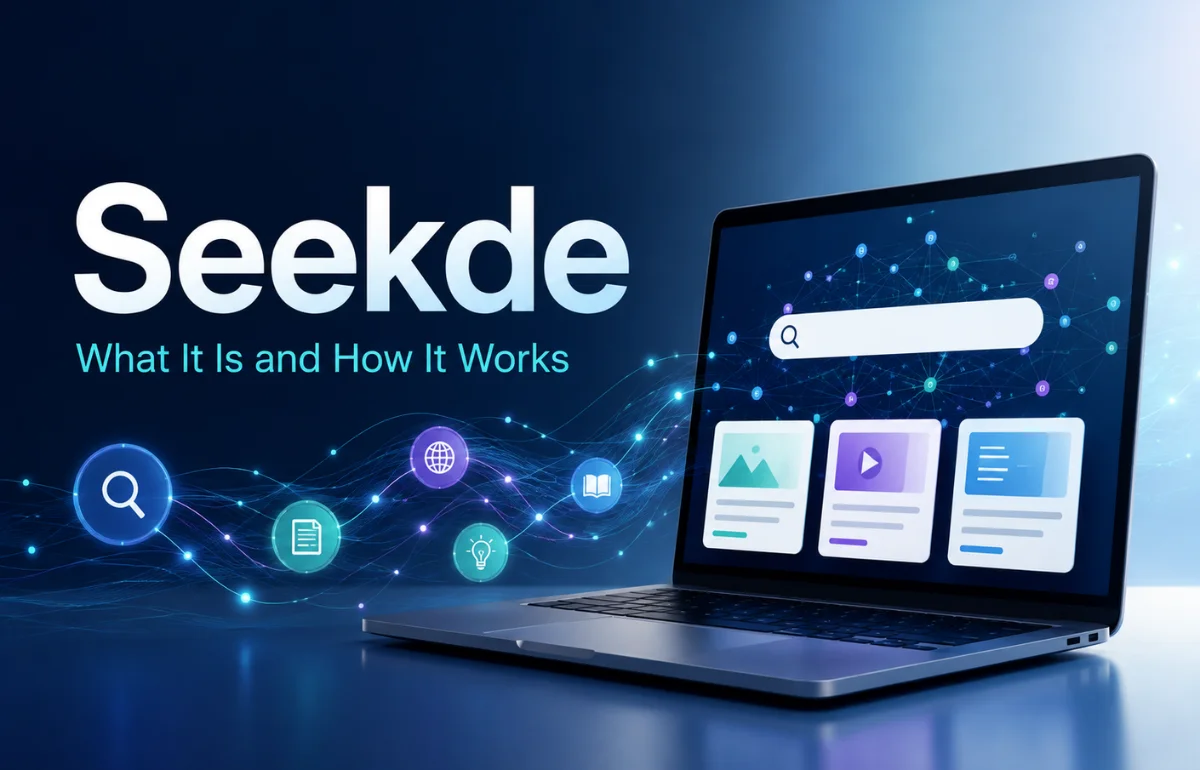
Seekde is described as an emerging digital discovery and knowledge platform designed to help people find, understand, and connect information rather than simply receive a page of search links. Its public-facing material presents the platform around contextual discovery, knowledge mapping, source transparency, and adaptive learning. In simpler terms, Seekde aims to understand what a person is trying to learn, organize relevant information, and show how different ideas relate to each other.
I would not describe Seekde as a proven replacement for Google or an established AI research assistant, however. When I researched its public presence in August 2026, I found ambitious descriptions of the technology but relatively little independently verifiable information about ownership, pricing, technical infrastructure, or large-scale user adoption. That distinction matters if you are deciding whether to trust or use the platform.
What Is Seekde?
The clearest public description I found comes from a Seekde-branded website that calls it a “next-generation knowledge platform.” According to that site, its purpose is to make digital discovery more trustworthy by adding context, showing relationships between ideas, and emphasizing the origins of information.
That places Seekde somewhere between a conventional search engine, a research assistant, and a knowledge-discovery system.
A normal web search generally starts with a query and returns pages considered relevant to that query. The user then decides which pages to open, compare, and trust.
Seekde’s stated approach is different. It aims to interpret the intent behind a question, connect related concepts, and make the research process less fragmented. Its public description emphasizes contextual discovery, knowledge mapping, adaptive learning, trustworthy sources, and transparency.
I think the distinction between what Seekde claims and what has been independently demonstrated is important. Some articles online describe advanced features very confidently, yet independent testing, technical documentation, and substantial user-review data remain difficult to find. One 2026 review similarly noted the lack of clear pricing, company background, founders, and meaningful independent user feedback.
How Does Seekde Work?
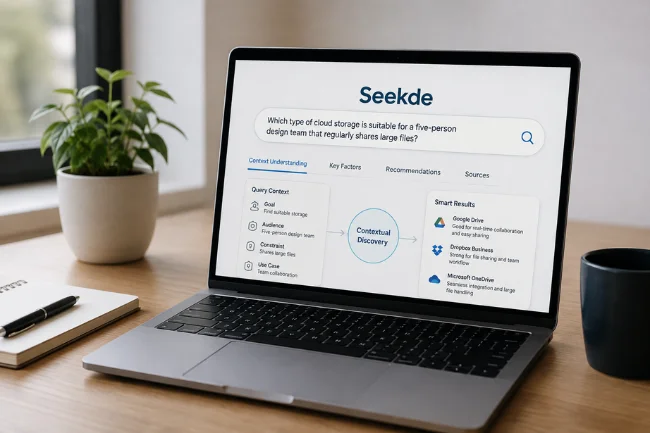
Seekde’s concept revolves around moving beyond exact keyword matching.
Instead of treating a query only as a collection of words, the platform says it considers the meaning and objective behind that query. Its public website refers to this approach as contextual discovery.
For example, there is a meaningful difference between searching:
“cloud storage”
and:
“Which type of cloud storage is suitable for a five-person design team that regularly shares large files?”
The second query contains a goal, audience, size constraint, and use case. A context-aware discovery system should ideally recognize those details instead of treating every mention of “cloud storage” alike.
Contextual Discovery
Seekde says it interprets the intent behind users’ questions so it can provide information aligned with their actual goals.
That could be useful for exploratory searches where I do not yet know the exact terminology required to find a good answer.
The important test, however, is not whether a system says it understands intent. It is whether the resulting information remains accurate, relevant, traceable, and useful.
Knowledge Mapping
Knowledge mapping is one of the more interesting ideas associated with Seekde.
Rather than presenting information as unrelated fragments, the platform says it can reveal connections among topics and concepts. Its public material positions this as a way to help users understand the “bigger picture.”
Imagine researching renewable energy.
A simple answer might explain solar power. A knowledge-oriented approach could help connect solar energy with battery storage, grid stability, government incentives, manufacturing costs, environmental effects, and energy policy.
For students and researchers, those relationships may be more valuable than receiving another isolated definition.
Adaptive Learning
Seekde also says its system adapts as people interact with it, with the goal of producing increasingly personalized results.
Personalization can potentially make discovery more efficient because a beginner and a specialist rarely need information presented at the same depth.
At the same time, I would want greater technical transparency before making strong claims about how Seekde’s adaptive learning operates. Public descriptions explain the intended benefit more clearly than the underlying implementation.
Source Transparency
This may be Seekde’s most important stated principle.
Its website says results are intended to highlight sources, authorship, references, and update histories so that users can make their own credibility judgments.
That is a valuable direction because a polished answer is not automatically a trustworthy answer. If I am researching something important, I want to know where a claim came from, how current the source is, and whether I can inspect the original material.
Main Seekde Features at a Glance
Here is how I would separate Seekde’s publicly described capabilities from the questions that still need stronger verification.
| Area | What Seekde says it offers | What remains unclear |
|---|---|---|
| Contextual discovery | Understand the goal behind a query | Technical method and independent accuracy testing |
| Knowledge mapping | Connects related concepts and topics | Exact interface and depth of mapping |
| Adaptive learning | Personalizes discovery over time | Data used for personalization and user controls |
| Source transparency | Presented as a major focus | Consistency across real-world results |
| Trust-focused discovery | Prioritizes credible information | Exact source-ranking and verification methodology |
| User audiences | Students, researchers, professionals, educators, learners | Adoption numbers and independent user feedback |
These features are described on Seekde’s own public material, so I treat them as platform claims rather than independently validated performance results.
What Can Seekde Be Used For?
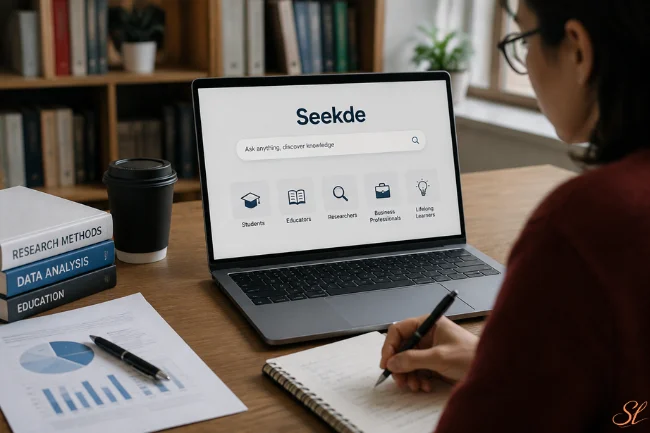
Seekde appears to target situations where understanding matters more than simply locating one webpage.
Its public material specifically mentions students, educators, researchers, business professionals, and lifelong learners.
Students and Educators
A student could potentially use a discovery platform to understand relationships between concepts instead of collecting disconnected search results.
For example, someone researching climate change may need to understand atmospheric science, energy production, economics, public policy, agriculture, and environmental effects together rather than separately.
Seekde’s own material presents this connected-learning approach as one of its educational uses.
Researchers
Researchers often need more than a quick answer. They need original sources, related concepts, contradictory evidence, publication dates, and a clear trail back to the underlying material.
Knowledge mapping could be valuable here, although I would still verify any important finding against original papers, institutional databases, or other primary sources.
Business Professionals
Professionals can also benefit from information synthesis when researching competitors, markets, technologies, regulations, or industry trends.
The advantage would not simply be “finding information faster.” The real value would be reducing the time required to understand how different pieces of information affect a decision.
Seekde explicitly lists business professionals among the audiences it intends to serve.
Seekde vs. Traditional Search vs. AI Assistants
I would not treat these tools as interchangeable.
Each approach solves a somewhat different information problem.
| Capability | Seekde’s stated approach | Traditional search | AI assistant approach |
|---|---|---|---|
| Main output | Connected discovery and contextual information | Ranked webpages and links | Direct generated responses |
| Query understanding | Intent-focused | Keyword and semantic relevance | Conversational intent |
| Knowledge connections | Core part of the concept | Usually discovered manually | Often explained conversationally |
| Source transparency | Presented as a major focus | Original webpages are directly accessible | Varies by product and mode |
| Personalization | Adaptive learning is claimed | Varies by service | Varies by service |
| Best suited to | Topic exploration and understanding | Finding specific sites and primary sources | Questions, explanations, drafting, analysis |
| Current maturity | Emerging and lightly documented | Highly established | Established category with multiple major platforms |
I would therefore view Seekde as a possible complement to established tools rather than assuming it should replace them.
For a known website, official document, breaking event, local business, or primary source, conventional search may remain more direct. For exploring relationships around an unfamiliar subject, Seekde’s proposed discovery model is more interesting.
Is Seekde a Real and Legitimate Platform?
This question deserves more attention than it receives in many Seekde articles.
I found active Seekde-branded web properties describing a digital discovery platform, including Seekde.net. That site describes a mission, target audiences, contextual discovery, knowledge mapping, adaptive learning, and future development plans.
However, the broader web footprint is unusually difficult to interpret.
For example, Seekde.org currently functions partly as a multi-category content website covering areas such as business, education, fashion, health, real estate, technology, and artificial intelligence. It also contains material that does not clearly relate to a search or discovery product.
I also found that other 2026 reviewers have struggled to verify basic details including company background, founders, pricing, and substantial independent user feedback.
That does not prove Seekde is illegitimate.
It means there is currently not enough transparent public documentation for me to treat every claim made about Seekde online as an established fact.
Information About Seekde That Is Still Missing
This is where I think most articles about Seekde fall short.
They repeat features, but they rarely ask what evidence a potential user actually needs.
Clear Company Ownership
I would like to see a clearly documented company name, leadership team, operating location, and corporate background associated with the product.
Those details make it easier to understand who is responsible for a platform and who users are trusting with their information.
Transparent Pricing
I could not verify a clear pricing structure from the main Seekde-branded page I reviewed.
Other recent coverage has reached the same conclusion, with some 2026 articles explicitly describing pricing as unclear or inconsistently documented.
Until official pricing is clearly published, I would avoid repeating claims about specific free or premium plans.
Privacy and Data Handling
Adaptive systems raise obvious questions.
What information is stored? Is search history retained? Is it used to personalize future results? Can personalization be disabled? Can users delete their data? Is information used for model training?
I would want direct answers from an official privacy policy before submitting confidential business material, private documents, personal information, or sensitive research.
Technical Documentation
Terms such as artificial intelligence, semantic understanding, adaptive learning, and knowledge mapping can describe many different technical architectures.
Without detailed documentation, I would not assume Seekde uses a particular large language model, retrieval system, embedding database, ranking model, or retrieval-augmented generation architecture simply because those technologies are common elsewhere.
Independent Benchmarks and Reviews
I would also like to see third-party testing.
A useful benchmark could compare Seekde against other research methods across factual accuracy, source quality, citation correctness, freshness, research time, and performance on complex questions.
That would tell users far more than another list of marketing features.
How I Would Evaluate Seekde Before Relying on It
I would start with low-risk questions where I already know enough about the subject to recognize obvious mistakes.
Then I would test a more complex query and inspect every cited source.
I would ask whether the platform represents disagreement between sources fairly, whether dates are visible, whether quotations match the original material, and whether the answer changes when I slightly rephrase the question.
For business, academic, medical, financial, or legal research, I would never treat a discovery tool as the final authority. I would use it to locate and organize information, then verify decisions against primary or professionally authoritative sources.
This is not a Seekde-specific criticism. It is a practical standard I use whenever automated systems summarize information on my behalf.
Who Should Consider Using Seekde?
Seekde is most interesting for people who frequently begin with broad questions rather than known destinations.
Students, educators, researchers, analysts, writers, and curious learners may find its knowledge-discovery concept appealing because their work often involves connecting information rather than retrieving one fact. Seekde itself identifies several of these groups as its intended users.
I would be more cautious if the task involves confidential company data, sensitive personal information, high-stakes decisions, or anything requiring guaranteed sourcing until the platform publishes clearer documentation about privacy, security, ownership, and validation.
Why Seekde Is Worth Watching
Whether Seekde eventually becomes a major search product is still an open question.
What interests me more is the problem it is trying to address.
Finding information is no longer the only challenge online. People also need ways to determine what information means, how ideas connect, which sources deserve trust, and what they should investigate next.
Seekde’s public roadmap says the platform plans to continue improving adaptive learning, knowledge mapping, and partnerships around information accuracy.
If it can combine those ideas with transparent ownership, strong privacy practices, independently tested results, and clear source attribution, its discovery-first approach could become genuinely useful.
For now, I would describe Seekde as promising but still lightly documented.
Frequently Asked Questions About Seekde
What is Seekde?
Seekde is described as a digital discovery and knowledge platform focused on contextual search, knowledge mapping, adaptive learning, and transparent sources.
Is Seekde a search engine?
Not exactly. It is presented more as a knowledge-discovery platform that tries to organize and connect information instead of only returning a conventional list of webpages.
Is Seekde free?
I could not verify a definitive official pricing structure. Recent third-party coverage also reports that Seekde pricing remains unclear or inconsistently documented.
Is Seekde safe to use?
There is not enough independently documented information for me to make a blanket safety claim. I would avoid entering sensitive information until its privacy, ownership, and data-handling practices are clearly verified.
How is Seekde different from Google?
Google primarily helps users discover webpages and other indexed resources, while Seekde says its model focuses on understanding query context, connecting concepts, and presenting knowledge in a more structured discovery experience.
Final Thoughts on Seekde
Seekde presents an interesting idea: online search should help me understand information, not merely find more of it.
Its emphasis on contextual discovery, knowledge mapping, adaptive learning, source credibility, and transparency addresses real frustrations people face when researching complex subjects.
At the same time, I would resist the temptation to describe Seekde as a fully proven next-generation search engine before stronger evidence exists. Its company background, pricing, privacy details, technical methodology, user adoption, and independent performance testing need clearer documentation.
If you are curious about Seekde, the best next move is to evaluate it the same way you would any emerging information tool: start with non-sensitive searches, inspect the original sources, compare its answers with established resources, and judge the quality of the evidence rather than the confidence of the presentation.
That approach gives you the potential benefits of smarter digital discovery without giving up the critical thinking that trustworthy research still requires.

Noah Sterling is a technology research writer with 8+ years of experience covering emerging technologies, software trends, digital tools, and innovation. He creates practical, research-based articles to help readers understand the evolving technology landscape.