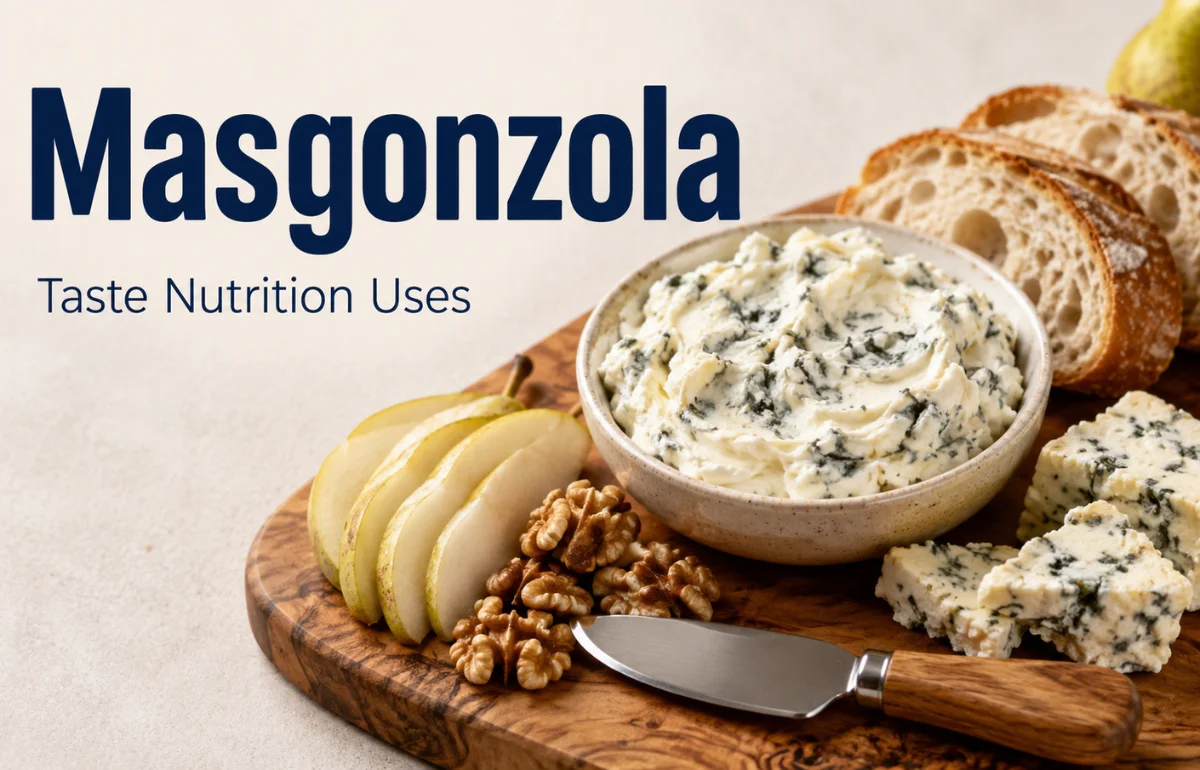
Masgonzola is best understood as a creamy combination of Gorgonzola and mascarpone rather than a formally recognized, stand-alone variety of blue cheese. I found the term used especially in Swiss and German-language food sources, where Masgonzola is explicitly described as “Mascarpone-Gorgonzola.” Commercial versions may combine roughly equal amounts of the two cheeses, producing something milder, richer, and more spreadable than ordinary Gorgonzola.
That distinction matters because Gorgonzola is an officially protected Italian PDO cheese, while I could not verify Masgonzola as a separate PDO, geographical indication, or standardized traditional cheese. The most useful way to think about it is as a Gorgonzola-mascarpone specialty: the blue, tangy character of Gorgonzola softened by the buttery creaminess of mascarpone.
What Exactly Is Masgonzola?
The name itself gives away much of the answer. “Masgonzola” combines elements of mascarpone and Gorgonzola, and established recipe sources use the word as shorthand for a Gorgonzola-mascarpone product.
Betty Bossi, a long-established Swiss food and recipe publisher, specifically identifies Masgonzola as “Mascarpone-Gorgonzola” in recipes. Its Gorgonzola risotto recipe also suggests replacing separate Gorgonzola and mascarpone with Masgonzola, which makes the intended meaning unusually clear.
Retail evidence points in the same direction. Coop Switzerland sells an Italian Gorgonzola-and-mascarpone product containing 50% Gorgonzola and 50% mascarpone. Migros has also listed a product made with the same 50/50 combination.
So, when I use the term Masgonzola here, I mean a cheese specialty combining these two dairy products rather than an independently protected blue cheese.
Is Masgonzola a Real Cheese Variety?
This is where online information can become confusing.
You may encounter articles describing Masgonzola as an old European blue cheese with its own history, aging styles, milk types, and traditional production process. I could not find reliable primary documentation supporting that description. One such web article even proposes “young,” “aged,” cow-milk, and mixed-milk varieties without providing evidence for recognized standards behind those categories.
Gorgonzola is different. It is registered as a Protected Designation of Origin in the European Union, and its production is governed by a defined specification. Genuine Gorgonzola PDO comes from designated areas of Piedmont and Lombardy in Italy.
Masgonzola does not appear to have that independent protected status. It is more accurately treated as a culinary or commercial name for a Gorgonzola-mascarpone combination.
Gorgonzola facts in this comparison follow the official PDO consortium and European registration.
How Masgonzola Is Made
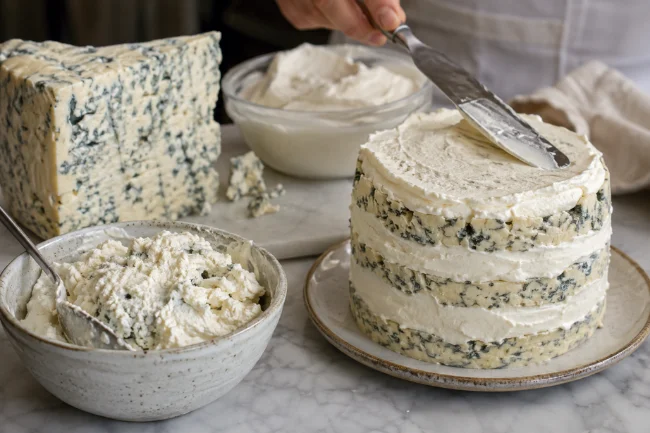
There does not appear to be one legally defined Masgonzola production method, which is another reason I would avoid describing it as a standardized cheese variety.
One straightforward approach is an approximately equal combination of mascarpone and Gorgonzola. Coop’s commercial example lists 50% full-fat Gorgonzola soft cheese and 50% double-cream mascarpone.
Other producers create a visibly layered cheese rather than blending everything into one uniform mixture.
Italian producer CasArrigoni, for example, makes its Gorgonzola and Mascarpone specialty by alternating layers of mild Gorgonzola with mascarpone. The result shows white or pale mascarpone layers beside creamy, blue-veined Gorgonzola.
This layered construction also explains why two Masgonzola-style products can look quite different. One may resemble a smooth cheese spread, while another may have obvious stripes or sections of blue cheese and white mascarpone.
What Does Masgonzola Taste Like?
If ordinary blue cheese feels too aggressive, the appeal of Masgonzola is easy to understand.
Gorgonzola contributes tanginess, saltiness, earthy notes, and the characteristic flavor associated with blue veining. Mascarpone pulls in the opposite direction: it is mild, buttery, milky, and rich.
Combined, the two produce a flavor that is usually softer and rounder than straight Gorgonzola. CasArrigoni describes its version as combining mascarpone’s delicate, sweet, buttery character with the stronger flavor of mild Gorgonzola.
I would therefore expect the balance to depend heavily on the ratio. A 50/50 product will taste significantly creamier and less salty than a preparation containing only a small amount of mascarpone.
Texture is just as important as flavor. Mascarpone adds enough fat and moisture to make the mixture particularly useful when you need blue-cheese flavor without a dry or crumbly texture.
Masgonzola Nutrition: What the Numbers Actually Look Like
There is no single universal nutrition profile for Masgonzola because the name does not refer to one regulated formula.
For a useful real-world benchmark, I compared Coop’s 50/50 Gorgonzola-and-mascarpone product with the official nutritional information published for Gorgonzola PDO.
The Masgonzola-style values come from a currently listed 50/50 commercial product; the Gorgonzola figures come from the Consorzio per la Tutela del Formaggio Gorgonzola.
The comparison shows an interesting trade-off. Adding mascarpone can increase calories and total fat while lowering protein and salt per 100 grams.
For a 30-gram portion of the cited 50/50 product, that works out to roughly 111 calories, 10.5 grams of fat, 3.6 grams of protein, and 0.21 grams of salt. Actual values will change with the brand and proportion of the two cheeses.
Is Masgonzola Healthy?
I see Masgonzola primarily as a rich cheese rather than a food that needs to be labeled either “healthy” or “unhealthy.”
Its Gorgonzola component contributes protein and minerals, while the mascarpone makes the finished product richer in fat and calories. In the commercial example above, saturated fat accounts for 23 grams per 100 grams, so portion size matters if saturated fat intake is something you monitor.
The lower salt level of some Gorgonzola-mascarpone blends can be an advantage compared with straight Gorgonzola, although recipes and manufacturers vary considerably.
There is another detail I would not overlook: authentic Gorgonzola PDO is reported by its official consortium as naturally lactose-free at less than 0.1 g per 100 g, but that does not mean Masgonzola is automatically lactose-free. Adding mascarpone changes the product, so anyone avoiding lactose should check the actual package rather than assuming Gorgonzola’s characteristics apply to the blend.
Masgonzola also remains a milk-based product and is unsuitable for someone with a milk-protein allergy.
Masgonzola vs. Gorgonzola: Which Should You Choose?
I would choose between them according to what I want the cheese to do in a dish.
Straight Gorgonzola gives you a clearer blue-cheese identity. Authentic Gorgonzola PDO comes in milder and stronger styles: Gorgonzola Dolce is aged for 50 to 150 days, while Gorgonzola Piccante is aged for 80 to 270 days.
Masgonzola is better when creaminess matters as much as intensity. It can give a sauce body without requiring as much extra cream, and it spreads much more easily over bread or crackers.
For people who normally find blue cheese overpowering, a mascarpone-Gorgonzola blend can also be a gentler introduction to its flavor.
The Best Ways to Use Masgonzola
Pasta and creamy sauces
This may be the most natural use. The mascarpone melts into a smooth sauce while the Gorgonzola supplies flavor, so you can stir small pieces into hot pasta with a little pasta water rather than building a complicated cheese sauce.
Pappardelle, gnocchi, ravioli, and short pasta shapes all work particularly well with this type of creamy blue-cheese mixture. Betty Bossi specifically lists Gorgonzola-mascarpone as an option in a pappardelle preparation.
Risotto
Masgonzola can be folded into risotto near the end of cooking, where it adds both creaminess and savory depth.
This use is well established enough that Betty Bossi suggests 200 grams of Masgonzola as a substitute for using Gorgonzola and mascarpone separately in its Gorgonzola risotto.
Crostini, bread, and crackers
Because it is softer than many traditional blue cheeses, Masgonzola makes an easy spread.
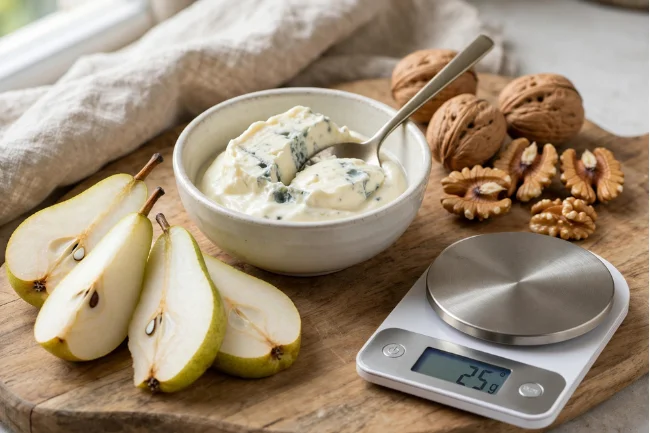
I would pair it with ingredients that offset its richness: pear, fig, apple, walnuts, hazelnuts, honey, or a slightly bitter leafy green.
Dates and other appetizers
One of the more interesting documented uses I found is Masgonzola-filled dates. Betty Bossi mixes the cheese with a little milk, pipes it into dates, and finishes them with walnuts and arugula.
That combination works because sweetness from the fruit balances both the saltiness of Gorgonzola and the richness of mascarpone.
Pizza, flatbread, and baked dishes
Small pieces can be scattered over pizza or flatbread, particularly with mushrooms, pear, onion, pumpkin, or walnuts.
Coop also uses Gorgonzola-mascarpone in baked pumpkin bites, showing that the mixture holds up well in savory oven dishes.
How to Store Masgonzola
Because Masgonzola-style products combine fresh mascarpone with soft blue cheese, I would follow the storage instructions on the specific package rather than relying on a universal shelf-life claim.
Coop’s current Gorgonzola-mascarpone product specifies refrigerated storage at no more than 5°C.
Once opened, keep the cheese well covered and minimize unnecessary time at room temperature. If you buy a prepared commercial product, the use-by date and manufacturer’s instructions should take priority over generic cheese-storage advice.
Straight Gorgonzola behaves somewhat differently because it continues to mature. The official consortium recommends keeping Gorgonzola PDO refrigerated and consuming it within a few days after purchase for its best characteristics.
How to Buy the Right Product
The biggest practical problem with Masgonzola is that the word may not appear on the package at all.
When shopping, I would also look for terms such as:
- Gorgonzola and Mascarpone
- Gorgonzola e Mascarpone
- Gorgonzola-Mascarpone
- Gorgonzola with Mascarpone
Those descriptions are often more useful than searching exclusively for “Masgonzola.” Products may be mixed throughout or constructed in alternating layers.
I would also check the ingredient ratio. A 50/50 version will be exceptionally creamy, whereas a product containing proportionally more Gorgonzola should deliver a stronger blue-cheese character.
FAQs About Masgonzola
What is Masgonzola made of?
Masgonzola generally refers to a combination of Gorgonzola and mascarpone; documented commercial versions include a 50% Gorgonzola and 50% mascarpone formula.
Is Masgonzola the same as Gorgonzola?
No. Gorgonzola is a protected Italian PDO blue cheese, while Masgonzola is commonly used for a preparation combining Gorgonzola with mascarpone.
What does Masgonzola taste like?
It combines the tangy, earthy character of Gorgonzola with the mild, buttery richness of mascarpone, producing a creamier and generally gentler blue-cheese flavor.
What can I use Masgonzola for?
It works particularly well in pasta sauces, risotto, crostini, pizza, savory bakes, cheese boards, and sweet-savory appetizers such as stuffed dates.
Where can I buy Masgonzola?
Look in the refrigerated cheese section for “Gorgonzola with Mascarpone” or “Gorgonzola e Mascarpone,” since many retailers sell the product without using the Masgonzola name.
A Better Way to Understand Masgonzola
After checking recipes, retailers, an Italian cheese producer, and official Gorgonzola records, I find the evidence much stronger for treating Masgonzola as a Gorgonzola-mascarpone specialty than as a separate historic blue cheese.
That definition also makes the food easier to understand: Gorgonzola brings blue veining, saltiness, tang, and character; mascarpone adds sweetness, fat, softness, and a velvety texture. The exact balance depends on the producer, so nutrition and flavor should always be judged from the specific product rather than from a generic “Masgonzola” profile.
If you’re trying Masgonzola for the first time, start with a small amount in risotto, pasta, or on toasted bread with pear or honey. It is one of the simplest ways to enjoy blue-cheese flavor in a softer, creamier form.

Dr. Hannah Collins is a nutrition and diet specialist with 13+ years of experience helping people make informed food choices and develop healthier eating habits. She shares evidence-based nutrition guidance focused on balanced diets, meal planning, healthy lifestyles, and sustainable wellness.