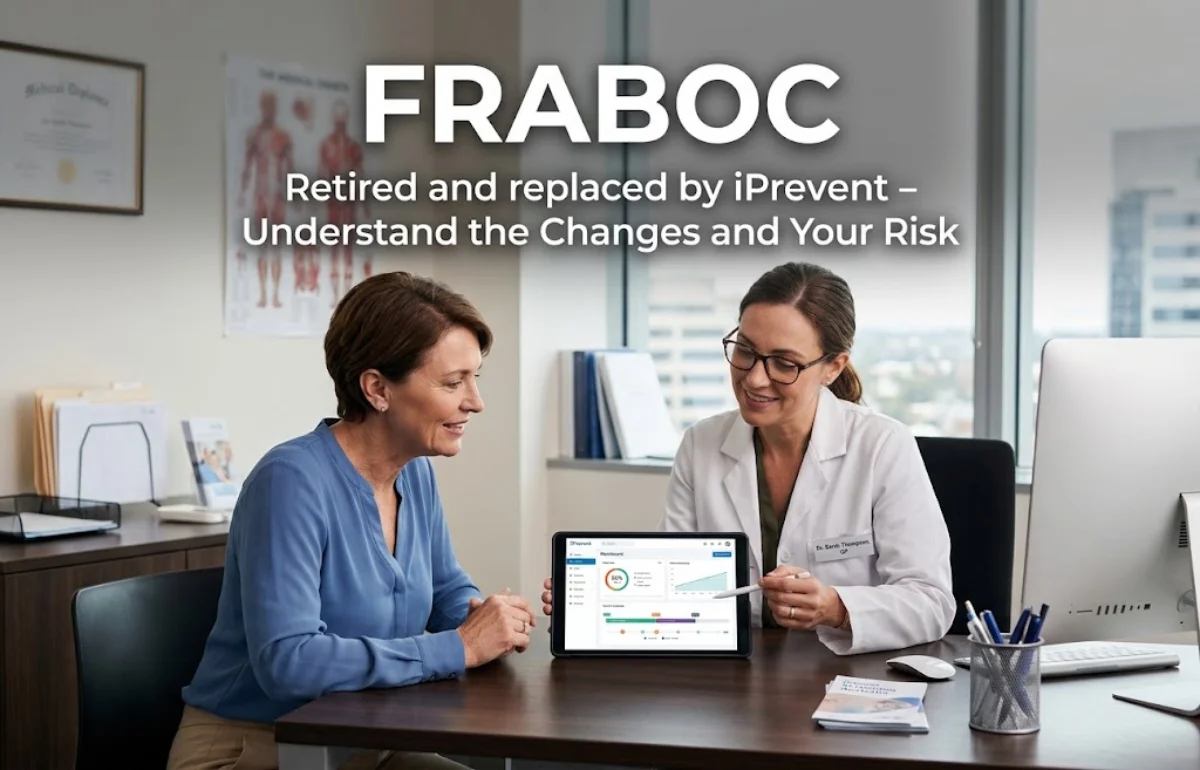
FRABOC stands for Familial Risk Assessment – Breast and Ovarian Cancer, an online clinical tool that Cancer Australia developed to help GPs and nurses work out a woman’s breast and ovarian cancer risk based on her family history.
It wasn’t something you filled in yourself at home. A health professional used it during a consultation, entered details about relatives who’d had cancer, and got back a risk category that shaped the conversation about screening and next steps.
FRABOC is no longer active. It’s been retired and replaced by a newer tool called iPrevent, but the questions FRABOC used to ask are still the ones that matter most when doctors talk about inherited cancer risk today.
I started digging into this properly after a family member’s diagnosis sent me down a rabbit hole of half-remembered advice from my own GP visits years earlier. Somewhere in an old referral letter was a mention of FRABOC, and I couldn’t find it anywhere online. That confusion is, I suspect, why a lot of people end up searching this term in the first place.
What FRABOC Actually Did
FRABOC was built for structure, not for guesswork. Before tools like this existed, a GP might hear “my mum had breast cancer” and have to rely on general knowledge to decide whether that warranted anything beyond standard screening.
FRABOC changed that by turning a family history conversation into a repeatable process. The clinician would enter details about relatives on both sides of the family, including who was diagnosed, at what age, and with what type of cancer.
The tool would then sort the patient into one of three risk bands, giving the GP something concrete to act on instead of a vague impression.
Who Was It Designed For
FRABOC was aimed squarely at general practitioners and practice nurses, not the general public. You wouldn’t have stumbled onto it through a Google search and filled it in on your own, the way you might with a symptom checker.
That distinction matters because a lot of confusion online treats FRABOC as if it were a consumer-facing risk calculator. It never was. It sat in the background of a clinical appointment, and the patient experienced the output as a conversation, not a form.
Why You Can’t Find FRABOC Anymore
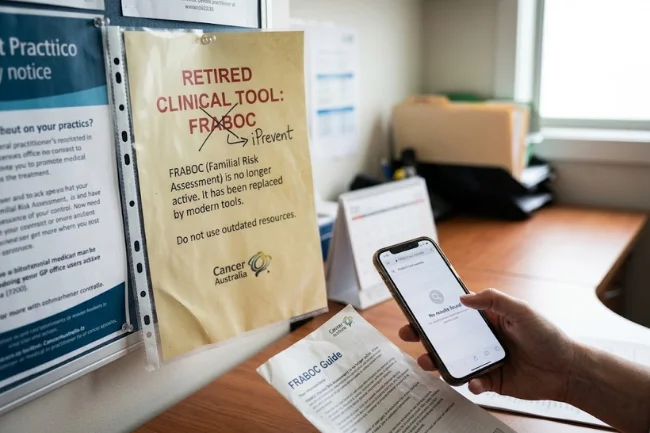
Cancer Australia officially discontinued FRABOC and removed it from its website. If you’ve been searching for a live version, that’s why nothing comes up, aside from old PDFs, outdated clinic handouts, or archived health department pages that never got updated.
This trips people up more than you’d expect. Referral letters, old fact sheets, and even some GP training material from years ago still reference FRABOC by name, so patients go looking for a tool that technically doesn’t exist anymore.
The retirement wasn’t a downgrade. It reflected the fact that breast cancer risk depends on more than family history alone, and the research community wanted a tool that could account for that properly.
What Replaced FRABOC: iPrevent
iPrevent is the tool Australian clinicians use now. It was developed by a multidisciplinary team at the Peter MacCallum Cancer Centre in Melbourne and is endorsed by the Royal Australian College of General Practitioners.
Where FRABOC only looked at family history, iPrevent pulls in breast density, reproductive history, hormone use, prior biopsies, weight, and lifestyle factors alongside the family history questions FRABOC used to ask.
Instead of sorting you into one of three broad categories, iPrevent calculates a personalised five-year and lifetime risk percentage. It also recommends specific management options, from more frequent screening to risk-reducing medication, based on published Australian guidelines.
Under the hood, iPrevent automatically chooses between two validated statistical models, IBIS and BOADICEA, depending on which fits your risk profile better. You don’t need to know which one it’s using. The tool handles that decision for you and presents the result in plain language, along with a graph you can actually make sense of.
FRABOC vs iPrevent
If you’re trying to work out where you stand today, iPrevent is the tool to look for, not FRABOC. You can find it by searching “iPrevent Peter Mac” or through your GP.
The Three Risk Categories FRABOC Used
Even though the tool itself is gone, the risk framework it popularised is still the mental model most Australian clinicians use when they talk about family history. It’s worth understanding because iPrevent’s output still gets mapped back onto something similar.
Most people who go through any version of this assessment land in that first category. The point of the exercise was never to confirm fear. It was to give an open-ended question a definite answer.
What Family History Does and Doesn’t Tell You
Having one relative with breast cancer doesn’t automatically put you in a higher risk bracket. Breast cancer affects roughly one in seven Australian women over a lifetime, so it shows up in a lot of families without pointing to an inherited cause.
What actually raises a flag is pattern, not presence.
The signals that mattered most under FRABOC, and still matter under iPrevent, include multiple relatives on the same side of the family diagnosed with breast or ovarian cancer, a relative diagnosed before age 50, breast and ovarian cancer both appearing in the family, a male relative with breast cancer, and a known BRCA1 or BRCA2 mutation already identified.
Your Father’s Side Counts Just as Much
This is the part people miss most often. A BRCA mutation can be inherited from either parent, and a father who carries the gene but was never diagnosed himself can still pass it to a daughter.
When a GP takes a proper family history, they should be asking about both sides equally. If you’ve only ever thought about your mother’s relatives when someone mentions your risk, it’s worth going back and mapping out your father’s side too.
What I Learned Bringing This to My Own GP

After that family diagnosis, I made an appointment specifically to have this conversation properly instead of carrying it around unresolved. My GP didn’t use FRABOC, because by then it had already been phased out, but she worked through the same categories using current guidelines.
She asked about ages at diagnosis, which side of the family, and whether ovarian cancer had come up anywhere. I ended up in the average risk category, which meant no change to standard screening, just a clear answer instead of a lingering question.
What surprised me was how short the appointment actually was. I’d built it up into something bigger in my head. In reality, it was maybe fifteen minutes of specific questions and a plain explanation of what the answer meant for me.
Questions Worth Bringing to That Appointment
A GP appointment about family history moves faster and goes further if you turn up prepared. Before you go in, it helps to know the following about your relatives on both sides: who was diagnosed, their age at diagnosis, whether it was breast or ovarian cancer, and whether anyone has had genetic testing already.
If a relative has had BRCA testing, bringing the actual result or report speeds things up considerably, since your GP can factor in a known result rather than estimating probability. Even a rough family tree scribbled on paper the night before is more useful than trying to recall everything on the spot.
Beyond Family History: The Other Models Worth Knowing About
Family Cancer Clinics rarely rely on a single tool. Alongside iPrevent, specialists sometimes use CanRisk, which is the modern online version of the BOADICEA model, particularly for families with a more complex genetic picture.
Research comparing these models has generally found that BOADICEA and IBIS, the two models built into iPrevent, produce more accurate predictions for Australian women with a documented family history than older, simpler calculators. That’s part of why iPrevent has become the standard rather than a replacement built from scratch.
If your GP does refer you to a Family Cancer Clinic, don’t be surprised if a specialist runs a second, more detailed assessment on top of whatever you completed at your GP’s office. That’s not a sign something went wrong. It’s a normal part of getting a more precise picture once family history looks genuinely significant.
Living With the Uncertainty in the Meantime
There’s a specific kind of worry that comes with knowing cancer runs somewhere in your family but not knowing what that means for you personally. It’s quieter than acute fear, more like background noise that never fully switches off.
I’ve talked to more than one woman who avoided getting assessed at all because she’d rather not know. The logic makes sense on the surface, but unresolved uncertainty tends to expand to fill whatever space you give it, whereas an actual number or category, even an unwelcome one, gives the worry somewhere to land.
Getting assessed doesn’t remove risk. What it does is replace an open-ended question with a specific, workable answer, which is exactly what FRABOC was designed to do and what iPrevent does more thoroughly today.
Frequently Asked Questions
Is FRABOC still available in Australia?
No, FRABOC has been retired and removed from the Cancer Australia website. It’s been replaced by iPrevent, which Australian GPs and patients use today.
What does FRABOC stand for?
FRABOC stands for Familial Risk Assessment – Breast and Ovarian Cancer, a tool that translated family cancer history into a risk category for clinicians.
What tool replaced FRABOC?
iPrevent, developed by the Peter MacCallum Cancer Centre, replaced FRABOC. It gives a personalised lifetime risk percentage rather than a broad category.
Can I use iPrevent myself, or do I need a doctor?
You can complete iPrevent yourself online, though it’s designed to be discussed with your GP afterward so the results translate into a screening or referral plan.
Does one relative with breast cancer mean I’m high risk?
Not usually. A single relative rarely changes your risk significantly. What matters more is a pattern, such as multiple relatives, early diagnosis ages, or a known BRCA mutation.
Where to Go From Here
FRABOC did its job for years, and the framework it built is still shaping how Australian clinicians talk about inherited cancer risk, even though the tool itself has been retired. If you’re trying to understand your own situation today, iPrevent is the current starting point, and your GP is the person to walk through the result with.
If you’ve got a family history sitting unresolved in the back of your mind, book the appointment. Bring the names, the ages, and whichever side of the family it runs through. An actual answer, in almost every case, turns out to be far less frightening than the not knowing.
Disclaimer
I’ve written this from what I’ve learned researching my own family history, not as a clinician. Nothing here is a diagnosis, a risk score, or a substitute for sitting down with your GP or a genetic counsellor. If any of this sounds like your own situation, the next right step is a conversation with someone qualified to look at your specific history — not this article.

Claire Morgan is a health and wellness writer with 7 years of experience creating clear, research-informed content on nutrition, sleep, movement, preventive habits, and everyday wellbeing. She focuses on making reliable health information practical and easy to understand. Her articles are educational and do not replace professional medical advice.