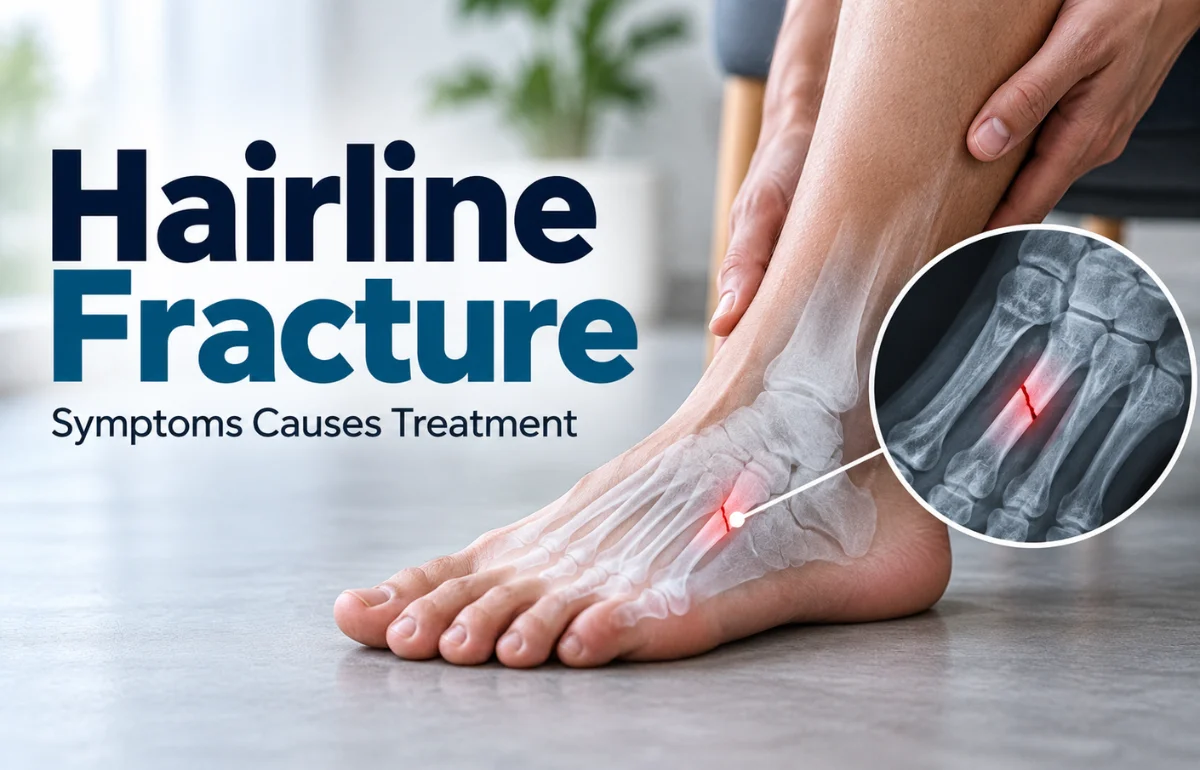
A hairline fracture is a very small crack in a bone, usually caused by repeated stress rather than one major injury. Doctors commonly refer to this type of injury as a stress fracture or bone stress injury. It often develops when a bone is loaded repeatedly without enough time to repair itself between activities.
Unlike a dramatic broken bone after a fall or accident, a hairline fracture can begin with mild, easy-to-ignore pain. The discomfort typically becomes more noticeable during running, walking, jumping, or other weight-bearing activity and improves with rest in the early stages. The feet and lower legs are especially common locations.
What makes these injuries tricky is that you may still be able to walk, the area may look normal, and an early X-ray may show nothing unusual. That does not mean the bone is fine.
What Is a Hairline Fracture?
The term “hairline fracture” describes the appearance of a tiny crack in bone. In everyday medical use, it is often used interchangeably with stress fracture, although “hairline fracture” itself is not a precise orthopedic classification.
A stress fracture usually develops through repeated loading. Each time you run, jump, march, or perform another repetitive activity, your bones experience small amounts of stress. Healthy bone normally adapts to that stress through a continuous rebuilding process called bone remodeling.
Problems begin when new damage accumulates faster than the body can repair it. The injury may start as a bone stress reaction, where the bone becomes irritated or swollen without a visible crack. Continued loading can eventually produce an actual fracture line.
I find this distinction useful because it explains why treating symptoms early matters. You do not necessarily go from a completely healthy bone to a fracture in one workout. There can be a window in which reducing the load may prevent a developing bone stress injury from progressing.
Where Do Hairline Fractures Commonly Occur?
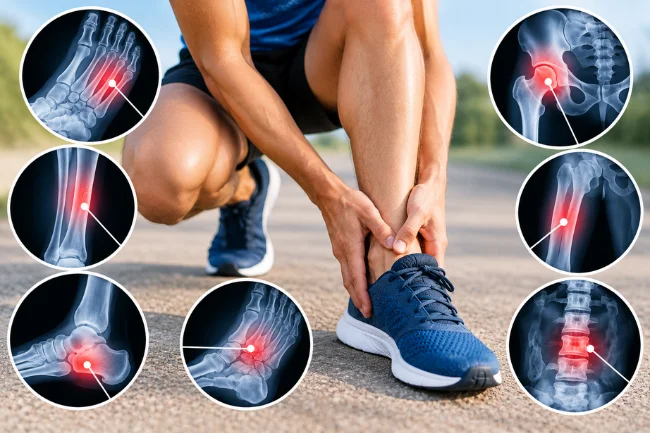
Hairline fractures are particularly common in bones that repeatedly carry body weight.
Common sites include:
- Metatarsal bones in the foot
- Tibia, or shinbone
- Fibula in the lower leg
- Calcaneus, or heel bone
- Navicular bone in the midfoot
- Hip and femur in some athletes
- Lower-back bones in certain sports
Metatarsal stress fractures are especially associated with running, dancing, jumping and marching. Stress fractures can occur elsewhere, including the wrists and hands, but lower-body weight-bearing bones are affected more often.
The location matters because not every small fracture carries the same risk. Some bones heal reliably with reduced activity, while certain fracture sites have poorer blood supply or are exposed to forces that can make healing more difficult.
That is one reason I would not judge the seriousness of a fracture by pain intensity alone.
Hairline Fracture Symptoms
The classic symptom is localized pain that becomes worse when the injured bone is loaded.
At first, you may notice discomfort only near the end of a workout. The pain may disappear fairly quickly when you stop. If the injury progresses, pain can begin earlier during activity, persist afterward, and eventually occur during ordinary walking or daily tasks.
Other possible symptoms include:
- Tenderness directly over one spot on the bone
- Swelling around the painful area
- Mild bruising
- Pain when walking, running or jumping
- Pain that improves with rest during the early stage
- Limping as the injury becomes more severe
- Aching at rest or at night in more advanced cases
One detail worth paying attention to is how focused the pain feels. A stress fracture often produces a relatively specific tender point rather than vague soreness across a large muscle area.
Pain at rest or at night deserves medical attention, particularly when it is persistent.
What Causes a Hairline Fracture?
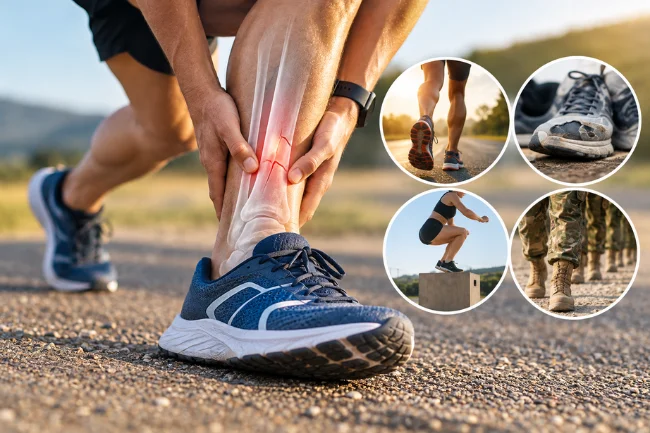
Most hairline stress fractures are overuse injuries.
Imagine increasing your running mileage, starting daily basketball after months of inactivity, joining a military training program, or spending a vacation walking far more than usual. Your cardiovascular fitness may tolerate the extra activity, but bone adapts on a different timetable.
The American Academy of Orthopaedic Surgeons notes that bone stress injuries can appear after rapid increases in the frequency, duration or intensity of physical activity.
Common triggers include:
- Increasing running mileage too quickly
- Starting a new sport or workout program
- Training on consecutive days without enough recovery
- Repetitive jumping
- Long-distance walking or marching
- Changing to a harder training surface
- Returning to sport too aggressively after time off
- Wearing worn or unsuitable footwear
- Repeating physically demanding movements at work
A hairline fracture can also occur when the bone itself is weaker than normal. Osteoporosis, low bone density, nutritional problems and certain medical conditions or medications may make bone less able to tolerate ordinary loads.
Who Is Most at Risk?
Athletes are well represented among people with stress fractures, but you do not have to be an athlete to develop one.
Runners, dancers, gymnasts, basketball players, tennis players and military personnel are commonly exposed to repetitive loading. A previously inactive person who suddenly begins an intense exercise routine can also be vulnerable.
Other factors that may increase risk include:
Low Energy Availability and RED-S
One of the most overlooked issues is not simply “poor nutrition,” but whether a person is eating enough to support both normal body functions and their training.
Relative Energy Deficiency in Sport, often called RED-S, can occur when energy intake does not keep pace with exercise demands. It can affect females and males and may harm bone health, hormones, recovery and athletic performance. Stress fractures can be one consequence.
This is broader than the older concept of the female athlete triad.
Low Bone Density
Osteoporosis and other causes of reduced bone strength can increase fracture risk, sometimes even during normal daily activity.
Previous Stress Fracture
A previous bone stress injury is an important risk factor for another one.
Biomechanics and Muscle Fatigue
Foot shape, leg alignment, running mechanics, reduced muscle strength and fatigue can influence how force travels through the body.
Muscles normally absorb part of the force created during movement. When they become fatigued or cannot distribute that load efficiently, more stress may reach the bone.
Inadequate Recovery
Sleep, rest days and recovery between hard sessions matter. Bone needs time and sufficient energy to remodel after training.
Hairline Fracture vs. Sprain vs. Shin Splints
These conditions can feel similar at first, which is why self-diagnosis based only on pain location is unreliable.
| Feature | Hairline/Stress Fracture | Sprain | Shin Splints |
|---|---|---|---|
| Tissue affected | Bone | Ligament | Tissues around the tibia |
| Typical cause | Repetitive bone loading | Joint twisting or overstretching | Repetitive running/loading |
| Pain pattern | Often focused in one small area | Usually around an injured joint | Often spread along the inner shin |
| Tenderness | Frequently very localized | Around ligament/joint | Usually broader area |
| Swelling | Possible | Common | Usually mild |
| Early X-ray | Can appear normal | Usually not used to diagnose ligament damage | Usually normal |
| Main concern | Crack can worsen if loading continues | Ligament damage/instability | Persistent overuse irritation |
This table is only a general comparison. Symptoms overlap, and persistent bone pain deserves professional evaluation.
How Is a Hairline Fracture Diagnosed?
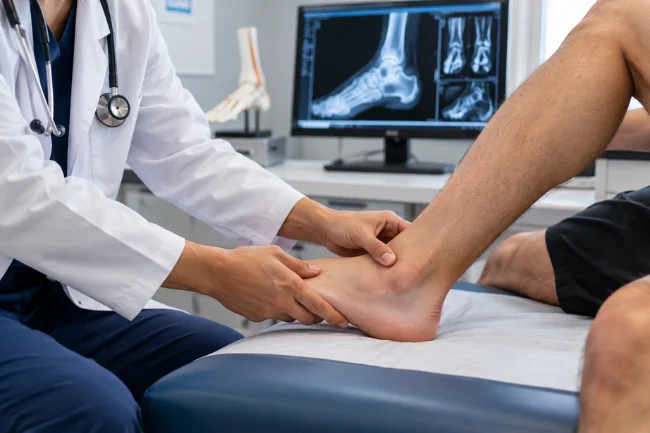
Diagnosis usually begins with your history.
A clinician may ask when the pain started, which activities trigger it, whether your training recently changed, whether you have had previous fractures, what medications you use and whether there are concerns about bone health or nutrition.
During an examination, the clinician may look for highly localized tenderness and assess how the affected area responds to movement or loading. Imaging may then be used to confirm the diagnosis or determine the severity.
X-Ray
X-rays are commonly used first, but an early stress fracture may not be visible.
Signs can take time to appear because an X-ray is better at showing established changes in bone than the earliest stages of a bone stress reaction.
MRI
MRI can show bone swelling and other early changes that an X-ray may miss. Mayo Clinic describes MRI as the best imaging method for identifying stress fractures.
CT Scan
CT provides detailed images of bone and may help clinicians evaluate a known fracture more closely or clarify certain findings.
Bone Density Scan
A DEXA bone-density scan does not diagnose the small crack itself. It may be considered when a fracture happens after unusually light activity or when there are reasons to suspect reduced bone strength.
| Test | Main Role | Can an Early Injury Be Missed? |
|---|---|---|
| X-ray | Often the initial bone image | Yes |
| MRI | Detects bone stress and early injury | Less likely |
| CT | Detailed view of bone structure/fracture | Can be less useful for very early stress reaction |
| DEXA | Measures overall bone density | Not designed to locate a stress fracture |
What to Do If You Think You Have a Hairline Fracture
Continuing to repeatedly “test” a painful bone by running, jumping or doing the activity that caused it can turn a manageable stress injury into a more serious one.
Until you are evaluated, stop or substantially reduce the activity that causes pain.
Ice may help with swelling. Avoid placing ice directly against the skin. If walking itself hurts, medical assessment becomes even more important because you may need a boot, stiff-soled shoe or crutches to reduce the load on the bone.
Advice about pain-relieving medicines can vary depending on the injury and your medical history, so I would not use medication to mask pain and continue exercising. Ask a healthcare professional what is appropriate for you.
Hairline Fracture Treatment
The basic treatment principle is simple: reduce enough stress on the injured bone to allow it to repair itself.
That does not mean every patient receives identical treatment.
Rest and Activity Modification
You will usually need to stop the activity responsible for the injury for a period of time.
Depending on the fracture, pain-free lower-impact activities such as swimming or cycling may be possible while the bone heals. The key phrase is pain-free and medically appropriate for the fracture location.
Boots, Braces and Crutches
If normal walking places too much stress on the injured area, a clinician may recommend:
- A walking boot
- Hard-soled shoe
- Brace
- Crutches
- Temporary restrictions on weight-bearing
These devices are not necessary for every hairline fracture.
Surgery
Most stress fractures do not require surgery. However, surgery may be considered for fractures that are unlikely to heal reliably, are located in problematic areas, have failed to heal or require stabilization.
How Long Does a Hairline Fracture Take to Heal?
There is no universal healing time because recovery depends on the bone involved, severity of the injury, general bone health and how quickly the provoking activity is reduced.
AAOS states that bone stress injuries may require at least three weeks to heal, while more severe injuries can take three months or longer. Other clinical guidance commonly places uncomplicated foot stress-fracture recovery around several weeks.
A calendar alone should not decide when you return to sport.
Pain, examination findings, fracture location and sometimes repeat imaging all contribute to the decision. Returning too early can restart the injury cycle and delay healing.
Can You Walk on a Hairline Fracture?
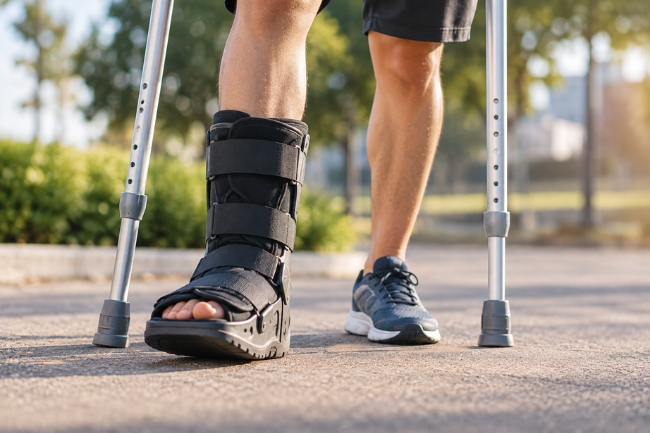
Sometimes, but being physically able to walk does not prove that walking is safe.
Some people with mild bone stress injuries can walk without significant pain. Others need protected weight-bearing with a boot or crutches.
If ordinary walking causes pain, limping or increasing tenderness, the bone is still being stressed. That is a strong reason to seek assessment rather than simply pushing through it.
A Practical Way to Describe the Injury to Your Doctor
In researching this topic, I found that many explanations focus heavily on pain intensity. A more useful way to organize your symptoms is to record three things:
- Location: Can you point to one exact painful spot with a fingertip?
- Load change: What changed before the pain began—mileage, workout frequency, footwear, work demands, sport or walking?
- Pain progression: Does pain disappear with rest, return sooner each session, affect walking, or continue at night?
This is not a home diagnostic test. It is simply a clearer way to communicate the pattern to a healthcare professional.
Also mention previous fractures, menstrual changes where relevant, major dietary restrictions, unexplained weight changes, osteoporosis, long-term medications and unusually low-energy injuries. These details may reveal why the fracture developed rather than only where it developed.
How to Prevent Another Hairline Fracture
Preventing recurrence means addressing both sides of the equation: how much load the bone receives and whether your body has enough capacity and recovery time to adapt to it.
Useful strategies include:
- Increase training volume gradually
- Build recovery days into your schedule
- Avoid repeatedly training through focal bone pain
- Replace worn athletic shoes
- Use appropriate footwear for the activity
- Include strength training where appropriate
- Cross-train instead of repeating the same high-impact movement daily
- Eat enough to support your training load
- Get adequate calcium, vitamin D, protein and overall nutrition
- Prioritize sleep
- Address biomechanical issues when they repeatedly cause injury
AAOS also recommends adequate recovery, cross-training, gradual increases in activity and sufficient energy intake as part of preventing bone stress injuries.
The point is not to make your bones avoid stress entirely. Bones become stronger in response to appropriate loading. The problem is repeated overload without enough recovery.
When Should You See a Doctor?
Get medical advice if you have persistent, localized bone pain, particularly when it repeatedly returns with activity.
Evaluation becomes more urgent when:
- Pain occurs during ordinary walking
- You are limping
- Pain continues at rest or during the night
- Swelling is increasing
- Symptoms are worsening rather than improving
- You cannot comfortably bear weight
- The injury followed significant trauma
- You have osteoporosis or another condition affecting bone strength
Severe pain, obvious deformity, an open wound over a suspected fracture, loss of sensation, or inability to use the injured limb requires prompt medical attention.
Frequently Asked Questions
Can a hairline fracture heal on its own?
Many stress fractures can heal without surgery when the bone is properly unloaded, but continuing the activity that caused the injury may delay healing or worsen the crack.
Does a hairline fracture show up on an X-ray?
Not always. Early stress fractures can look normal on X-rays, so MRI or other imaging may be considered when suspicion remains high.
What does a hairline fracture feel like?
It commonly causes focused tenderness and pain that increases with weight-bearing or repetitive activity and initially improves with rest.
Do you need a cast for a hairline fracture?
Not necessarily. Treatment may involve activity modification, a stiff-soled shoe, walking boot, brace or crutches depending on the location and severity.
Can a hairline fracture get worse if untreated?
Yes. Continued repetitive loading can allow a bone stress injury to progress, potentially creating a larger fracture and extending recovery time.
The Bottom Line
A hairline fracture may be small, but it should not be treated as insignificant. Localized bone pain that repeatedly appears with walking, running, jumping or another repetitive activity is your signal to reduce the load and find out what is happening.
Early bone stress injuries are generally easier to manage than fractures that have been repeatedly exercised on for weeks. If pain is persistent, affects normal walking, appears at rest or keeps returning when you resume activity, arrange an evaluation with a qualified healthcare professional.
The goal is not simply to make the pain disappear. It is to let the bone heal, identify why the overload occurred and return to activity gradually enough that the same injury does not start again.
Medical Disclaimer:
This article is for general informational purposes only and is not a substitute for professional medical advice, diagnosis, or treatment. Always consult a qualified healthcare provider about symptoms, injuries, or treatment decisions

Claire Morgan is a health and wellness writer with 7 years of experience creating clear, research-informed content on nutrition, sleep, movement, preventive habits, and everyday wellbeing. She focuses on making reliable health information practical and easy to understand. Her articles are educational and do not replace professional medical advice.