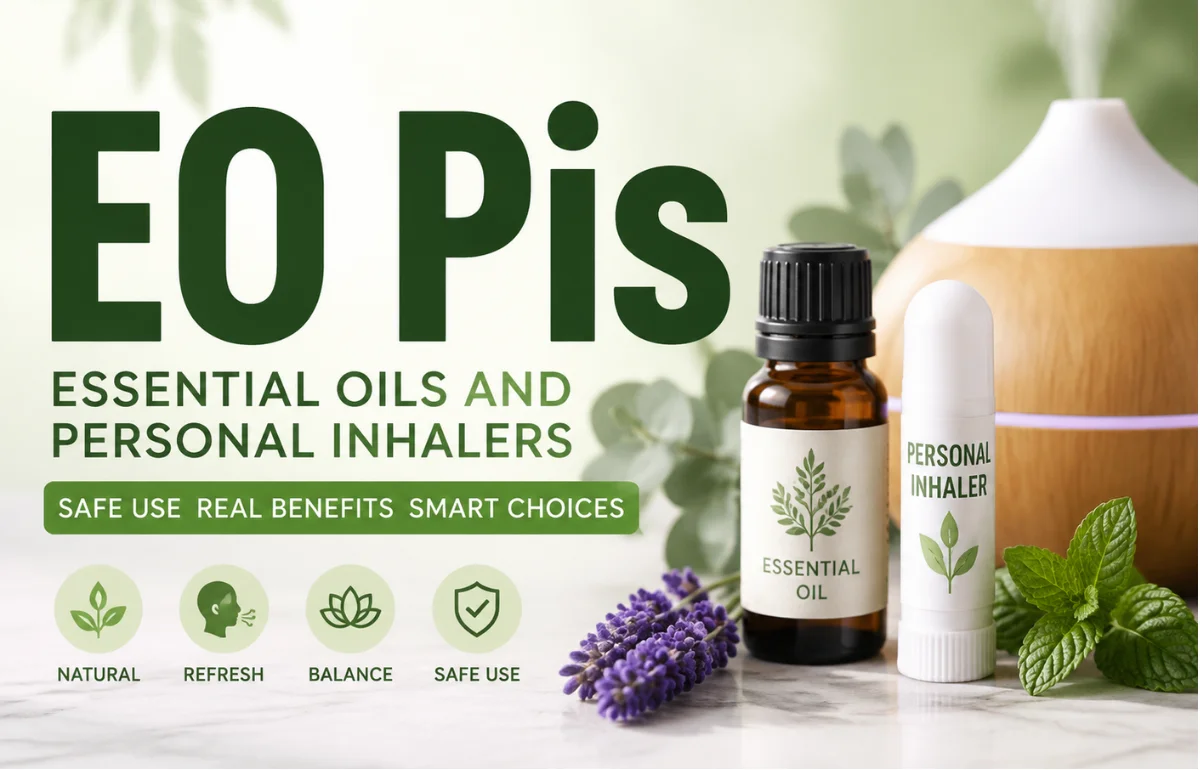
EO Pis is a nonstandard online term most often used in wellness content to describe essential oils or essential oil personal inhalers. Essential oils are concentrated aromatic extracts obtained from plant material, while a personal inhaler is a small tube containing a scented wick for individual inhalation. Because “EO Pis” has no single recognized medical or industry definition, I use it here as an umbrella phrase for those two related ideas—not as the name of a proven treatment or officially defined product category.
That distinction matters. Search results also use EO PIS for unrelated business systems, so the surrounding words should determine the meaning. When a page mentions lavender, aromatherapy, carrier oils, diffusers, or inhalers, the wellness meaning is usually intended. Aromatherapy itself is a complementary health approach that commonly involves inhalation or diluted application to the skin.
Why the Meaning of EO Pis Is Confusing
When I reviewed current pages ranking for this phrase, I found several incompatible definitions. Some call EO Pis another name for essential oils. Others expand it as “essential oil personal inhalers.” Another group uses EO PIS for enterprise operations and performance-information systems.
That suggests the keyword is being shaped by online publishing rather than an established aromatherapy standard. A trustworthy article should acknowledge the ambiguity instead of inventing one fixed expansion and repeating it as fact.
| Words near “EO Pis” | Likely meaning | Probable search intent |
|---|---|---|
| Lavender, diffuser, carrier oil | Essential oils or aromatherapy products | Benefits, uses, and safety |
| Wick, aroma stick, portable tube | Essential oil personal inhaler | How the device works |
| KPI, dashboard, enterprise data | Business information system | Operations management |
| PIS benefit, Brazil, worker payment | A different PIS-related search | Employment-benefit information |
For the rest of this guide, EO Pis refers to essential oils and the personal inhalers used to smell them.
EO Pis, Essential Oils, and Personal Inhalers
These terms are related, but they are not interchangeable.
| Term | What it is | Common use | Main caution |
|---|---|---|---|
| Essential oil | A concentrated aromatic plant extract | Diffusion or diluted topical use | Can irritate skin or become toxic when misused |
| Personal inhaler | A capped tube with a scented wick | Private, portable inhalation | Strong aromas may trigger irritation or headache |
| Diffuser | A device that disperses aroma into a room | Shared ambient scent | Exposes everyone nearby |
| Pre-diluted roller | Essential oil mixed with a carrier oil | Limited topical application | Requires suitable dilution and a patch test |
Johns Hopkins describes an aroma stick as a portable inhaler with an absorbent wick and a cover that contains the scent between uses. A personal aroma stick affects only its user, unlike room diffusion.
How EO Pis May Affect the User
Inhalation and Scent Perception
When an aroma is inhaled, odor molecules stimulate the olfactory system. Smell is closely connected with brain regions involved in emotion and memory, which helps explain why a familiar scent can feel comforting, energizing, or unpleasant.
That does not mean every fragrance produces a predictable medical effect. Scent preference, concentration, previous associations, the setting, and individual sensitivity all influence the experience.
I find it more accurate to describe EO Pis as sensory tools that may support a calming, focusing, or refreshing routine—not as products that automatically treat anxiety, insomnia, respiratory disease, or pain.
Topical Application
Some essential oils appear in massage oils, creams, cleansers, and other skin products. Pure oils are highly concentrated, so direct application can cause irritation or allergic reactions.
Poison Control advises checking whether an oil is suitable for skin use, following product directions, avoiding damaged skin, and diluting concentrated oils in a carrier oil.
What the Evidence Says
Evidence is not equally strong for every oil, condition, dose, or delivery method. NCCIH notes that rigorous aromatherapy research remains limited for uses such as insomnia, while Johns Hopkins reports mixed results from human clinical trials.
An oil may show an interesting laboratory property without being proven to treat a health condition in real life. Lab findings, traditional use, personal preference, and clinical evidence should not be treated as equivalent.
Common EO Pis and Their Realistic Uses
Lavender
Lavender is widely chosen for its soft floral scent and association with evening routines. Some people find the aroma relaxing, but research does not justify promising better sleep for everyone.
A lavender aroma stick may be more considerate than whole-room diffusion when other people dislike fragrance. Stop using it if the scent causes headache, coughing, nausea, or irritation.
Peppermint
Peppermint has a sharp, cooling aroma that many users associate with alertness. Evidence varies by formulation and purpose; findings involving enteric-coated capsules, for example, cannot be transferred automatically to inhaled oil.
Peppermint should not be applied near the face of infants or young children. NCCIH warns that menthol exposure in this setting can cause serious adverse effects.
Tea Tree
Tea tree oil is mainly used in topical products rather than personal inhalers. A small body of research suggests that properly formulated topical products may help with acne or athlete’s foot, but stronger evidence is needed.
Tea tree oil must not be swallowed. Oral exposure can cause confusion, poor coordination, inability to walk, and coma. Old or poorly stored oil may also be more likely to irritate skin.
Eucalyptus and Citrus Oils
Eucalyptus has a strong, clean scent often used in cold-season products. Smelling it may feel refreshing, but it should not be described as treating an infection or respiratory disease. Swallowed eucalyptus oil can cause severe poisoning, including seizures.
Lemon, sweet orange, and bergamot are popular for bright aromas. Some citrus oils can make skin more vulnerable to sunlight after topical application. FDA warns that plant-derived and “natural” ingredients can still be irritating, allergenic, or harmful when used incorrectly.
Choosing the Right EO Pis Format
I recommend choosing the delivery method before choosing the scent. This prevents a common mistake: buying an oil first and only later wondering where, how, and around whom it can be used.
Personal Inhaler
An aroma stick is compact, reusable, and limited to one user. It may suit an office, shared home, commute, or travel bag better than a diffuser.
Use gentle inhalation rather than pressing the tube inside the nostril. Keep the wick and oil away from direct contact with the nose, mouth, and eyes.
Diffuser
A diffuser affects everyone in the room. Consider children, pets, asthma, migraines, fragrance sensitivity, pregnancy, and anyone who does not want the exposure.
Follow the device instructions, use ventilation, avoid continuous all-day diffusion, and stop if anyone develops coughing, wheezing, dizziness, headache, or nausea.
Pre-Formulated Topical Product
For beginners, a reputable pre-diluted roller or body product is easier to assess than a homemade mixture. Read the complete ingredient list and follow the labeled application area and frequency.
Do not assume that a recipe using “a few drops” is safe. Drop size varies, oils differ in irritation potential, and suitable concentrations depend on the product, body area, age, and intended use.
EO Pis Safety Rules I Would Not Skip
Never Treat “Natural” as a Safety Guarantee
Essential oils can cause rashes, burns, allergic reactions, poisoning, and drug interactions. Some are dangerous when swallowed, and aspiration into the lungs can cause serious injury.
Do Not Ingest an Oil Because a Blog Recommends It
Food flavoring, a professionally formulated oral product, and a bottle sold for aromatherapy are not equivalent. Unless a qualified clinician has advised a specific formulation, keep essential oils out of the mouth.
Dilute Products Intended for Skin Application
Use a suitable carrier oil or a professionally formulated base. Perform a patch test and avoid broken, inflamed, or highly sensitive skin.
Oil and water do not mix reliably, so undiluted drops added to bath water can remain concentrated against the skin. Johns Hopkins specifically warns against this practice for children.
Use Extra Caution With Children and Health Conditions
Children can react differently from adults. People who are pregnant, breastfeeding, taking medication, living with asthma, prone to seizures, or managing chronic illness should discuss use with an appropriate health professional.
EO Pis should never replace prescribed treatment, urgent care, or evaluation of persistent symptoms.
Store Every Bottle as a Potential Poison
Keep oils tightly closed, away from heat and sunlight, and out of reach of children. If an oil is swallowed or causes severe symptoms, contact local poison-control or emergency services.
How I Evaluate an EO Pis Product Label
When I assess a product, I use a “one oil, one purpose, one route” rule. I identify what the product contains, why it is being used, and whether it is intended for inhalation, skin application, or another route.
A useful label should provide:
- The common and botanical plant name
- The plant part and extraction method
- A complete ingredient list
- Directions and safety warnings
- A batch or lot number
- Storage guidance
- A manufacturer and contact method
Johns Hopkins recommends looking for the Latin plant name, plant part, country of origin, and extraction method. It also warns that “therapeutic grade” is a marketing phrase, not a U.S. government grading or certification system.
I would avoid a product that promises to cure disease, provides no ingredient details, encourages undiluted use, or relies on vague claims such as “chemical-free.” The meaningful questions are identity, concentration, quality, intended use, and risk.
A Low-Risk Way to Start
Start with one familiar aroma and one short use period. A capped personal inhaler allows more control than continuous room diffusion and makes it easy to stop if the scent feels unpleasant.
Record the product, method, duration, and any reaction. Do not introduce several oils at once. If irritation develops, stop using the product; if breathing difficulty, severe drowsiness, confusion, vomiting, or another serious symptom occurs, seek urgent help.
This simple tracking approach separates a pleasant expectation from an observable response. It also helps identify the cause if a problem appears.
Frequently Asked Questions
What Does EO Pis Stand For?
EO Pis has no universally accepted expansion; wellness pages usually use it for essential oils or essential oil personal inhalers.
Are EO Pis the Same as Essential Oils?
Sometimes. The phrase may describe the oils themselves or portable aroma sticks containing an essential-oil-scented wick.
Are EO Pis Safe to Inhale Every Day?
Not for everyone. Use short, label-directed exposure and stop if you develop headache, coughing, wheezing, nausea, dizziness, or irritation.
Can I Put EO Pis Directly on My Skin?
Do not apply concentrated oil unless the label permits it; most topical uses require appropriate dilution or a professionally formulated product.
Can EO Pis Treat Anxiety, Insomnia, or Congestion?
They may support comfort or a relaxation routine, but evidence varies and they should not replace medical diagnosis or treatment.
A Sensible Next Step
EO Pis can be a useful search term for understanding essential oils and personal aroma inhalers, but it is not a standardized medical category. I would begin by confirming the term’s context, choosing one clearly labeled product, and deciding whether the goal is simply a preferred scent or support for a wellness routine.
Use the lowest practical exposure, note how you respond, and bring persistent health symptoms to a qualified professional rather than relying on an aroma alone.

Claire Morgan is a health and wellness writer with 7 years of experience creating clear, research-informed content on nutrition, sleep, movement, preventive habits, and everyday wellbeing. She focuses on making reliable health information practical and easy to understand. Her articles are educational and do not replace professional medical advice.