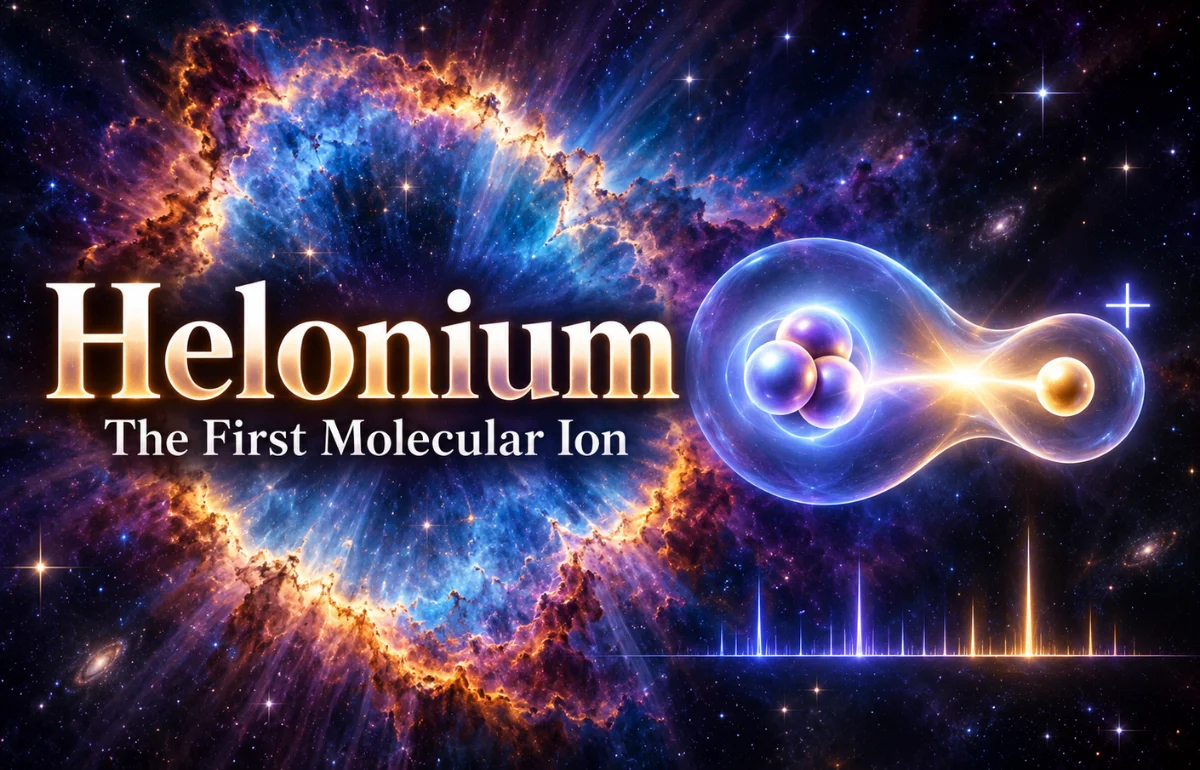
Helonium is another name for the helium hydride ion, HeH⁺: a tiny molecule made from helium and hydrogen with an overall positive charge. It is not a newly discovered element, and it has no place of its own on the periodic table. Scientists care about it because models of the young Universe identify HeH⁺ as one of the earliest molecular bonds. Researchers found evidence of the ion in a laboratory in 1925, but a clear detection beyond Earth did not arrive until 2019. That gap tells a story about chemistry, astronomy, and the difficulty of detecting something real but fleeting.
If you searched for “helonium” after seeing a claim about a mystery element or the “first molecule,” here is the practical answer: the substance is real, but those labels need context. I find the clearest way to understand it is to keep three questions separate: what it is, what scientists have observed, and what they infer about the early Universe.
Helonium at a glance
| Question | Short answer |
|---|---|
| What is helonium? | The helium hydride ion, HeH⁺ |
| Is it an element? | No; it is a positively charged molecular ion |
| What is it made from? | Helium and hydrogen |
| What is its formal name? | Hydridohelium(1+) |
| When was it identified in the laboratory? | 1925 |
| When was it detected in space? | 2019, in the planetary nebula NGC 7027 |
| How was it detected? | By its far-infrared rotational emission using SOFIA |
The European Bioinformatics Institute’s ChEBI database records hydridohelium(1+) as CHEBI:33688, with a net charge of +1. Its database formula is HHe; astronomers and chemists commonly write HeH⁺. The order of the letters does not create a second species.
Is helonium an element or a molecule?
The name is misleading if you expect every word ending in “-onium” to name an element. Helium is an element with atomic number 2. Hydrogen is an element with atomic number 1. Helonium refers to a bonded combination of those ingredients, carrying a positive charge. It has no independent atomic number, so a claim that it is element 119 confuses two different kinds of matter.
It helps to distinguish an atom from an ion. A neutral helium atom has two protons and two electrons. A proton is the positively charged nucleus of ordinary hydrogen. When helium binds with that proton to form HeH⁺, the combined particle has three protons and two electrons in total. One extra positive charge remains. That is what the superscript plus sign says; it does not mean a third element has appeared.
You may also see “helium hydride ion,” “hydridohelium(1+),” or HHe⁺. These names point to the same basic ion. In popular writing, “helonium” is convenient, but HeH⁺ makes the chemical ingredients easier to see. None of these names should be confused with ordinary helium gas, which consists of neutral helium atoms.
How can helium, a famously unreactive gas, form HeH⁺?
Helium’s reputation for being inert is well deserved under everyday conditions. That does not mean it cannot participate in any bond under any conditions. A charged hydrogen nucleus changes the situation: the proton can bind to a helium atom, producing a molecular ion.
One formation route can be written as:
He + H⁺ → HeH⁺ + photon
The photon carries away energy. Chemists call this radiative association. Without a way to shed energy, two particles passing close together would have a harder time remaining bound. This explains a possible reaction; it does not mean you can mix two household gases and collect a jar of helonium.
HeH⁺ is highly reactive in the presence of many neutral particles. It can transfer its proton, and it does not accumulate as an ordinary bulk material under familiar conditions. Descriptions of it as an exceptionally strong acid refer to gas-phase proton transfer. They should not conjure up an image of a liquid acid with a familiar pH: acidity in a dilute gas is being discussed in a different setting.
There is a useful lesson here. “Helium is unreactive” describes its usual behaviour; “helium can form HeH⁺” describes a particular ion and environment. The two statements fit together once you specify what is reacting and under which conditions.
Why is helonium connected to the first chemistry in the Universe?
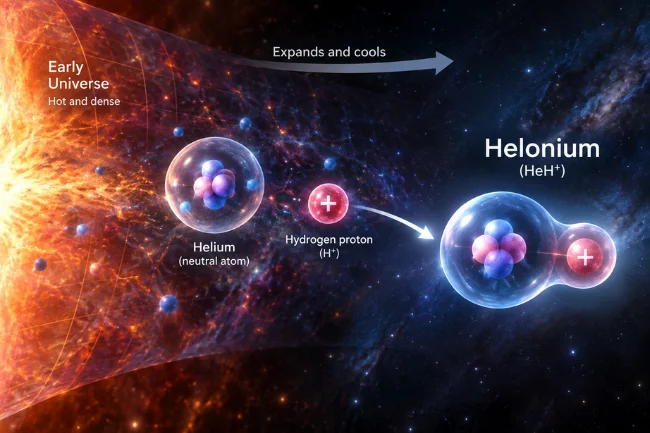
The early Universe began too hot for stable atoms and molecules. As it expanded and cooled, electrons joined atomic nuclei. Neutral helium could appear while some hydrogen remained ionized as free protons. Those two ingredients supplied a route to HeH⁺, making it a leading candidate for the earliest molecular bond.
The distinction between a prediction and an observation matters. Nobody watched the first helium hydride ions form billions of years ago. Physicists reconstruct that period using established laws, measured reactions, and models of changing temperature and density. The 2019 discovery confirmed the ion exists in an astronomical environment today; it did not directly photograph primordial gas.
Was it really the first molecule?
You will often read that helium hydride was “the first molecule.” That is useful shorthand, but I would say “an early molecular ion expected to form” when precision matters. HeH⁺ has a bond between two atomic nuclei and an electrical charge. It is different from neutral molecular hydrogen, H₂, which consists of two hydrogen atoms and has no net charge.
The phrase also describes a scientific reconstruction, not a specimen preserved from that era. The HeH⁺ detected in NGC 7027 formed in a much younger setting. Its chemistry gives astronomers a way to test part of the story about conditions long before stars existed.
What happened after HeH⁺ formed?
Calling HeH⁺ an early molecule does not mean it stayed intact forever. As neutral hydrogen became available, a reaction could move the hydrogen nucleus away from helium:
HeH⁺ + H → He + H₂⁺
The resulting H₂⁺ can take part in further reactions that produce H₂. The helium is released, so HeH⁺ acts as one step in a larger chemical network rather than as the final product. That network is why an ion built from just two nuclei can matter to a much larger astronomical story.
Molecular hydrogen matters because molecules can help gas release energy through radiation. Cooling makes it easier for some clouds to contract and eventually form stars. The chain is not as simple as “helonium made the first stars”: temperatures, densities, other reactions, and different cooling processes all influence what happens. HeH⁺ contributes to models that try to account for those conditions.
How did scientists find something so difficult to keep around?
The laboratory and space discoveries are separate events. T. R. Hogness and E. G. Lunn reported evidence for helium hydride ions in a 1925 Physical Review study of ions formed in gas mixtures. Making or detecting an ion in laboratory equipment, however, does not prove that an astronomical object contains enough of it to reveal a measurable signal.
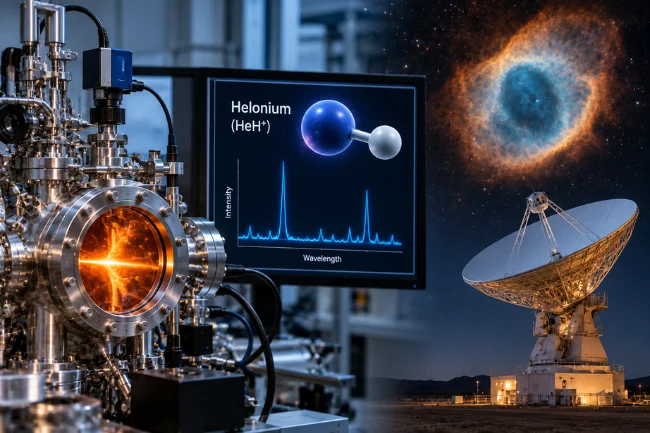
For decades, astronomers searched places where the ion might form. In 2019, a team led by Rolf Güsten reported an unambiguous detection in NGC 7027, a planetary nebula. Their published observation in Nature used SOFIA, an aircraft carrying a telescope, and the GREAT/upGREAT far-infrared spectrometer. Almost 94 years passed between the early laboratory evidence and that space detection.
This timeline is easy to garble. Helonium was not discovered for the first time in 2019; that was the first secure detection in interstellar space. Nor did the 1925 experiment reveal the young Universe. It provided laboratory evidence that the ion could exist.
What exactly did SOFIA measure?
Molecules can rotate at defined energy levels. When a molecule moves from one level to another, it can emit radiation at a characteristic frequency. For HeH⁺, the fundamental rotational transition lies near 2.010 terahertz, corresponding to a wavelength of about 149.1 micrometres. Think of the frequency as a spectral fingerprint, provided it is measured precisely enough to distinguish it from neighbouring signals.
Earth’s atmosphere absorbs much of this far-infrared radiation. SOFIA flew above much of the absorbing water vapour, giving its instrument a better view. The researchers also had to separate the expected HeH⁺ feature from nearby emission associated with CH, another astronomical molecule. A convincing identification depends on the match between a measured astronomical line and laboratory spectroscopy, not on an ordinary photograph showing individual ions.
SOFIA’s science flights ended in 2022. Its retirement does not undo the 2019 result; the published spectra and subsequent laboratory work can still be studied.
Why look in NGC 7027 rather than at the edge of the Universe?
NGC 7027 is a planetary nebula: an expanding envelope of gas from a star late in its life. Its energetic central star creates an ionization front where radiation, hydrogen, and helium can interact. That makes it a promising nearby place to find HeH⁺, even though the nebula is not a relic cloud from the Big Bang.
I think this is the most useful way to read the observation: NGC 7027 is a natural laboratory, not a time machine. Finding the ion there checks whether astronomers understand how it forms and disappears in real space. Researchers can then improve reaction networks used for other environments. They still have to account for the differences between a young planetary nebula and the early Universe.
| Claim | What the evidence establishes |
|---|---|
| HeH⁺ exists | Laboratory measurements have identified and studied the ion |
| HeH⁺ exists beyond Earth | Its spectral line was detected in NGC 7027 in 2019 |
| HeH⁺ formed in the early Universe | Physical models predict its formation under primordial conditions; no one observed that era’s individual ions |
| A newer laboratory result changes early-Universe estimates | Updated reaction measurements can revise models; the size of the effect depends on the full chemical network |
This separation between measured signals and modeled history is more useful than treating every headline about the “first molecule” as the same kind of proof.
What have more recent experiments changed?
Finding an ion is only part of the work. To estimate how much HeH⁺ might exist in a gas cloud, researchers need to know both how quickly it forms and how quickly other particles destroy it. An uncertain reaction rate can change a model’s answer even when the existence of the ion is beyond doubt.
The 2025 low-temperature reaction result
In a 2025 Astronomy & Astrophysics study, researchers investigated HeH⁺ colliding with deuterium atoms. Deuterium is an isotope of hydrogen with an extra neutron. They studied the reaction HeH⁺ + D → HD⁺ + He at low collision energies and found it could proceed quickly without the energy barrier assumed in some earlier calculations. The authors argued that a problem with a previously used reaction model had led to underestimated rates.
This is a good place to resist an oversimplified headline. The experiment directly tested deuterium atoms, not every possible hydrogen collision in every cosmic setting. Combined with theoretical work, it suggests that some estimates of primordial HeH⁺ abundance need reassessment. The result does not erase HeH⁺ from the early-Universe story or establish one universal new abundance on its own.
The 2026 frequency measurement
A 2026 spectroscopy study revisited the fundamental rotational transition using ions in a cold laboratory trap. It reported a frequency of 2010.183312(8) gigahertz, improving the accuracy and precision of an earlier measurement by roughly an order of magnitude. The digits in parentheses express uncertainty in the last quoted digits: here, about 0.000008 gigahertz, or 8 kilohertz.
Why should a reader care about such a small adjustment? When astronomers scan crowded spectra, a more exact laboratory frequency sharpens the target. It helps them identify an existing line and plan searches for the same ion elsewhere. It does not mean scientists discovered a new element or reversed the 2019 detection.
Does helonium have a practical use?
There is no established everyday product made from HeH⁺. Its value lies in research. Chemists use it to test ideas about ion reactions, low-temperature collisions, and the behaviour of a proton attached to an otherwise unreactive atom. Spectroscopists measure its transitions so that astronomers know what to look for in distant gas.
It is useful for checking how scientific knowledge comes together, too. The laboratory can identify a particle and measure its frequencies; a telescope can identify its signal in a particular place; a model can ask what similar reactions would do under earlier conditions. Each answers a different question. Keeping those answers separate makes the science clearer, especially when a striking nickname invites exaggerated claims.
What should you remember about Helonium?
Helonium is the real, positively charged helium hydride ion HeH⁺. Its link to the first molecular chemistry comes from models of the cooling early Universe. Its detection in the younger nebula NGC 7027 came from a distinctive spectral line measured in 2019. Modern experiments continue to refine the rates and frequencies needed to understand it.
If you want to check a new claim, start with two questions: is it describing a laboratory measurement, an astronomical observation, or a model? And does “first molecule” mean an expected early bond rather than a surviving primordial specimen? Those questions will take you further than the nickname alone.
Frequently asked questions
What is the chemical formula for helonium?
It is usually written HeH⁺; HHe⁺ refers to the same positively charged helium hydride ion.
Is helonium element 119?
No. It is a molecular ion containing helium and hydrogen, not a separate element with an atomic number.
Why is HeH⁺ called the first molecule?
Models place its formation among the earliest molecular bonds after the Universe cooled enough for neutral helium to meet hydrogen protons.
Where was helonium found in space?
Astronomers detected HeH⁺ in the planetary nebula NGC 7027 using SOFIA; the discovery was published in 2019.
Can scientists make helonium on Earth?
Yes. Laboratories can produce and measure HeH⁺ ions, although it is not an everyday substance stored in a bottle.

Noah Sterling is a technology research writer with 8+ years of experience covering emerging technologies, software trends, digital tools, and innovation. He creates practical, research-based articles to help readers understand the evolving technology landscape.