Fappelo is the name used by Fappelo.net, a general-interest website that publishes articles on technology, business, health, travel, lifestyle, food, and other subjects. Its homepage describes it as a creative hub, but the feature a visitor can readily use is an article directory: choose a category, open a post, and read it in a browser. The site also has an About page that promotes content-creation services. Those descriptions tell us how the website presents itself; they do not, by themselves, establish that it operates a social network or an official mobile app.
I reviewed the homepage, category pages, individual posts, the About and Contact pages, and the linked News area in September 2026. The name turns up in different contexts, so the most useful question is often more specific than “What is Fappelo?” It is: “Which Fappelo address am I looking at, and what can I actually do there?”
Fappelo at a glance
| Question | What I could establish from the public pages |
|---|---|
| Main website examined | Fappelo.net |
| What visitors can use | Publicly viewable articles, categories, and site search |
| Topics shown | Tech, General, Health, Business, Travel, Lifestyle, Fashion, Game, Food, and Education, plus a linked News area |
| Social networking tools | I did not find a visible member feed or a profile-based social network on the pages reviewed |
| Official app | I could not verify one from the website’s public navigation |
| Price to read | The articles I checked opened without a subscription prompt |
| Owner | No named legal owner was established by the pages reviewed |
These are observations, not promises about every page or future version of the site. If you are considering a payment, an account, or a download, check the exact page you plan to use rather than relying on a broad description of the brand.
What does Fappelo actually do?
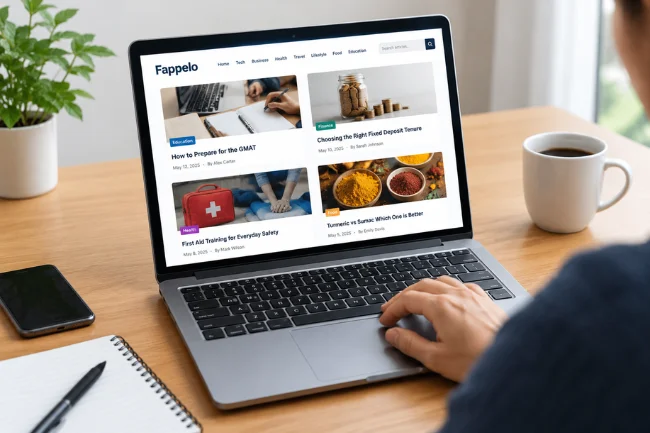
As a reader, you can browse the main homepage, follow the navigation to a subject area, and open individual articles. There is a search field, and posts show titles, dates, categories, and an author name. That is a familiar publishing layout, not evidence of a new type of app.
For example, the homepage I reviewed linked to an article about preparing for the GMAT, one about choosing a fixed-deposit tenure, a first-aid training article, and a piece comparing turmeric and sumac. The subject mix is unusually broad, which is why someone expecting a single-purpose platform may feel lost at first. The site is easier to understand if you treat each article on its own merits.
Browsing the main categories
The footer lists Tech, General, Health, Business, Travel, Lifestyle, Fashion, Game, Food, and Education. The top navigation highlights a smaller set. That difference means the footer can reveal topics you missed at the top.
Category names are labels, not guarantees of editorial specialization. During my review, the Tech page included a GMAT preparation article alongside pieces on temporary phone numbers, industrial equipment, cloud migration, and mobile devices. If you need dependable advice on an exam, a medical issue, or a financial decision, check the author, evidence, date, and relevant primary sources on the individual post.
The linked News section looks different
There is a detail that a quick description of Fappelo can miss: the main site’s navigation links to a /news/ area that uses a different-looking layout. When I checked it, that section listed more recent posts and displayed different bylines. Its visible menu included Business, Education, Fashion, Lifestyle, Sports, and Technology.
That does not prove it is operated by another company; it is a linked section under the same domain. It does mean readers should avoid describing the entire domain as though it has one uniform menu, one author, or one publication schedule. A post on the main homepage and a post inside /news/ may have different presentation and context.
Is Fappelo a content-creation business too?
Its About page describes blog writing, social media content, video, infographics, e-books, website copy, SEO, and content distribution as services. That is more than the homepage’s short “creative hub” description. Someone researching the company for a possible project could reasonably come away with a second question: is this an active agency, an editorial site, or both?
I can confirm that the services are advertised on the site’s own page. I cannot confirm completed client work, staff credentials, prices, or a formal business identity from that promotional text alone. If you want to buy a service, ask for a proposal that names the contracting party, deliverables, revision limits, fees, and ownership of finished work. A service description explains what is being offered; a written agreement explains what you would receive.
The Contact page provides an email address and links to messaging channels. That gives a route for questions, but a contact method is not the same as independently verified company information. I would ask for relevant samples and a clear invoice before sending a deposit or sharing sensitive business material.
Is Fappelo a social media platform or a mobile app?
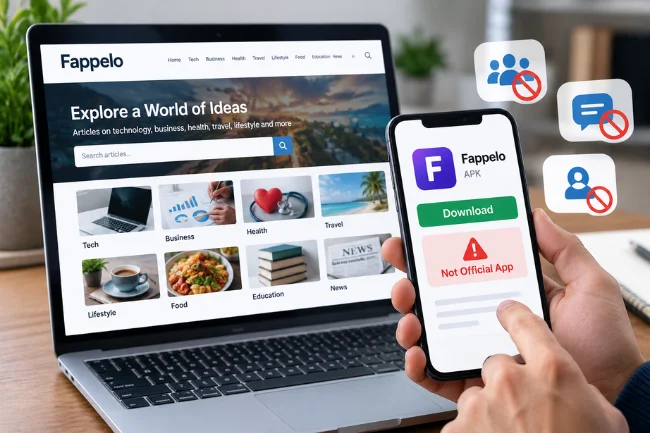
The homepage says visitors can “connect with creators.” I read that as promotional language until a working feature demonstrates what it means. On the public pages I reviewed, I could browse posts and categories, but I did not see an obvious member feed, profile discovery, direct messaging, or a creator dashboard comparable to a social platform.
There may be features elsewhere or changes after my review. Still, calling Fappelo a social network as a settled fact would go beyond what those public pages show. The more precise description is a publishing website that also talks about creators and content services.
The same distinction applies to apps. I did not find a verified official app link in the site’s public navigation. That is not proof that no app exists anywhere. It means a search result labeled “Fappelo APK” should not be treated as an authorized download simply because it uses the name. I would want the website to identify the app and link to the exact developer listing before installing it.
If an unfamiliar page prompts you to install an Android package from outside an app store, stop and verify who distributes it. Google explains that Play Protect checks installed apps and can warn about harmful downloads, including some apps obtained outside Google Play. Those checks help, but they do not turn an unverified developer into the operator of Fappelo.net.
Why do search results for Fappelo seem inconsistent?
Part of the confusion comes from spelling. Fappelo, Fapello, and Fappello look similar in a search snippet or phone notification. They are different strings, and domains using them can have different owners, purposes, and content. A result for one spelling is not automatically a result for another.
Another part comes from the website itself. A reader sees a broad magazine-style homepage, an About page selling content services, and a linked News section with its own appearance. Those are observations from the public pages, but they answer different questions. “What can I read?” and “What services does the site claim to sell?” do not have the same answer.
How to separate similar names
| What you see | What you can conclude | What still needs checking |
|---|---|---|
fappelo.net | This is the domain examined in this article | The specific page, its author, and any transaction terms |
fappelo.net/news/ | A linked area beneath the same domain | The context and quality of the individual News post |
A domain spelled fapello or fappello | It is a different web address | Its operator and whether any relationship exists |
| An APK or app-store result containing “Fappelo” | Someone used that name in a listing | Developer identity and an official link from the website |
Is Fappelo safe to browse?
No honest review can guarantee that an entire changing website is safe for every visitor and every action. Reading a publicly accessible page is a different decision from creating an account, submitting payment details, downloading software, or hiring a company. Each involves a different level of trust.
The site’s public pages opened for me in a browser. A third-party ScamAdviser report for Fappelo.net lists a valid SSL certificate and describes the domain as likely safe, while also noting cautionary signals. I would treat that assessment as one automated data point, not a verdict on every article, link, or commercial offer. ScamAdviser’s page also warns when its analysis has not been refreshed recently.
The padlock in a browser tells you about an encrypted connection, not whether the person receiving your information is trustworthy. The US Federal Trade Commission makes the same distinction: scammers can encrypt their websites too. That is why I look at the exact domain, the request being made, and the supporting evidence before entering information.
A practical check before you interact
First, read the complete address. A single added letter, a different ending, or an unexpected subdomain changes where you are. Open the site by typing the address you intend to visit if a message or advertisement seems ambiguous.
Next, ask what the page wants from you. An ordinary article should not need your card number or a software installation to display a paragraph. A business enquiry may require contact details, but you can still limit what you send until you have agreed on terms.
Then examine the claim you came for. If a health article gives treatment advice, compare it with a qualified clinical source. If a finance article makes a prediction, inspect the numbers and date. If a post recommends a service, look for disclosure of commercial relationships and independently check the provider. Broad topical coverage makes this article-level check especially useful.
Finally, be cautious with outbound links. A link from a publishing site can lead to a separate company with different privacy and payment practices. Confirm the new address after clicking; the original site’s apparent legitimacy does not carry over to the destination.
Who owns Fappelo, and when was the domain registered?
The public pages I reviewed do not clearly name a legal company or individual owner for Fappelo.net. Its About page speaks in a collective business voice, while the main article pages display a byline called Mason. A byline, a contact email, and a promotional “we” cannot by themselves establish who controls the domain or who would be responsible for a purchase.
ScamAdviser reports a registration date of October 22, 2024, and says the domain’s registration contact details are hidden. That is useful background, but domain registration is not a certificate of business legitimacy. Nor does a hidden registrant automatically imply misconduct: ICANN says personal registration details may be redacted for privacy.
If ownership matters to you, use ICANN’s registration-data lookup to inspect the publicly available record, and ask the site directly for its registered business details. For a paid project, compare the name on the proposal, invoice, payment request, and any legal terms. If those names do not line up, get an explanation before paying.
Is Fappelo free, and do you need an account?
The articles and category pages I opened were available without a payment screen or sign-in. That supports a narrow answer: you can read the public material I checked without subscribing. It does not prove that every future page, advertised service, or third-party destination will be free.
I did not need a reader account for ordinary browsing. I also did not see evidence on those pages that joining a community is the central experience. If you encounter a registration form, pause to identify its purpose: newsletter, comments, a paid service, or something else. Read the terms for that specific form before reusing a password or supplying personal details.
How I would judge the articles themselves
The strongest way to evaluate a broad publisher is article by article. I begin with the headline and date, then check whether the piece answers its stated question. Next I look for an identifiable writer, a clear explanation of how key claims were established, and links to sources I can inspect.
On Fappelo.net, the category labels sometimes encompass surprising subjects. I found GMAT advice under Tech. That does not, by itself, make the article wrong; it tells me the label is a loose sorting tool rather than evidence of specialist review. I would judge the GMAT claims using appropriate exam sources, just as I would judge a first-aid piece against current training guidance.
What remains unverified?
I could verify the visible site layout, category links, sample posts, Contact page, and the claims made on its About page. I could not establish a named legal owner, independently confirm the advertised team’s client history, or verify an official mobile app from those pages. I also did not test a purchase, submit a service enquiry, create an account, or audit the technical security of the website.
Frequently asked questions
What is Fappelo used for?
Fappelo.net mainly lets visitors find and read articles across several subjects. Its About page also advertises content-creation services.
Is Fappelo a social media site?
I found a public publishing website, not a visible profile-based social network. The site’s reference to creators does not establish social features on its own.
Is there an official Fappelo app?
I could not verify an official app from the website’s public links. Check the operator and developer before installing any app or APK using that name.
Is Fappelo.net free to use?
The articles I reviewed opened without a subscription. Any proposed content-creation service or other paid offer should be evaluated separately.
Are Fappelo and Fapello the same?
They are different spellings. Do not assume that websites or apps using those names share an owner without direct, verifiable evidence.
Final word
Fappelo.net is easiest to understand as a broad article website with a separate claim on its About page to offer content services. Browse the subjects that interest you, but check each article’s sources and date, and verify the full domain before sharing information or downloading anything. If you are considering a paid service, request the business details and terms first.

Noah Sterling is a technology research writer with 8+ years of experience covering emerging technologies, software trends, digital tools, and innovation. He creates practical, research-based articles to help readers understand the evolving technology landscape.