Crackstube most commonly points to Crackstube.com, a multi-topic digital publication that hosts articles on technology, business, finance, education, health, lifestyle, travel, home improvement, law, and real estate. The site also invites guest contributions and says it sells editorial placements. It is an article website, based on the pages I reviewed, rather than a place I would describe as a software download or video streaming service. The name can still cause confusion: a search result, social post, or similar-looking domain may refer to something else. If you want to know whether a particular page is useful or trustworthy, start with its full web address and the content on that page.
I reviewed the publisher’s About page, contributor guidelines, contact page, and terms for this article on September 27, 2026. Those pages provide a firmer basis than guessing what a website does from its name. They also show the difference between what a publisher says about itself and what a reader can independently confirm.
What does Crackstube.com actually offer?
The site describes itself as an independent digital publication. Its navigation points to categories including technology, finance, business, education, health, lifestyle, travel, home improvement, law, and real estate. That range makes it more like a general-interest magazine than a specialist technology resource.
For readers, the basic product is articles. Judge each one on its own: look for a clear author, supporting sources, an update date when timeliness matters, and an explanation you can follow.
For writers and marketers, there is another side to the site. Crackstube’s contributor guidelines invite submissions and explicitly describe a paid guest-posting model. The site says it reviews submissions before publication. Its terms say the publisher may edit or reject material and that posting does not guarantee rankings or traffic. These are the site’s stated policies, not my endorsement of the quality of every published article or placement.
| If you came looking for… | What the reviewed pages show | Your next check |
|---|---|---|
| Articles on everyday subjects | A publication with multiple topic categories | Open recent posts in your subject area and inspect their sources |
| A guest-post opportunity | Contributor guidelines and a stated paid placement model | Read the current terms and request the full price and link treatment in writing |
| Software cracks or video streams | The reviewed pages describe publishing services | Verify the exact URL; a similar name does not establish affiliation |
| Proof that a site is safe | About, contact, guidelines, and policy pages exist | Assess the specific page, its links, and any requests it makes of you |
Why does the name cause so much confusion?
“Crack” can suggest modified software, while “tube” often evokes video. That association is easy to understand, but a name is a poor substitute for looking at a site. The publisher’s own About page says the Crackstube name represents curiosity and knowledge. That is a statement about its branding, not a linguistic fact that resolves every search result.
The spelling adds another wrinkle. “CracksTube,” with a capital T, and “Crackstube” use the same letters; capitalization does not change the domain crackstube.com. Add a different ending, an extra word, or a misspelling, however, and you may be dealing with another website entirely.
When I research an unfamiliar site, I separate the search term, the domain opened, and the individual page. Search snippets can blur those distinctions; the address bar shows the destination reached.
A quick example of the distinction
Suppose someone sends you a message that says, “Read this on Crackstube.” If the link opens a category article at crackstube.com, you can evaluate it as a published article. If it opens a different domain asking you to install an APK or browser extension, that is a separate decision with a different risk profile. I would not transfer trust, ownership claims, or safety conclusions from one address to the other.
Nor would I infer that every page on one domain is equally well researched. A technology post, a health article, and a paid contribution require different checks.
What I checked on the site—and what that proves
I could access the site’s About, contact, terms, and guest-post guidelines pages during this review. The navigation displayed its subject categories. The guidelines gave concrete submission requirements, and the terms described its commercial arrangement. That is useful first-hand observation of the pages available at the time I checked them.
It has limits. I did not audit ownership, verify the editorial process, test every outbound link, buy a placement, or scan files from similarly named domains. A contact address allows an inquiry; it does not establish ownership of other sites. An editorial policy states a standard; published work shows how well the site follows it.
If you are reading a specific Crackstube article, I suggest checking whether it links to primary evidence. A finance article needs more than confident wording; a health article should give you sound sourcing and appropriate limits; a time-sensitive technology article should show when its facts were checked. Broad category coverage is convenient, but it raises the importance of judging each article separately.
Is Crackstube safe to visit?
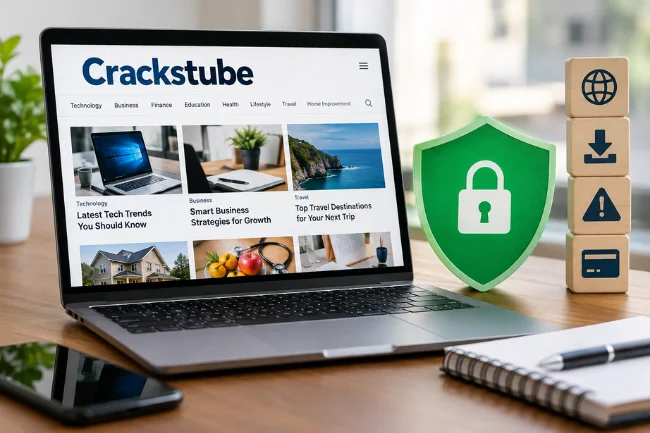
There is no meaningful single safety rating for a keyword. For the domain I reviewed, the pages I inspected presented articles and publishing information. That observation does not amount to a security certification, nor does it cover unrelated lookalike sites or every link inside an article.
Pay attention to what a page asks you to do. Reading a public article is different from downloading a program, granting browser notifications, entering payment details, or uploading a document. The more access or information a site requests, the more carefully I would check who is requesting it and why.
The Federal Trade Commission advises people to download software only from websites they know and trust, because free downloads can conceal malware. If a page that appeared to promise an article suddenly pushes an installer, that mismatch is enough reason to stop. A padlock or HTTPS connection protects data in transit; it does not certify a publisher’s accuracy or make an unknown download safe.
Signs that deserve a pause
- A button says “read article,” but the click starts an executable or APK download.
- A page asks you to disable browser protection or install an extension before you can continue.
- A pop-up claims your device is infected and demands immediate payment or a call.
- The address changes to a domain you did not expect before you submit details.
- A publisher asks for a fee without explaining what will be published, when, and on what terms.
Those signs are reasons to halt the interaction. If you downloaded a suspicious file, do not run it; use trusted security software. If you entered a password, change it through the genuine service and review account activity. The FTC recommends using a trusted device after a suspected infection.
Is Crackstube legal?
Asking whether a name is legal skips the key detail: which website and which activity? Publishing informational articles and selling space for contributed content are different from distributing copyrighted material without authorization. The pages I reviewed describe the former. I found no basis in those pages to label Crackstube.com an illegal software repository or streaming service.
That does not make every claim on the site correct, every commercial practice worthwhile, or every external link safe. If you encounter a separate site advertising unauthorized copies of software, movies, or television, assess that site on its own facts. Laws and exceptions differ by country. For context, the U.S. Copyright Office explains that downloading copyrighted files without the rights holder’s authority can create infringement risk under U.S. law.
I would also avoid turning a copyright question into a blanket warning about ordinary open-source software. Free and lawful software exists. The useful distinction is whether the distributor has permission and whether the download comes from an authentic, trusted source.
How Crackstube guest posting works
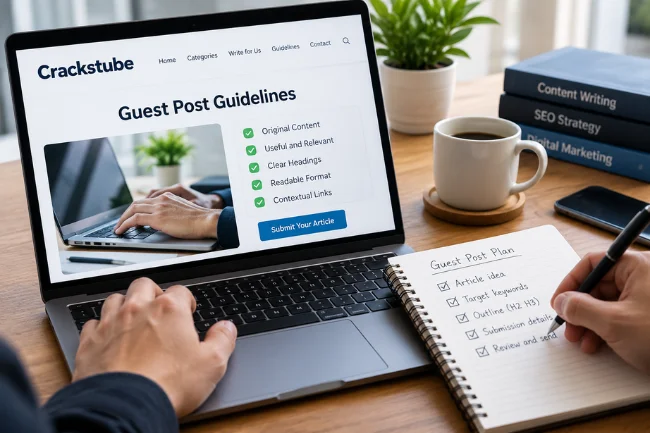
This is where a closer look reveals information a generic site description can miss. Crackstube’s guest-post guidelines say submissions must be original, useful, relevant, and written in natural English. They specify a minimum of 500 words and recommend 1,000–1,500 words; longer articles are acceptable when they add value.
The guidelines ask for clear H2 and H3 headings, short readable paragraphs, and restrained contextual links. The requested submission includes a final article, suggested title, category, and any proposed target URLs or anchor text. The publisher says it reviews content and can request changes or decline it. Those are its published rules; acceptance of a draft is not something I can promise.
The commercial part deserves careful reading. The guidelines call it a paid guest-posting model but do not publish a fixed price or turnaround time on that page. They say those details can be shared during submission. The terms and conditions say payments become non-refundable after content approval or publication, that removal requests are not guaranteed, and that the site makes no promise of traffic, rankings, or SEO outcomes.
Before paying, I would ask for written answers to a few specific questions. What is the total price? Is it a new article or a change to an existing one? Which URL will host it? Can the publisher edit your wording or links? How are paid links labeled? When does the refund window close? Can you request corrections later? A clear reply is more valuable than a vague promise of “high authority.”
Paid links and realistic SEO expectations
Buying publication space does not buy a Google ranking. Google’s outbound-link guidance says paid placements should be marked with rel="sponsored"; nofollow is also acceptable. Its spam policies address links placed primarily to manipulate rankings, including certain paid guest posts with optimized anchors.
This is a practical reason to evaluate a guest post by its readership and editorial fit. Would people in your field actually benefit from the article? Does the publisher label the commercial arrangement appropriately? A placement can have communication value even when you cannot count on ranking gains. If somebody guarantees a particular SEO result from one post, I would ask what evidence supports that promise.
| Question to ask before paying | Why the answer matters |
|---|---|
| Where will my article appear? | The category and surrounding content affect whether the intended audience sees it |
| What is the full price and approval point? | The terms tie refunds to approval or publication |
| Will the post be disclosed as paid? | Readers should understand the relationship, and paid links need appropriate qualification |
| What edits and links can change? | The terms reserve editorial control and do not guarantee removal requests |
| What happens if the page is removed or revised? | A placement’s long-term availability and wording affect its value |
How I would verify a Crackstube-related link
Start in the address bar. Read the whole domain before the first single slash after its extension. On www.crackstube.com/category/technology/, the site is crackstube.com; the words after it identify a path within that site. On crackstube.example.com, by contrast, the registered domain would be example.com. Similar lettering near the beginning of an address can be misleading.
Next, check how you arrived. A direct link from the publication’s own navigation gives you more context than a forwarded message with a shortened URL. If a link redirects, look again at the destination before entering credentials, downloading anything, or paying.
Then inspect the page that matters to your decision. For a reader, that means the article’s evidence and author information. For a contributor, it means the latest guidelines, terms, price quotation, and editorial correspondence. For a download, it means verifying the developer and distribution source independently. The right checks depend on what you plan to do.
You can use ICANN’s lookup service to examine available registration details, but do not treat hidden registrant data as proof of misconduct. ICANN explains that some data may be withheld or redacted for privacy. Registration details are one clue, not a substitute for examining the site’s behavior.
Finally, keep a record of any commercial agreement. Save the current terms, the price, the promised publication scope, and the final approved draft before you submit payment. Policies can change, and a written record makes it easier to resolve a disagreement about what was offered.
Who is this site useful for?
If you simply want to read about a topic, Crackstube.com gives you a broad selection. I would treat it as a starting point, then follow strong claims to their original sources. That is especially sensible for medical, financial, or legal topics, where a clear explanation may still omit details relevant to your circumstances.
If you are a writer, the contributor guidelines tell you the expected length and format before you pitch. If you are a business considering a paid post, the published terms tell you which questions to settle first. If you were looking for cracked software or streaming links, the publisher pages I reviewed are not evidence that this is such a service. Search for an authorized source of the specific product or content you need instead.
These are distinct intentions under one keyword. The precise domain and the action you intend to take will get you closer to a useful answer.
Frequently asked questions
What is Crackstube?
Crackstube.com presents itself as a multi-category article publisher with guest-posting opportunities. Check the full address if a search result points elsewhere.
Is Crackstube.com a software-crack or streaming website?
The publisher pages I reviewed describe articles and paid contributions, not a software or video service. That finding does not describe other domains with similar names.
Can I publish a guest post on Crackstube?
Its guidelines invite original submissions and describe a paid placement model. Ask for the current price, timeline, and terms before submitting or paying.
Is it safe to click a Crackstube link?
Check the destination and what the page requests. Reading an article, installing software, and entering payment information carry different risks.
Does a paid Crackstube post guarantee SEO results?
No. The site’s terms explicitly decline to guarantee rankings or traffic, and Google says paid links should be properly qualified.
The practical takeaway
Crackstube.com is best understood through what its own pages actually show: a broad digital publication that also offers paid guest posting. The useful next step depends on why you searched for it. Open the exact domain, check the particular article or offer, and read the current terms before you share information or spend money. A few minutes of precise checking will tell you more than the name alone ever could.

Noah Sterling is a technology research writer with 8+ years of experience covering emerging technologies, software trends, digital tools, and innovation. He creates practical, research-based articles to help readers understand the evolving technology landscape.