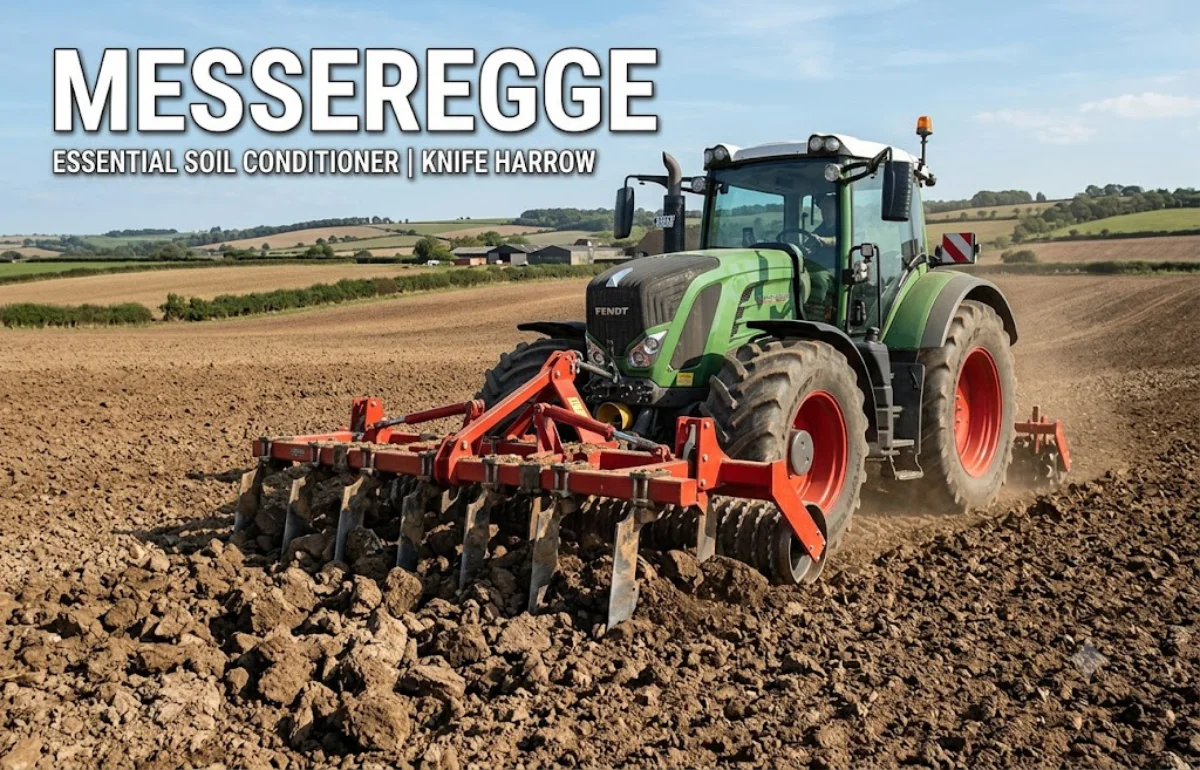
Messeregge is a German agricultural term for a blade-equipped harrow or scarifying attachment used in soil preparation. In practical terms, it uses rows of knife-like steel elements to break larger clods, level the field surface, and condition soil before or alongside rolling. It is commonly mounted at the front of a tractor or fitted as a leading tool on a front packer rather than used as a kitchen utensil, regional dish, app, or abstract business concept. German-English dictionary evidence classifies the word under agriculture and translates it as “scarifier,” while machinery manufacturers document it as a real, adjustable field implement.
When I first researched Messeregge, I found an unusual amount of conflicting content online. Some pages treated it as food, others as a digital platform, and still others as a design term.
The reliable trail was much clearer: agricultural dictionaries, operating manuals, product catalogues, parts lists, and equipment photographs all point to soil-working machinery.
Messeregge at a Glance
| Feature | Practical meaning |
|---|---|
| Main category | Agricultural soil-preparation equipment |
| Literal word structure | Messer, meaning knife or blade, plus Egge, meaning harrow |
| Common English rendering | Scarifier, knife harrow, or blade harrow |
| Typical position | Front-mounted or installed ahead of a front-packer roller |
| Main job | Breaking clods, leveling the surface, and preparing a more even seedbed |
| Working elements | Steel knives mounted across a carrying frame |
| Key adjustments | Working angle, height, or depth, depending on the model |
What Does the Word Messeregge Mean?
Messeregge is a compound German noun. Messer means “knife” or “blade,” while Egge refers to a harrow, the implement used to work the upper soil layer.
Together, the words describe a harrow that relies on blade-like elements instead of the long spring tines or rotating discs found on other equipment.
Langenscheidt lists Messeregge as a feminine agricultural noun and gives “scarifier” as its English translation. That is accurate but broad.
In an equipment discussion, “knife harrow” or “blade harrow” often communicates the construction more clearly to an English-speaking reader.
I use the agricultural definition because it is supported by primary documentation. Kerner’s front-packer brochure labels a Messeregge as an adjustable leading tool, shows its blade arrangement, and presents it alongside a spring-tine harrow as an alternative attachment.
Fliegl also markets front-mounted units for breaking larger soil clods.
How a Messeregge Works
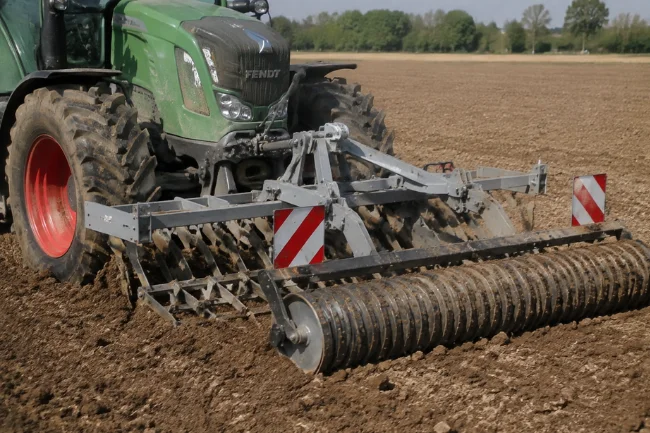
A Messeregge commonly works ahead of a roller or front packer. As the tractor moves, the blades meet raised clods and uneven surface material.
Their cutting and planing action reduces larger lumps and spreads soil more evenly across the working width.
The roller behind it then presses, crumbles, or reconsolidates the prepared surface. The attachment is therefore not always a complete tillage system by itself.
Much of its value comes from combining an initial cutting or leveling action with a following rolling action in one coordinated pass. Kerner describes this combination as joining the leveling and crushing effect of a pulled tool with the depth guidance and reconsolidation of a rolling tool.
Main Components
A typical unit has a carrying frame, mounting points, steel blades, and a mechanism for altering height, depth, or working angle. Its broad lattice can look quite different from a conventional tooth harrow.
On Kerner systems, the front packer can accept either a knife harrow or a spring-tine harrow. Threaded spindles adjust height, while the brochure also documents hardened steel knives and an adjustable working angle.
Exact construction varies by model and manufacturer.
A Surface-Conditioning Tool
A Messeregge is mainly intended for controlled work near the prepared surface. It is not a substitute for a plough when deep soil inversion is required, nor does it behave like an aggressive powered cultivator.
Its role is to attack clods, correct minor unevenness, and present the following roller with a more uniform layer.
This makes the tool relevant to reduced-intensity and non-inverting soil management. Germany’s LTZ Augustenberg explains that conservation tillage uses non-inverting implements to leave much of the soil structure intact and retain crop residues near the surface.
A Messeregge can form part of such a system, although the result depends on the full machinery combination and field conditions.
What Is a Messeregge Used For?
Breaking Larger Soil Clods
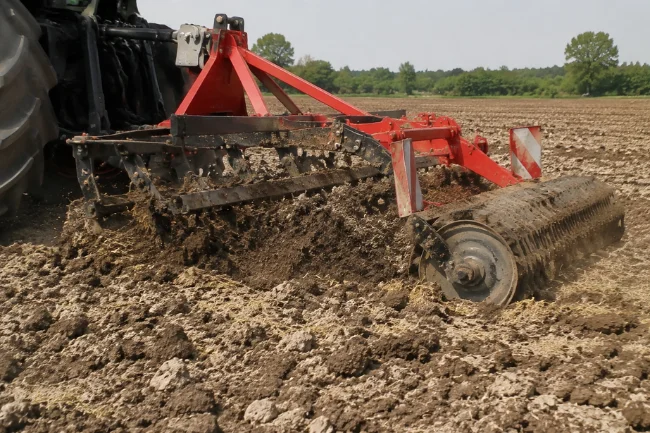
The clearest documented use is clod reduction. Fliegl describes its front-mounted Messeregge as a tool for breaking larger clods, while Kerner emphasizes crumbling and leveling before the rolling stage.
This is useful when an earlier operation leaves an irregular surface. The front tool begins breaking and spreading the material instead of asking the rear implement to handle every large lump alone.
Supporting an Even Seedbed
Large voids, hard clods, and abrupt surface changes can make seed-depth control less predictable. By reducing those irregularities, the attachment can help the following roller or seedbed implement leave a more consistent finish.
I would call this seedbed support rather than a promise of improved emergence. Moisture, soil texture, timing, compaction, drill setup, and seed quality still matter.
Combining Field Operations
A front-mounted attachment can work while another implement operates behind the tractor. A correctly matched combination may level, reduce clods, reconsolidate, and complete a rear operation during the same journey.
That can reduce the need for separate passes, but savings depend on tractor power, ballast, wheel slip, fuel use, field shape, and the rear implement. The name of the attachment alone does not guarantee efficiency.
When Another Tool May Be Better
A Messeregge may be a poor choice when soil is wet and plastic, heavy residue repeatedly catches in the frame, or deep compaction requires subsoiling. Very dry, rock-hard clods may also require a different sequence or a more aggressive implement.
I recommend inspecting the worked layer rather than judging only from the cab. Check whether clods have fractured and whether the following roller has created a firm seedbed rather than an over-compacted crust.
Messeregge vs. Other Harrows and Cultivators
| Implement | Working element | Typical action | Main difference |
|---|---|---|---|
| Messeregge | Steel knives or blade sections | Cuts, levels, and breaks surface clods | Blade-led, planing action |
| Spring-tine harrow | Flexible curved tines | Scratches, vibrates, mixes, and levels | More flexible combing action |
| Disc harrow | Angled rotating discs | Cuts and mixes soil and residue | Usually creates more mixing |
| Power harrow | PTO-driven rotating tines | Intensively crumbles and prepares soil | Powered and generally more intensive |
| Roller or front packer | Rings, tyres, or bars | Reconsolidates, crushes, and controls depth | Rolls rather than leading with blades |
The closest alternative is often the spring-tine harrow because manufacturers may offer both as front-packer options. Kerner treats them as separate leading tools and lists different weights for each.
The choice depends on whether the field needs a firmer cutting and leveling effect or a more flexible tine action.
How to Choose the Right Messeregge
Match the Working Width and Machine
The attachment must match the front packer and the rest of the combination. An undersized tool can leave untreated strips, while an incompatible oversized unit can create mounting, balance, and transport problems.
Manufacturers supply model-specific widths, frames, and parts rather than one universal design. Current catalogues show that Messeregge assemblies are tied to particular machine sizes.
Confirm Tractor Compatibility
Front-mounted equipment changes axle loading, steering, visibility, and transport dimensions. Kerner’s manual tells operators to observe total weight, axle loads, tyre capacity, secure mounting, and front-axle loading requirements.
Before buying, I would request the installed weight, centre of gravity, mounting category, hydraulic needs, lighting package, and road-transport dimensions.
Look for Practical Adjustment
Height, depth, and angle influence how strongly the knives engage. Kerner specifies that its front packer should be level in the field and that adjustment spindles should have equal settings to maintain a uniform working depth.
Uneven adjustment can make one side cut hard while the other barely touches the soil.
Check Wear Parts and Dealer Support
Ask how the knives are attached, how quickly they can be changed, and whether replacements are available locally.
Kerner’s parts documents list dedicated Messeregge knives, frames, cylinders, and assemblies, showing that wear-part support is central to ownership.
Setup, Operation, and Safety
Always start with the manual for the exact model. On one documented Kerner configuration, the tractor hydraulics are placed in float during field use, the front packer is aligned level, and the adjustment spindles are checked for equal settings.
Another brand may require a different procedure.
Begin with a conservative setting and make a short test run. Stop safely, inspect the full working width, and adjust after seeing the result.
A deeper setting is not automatically better; it can increase draft, collect residue, or move more soil than intended.
Sharp knives, folding frames, hydraulics, and heavy mounted equipment create serious hazards. Lower and secure the implement, stop the engine, remove the key, and relieve pressure as directed before inspection.
The operating manual also calls for checks of bolts, warning equipment, and lighting.
Maintenance That Protects Performance
Inspect the knives for rounding, bending, cracks, and uneven wear. Compare blades across the full width because a machine may continue running while its finish gradually becomes inconsistent.
Check mounting bolts and frame fasteners at the stated intervals, lubricate specified points, and keep hydraulic connections clean.
Kerner calls for bolt checks and daily lubrication of applicable grease points during operation.
Clean the attachment before storage and support it securely on firm ground. Removing packed soil makes corrosion, damaged blades, and loose hardware easier to detect.
Why Is There So Much Confusion Online?
Messeregge is unfamiliar to most English speakers and has a relatively small search footprint. That has encouraged websites to assign it invented meanings, including a regional dish, digital platform, branding method, exhibition system, or knife-edge concept.
I found no authoritative culinary, software, or exhibition source that displaces the documented agricultural use.
By contrast, the farming definition appears in a major dictionary, manufacturer brochures, operating instructions, product listings, parts catalogues, and equipment photographs. The responsible approach is to treat agriculture as the established meaning and label any other use as a brand name, creative coinage, or unsupported claim unless evidence is provided.
The Practical Takeaway
Messeregge is a specialized agricultural attachment designed to cut, level, and break clods ahead of a roller or related soil-preparation system. Its strength is controlled surface conditioning rather than dramatic deep tillage.
Before buying or operating one, confirm the exact model, tractor and packer compatibility, adjustment method, transport requirements, and replacement-part support.
A sensible next step is to compare two configurations using the same working width, installed weight, blade cost, adjustment range, and dealer support—not merely the lowest purchase price.
Frequently Asked Questions
What is a Messeregge?
A Messeregge is a German blade harrow or scarifier used to break soil clods, level the surface, and support seedbed preparation.
Is Messeregge a traditional food?
No authoritative culinary source supports that claim. Documented dictionary and machinery sources identify it as agricultural equipment.
What is Messeregge called in English?
Langenscheidt translates it as “scarifier”; “knife harrow” and “blade harrow” are also clear descriptive translations.
How is it different from a spring-tine harrow?
A Messeregge uses knife-like blades, while a spring-tine harrow uses flexible tines that scratch, vibrate, and comb through soil.
Can a Messeregge fit any tractor?
No. Compatibility depends on working width, mounting system, front-axle capacity, weight, hydraulics, and the paired packer or implement.

Ethan Caldwell is a business research writer with 9+ years of experience covering entrepreneurship, market trends, business strategies, and industry insights. He focuses on creating clear, data-informed articles that help readers understand modern business concepts.