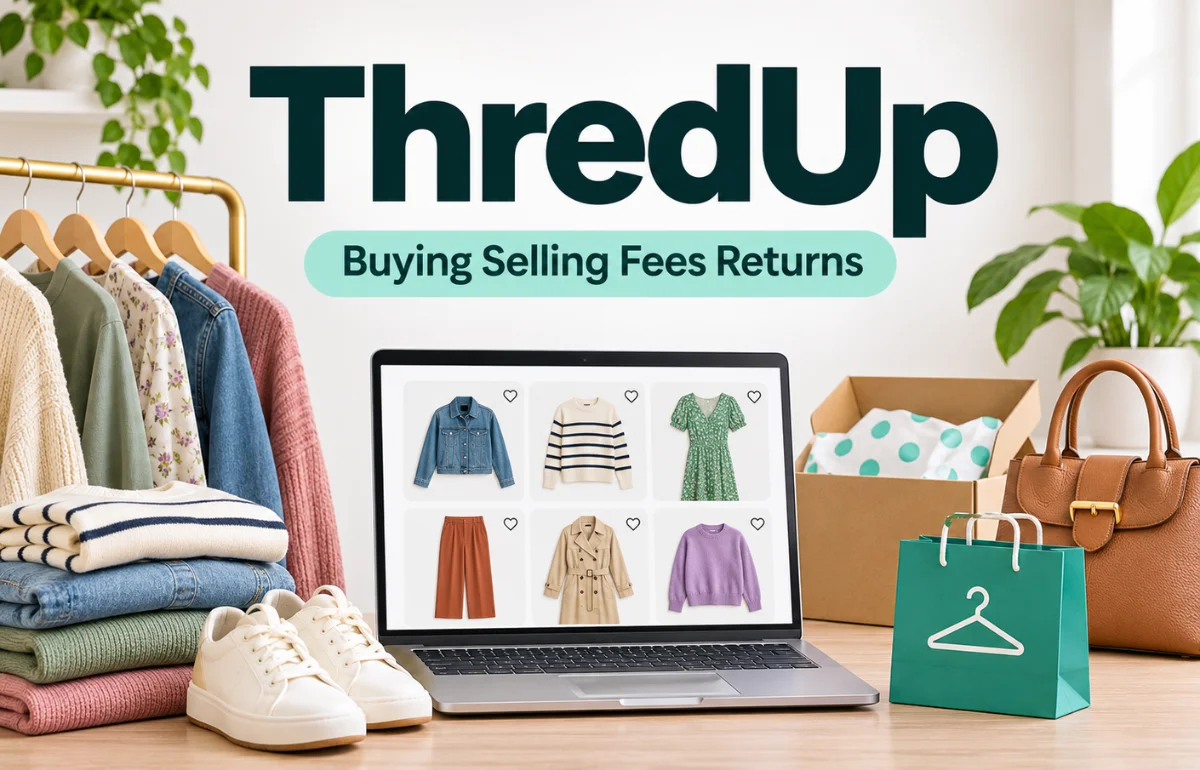
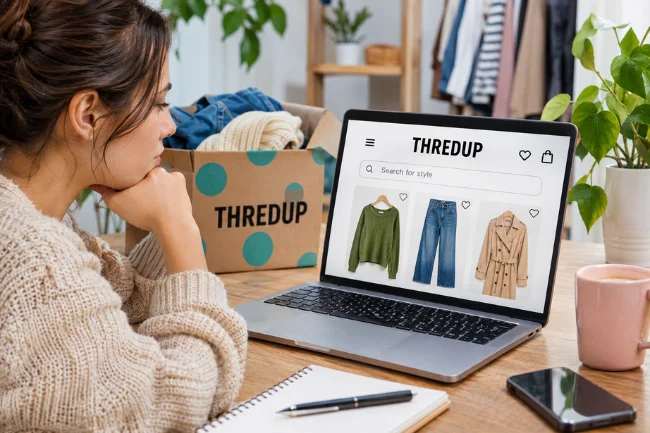
ThredUp is an online secondhand clothing marketplace where people can buy pre-owned fashion and sell eligible items from their closets. Its best-known selling option is a consignment-style Clean Out service: you send clothes to ThredUp, and the company handles inspection, photography, pricing, and listings. Shoppers can browse individual pieces from familiar brands, often at prices below comparable new clothing.
I think of ThredUp as a digital thrift store with a resale service attached. It makes finding used clothing and clearing a closet easier, but neither a perfect fit nor a seller payout is guaranteed. Here is what to expect from buying, fees, returns, and selling.
What Makes ThredUp Different From a Traditional Thrift Store?
A neighborhood thrift shop lets you examine clothes in person. ThredUp moves much of that experience online: shoppers search by brand, size, category, condition, and price rather than sorting through physical racks. You gain selection and convenience, but lose the ability to try on an item before paying.
Unlike a simple peer-to-peer resale listing, ThredUp’s traditional Clean Out service does most of the selling work for the owner. That distinction matters. The company earns a share of a sale, while the person who supplied the clothing receives an eligible payout after the applicable conditions are met.
Founded in 2009, ThredUp focuses particularly on women’s and kids’ fashion and accessories. Its newer Direct Selling beta lets participating sellers list and ship items themselves.
Is ThredUp Legit and Safe to Use?
Yes. ThredUp is an established, publicly traded resale company, not an anonymous classified-ad site. It operates a website and shopping app, publishes seller terms and help documentation, and provides order tracking and customer support. That makes the underlying business legitimate, although individual experiences with sizing, item condition, delivery, and payouts can still vary.
Legitimacy does not guarantee satisfaction. Before buying, I would check return eligibility; before selling, I would check realistic payouts and the rules for reclaiming unsold items.
How Buying Clothes on ThredUp Works
Find the Right Item Instead of Chasing the Biggest Discount
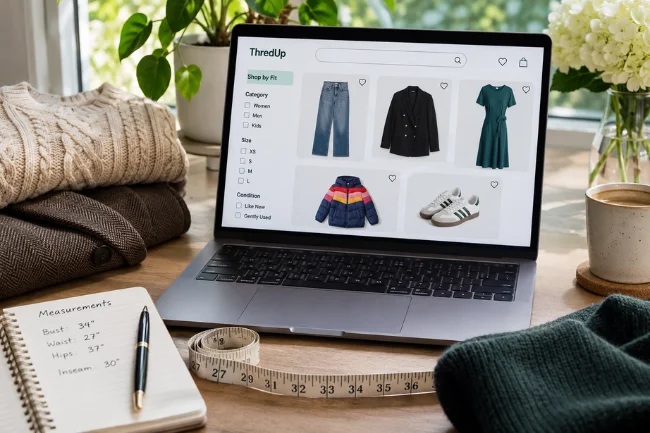
Shopping begins with a category or search: jeans, work dresses, children’s jackets, sneakers, or a specific label. Filters narrow the results. ThredUp has also introduced personalized discovery features and image-based searching, which can help when you know the look you want but not the exact product name.
Because many listings represent one individual secondhand item, inventory changes as pieces sell. I would start with a wardrobe gap rather than an attractive percentage-off banner. Searching for “black wool blazer in my measurements” is more useful than browsing hundreds of random bargains.
A practical trick is to save the measurements of three garments you already love: one top, one pair of trousers, and one dress or jacket. Those numbers create a personal reference when different brands use inconsistent size labels.
Inspect Condition, Fabric, and Measurements
A secondhand listing deserves more attention than a standard new-clothing product page. Look closely at every available photo, the condition description, material composition, size, and measurements. A brand’s medium may fit differently from another brand’s medium, especially after washing or previous wear.
Fabric affects value, too: a pilled cashmere sweater may require more care, while a fitted, non-stretch dress carries greater sizing risk than a relaxed cardigan.
“New with tags” does not guarantee a flawless item. ThredUp’s acceptance standards provide context, but photos and item details deserve a separate look.
Check the Total Price and Return Terms
The listed price is only one part of a purchase. Shipping, applicable taxes, and any extra marketplace charges can affect the final amount. ThredUp’s checkout guidance says a Direct Listing purchase may include a 7% buyer fee as well as shipping if the seller does not cover it.
For standard eligible returns, ThredUp generally requires an item to be postmarked within 14 days of delivery. Its published policy includes a $3.99 restocking fee per returned item, excludes original shipping refunds, and treats final-sale items as nonreturnable. Refund method and return-shipping arrangements also affect what you recover. Direct Listings can have different protections, so check the actual listing rather than assuming every item follows identical rules.
I use a simple rule: if fit is uncertain and the item is final sale, the price must be low enough that I can comfortably accept the risk. For expensive purchases, that rule saves more money than an occasional coupon.
How Selling on ThredUp Works
Choose the Right Selling Method
There is no single answer to “How much does ThredUp take?” because the platform offers different selling arrangements. Its managed Clean Out service prioritizes convenience; Direct Selling gives participating sellers more control and responsibility.
| Selling option | What you handle | What ThredUp handles | Main trade-off |
|---|---|---|---|
| Standard Clean Out | Select and send eligible items | Inspection, photos, pricing, listing, fulfillment | Less work, but limited price control and a service fee unless waived |
| Premium Clean Out | Select and send higher-value items | Priority processing and managed sales | More pricing flexibility and longer selling windows, but a higher service fee |
| Direct Selling (beta) | Create listings, set prices, store and ship sold items | Marketplace tools and transaction support | More control and currently no seller listing fee, but more hands-on effort |
ThredUp currently lists standard Clean Out service fees at $14.99 and Premium at $34.99, deducted from earnings rather than collected upfront; promotional waivers can change what a particular customer pays. Direct Selling’s beta terms currently describe no seller fee, though optional shipping, returns, or discount choices may reduce proceeds. Always confirm the terms displayed for your account before committing.
Decide What Belongs in a Clean Out Bag
For a managed Clean Out, ThredUp primarily accepts clean, good-condition women’s and kids’ clothing, shoes, bags, and eligible accessories. Its current rules exclude men’s clothing, most undergarments, sleepwear, altered garments, and several other categories. Children’s clothes need identifiable brand tags, and many items need size labels.
Some familiar lower-resale-value brands may be accepted for listing without qualifying for a payout unless the item reaches the platform’s stated sales threshold. Sending those pieces is better viewed as closet clearing than income generation. Check the current accepted-items guide before filling a box.
My preferred sorting system has three piles: likely resale winners, everyday pieces I mainly want gone, and items worth keeping or donating locally. A nearly unworn premium jacket belongs in the first pile. A worn-out shirt should not be sent just because the shipping label is convenient.
Understand How Seller Payouts Are Calculated
With Clean Out consignment, ThredUp sets an initial listing price using factors such as brand, quality, and past sales. Sellers receive a percentage of the final selling price, not the original retail price. Promotional discounts and later markdowns can reduce earnings; fees may also apply to the Clean Out as a whole.
The official earnings guide illustrates how dramatically percentages change with sale price. Its examples show a $20 sale producing $3 in gross seller earnings, while a $100 sale produces $60, before any relevant service fee. These are illustrations, not guaranteed prices for your clothes.
I would estimate a Clean Out by likely resale proceeds, not original purchase prices. For a valuable piece, compare the net estimate with the time required to sell it yourself.
Know How Long the Process Can Take
Managed consignment is not instant cash. ThredUp’s published expectations put Standard processing at roughly 21–28 days, followed by a 30–45-day consignment window. Premium processing is about 14 days, with a 60–90-day selling window. Earnings for ordinary returnable sales are released after the buyer’s return period; final-sale items follow a different schedule.
The company estimates an overall process of about 10–14 weeks for many Standard Clean Outs and 16–20 weeks for many Premium Clean Outs. Some items may sell and generate earnings earlier; others may never sell. These are estimates, not deadlines or promises.
Rejected and unsold items also deserve attention. Premium generally returns unlisted pieces by default, whereas Standard uses reuse or recycling partners for unlisted pieces. Accepted items that do not sell may be reclaimed during a specified window for a fee plus shipping. I would photograph valuable pieces and track those deadlines before sending anything I might regret losing.
What Does ThredUp Really Cost? A Better Way to Compare Deals
The most useful price is not the headline discount or initial payout. It is the net result after charges, uncertainty, and your time. This applies differently to shoppers and sellers, but the principle is the same.
| Decision | Tempting number | Better number to evaluate |
|---|---|---|
| Buying a thrifted jacket | Listing price or percentage off retail | Checkout total plus expected fit and return risk |
| Returning a purchase | Original amount paid | Refund after restocking and any return-shipping costs |
| Sending a Clean Out | Original retail prices of your clothes | Expected payouts minus applicable service and reclaim fees |
| Using Direct Selling | Asking price | Final proceeds after optional seller-covered costs and your time |
Here is a hypothetical shopping example. Suppose a used coat costs $32, shipping is $8, and tax adds $3. Your real checkout spend is $43, not $32. If you wear that coat twenty times, the purchase costs $2.15 per wear. If it sits untouched, even the most impressive markdown was a poor decision.
I call this the “three-price test”: check the displayed price, the all-in price, and the likely cost per wear. For selling, replace cost per wear with net payout per hour of effort. It is a simple decision framework, not an official ThredUp metric, but it helps compare options more fairly.
When Is ThredUp Worth It for Buyers?
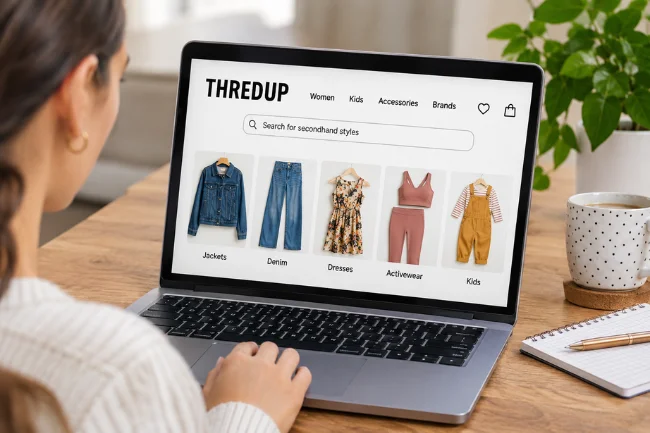
ThredUp can be especially useful when you already know which brands, silhouettes, and measurements work for you. Everyday jackets, denim, dresses, activewear, and kids’ clothes are natural categories to explore, provided the condition and total price make sense.
It may be less suitable when you need a precise outfit by tomorrow, require easy free returns, or have never tried the brand’s sizing. Unique inventory makes exact replacement difficult. If a purchase has to fit perfectly for an important event, an in-person store with a changing room may be the safer choice.
When Is Selling on ThredUp Worth It?
The managed service makes sense for someone who values convenience more than squeezing the highest possible price from each item. Packing one box is less work than taking individual photos, answering buyer messages, negotiating, and shipping separate orders.
But convenience has a price. Lower-value items may produce minimal earnings, and an unsold piece may need to be reclaimed within a narrow period. If you have a sought-after designer item, a direct marketplace sale may be worth the extra work, especially if you know its resale demand and can confidently describe its condition.
I would treat Clean Out proceeds as recovered value, not reliable income.
Is ThredUp Better for the Environment?
Extending the useful life of clothing can reduce the demand for newly manufactured items, which is the strongest environmental argument for secondhand shopping. It also creates another potential destination for garments that would otherwise remain unworn.
Still, “used” is not automatically synonymous with “zero impact.” Shipping, processing, packaging, returns, and the eventual fate of unsold clothing all matter. Buying extra garments because resale feels guilt-free can cancel out some of the intended benefit.
According to ThredUp’s 2026 Resale Report, prepared with GlobalData, the global secondhand apparel market is projected to reach $393 billion by 2030. That is an industry forecast, not proof that every resale transaction saves a specific amount of carbon or water. I would judge sustainability by whether a purchase replaces a new one and gets regular use.
ThredUp vs. Poshmark, Depop, and Local Thrift Stores
Compared with self-listing on Poshmark or Depop, ThredUp Clean Out generally saves seller time but limits control. Its Direct Selling beta is closer to those marketplaces: participating sellers set prices and ship orders. Local thrift shops, meanwhile, let buyers inspect clothes in person. I would choose based on effort, control, and fit risk rather than platform popularity.
Five Mistakes I Would Avoid Before Using ThredUp
First, I would not buy solely because the estimated original retail price makes the discount look huge. Comparable new sale prices sometimes tell a more useful story.
Second, I would not assume that a numerical size guarantees fit. Measurements, cut, fabric, and condition matter more than a familiar label.
Third, I would not fill a Clean Out bag with damaged garments or brands that currently have no payout eligibility, expecting a meaningful check later.
Fourth, I would not overlook final-sale labels, Direct Listing terms, or the possibility that return fees erase a small bargain.
Fifth, I would not send sentimental or expensive clothing without understanding the reclaim rules. If getting an item back is essential, retaining control through a self-managed listing may be the better option.
My Practical Verdict: Should You Try ThredUp?
I see ThredUp as a useful service with two very different benefits: convenient secondhand shopping and reduced effort when selling unwanted clothing. Its biggest strengths are variety and a managed consignment option. Its main limitations are uncertain fit, variable payouts, and policies that can meaningfully affect the final value.
For a first purchase, I would choose one reasonably priced, return-eligible item in a brand I know well. For a first Clean Out, I would check the earnings estimator, send only suitable items, and keep a record of what went in. Visit ThredUp to compare current listings and terms before making either decision.
Frequently Asked Questions About ThredUp
Is ThredUp a Thrift Store or a Consignment Store?
It functions as an online thrift marketplace for shoppers and a consignment service for many sellers, alongside a newer self-managed Direct Selling option.
Does ThredUp Pay You for All the Clothes You Send?
No. Some items are rejected, some do not sell, and certain low-resale-value brands may not qualify for a payout.
How Long Does ThredUp Take to Pay Sellers?
Managed Clean Outs can take several weeks to months overall; individual earnings depend on when an item sells and whether the buyer can return it.
Can You Return Clothes Bought on ThredUp?
Many items are returnable within 14 days of delivery, but fees apply and final-sale items are excluded. Direct Listing rules may differ.
Is ThredUp Cheaper Than Buying New Clothes?
Often, but not always. Compare the full checkout amount with current new-item sale prices, and consider fit, condition, and potential return costs.

Ethan Caldwell is a business research writer with 9+ years of experience covering entrepreneurship, market trends, business strategies, and industry insights. He focuses on creating clear, data-informed articles that help readers understand modern business concepts.