
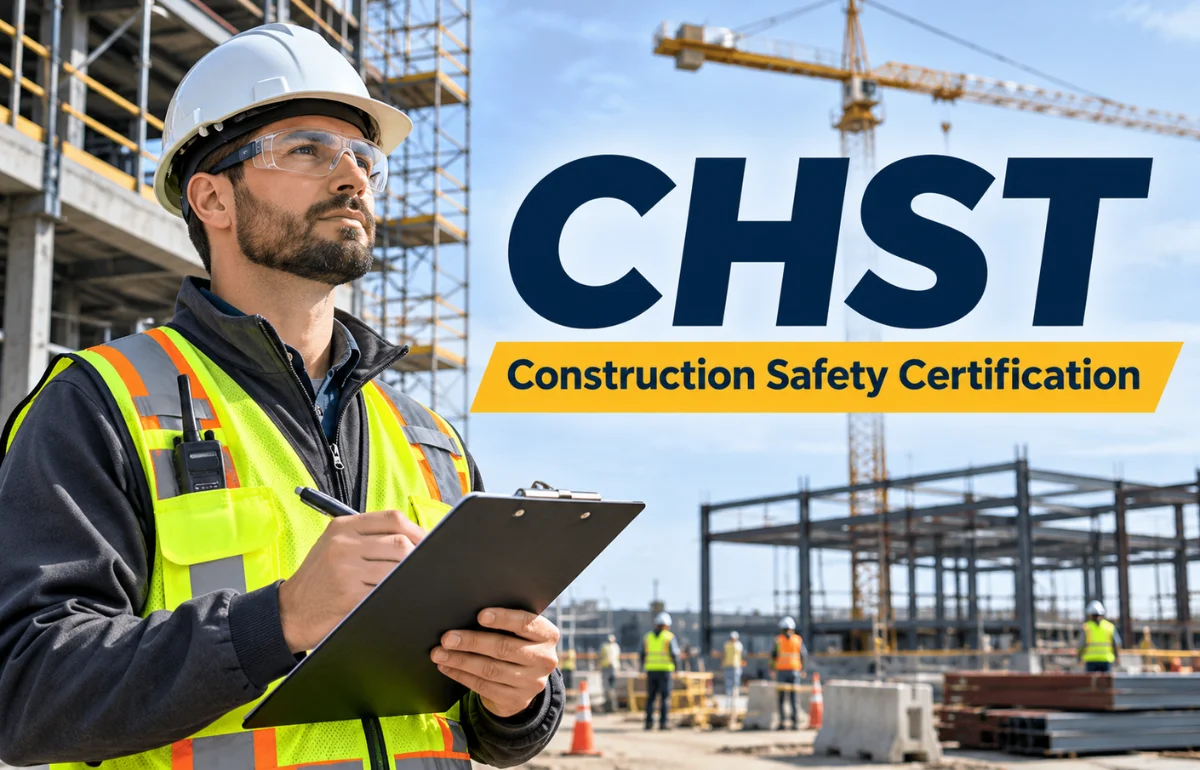
CHST stands for Construction Health and Safety Technician, a professional certification awarded by the Board of Certified Safety Professionals (BCSP). It recognizes individuals with the experience and technical knowledge needed to identify construction hazards, reduce workplace risks, and help prevent injuries and illnesses. CHST-certified professionals support construction site inspections, safety training, emergency preparedness, and occupational health programs.
To qualify, candidates need at least three years of construction safety experience, with 35% or more of their job duties involving safety, health, and environmental responsibilities. They must also pass the CHST examination and maintain their certification through renewal and recertification requirements.
I consider CHST a particularly relevant credential for construction professionals who already handle safety responsibilities and want formal recognition of their expertise.
However, earning the certification involves more than understanding safety regulations. It requires practical judgment, communication skills, and the ability to recognize risks before someone gets hurt.
What Is CHST and Why Does It Matter in Construction?
Construction sites change constantly. One day, workers may be preparing foundations. The next, several contractors could be installing electrical systems, lifting materials, or working at heights.
Each activity introduces different hazards, and those hazards can overlap.
That’s where a Construction Health and Safety Technician makes a difference.
The CHST credential demonstrates that someone has met established standards for construction safety knowledge and experience. It provides employers with an additional way to assess professional competency.
Unlike a short safety awareness course, CHST is an experience-based certification. Candidates cannot qualify simply by attending classes or memorizing regulations.
I believe this distinction matters because construction safety involves decisions that cannot always be made from a textbook.
For example, knowing that fall protection is necessary is one thing. Recognizing whether the selected protection system is suitable for a specific task requires a deeper understanding of working conditions.
A certified technician helps turn safety expectations into procedures that workers can follow.
Who Issues the CHST Certification?
The Board of Certified Safety Professionals, commonly known as BCSP, administers the CHST certification.
BCSP is a professional credentialing organization that offers several safety, health, and environmental certifications.
Its CHST program specifically addresses the construction industry, including general contractors, subcontractors, project owners, and construction safety service providers.
The credential is not issued by the Occupational Safety and Health Administration (OSHA).
This distinction is worth understanding because CHST certification and OSHA training serve different purposes.
What Does a CHST-Certified Professional Do?
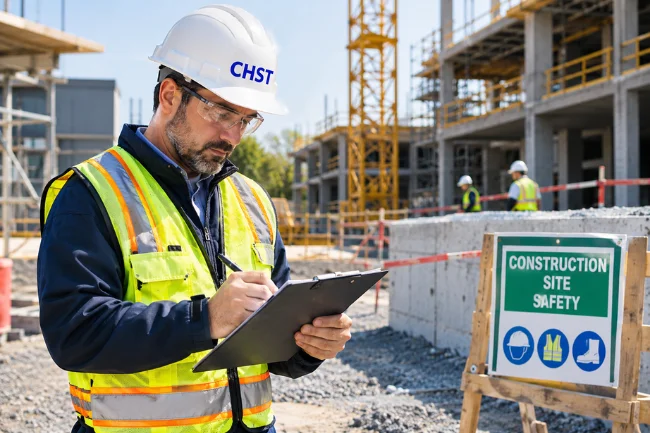
A CHST-certified professional helps organizations recognize, evaluate, and control workplace hazards throughout construction projects.
Responsibilities vary depending on project size, employer requirements, and the individual’s authority.
Identifying Hazards and Assessing Risks
One of the main responsibilities involves identifying situations that could cause injuries or illnesses.
Common examples include unprotected edges, unsafe scaffolding, electrical hazards, excavation risks, moving equipment, and exposure to airborne contaminants.
A construction safety technician examines working conditions and recommends appropriate controls.
I would prioritize hazards based on their potential severity and likelihood rather than treating every observation as equally urgent.
For instance, an unprotected excavation presents a different level of danger from a minor housekeeping issue.
Both deserve attention, but effective risk assessment helps determine which action should come first.
Conducting Safety Inspections and Training
Construction safety professionals regularly inspect worksites, review equipment conditions, and document unsafe practices.
They may also participate in toolbox talks, employee orientations, and task-specific safety training.
Effective communication is especially important when workers have different experience levels or speak different languages.
A good safety briefing should explain the hazard, the required precautions, and what workers must do when conditions change.
Supporting Incident Investigations
When an accident or near miss occurs, CHST professionals may help investigate what happened.
The objective is to identify contributing factors and prevent similar incidents.
That could involve reviewing work procedures, interviewing witnesses, examining equipment, or evaluating whether existing controls were adequate.
I favor investigations that examine underlying causes instead of automatically blaming the person closest to the incident.
Coordinating Emergency Preparedness
Emergency planning is another responsibility associated with construction safety.
Depending on the project, this may involve evacuation procedures, emergency communications, fire prevention, rescue planning, and coordination with emergency responders.
An emergency action plan should reflect the actual conditions of the jobsite, not simply repeat a generic company document.
Who Should Consider CHST Certification?
The CHST certification is primarily intended for people who already work in construction and regularly perform safety-related duties.
Suitable candidates may include construction safety coordinators, site safety officers, safety technicians, field supervisors, and experienced construction workers who have moved into occupational safety roles.
It can also benefit professionals employed by engineering companies, specialty contractors, and construction consulting firms.
However, job titles alone do not determine eligibility.
A project supervisor who performs substantial safety duties may qualify, while someone with an impressive job title but limited relevant experience might not.
I recommend examining actual responsibilities before deciding whether to apply.
CHST Certification Requirements in 2026

BCSP establishes specific eligibility requirements for candidates pursuing the Construction Health and Safety Technician credential.
Understanding these requirements early can prevent unnecessary application expenses.
Work Experience Requirements
Applicants must have at least three years of construction safety experience.
During that experience, at least 35% of their job duties must involve technical knowledge and responsibilities related to safety, health, and the environment.
Examples of relevant work include conducting hazard assessments, implementing safety procedures, investigating incidents, and evaluating construction safety controls.
General construction experience does not automatically satisfy these requirements.
For example, someone who has spent several years operating construction equipment may have extensive field knowledge but still need additional qualifying safety experience.
BCSP evaluates applicants against its established eligibility criteria.
Educational Qualifications
One attractive feature of CHST certification is that BCSP does not require a specific academic degree.
You can pursue the credential without holding a bachelor’s degree in occupational health and safety.
However, the absence of a degree requirement does not mean the examination is easy.
Candidates must still demonstrate substantial practical knowledge.
Additional training in construction safety, hazard identification, industrial hygiene, and risk management can strengthen preparation.
Professional Conduct Requirements
BCSP also requires applicants to disclose certain criminal convictions and disciplinary actions involving professional licenses or credentials.
These matters are reviewed under its applicable policies.
Candidates must meet BCSP’s professional standards throughout the certification process.
How to Become CHST Certified
The certification process begins with confirming eligibility and submitting an application through BCSP.
Submit Your Application
I suggest reviewing your employment history before opening an application.
Identify qualifying construction projects, employment dates, and the specific safety responsibilities performed.
Then create a BCSP account and complete the application through its official online portal.
BCSP reviews the submitted information to determine examination eligibility.
Schedule and Pass the Examination
After receiving approval, candidates can purchase examination authorization and schedule their assessment through Pearson.
The test is computer-based and administered at authorized examination centers.
Candidates generally have one year from application approval to pass the examination.
Official results become available after completing the test.
Those who pass and satisfy the certification requirements receive the CHST credential.
What Is Covered in the CHST Exam?
The CHST examination evaluates construction safety knowledge across four major domains.
BCSP’s CHST5 examination blueprint assigns a specific percentage of the assessment to each subject area.
| CHST exam domain | Exam weight |
|---|---|
| Hazard and Risk Identification and Control | 36.6% |
| Emergency Preparedness, Incident Investigation, and Response | 19.9% |
| Safety Program Development, Implementation, and Sustainment | 22.5% |
| Leadership, Communication, and Training | 21.0% |
Source: BCSP CHST5 examination blueprint.
The examination lasts four hours and tests whether candidates can apply safety principles to construction situations.
Understanding the Main Exam Topics
Hazard identification receives the greatest emphasis.
Candidates should understand fall protection, electrical hazards, excavation safety, equipment operation, chemical exposure, and the hierarchy of controls.
Emergency preparedness covers incident response, emergency action plans, and appropriate communications during critical situations.
Safety program questions address inspections, regulatory responsibilities, documentation, and incident prevention.
Leadership topics examine training methods, worker behavior, communication, and safety decision-making.
I would give particular attention to scenario-based questions because recognizing the safest response matters more than memorizing isolated definitions.
How to Prepare for the CHST Exam
Preparing effectively requires an organized approach that combines technical study with practical application.
I wouldn’t rely exclusively on practice questions or one commercial study guide.
Start With the Official Exam Blueprint
BCSP publishes an examination blueprint identifying the topics candidates are expected to understand.
Use it to identify knowledge gaps before spending money on preparation materials.
For example, someone experienced in fall protection may need additional study in emergency management or industrial hygiene.
This approach keeps preparation focused.
Use Reliable Study Resources
BCSP offers CHST examCORE, a self-paced examination preparation program.
Candidates can also study relevant OSHA construction standards, safety management principles, and occupational health references.
Practice examinations can help identify weak areas, but they should not replace understanding the material.
I recommend reviewing the explanations behind incorrect answers instead of simply repeating questions until the correct responses become familiar.
Connect Questions to Real Construction Situations
Imagine workers preparing to enter an excavation while heavy equipment operates nearby.
A useful preparation exercise is to identify the hazards, evaluate existing controls, and determine what additional precautions are necessary.
This encourages the practical reasoning expected of a safety professional.
It also improves retention because theoretical concepts become connected to recognizable working conditions.
CHST Certification Costs and Renewal Requirements
The cost of certification includes application and examination fees.
According to BCSP’s published 2026 fee information, the standard application fee is $140, while an individual examination costs $300.
BCSP also lists a $550 examination bundle and discounted application-plus-examination combinations.
Certification holders currently pay a $150 annual renewal fee.
Fees may change, so I recommend confirming current prices before paying.
Maintaining Your Certification
Passing the examination is not the end of the process.
CHST credential holders must complete 20 recertification points during each five-year recertification cycle.
Eligible professional development activities may include continuing education, conferences, and other activities recognized by BCSP.
Candidates should retain supporting documentation and record qualifying activities throughout their certification cycle.
Maintaining the credential demonstrates ongoing professional development rather than relying only on previously acquired knowledge.
CHST vs. OSHA 30, STSC, OHST, and CSP
Several safety credentials appear in construction job advertisements, but they are not interchangeable.
Understanding their differences can help you choose the right qualification.
| Credential | Primary focus | Main distinction |
|---|---|---|
| CHST | Construction safety specialists | Requires qualifying construction safety experience and an exam |
| OSHA 30 | Workplace hazard awareness | Training completion, not professional certification |
| STSC | Construction supervisors | Recognizes safety knowledge among construction leaders |
| OHST | Occupational hygiene and safety | Focuses on broader occupational safety and hygiene |
| CSP | Advanced safety professionals | Requires higher education, professional experience, and an accepted qualifying credential |
OSHA specifically states that its Outreach Training Program completion cards are not professional certifications or licenses.
I would choose CHST over a general safety credential when construction site safety is the main professional focus.
However, individuals pursuing senior, organization-wide safety leadership positions may eventually consider CSP certification.
CHST alone does not satisfy the CSP qualifying credential requirement, so candidates should examine the separate CSP eligibility criteria.
Career Opportunities and Benefits of CHST Certification
Earning the certification may strengthen a professional’s qualifications for construction safety positions.
Potential opportunities include site safety coordinator, construction safety technician, safety specialist, and health and safety officer roles.
Experienced professionals may also pursue broader responsibilities in project safety management.
Does CHST Certification Increase Salary?
The credential can help demonstrate specialized knowledge during hiring and promotion discussions.
However, salary outcomes depend on several factors, including location, employer size, project complexity, responsibilities, and professional experience.
I would avoid assuming that certification automatically guarantees a particular salary increase.
Its value is strongest when combined with measurable performance, communication skills, and relevant construction experience.
Employers ultimately need professionals who can prevent incidents, solve problems, and help projects operate safely.
Practical Safety Skills That Matter Beyond Certification
One area I believe deserves more attention is how construction safety professionals measure whether their recommendations actually work.
An inspection report may identify several hazards, but identifying them is only the beginning.
A more useful approach tracks whether corrective actions are completed, verified, and sustained.
Measure Corrective Action Closure
Consider a project where inspections regularly identify unsafe access routes.
Rather than counting only completed inspections, I would monitor how quickly corrective actions are resolved.
If the same problem continues appearing, the existing solution may not be effective.
Tracking recurring hazards can reveal weaknesses that traditional inspection totals overlook.
Monitor Risks Between Contractors
Construction sites often involve multiple contractors working simultaneously.
One team may be carrying out overhead installation while another operates directly below.
Each contractor might consider its individual activity safe, yet the interaction creates an additional risk.
A CHST professional should examine these overlapping activities during planning and coordination.
Make Safety Communication Actionable
Safety messages work best when workers understand exactly what action is required.
Instead of delivering lengthy generic presentations, I would focus briefings on the hazards workers will encounter during that shift.
Workers should know which controls are required, who to contact when conditions change, and when work must stop for reassessment.
These practices support safer decisions beyond certification requirements.
Is CHST Certification Worth It?
For construction professionals with qualifying experience, CHST can be a worthwhile investment.
It offers formal recognition of construction safety knowledge without requiring a college degree.
The credential may also support professional development and strengthen credibility with employers and project stakeholders.
Nevertheless, it is not a replacement for practical experience, continued learning, or site-specific training.
I see the greatest value when professionals use their certification knowledge to improve actual safety performance rather than treating the credential as another line on a résumé.
Conclusion
CHST certification recognizes construction professionals who possess experience and technical competency in workplace safety.
For eligible candidates, it can support career development while strengthening the skills needed to prevent construction-related injuries and illnesses.
If you’re considering certification, begin by reviewing the official BCSP CHST requirements. Compare your experience against the eligibility criteria, examine the current test blueprint, and develop a realistic preparation plan.
Frequently Asked Questions About CHST
1. What does CHST stand for?
CHST stands for Construction Health and Safety Technician, a professional certification issued by the Board of Certified Safety Professionals.
2. Is the CHST exam difficult?
The exam can be challenging because it assesses construction safety knowledge, risk management, and practical decision-making across multiple subject areas.
3. Can I get CHST certification without a degree?
Yes. BCSP does not require a college degree, but candidates must meet the construction safety experience requirements and pass the examination.
4. How long does CHST certification last?
Certification requires annual renewal and completion of 20 recertification points within each five-year recertification cycle.
5. Is CHST better than OSHA 30?
They serve different purposes. CHST is an experience-based professional certification, while OSHA 30 is a workplace safety awareness training program.

Ethan Caldwell is a business research writer with 9+ years of experience covering entrepreneurship, market trends, business strategies, and industry insights. He focuses on creating clear, data-informed articles that help readers understand modern business concepts.