
When people search for “chief technical examiner,” they are usually trying to understand a specialized role within India’s public procurement and vigilance system. A Chief Technical Examiner (CTE) is a senior technical officer associated with the Chief Technical Examiners’ Organisation (CTEO), the technical wing of the Central Vigilance Commission (CVC). The CTEO examines selected government procurement and contract activities to identify technical, financial, procedural and quality-related irregularities.
Its work can cover construction, supplies, electrical and mechanical contracts, IT procurement, services and other public procurement activities. I find it useful to think of the CTE as an independent technical scrutiny function: the focus is not simply on whether a project was completed, but whether public money was used properly, the procurement process was fair, contractual requirements were followed, and the work or supplies actually met the required standards.
What Is a Chief Technical Examiner?
A Chief Technical Examiner is a senior technical officer working within the CTEO under the Central Vigilance Commission.
The role exists to provide specialist examination of selected procurement cases and works. Unlike the engineer or project team responsible for executing a contract, the CTEO performs an external technical and contractual review.
That distinction matters.
A project engineer may be responsible for designing, supervising or completing a project. A procurement officer may handle the tendering process. An internal audit team may review financial controls. The Chief Technical Examiner’s function is different: it examines the procurement or contract from a technical and vigilance perspective and checks whether the decisions, records, measurements, quality, payments and execution stand up to scrutiny.
The CTEO’s official examination framework includes areas such as estimates, technical sanctions, tendering, agreements, inspection and acceptance of materials, bills, site records and physical site inspection.
So, a CTE is not simply a “construction inspector.” The modern scope is much wider.
What Does CTE Stand For?
CTE stands for Chief Technical Examiner.
The wider organisation is known as the Chief Technical Examiners’ Organisation, commonly abbreviated as CTEO.
This distinction is worth remembering because people often use CTE and CTEO interchangeably even though they refer to different things:
Understanding these terms makes the rest of the process much easier to follow.
History of the Chief Technical Examiners’ Organisation
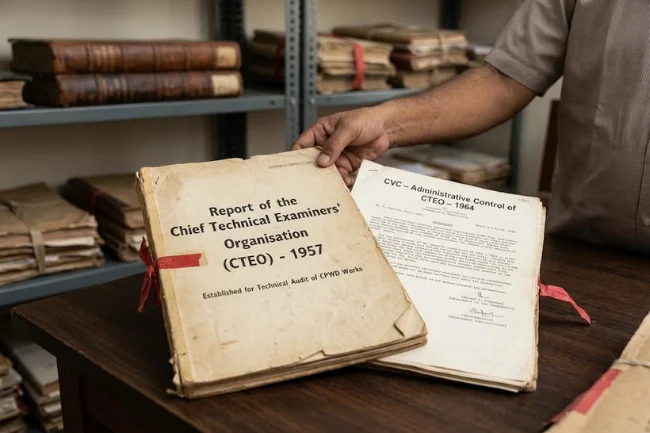
The CTEO has a long history in India’s public-sector procurement system.
It was established in 1957 under the then Ministry of Works, Housing & Supply. Its original purpose was to provide concurrent technical audit of Central Public Works Department works and improve economy in expenditure along with technical and financial control.
The Santhanam Committee on prevention of corruption later recommended strengthening the organisation and expanding its jurisdiction to construction work undertaken by other ministries and departments.
When the Central Vigilance Commission was established, the CTEO came under its administrative control in 1964. A second Chief Technical Examiner post was created in 1979 as procurement activity grew in volume and complexity.
This history explains something that is sometimes missed in online articles: CTEO began with a strong construction and engineering focus, but its responsibilities subsequently expanded as government procurement became increasingly diverse.
What Is the Role of a Chief Technical Examiner?
I would describe the CTE’s role as a combination of technical scrutiny, procurement oversight and preventive vigilance.
The objective is not limited to finding mistakes after money has been spent. A proper examination can reveal weaknesses in planning, tendering, contract administration and execution that may also exist elsewhere in an organisation.
Reviewing project estimates
The examination can begin before work is actually executed.
This may involve checking whether the estimate was prepared on a sound basis, whether quantities appear reasonable, whether specifications are appropriate and whether the rates used are adequately supported.
An inflated estimate can create problems long before a contractor begins work.
Examining technical sanctions and approvals
Technical approvals and sanctions establish the basis on which a project is supposed to proceed.
A CTE examination can compare approved requirements with the eventual procurement and execution to identify unjustified changes, weak documentation or departures from approved technical parameters.
Scrutinising tendering and procurement
Tendering is another major area of examination.
The CTEO’s framework considers matters such as the calling of tenders, comparative price bids, price loading, negotiations where applicable and the award of work.
The broader question is whether the process maintained fairness, transparency and equal treatment of eligible bidders.
Unreasonably restrictive specifications, unjustified conditions or inconsistent treatment of bidders can become significant findings.
Checking contracts and agreements
Once a tender is awarded, the contract becomes the basis for execution.
The examiner may therefore review the agreement, scope of work, specifications, approved rates, contractual obligations, variations and related records.
A common misconception is that technical examination stops at the tender stage. In reality, the contractual execution stage can reveal some of the most consequential discrepancies.
Inspecting physical work
For civil works, physical inspection can be particularly important.
Records may say that a particular quantity or quality of work was completed, but an examination can compare those records with the actual site condition.
Depending on the nature of the work, scrutiny may involve measurements, materials, workmanship, testing records, drawings and specifications.
This is where the technical expertise of the examining organisation becomes especially valuable.
Checking bills and payments
The financial side of technical examination is closely connected with physical execution.
The CTEO framework specifically includes scrutiny of bills.
The basic question is straightforward: does the payment correspond to what was actually supplied, executed or contractually permitted?
That can involve comparing measurements, approved quantities, rates, variations, test results and supporting documentation.
What Does a CTE Inspection Check?
A CTE inspection can look at much more than the finished asset.
The CVC framework identifies several major areas that can form part of an Intensive Examination.
The examination can also identify issues involving time and cost overruns, quality deficiencies, lack of transparency, non-adherence to procurement procedures, overpayments and tax or statutory compliance.
What Is an Intensive Examination by CTEO?
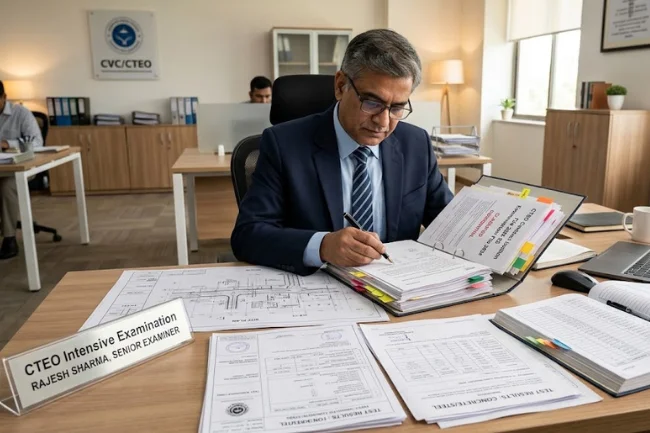
An Intensive Examination is a detailed examination of a selected procurement case or contract by CTEO.
This is more comprehensive than simply checking whether a file contains the necessary approvals.
The process can bring together document scrutiny, technical assessment, financial review and physical inspection.
The CVC describes Intensive Examination Reports as covering areas ranging from estimates and technical sanction to tendering, contract agreements, material acceptance, bills, site records and site inspection.
I think this is one of the most important concepts for anyone researching the chief technical examiner role because it explains what the CTEO actually does in practice.
The objective is not to label every deviation as corruption.
A deviation may have a legitimate contractual, technical or administrative explanation. The examination establishes the facts, documents the observation and seeks clarification or further action where necessary.
How Are Contracts Selected for Examination?
Not every government contract can be physically examined by CTEO.
The CVC’s annual reporting explains that organisations submit Quarterly Progress Reports, from which CTEO selects some contracts for Intensive Examination based on prescribed parameters. The organisation’s limited resources mean that only a portion of contracts can be examined directly. CTE-type examinations are therefore also carried out by CVOs within their respective organisations.
Examinations can also arise from complaints alleging particular misconduct or irregularities.
This is a useful distinction because a CTE inspection should not be assumed to mean that an organisation or contractor has already been found at fault.
Selection for examination is not itself a finding of wrongdoing.
What Happens After a CTE Examination?

The process does not simply end when an inspection team leaves a project site.
After an Intensive Examination, observations are documented in a report.
The report may identify issues involving procurement procedure, quality, quantities, payments, contract administration, time and cost overruns or other deviations.
After approval by the concerned CTE, the report is forwarded to the organisation’s Chief Vigilance Officer for comments and action. Where an observation appears to have a vigilance angle, it may be referred for detailed vigilance investigation and responsibility may need to be examined.
The CVC framework also provides for follow-up action. Where satisfactory clarification is received, an observation may be dropped. Where the explanation is inadequate and a vigilance angle exists, the matter can move into a more detailed investigation process.
That makes CTEO an important part of a wider accountability chain rather than an isolated inspection function.
CTE vs CVO: What Is the Difference?
This is a common point of confusion.
The two functions can overlap during the examination and follow-up process, but they are not the same role.
The CVC also requires CVOs to conduct CTE-type Intensive Examinations in their organisations because CTEO cannot directly examine every procurement activity. In 2024, CVOs from 299 organisations reported 1,845 CTE-type examinations.
What Types of Procurement Can CTEO Examine?
The scope has expanded substantially beyond traditional civil construction.
Depending on the applicable organisational framework and assignment, technical examination can cover areas such as:
- Civil works
- Horticulture works
- Electrical and mechanical contracts
- Store purchases
- Supply contracts
- IT-related procurement
- Consultancy
- Hiring of services
- Transport-related procurement
The expansion of CTEO’s scope reflects the fact that public procurement today involves much more than roads and buildings. Government expenditure can involve technology, equipment, professional services, engineering systems and large-scale procurement arrangements.
Common Issues Found During Technical Examination
The most useful way to understand the CTE role is to look at the types of problems an examination is intended to uncover.
Inflated or poorly supported estimates
If quantities, rates or assumptions used in an estimate are not adequately justified, the estimated value of a procurement can be affected.
Unfair or restrictive tender conditions
Tender conditions should not unnecessarily restrict genuine competition.
An unusual specification or eligibility requirement can therefore warrant scrutiny when there is no sound technical justification.
Quality deficiencies
Materials and finished work need to match contractual requirements.
Quality failures can become particularly serious where they affect durability, safety, functionality or the value received by the public organisation.
Measurement discrepancies
Measurements are fundamental to payment in many works contracts.
A difference between recorded quantities and actual quantities can therefore have a direct financial consequence.
Unauthorised deviations
Changes in specifications, design, quantities or scope need to be supported by the appropriate contractual and technical authority.
An undocumented or unjustified deviation can create both financial and accountability issues.
Overpayments
Payments that exceed the value of work or supplies actually due under the contract are another important area of scrutiny.
The CVC’s 2024 Annual Report specifically identifies overpayments, quality deficiencies, time and cost overruns and non-compliance with statutory norms among the issues reflected in Intensive Examination reports.
Why the Chief Technical Examiner Role Matters
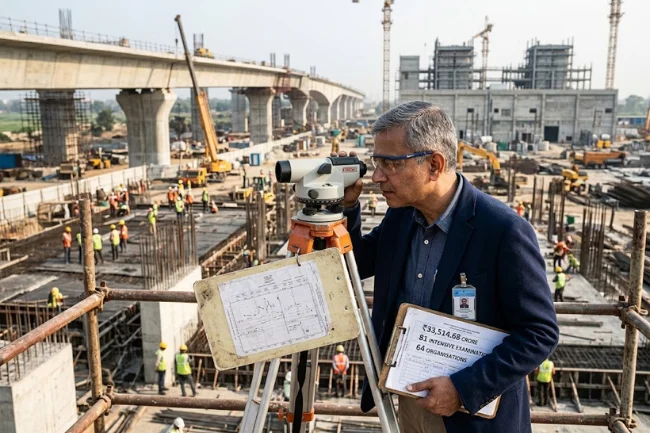
The value of this role becomes clearer when you consider how large public procurement can be.
According to the CVC Annual Report 2024, CTEO conducted 81 Intensive Examinations covering 64 organisations during 2024. The procurement cases examined had a combined value of more than ₹33,514.68 crore. The organisations included government departments, autonomous bodies, public sector undertakings and public sector banks.
These numbers show why technical examination cannot be treated as a simple construction-quality inspection.
A procurement contract can involve millions or billions of rupees and dozens of technical, administrative and contractual decisions. A weakness at the planning stage can eventually affect tendering, execution, payment and asset quality.
An effective examination therefore looks across the entire chain rather than concentrating on one isolated document.
How Organisations Can Prepare for a CTE Inspection
Preparation should begin long before an inspection notice arrives.
I would focus first on document consistency. The estimate, technical sanction, tender documents, contract agreement, drawings, measurements, test reports, bills and completion records should tell the same story.
Site records also need to reflect actual progress rather than simply repeating planned quantities.
It is equally useful to maintain a clear trail for approvals, deviations, variations and reasons for changes.
For contractors and project teams, the goal should not be to “prepare for the examiner” by creating paperwork at the last minute. The stronger approach is to maintain accurate technical and contractual records throughout the project.
That makes an eventual examination far easier to handle.
Recent Importance of CTEO
The CTEO continues to play a practical role in public procurement oversight.
The CVC’s 2024 Annual Report states that CTEO’s examinations covered a wide range of organisations and procurement cases, while observations included transparency, fair treatment of bidders, quality, financial implications, statutory compliance and deviations from applicable rules. The same report records 137 cases in which CTEO provided advice on vigilance or complaints during 2024.
The broader lesson I take from these figures is that technical vigilance is not only about catching individual mistakes. It can also reveal recurring weaknesses in procurement systems.
One irregularity may concern a single contract. A pattern of similar observations can indicate a problem in the organisation’s procedures, controls or decision-making culture.
FAQs About Chief Technical Examiner
What is the full form of CTE?
CTE stands for Chief Technical Examiner, while CTEO stands for Chief Technical Examiners’ Organisation.
Is CTE part of the Central Vigilance Commission?
Yes. The CTEO functions as the technical wing of the Central Vigilance Commission and came under its administrative control in 1964.
What does a Chief Technical Examiner inspect?
A CTE can examine estimates, tendering, contracts, procurement records, quality, measurements, bills, site records, physical execution and compliance with relevant procedures.
Does every CTE observation mean corruption?
No. An observation can be a technical, financial or procedural irregularity without automatically proving corrupt intent; explanations and evidence are considered during follow-up.
Who performs CTE-type examinations when CTEO cannot inspect every contract?
Chief Vigilance Officers can conduct CTE-type Intensive Examinations within their respective organisations under the CVC framework.
Conclusion
The chief technical examiner is much more than a government engineer checking construction quality.
The role sits within a wider public procurement and vigilance framework designed to examine whether contracts are planned properly, tendered fairly, executed according to requirements, documented accurately and paid for appropriately.
For me, the most useful way to understand the CTEO is to view it as a bridge between technical expertise and public accountability. It brings engineering and procurement scrutiny into areas where an ordinary administrative review may not reveal the full picture.
The official CVC framework also makes clear that Intensive Examination can extend from estimates and tendering to contractual execution, bills and physical site inspection.
If you are an engineer, contractor, procurement professional, vigilance officer or researcher, the best next step is to study the CVC’s Vigilance Manual and relevant CTEO guidance alongside the particular procurement rules governing your organisation. That gives you a far more accurate picture than relying on a generic definition of the role.

Ethan Caldwell is a business research writer with 9+ years of experience covering entrepreneurship, market trends, business strategies, and industry insights. He focuses on creating clear, data-informed articles that help readers understand modern business concepts.