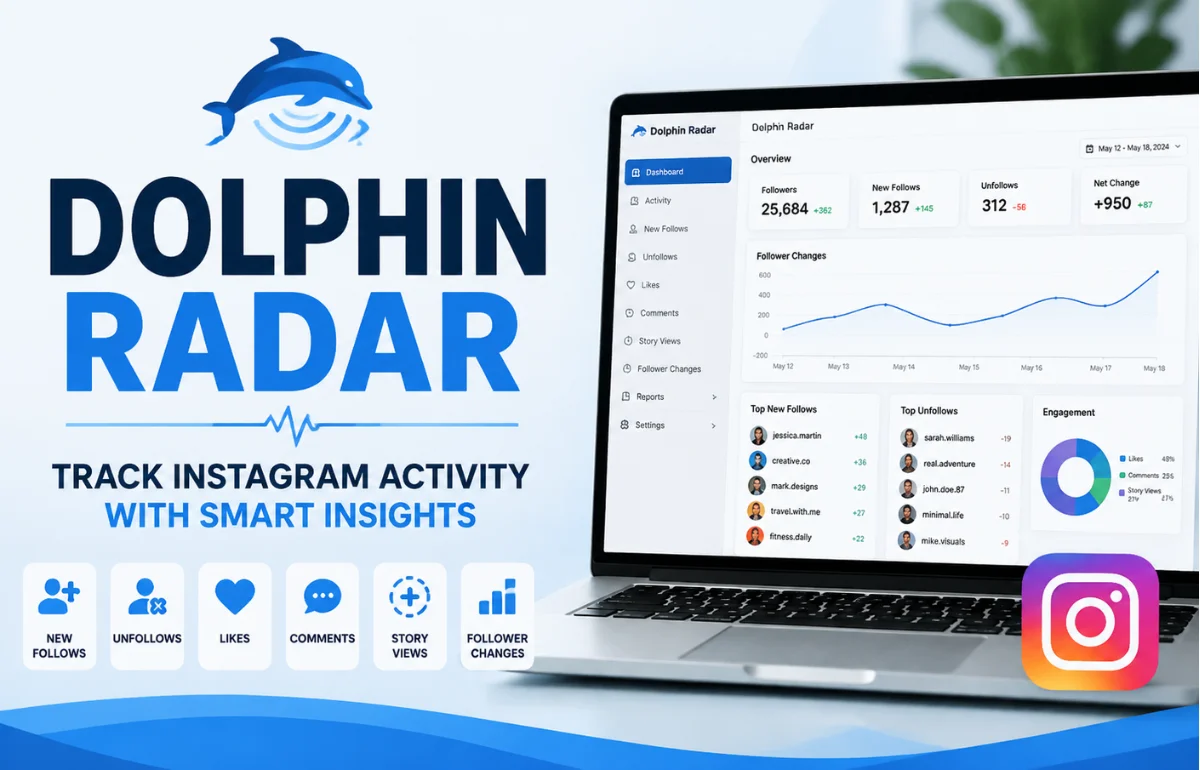
Dolphin Radar is a web-based Instagram tracking tool that monitors public account activity, including follows, unfollows, likes, comments, and story views, without requiring the tracked person’s login or notifying them in any way.
It works by pulling data that’s already publicly visible on Instagram and organizing it into weekly reports.
I first came across Dolphin Radar while researching tools for a client who wanted to keep tabs on a competitor’s Instagram growth without manually checking the profile every day.
What follows is everything I learned after actually using it, cross-checking its claims, and digging into pricing details that most reviews skip entirely.
What Dolphin Radar Actually Tracks
At its core, Dolphin Radar watches six categories of public activity on any Instagram account: new follows, unfollows, post likes, comments, story engagement, and follower count changes.
None of this requires the tracked account’s password.
You simply enter a public username, and the platform starts compiling what’s already visible to anyone browsing Instagram manually, just automated and organized into a report you can actually read.
I want to be upfront about the boundary here, because it matters more than any feature list.
If the account you’re trying to track is private, Dolphin Radar cannot see anything. No workaround exists. That’s an Instagram restriction, not a limitation of this specific tool, and any service claiming otherwise is lying to you.
Why I Started Using It
I’ll be honest, my first reaction to Instagram trackers in general was skepticism.
I’d tested a couple of similar tools before that promised real-time alerts and delivered almost nothing useful, so I went into Dolphin Radar expecting more of the same.
What changed my mind was tracking a public business account over three weeks and comparing what the weekly report showed against what I could see by manually checking the profile myself.
The follower numbers matched. The new-follows list matched. Even the unfollow count lined up with what I’d noted by hand.
Where it fell short was speed. This is not a tool for catching something the moment it happens. If someone follows a new account and then unfollows them an hour later, that entire event can vanish before your next report generates. I learned this the hard way when I was trying to catch a specific follow pattern and the window closed before my next refresh.
How Dolphin Radar Works Behind the Scenes
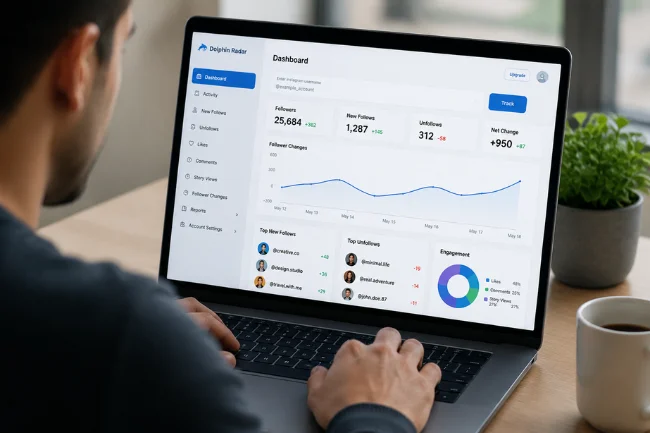
No Login From the Tracked Account
Dolphin Radar never asks for the password of the account you’re monitoring, and it never asks for yours to be connected either.
You sign up with an email address, enter the public username you want to follow, and the platform does its collection from the outside, the same way any logged-in Instagram user browsing manually would see that same data.
This is also why the tracked account gets no notification. Nothing about the process touches their profile directly, so there’s no trace left behind on their end.
Reports Run on a Schedule, Not Instantly
Despite marketing language that leans on words like real-time, the actual mechanism is scheduled scanning. Most plans generate weekly reports, with some standalone tools refreshing faster.
Between those scans, activity can happen and disappear without ever making it into your data. A follow that gets undone quickly, a like that gets removed, a comment that gets deleted, these things exist in a blind spot that no tracker in this category can close.
Dolphin Radar Pricing Breakdown
This is where most coverage of Dolphin Radar gets vague, so I pulled the actual numbers across its core plans and standalone tools.
A few things worth flagging that I didn’t see explained clearly anywhere else. Every subscription tier covers exactly one tracked account. If you want to monitor three profiles, you need three separate subscriptions running at once, which changes the real cost fast if you’re doing competitor research across a handful of accounts.
There’s also no free trial for the main Social Insights product. What does exist for free is a limited Recent Follow preview, a Comment Viewer capped at 15 comments per post, a partial Unfollower preview, and a Follower Export tool that handles up to 500 entries. Payment runs through Stripe, and the company states it does not store card details on its own servers.
Key Features Worth Knowing About
Follower and Recent Follows Tracker
This is the feature most people are actually searching for when they land on Dolphin Radar. It shows who a public account has followed recently, sorted by when the follow happened, restoring visibility that Instagram itself removed back in 2019.
Follower counts and new-follows data are the most dependable part of the whole platform, mainly because follower lists are stable and don’t change as fast as likes or comments.
Unfollower Tracker
Every weekly Activity report includes basic unfollow detection, but there’s also a dedicated standalone version for people who specifically care about that one signal. It compares consecutive follower snapshots to flag who dropped off.
On smaller accounts this is reliable. On accounts with hundreds of thousands of followers, snapshot sampling occasionally produces a false unfollow read, simply because a full re-scan of that many followers in one cycle isn’t always complete.
Likes and Comments Viewer
The Likes Viewer is actually free to use on its own, no subscription required, and works across photos, Reels, and carousels for any public account.
The Comments Viewer works similarly but caps free results at 15 comments per post. Paying unlocks the full comment history along with export options.
Anonymous Story and Highlight Viewer
You can browse stories, highlights, and posts from public accounts without logging into Instagram at all, and the account owner has no way of seeing that you looked. This works because the platform fetches content server-side rather than routing it through a viewer identity tied to your Instagram account.
Content that gets deleted before Dolphin Radar’s next scan simply won’t be captured. There’s no way around that.
AI Insights
This module only unlocks on Quarterly and Annual plans, and it’s the part of Dolphin Radar that leans hardest on marketing language. In practice, it aggregates the raw activity data into interest categories, engagement patterns, and behavioral summaries.
Treat these as directional pattern recognition, not verified facts about a person’s intentions. I found the insights genuinely useful for spotting broad trends over time, but they shouldn’t be the basis for any conclusion you’re not prepared to double-check manually.
What Dolphin Radar Cannot Do
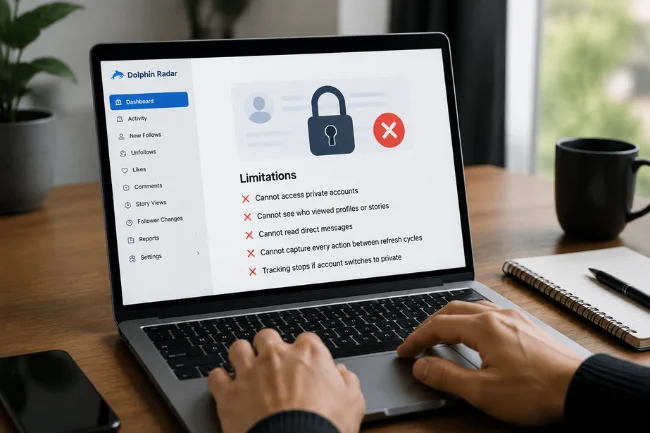
I think this section matters more than any feature breakdown, because most disappointment with tools like this comes from expecting something the technology simply cannot deliver.
Dolphin Radar cannot access private accounts under any subscription tier. It cannot show who viewed someone’s profile or story, because Instagram doesn’t expose that data to anyone outside the platform, not even to Instagram’s own advertisers. It cannot read direct messages. And it cannot guarantee it captured every single action between refresh cycles, particularly on very active or very large accounts.
If a tracked account switches to private mid-subscription, tracking simply stops. No plan or price tier changes that outcome.
Is Dolphin Radar Safe to Use?
From a personal account security standpoint, yes, reasonably so. You never hand over the password of the account you’re tracking, and Dolphin Radar never asks for your own Instagram credentials either. Payment processing runs through Stripe rather than being stored directly on Dolphin Radar’s servers.
The bigger question isn’t account security, it’s platform terms. Automated collection of Instagram data by third parties sits in tension with Meta’s own Terms of Use, which restrict unauthorized automated access even when only public data is involved. Dolphin Radar’s marketing describes itself as fully compliant, but that claim applies more cleanly to data privacy law than it does to Instagram’s own platform rules.
I’d also add a practical note that gets skipped in most coverage. If you’re considering this for monitoring a partner, an ex, or anyone in a personal relationship rather than for business research, think carefully about the ethics of that decision before the legality of it. The tool being technically able to do something doesn’t mean the situation calling for it is a healthy one.
Dolphin Radar vs Other Instagram Trackers
If speed is what you care about most, a focused, single-purpose app built for real-time push alerts will beat Dolphin Radar every time. What Dolphin Radar trades for that speed is depth: likes, comments, story activity, and pattern-based insights layered on top of the basic follow tracking that narrower tools handle alone.
Who Actually Gets Value From This Tool
Marketers and researchers monitoring competitor accounts or scouting influencers get the clearest return here, mainly because weekly reporting fits how that kind of research actually works. You’re rarely reacting to something in the exact minute it happens, you’re looking for patterns across days and weeks.
Casual curiosity is a worse fit. Paying a recurring subscription to check on one person’s activity occasionally rarely justifies the cost compared to just checking the public profile yourself when you think of it.
Anyone expecting access to private accounts, message content, or profile-viewer identities should skip this entirely, since none of that exists in any tier, regardless of price.
Frequently Asked Questions
Is Dolphin Radar free to use?
The core Social Insights tracker requires a paid subscription starting at $2.75/month on the annual plan, though the Likes Viewer and a limited Recent Follow preview are free.
Does Dolphin Radar work on private Instagram accounts?
No, it only reads publicly available data, and no third-party tool can bypass Instagram’s private account restrictions.
Will the person I’m tracking know about it?
No, tracked accounts receive zero notifications, since Dolphin Radar never interacts with or logs into their profile directly.
How many accounts can one subscription track?
Each subscription covers exactly one tracked account, so monitoring multiple profiles requires separate subscriptions running at the same time.
Is Dolphin Radar’s data updated in real time?
No, most reports run on a weekly schedule, so activity that happens and reverses between scans may never appear in your report.
Final Thoughts
Dolphin Radar does what it says on the label, within the limits every third-party Instagram tool shares. It won’t hand you private account data, message content, or instant alerts, but for tracking public follow patterns, likes, and engagement trends over time, the core mechanics hold up against manual verification.
If you’re doing competitor research or influencer scouting and weekly reporting fits your workflow, the annual plan is the more sensible entry point given how much cheaper it is per month than paying monthly. If you need something faster or narrower, it’s worth comparing against a dedicated real-time follow tracker before committing to a subscription.
Either way, go in knowing exactly what you’re buying: a public-data compiler with a one-week rhythm, not a surveillance tool with instant answers.

Ava Bennett is a social media strategy writer with 7+ years of experience covering social platforms, content trends, audience engagement, and digital communication strategies. She creates practical insights to help readers understand the evolving social media landscape.