TW most commonly means “Trigger Warning” in text messages, social media posts, captions, forums, and online communities. People place TW before sensitive or potentially distressing material so readers know what is coming before they continue. For example, “TW: discussion of self-harm” tells a reader that the following content includes that subject.
The abbreviation can have other meanings, though, including “This Week,” “Twitter,” “Taiwan,” and, in some casual slang, “twin.” The right meaning depends on where TW appears and what comes after it. When I research short internet abbreviations like this, I never rely on the letters alone; I look at placement, surrounding words, and the topic of the conversation. That simple context check usually reveals the intended meaning within seconds.
What Does TW Mean in Text?
In everyday online communication, TW usually stands for “Trigger Warning.” Dictionary.com lists TW as an abbreviation for trigger warning, while Cambridge defines a trigger warning as a notice placed before material that people may find very upsetting, especially when it relates to an experience they have had themselves.
A person might write:
“TW: graphic injury details”
“TW // eating disorder discussion”
“tw: mentions of abuse”
The purpose is not to summarize the whole post. It is to give readers enough information to decide whether they want to read, watch, listen, or scroll past.
TW is especially common before discussions involving violence, abuse, self-harm, suicide, eating disorders, grief, sexual assault, addiction, or other emotionally difficult subjects. The exact topics vary by community.
The Main Meanings of TW
TW is short enough to be ambiguous, so assuming it always means Trigger Warning can create confusion.
Here is a practical way to read it:
The important distinction is that only the first meaning functions as a content warning. The others are ordinary abbreviations or slang.
My Three-Clue Method for Decoding TW
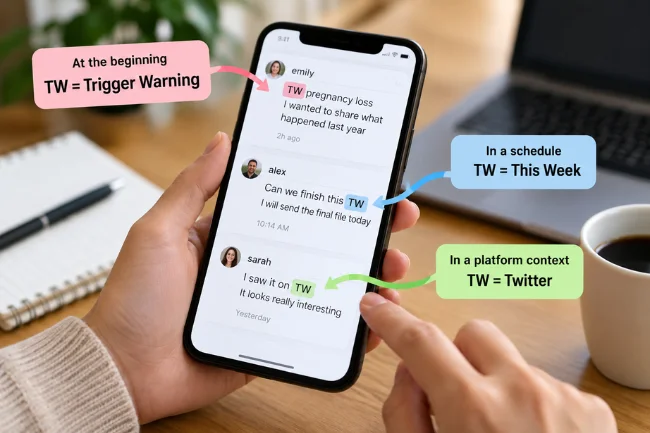
When I come across a short abbreviation with several possible meanings, I use three clues: position, following words, and conversation topic. I find this more reliable than memorizing a long list of definitions.
1. Check Where TW Appears
If TW appears at the beginning of a post or immediately before a sensitive subject, Trigger Warning is the strongest interpretation.
Example:
“TW: pregnancy loss. I wanted to share what happened last year.”
Here, TW clearly prepares the reader for the topic.
If it appears in the middle of a scheduling conversation, “This Week” may make more sense.
2. Read the Words Immediately After It
A colon, slash, dash, or topic label often signals a warning:
“TW: blood”
“TW // abuse”
“TW — grief”
If the next words relate to deadlines, travel, a country, or a person’s nickname, another meaning may fit better.
3. Look at the Platform and Conversation
A mental-health forum and a workplace chat use language differently. A TikTok caption discussing trauma makes Trigger Warning very likely, while a project message saying “need this done TW” probably refers to this week.
This context-first approach is useful because internet abbreviations can change faster than dictionary entries.
How TW Is Used on Social Media
TW appears across platforms, but the format changes slightly depending on how people post.
TW on TikTok
On TikTok, creators may place TW in a caption, on-screen text, or the opening seconds of a video before discussing sensitive material.
A typical format is:
“TW: discussion of disordered eating”
The warning works best when it appears before the potentially distressing material, not after a viewer has already encountered it.
TW on Instagram
Instagram users may add TW at the top of a caption, before a carousel slide containing sensitive material, or in Story text.
For a long caption, placing the warning before the first paragraph makes it easier to notice.
TW on Reddit
Reddit communities often have their own posting rules, flairs, spoiler formatting, or content labels. A user may still type TW in a title or at the beginning of a post, particularly in support-oriented communities.
The subreddit’s own rules should take priority because some communities require specific labels.
TW on Discord
In Discord servers, TW may appear before a message, link, image, or discussion topic. Some communities combine it with spoiler tags so users can choose whether to reveal the content.
TW in Text Messages and Group Chats
TW can also appear in private messages:
“TW: I’m going to mention the accident we talked about.”
In a direct conversation, this can be more personal than a public warning because the sender may know that a particular topic is difficult for the recipient.
TW vs. CW: Are Trigger Warning and Content Warning the Same?
TW and CW overlap, but they are not always used in exactly the same way.
CW stands for “Content Warning.” Cambridge defines it as a notice that material may be upsetting or offensive. Trigger Warning tends to be associated more specifically with potentially distressing material and trauma-related reactions.
While reviewing current dictionary definitions and research for this article, I found that the neat TW-versus-CW distinction used by many slang websites is not as universal as it first appears.
A useful practical distinction is:
I would not treat that table as a universal rule. A systematic review found no shared cross-sector standard and noted that “trigger warning” and “content warning” are sometimes used interchangeably.
That nuance matters. Online language develops through communities rather than a single rulebook, so the same label can be used differently across universities, support groups, social platforms, entertainment, and professional settings.
What Topics Commonly Receive a TW?
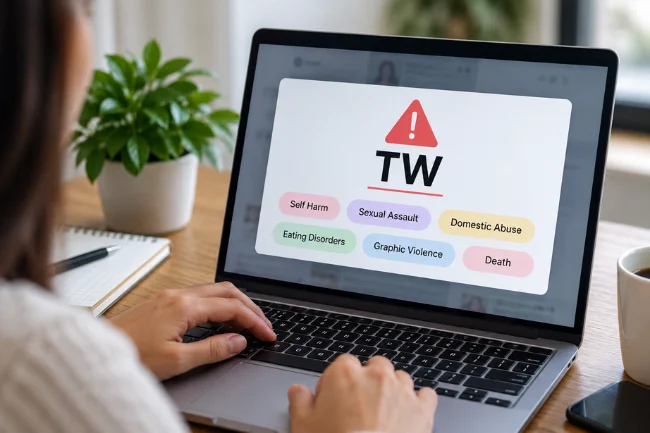
There is no official internet-wide checklist. Still, common TW labels include references to:
- self-harm or suicide
- sexual assault
- domestic abuse
- child abuse
- eating disorders
- graphic violence
- severe injury
- death or traumatic grief
- addiction
- war or terrorism
- panic attacks or traumatic experiences
A large systematic review of content-warning systems found warning categories spanning violence, sex, stigma, disturbing content, mental health, death, abuse, risky behavior, crime, flashing lights, and other areas.
That does not mean every difficult topic automatically requires the same warning everywhere. Audience, platform rules, context, and the level of detail all matter.
How to Write TW Correctly
The most useful warning is short, specific, and placed before the material.
Good examples include:
“TW: descriptions of self-harm”
“TW // domestic violence”
“TW: graphic injury photo on the next slide”
A vague warning such as “TW: sensitive stuff” gives the reader less information. Being specific lets someone decide whether the actual subject is relevant to them.
I also recommend avoiding a long block of warnings that is harder to scan than the content itself. If several closely related topics appear, group them clearly:
“TW: violence, blood, and injury details”
The goal is clarity, not performance.
Common TW Mistakes
Putting the Warning After the Sensitive Material
A warning cannot prepare someone for content they have already seen. Place it before the text, image, audio, or video section it refers to.
Using TW as a Joke
People sometimes use “triggered” casually to mean annoyed. That is different from using TW to flag potentially distressing content.
Joke warnings can make the label less clear in communities where people rely on it seriously.
Being Too Vague
“TW: bad topic” tells the reader almost nothing. “TW: discussion of suicide” is much more informative.
Specific wording gives people useful information without requiring them to guess what “sensitive” means.
Confusing a Trigger Warning With a Spoiler Warning
A spoiler warning protects plot information. A trigger warning identifies potentially distressing subject matter.
A post can need one, both, or neither.
Treating TW and CW as Rigid Technical Standards
They are communication conventions, not universally standardized labels.
Community rules and reader expectations matter more than pretending one definition applies everywhere.
Does TW Mean “Twin” in Slang?
Sometimes, but this usage is less standardized than Trigger Warning.
“Twin” itself is a friendly slang term used for someone a person feels close to, even when that person is not literally a sibling. Some contemporary slang sources record TW as a shortened form of twin in casual chats, while others treat “twin” and TW as separate forms.
If someone writes:
“What’s good, tw?”
and the conversation contains no sensitive subject, “twin” may be a plausible reading.
If a post says:
“TW: assault mentioned”
it clearly means Trigger Warning.
I would avoid presenting “twin” as the second universal definition of TW. It is better described as a possible slang meaning in certain communities.
Does TW Still Mean Twitter?
It can, particularly in older posts or informal conversations written when Twitter was the platform’s primary name.
Since Twitter was renamed X, using TW to mean Twitter is easier to misunderstand. If someone writes, “I saw that on TW,” the surrounding discussion about posts, tweets, accounts, or X may reveal the meaning.
For clear current writing, “X” or “Twitter/X” is usually less ambiguous.
Is TW the Same as a Mental-Health Treatment?
No. TW is a communication label, not a therapy or medical intervention.
Research on trigger warnings is more nuanced than the claim that they automatically prevent distress. A 2024 meta-analysis reported no overall effect on emotional responses to negative material or educational outcomes, while warnings increased anticipatory affect; findings on avoidance were mixed.
That does not make the label meaningless. A warning can still provide information and choice. It simply means writers should avoid making medical claims about what TW will do for every reader.
For an informational article, I think this distinction is worth stating because it separates everyday online etiquette from clinical advice.
How Should You Respond When Someone Uses TW?
Usually, you do not need to reply to the letters themselves.
TW tells you what type of content follows. You can continue reading, skip the post, mute the conversation, leave the page, or return later.
In a private conversation, you can also acknowledge the warning naturally:
“Thanks for the heads-up.”
If the person is sharing something difficult and you want to respond, focus on what they actually said rather than the abbreviation.
TW in Formal Writing
In casual digital communication, TW is widely understandable in many online communities. In formal writing, spelling out “trigger warning” or “content warning” is usually clearer on first use.
For example:
“Trigger warning: the following case study discusses sexual violence.”
This avoids assuming that every reader knows the abbreviation.
In academic, workplace, healthcare, or organizational material, follow the relevant institution’s style and accessibility policies. A social-media convention should not automatically replace an established content-labeling system.
A Quick Rule to Remember
If TW appears before a sensitive topic, read it as Trigger Warning first.
If that meaning does not fit, ask three questions:
Where is TW placed?
What words come immediately after it?
What is the conversation about?
Those clues are more useful than treating every two-letter abbreviation as fixed slang.
The most common meaning remains Trigger Warning, but context can shift TW to “This Week,” “Twitter,” “Taiwan,” “twin,” or another specialized meaning. Read the sentence before choosing the definition.
FAQs About TW
What does TW mean in texting?
TW usually means “Trigger Warning” in texting, especially when it appears before sensitive or potentially distressing content.
What does TW mean on TikTok?
On TikTok, TW most often means “Trigger Warning” and may appear in captions or on-screen text before videos discussing sensitive subjects.
Does TW mean twin?
TW can mean “twin” in some informal slang conversations, but that meaning is less standardized. Context and the surrounding words are the best clues.
What is the difference between TW and CW?
TW means Trigger Warning, while CW means Content Warning. CW is often used more broadly, although the two labels frequently overlap in real-world use.
What should I write after TW?
Write the specific topic being flagged, such as “TW: graphic injury details” or “TW: discussion of self-harm,” so readers know what to expect.
Final Takeaway
TW is simple once you read it in context. Most of the time, it means Trigger Warning: a short notice placed before potentially distressing material so readers can make an informed choice about continuing.
If you are writing TW yourself, keep it early, specific, and relevant. If you are trying to decode it, use the three-clue check—position, following words, and conversation topic—before assuming the meaning. That approach works not only for TW, but for many fast-changing abbreviations used across texts and social media.

Ava Bennett is a social media strategy writer with 7+ years of experience covering social platforms, content trends, audience engagement, and digital communication strategies. She creates practical insights to help readers understand the evolving social media landscape.